How to Write Meta Ads That Get Clicks From Cold Traffic
Turn the strategy into creatives
Create Meta ads for your product
Paste your product page. ADEN'S LAB turns the offer, audience, and positioning into complete ready-to-use Meta static ads.
Free to try No prompt writing

Meta ads on platforms like Facebook and Instagram can reach billions of users, but targeting cold audiences - those unfamiliar with your brand - requires a different approach. Here's what you need to know:
- Cold audiences convert 50% less than warm ones. They lack trust and awareness of your brand, so pushing for immediate sales often backfires.
- Ad creative matters more than ever in 2026. Meta's AI prioritizes creative elements over traditional targeting methods like demographics.
- Short-form videos (6-15 seconds) and user-generated content (UGC) perform better with cold traffic, increasing click-through rates by up to 4x.
- Your ad must stop the scroll in under 3 seconds. Use hooks like curiosity gaps or challenging assumptions to grab attention. You can also use an ad headline generator to quickly test different angles.
- Tailor your messaging. Focus on education, entertainment, and trust-building instead of aggressive sales tactics. Use Meta ad copy frameworks like Problem-Agitate-Solve (PAS) or Before-After-Bridge (BAB) to connect with users.
- Avoid mistakes like over-targeting, stale creatives, and pushy CTAs. Keep your ads fresh and your calls-to-action low-friction, such as "See How It Works" or "Get the Guide."
Tools like ADEN's LAB can streamline ad creation, generating AI-powered static ads in under 90 seconds. This allows you to test dozens of variations, reduce costs, and improve performance.
The takeaway? Success with cold traffic requires attention-grabbing creatives, trust-building messaging, and constant testing. Start by crafting ads that educate and engage, not just sell.
5 Minute Tutorial - How to Convert Cold Audiences on Meta
Put the playbook to work
Apply this playbook to your page
Paste your website and the Lab will turn the strategy you are reading into a ready-to-test ads.
Free to try No prompt writing
What Cold Traffic Is and Why It's Hard to Convert
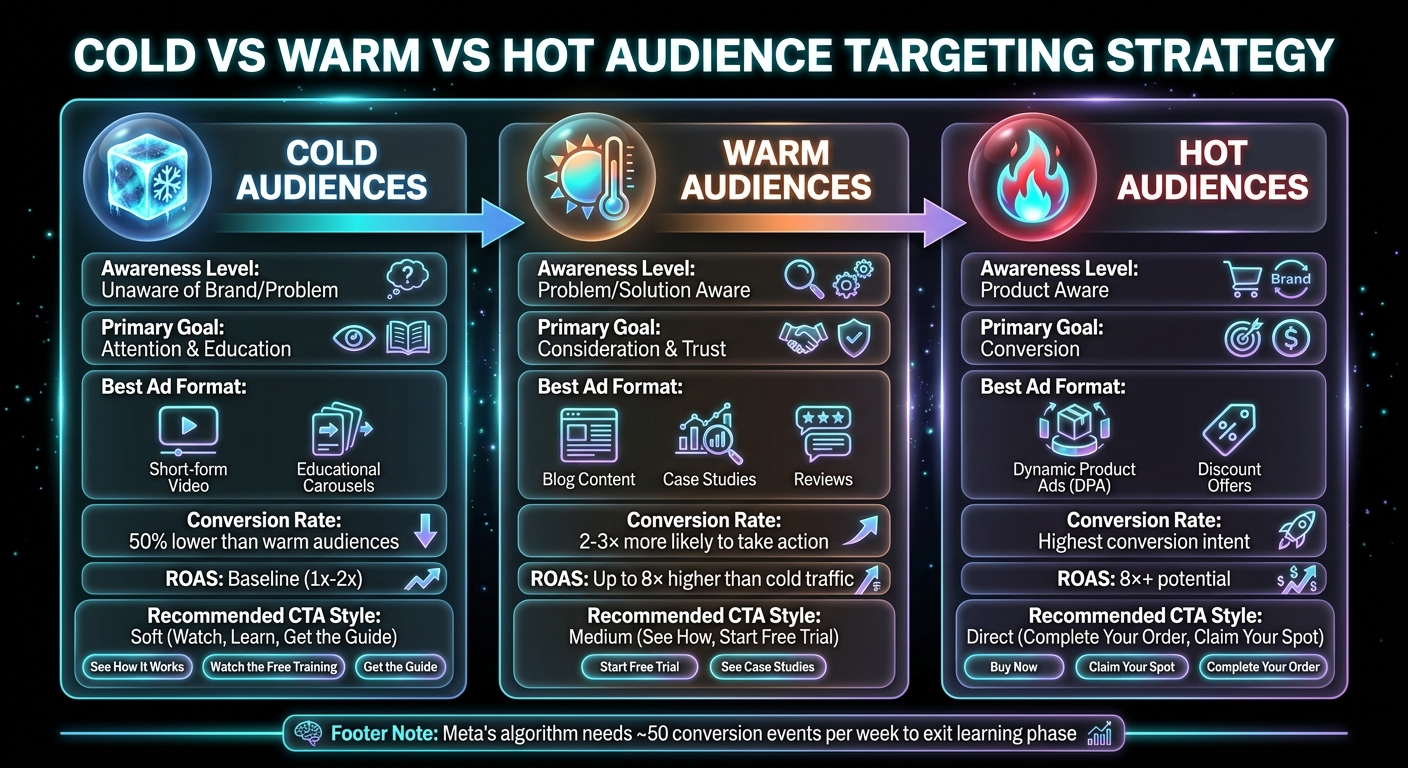
Cold vs Warm vs Hot Audience Targeting Strategy for Meta Ads
Cold traffic refers to users who have no previous interaction with your brand. They haven’t visited your site, watched your videos, or engaged with your social media content. While this group represents a massive audience on Meta platforms, they also come with significant challenges. These users scroll through their feeds with no context about your brand and no established trust.
The numbers tell the story: cold audiences convert at rates 50% lower than warm ones. In contrast, warm users - those who’ve interacted with your brand - are 2–3× more likely to take action when retargeted. Campaigns aimed at these warm users can deliver a Return on Ad Spend (ROAS) up to 8× higher than those targeting cold traffic.
Meta’s algorithm adds another layer of complexity. It needs around 50 conversion events per week to exit its "learning phase" and optimize ad performance. Since cold users rarely convert right away, ads targeting them often remain stuck in this phase, driving up your Cost Per Action (CPA). This is why crafting tailored, dynamic messaging is so critical.
Let’s look at how Meta ads need to adapt when targeting cold audiences compared to warm ones.
How Cold Traffic Differs on Meta Ads
The key difference between cold and warm audiences lies in intent. On platforms like Facebook and Instagram, people are there to connect with friends, not shop. This means your ad needs to blend seamlessly into their feed, avoiding a hard-sell approach. As Ace Reunis, Owner of Threadheads, explains:
"Facebook you need to set up a prospecting campaign... These are people who don't know about your brand, who don't know about your product. You're trying to get them to your website, you're trying to build brand awareness".
For warm and hot audiences - those already familiar with your brand - you can focus on direct calls-to-action (CTAs), testimonials, and discounts. Cold audiences, however, need a softer touch. They respond better to educational and entertaining content. The goal here isn’t to close the sale immediately but to earn their attention and secure a qualified click that moves them further down your funnel.
Here’s a quick breakdown of how your approach should shift depending on the audience:
| Audience Type | Awareness Level | Primary Goal | Best Ad Format |
|---|---|---|---|
| Cold | Unaware of Brand/Problem | Attention & Education | Short-form Video, Educational Carousels |
| Warm | Problem/Solution Aware | Consideration & Trust | Blog Content, Case Studies, Reviews |
| Hot | Product Aware | Conversion | Dynamic Product Ads (DPA), Discount Offers |
These differences highlight the need to tailor your messaging for cold audiences, which we’ll dive into next.
Why You Need Custom Messaging for Cold Audiences
Using standard ad copy - the kind designed for retargeting - simply doesn’t work with cold traffic. These users don’t know your brand, your product, or even the problem your product solves. To capture their attention, your messaging needs to stop the scroll in the first three seconds and build trust quickly.
A great example comes from Copyhackers. In April 2021, they ran a campaign using problem-focused video ads and the AIDA framework. The results? A 4× ROAS on day-of-purchase revenue and an LTV-based ROAS exceeding 20×. Their success came from addressing users’ pain points, offering solutions, and avoiding the pressure of an immediate sale.
This approach underscores the importance of creating messaging that resonates with cold audiences - messaging that piques curiosity, builds trust, and nudges users toward the next step in your funnel.
How to Write Meta Ads That Get Cold Traffic to Click
When it comes to cold traffic, your Meta ads need to work harder to grab attention and earn clicks from users who aren't familiar with your brand. The challenge lies in crafting ads that not only stop the scroll but also bring in qualified leads ready to explore your offer.
Meta users give you about 1.7 seconds before they move on. Add to that the fact that mobile devices, which account for more than 80% of Meta traffic, limit your primary text to just 125 characters and your headline to about 40 characters. Every word counts - so make it count.
Let’s break it down into three key elements: the opening line, the body copy, and the call-to-action (CTA).
Writing Opening Lines That Stop the Scroll
Your opening line has one job: make them stop scrolling. Meta users aren’t actively looking for your product - they’re browsing their feed for updates from friends. Your first line needs to break that pattern and catch their attention with fresh copy ideas.
Here are four types of hooks that work well for cold traffic:
| Hook Type | Purpose | Example |
|---|---|---|
| Pattern Interrupt | Breaks expectations or visual norms | "We fired our entire marketing team. Then revenue went up 340%." |
| Relevance Signal | Speaks directly to a specific audience | "If you run a DTC brand doing $1M–$5M/year, read this." |
| Curiosity Gap | Creates an information gap that begs to be closed | "The one change we made to our landing page that cost us $0." |
| Myth Bust | Challenges a widely held belief | "More sleep doesn't fix dark circles. Here's what actually does." |
Each hook serves a specific purpose. Pattern Interrupts grab attention by defying expectations - like claiming that firing your marketing team boosted revenue. Relevance Signals cut through the noise by immediately identifying the right audience. Curiosity Gaps tap into our natural urge to resolve unanswered questions, while Myth Busts challenge assumptions, making readers pause to learn more.
Keep in mind that your hook has to fit within 125 characters on mobile. Anything longer gets hidden behind "See more", and most users won’t bother clicking. Front-load your value so it’s impossible to miss.
Writing Body Copy That Builds Trust Fast
Once you’ve caught their attention, your body copy needs to quickly build trust with people who don’t know your brand. Cold audiences aren’t interested in technical jargon - they want to know how you can solve their problems.
Two proven frameworks for structuring your copy are Problem-Agitate-Solve (PAS) and Before-After-Bridge (BAB).
- PAS: Start by identifying a specific pain point, amplify it to make the reader feel its weight, and then present your product as the solution. For example: "Spending 10+ hours a week chasing status updates? That’s 520 hours a year you’ll never get back. Here’s how teams are cutting that time by 73%."
- BAB: Paint a picture of the "before" state (the problem), show the "after" state (the solution), and position your product as the "bridge" that gets them there.
These frameworks work because they align with where cold audiences are in their journey. They’re either Unaware (they don’t realize they have a problem) or Problem Aware (they know the issue but not the solution). By speaking to their current mindset, you make your message feel relevant and actionable.
To make your claims credible, apply the "So What?" Test to every statement. Instead of saying "cloud-based API", explain the benefit: "Syncs across devices" → "Your team always has the latest version" → "No more wasted hours fixing version conflicts."
Specificity is another trust builder. Replace vague phrases like "industry-leading" with concrete numbers, such as "Reduces production time by 73%". Precision signals that you know what you’re talking about - and that builds confidence.
Lastly, format your copy for mobile. Use short, clear lines with plenty of breaks. Dense paragraphs will lose readers scrolling on their phones.
Creating CTAs That Avoid Being Overly Forceful
Cold audiences aren’t ready for hard-sell CTAs like "Buy Now" or "Claim Your Spot." They don’t trust you yet, so pushing for a sale too soon feels intrusive.
Instead, go for low-friction CTAs that align with their stage in the funnel. Examples include "See How It Works", "Watch the Free Training", or "Get the Guide". These feel approachable and require little commitment.
As Rob Palmer, a direct response copywriter, explains:
"The ad is not where the sale happens - its only job is to earn a qualified click that the landing page converts."
Avoid generic phrases like "Learn More." Instead, be specific about what the user gets: "Download your free 12-page pricing guide" or "See before and afters." Specificity increases click-through rates by making the reward clear.
Here’s how CTAs should evolve based on audience readiness:
| Funnel Stage | Audience Temperature | Recommended CTA Style |
|---|---|---|
| Top of Funnel | Cold (No prior contact) | Soft: Watch, Learn, Get the Guide |
| Middle of Funnel | Warm (Engaged) | Medium: See How, Start Free Trial |
| Bottom of Funnel | Hot (High intent) | Direct: Complete Your Order, Claim Your Spot |
For cold traffic, stick to top-of-funnel CTAs. A good benchmark for cold audience Click-Through Rates (CTR) on Meta is between 1% and 3%. If your soft CTAs are hitting or exceeding that range, you’re doing it right.
Finally, focus on qualifying the click. Use your copy to attract users who are genuinely interested and filter out those unlikely to convert. This keeps your Cost Per Action (CPA) low and ensures your budget is well spent.
These strategies are key to turning cold traffic into engaged leads ready to explore your offer further.
Using ADEN's LAB to Create AI-Powered Ads for Cold Traffic
ADEN's LAB tackles one of the biggest challenges marketers face: creating impactful ads quickly. Writing cold traffic ads that resonate takes time, and when you're scaling campaigns, time is a luxury. This AI-powered platform is designed to generate static ads for Meta's Facebook and Instagram, cutting down on delays and helping you stay ahead.
What makes ADEN's LAB different? It’s built specifically for static ad formats optimized for Meta's algorithm. All you need to do is input a product or landing page URL, and the platform takes care of the rest - headlines, body copy, and CTAs tailored to cold audiences who don’t yet know your brand. It’s a game-changer for marketers looking to scale without waiting on traditional creative processes.
How ADEN's LAB Speeds Up Ad Creation
Speed is where ADEN's LAB shines. Just paste your product URL, and within 90 seconds, you’ll have fully designed static ads ready to use. Compare that to waiting days for a designer to create a few ads at $30–$50 each - it’s not even close.
This quick turnaround is a huge advantage for scaling. Early adopters have gone from creating 10 ads per week to over 200, seeing a 40% boost in conversions thanks to fresh creatives and constant testing. By skipping the usual brainstorming and drafting process, ADEN's LAB delivers multiple ad variations instantly, ready to upload into Meta Ads Manager. For brands running aggressive cold traffic campaigns, this volume of creatives can be the difference between success and falling behind.
Leveraging Buyer Psychology for Cold Audiences
ADEN's LAB doesn’t just churn out ads - it incorporates proven buyer psychology frameworks into every piece of copy. The platform is trained on techniques like curiosity gaps, social proof, and the pain-agitate-solve method, which are key for engaging audiences unfamiliar with your brand.
For example, if you’re marketing a fitness tracker to a cold audience, ADEN's LAB might create a headline like "Discover the Tracker That Tracks Your Wins", paired with body copy such as "New to fitness? Keep it simple" and a CTA like "Check It Out". It also uses strategies like scarcity ("Limited intro offer"), authority ("Backed by 10K users"), and reciprocity ("Free fitness guide inside") to build trust and relevance with cold traffic. This ensures your ads connect with potential customers in a way that feels both engaging and natural.
Keeping Ads Fresh with ADEN's LAB
Ad fatigue is a real issue - when users see the same ad too often, performance drops. ADEN's LAB solves this by letting you generate hundreds of ad variations (headlines, images, CTAs) in just minutes.
This high-volume output makes it easy to run A/B tests. Launch 5–10 new variations each week, identify the winners, and drop the ones that don’t perform. One e-commerce brand used this approach and saw their ROAS improve by 20–50% simply by keeping creatives fresh and avoiding fatigue.
Pricing is straightforward: plans start at $59/month for 30 ads, which breaks down to $1.97 per ad, with costs dropping to $0.90 per ad on larger plans [website]. But it’s not just about creating more ads - it’s about building a system that consistently improves performance over time.
Common Mistakes to Avoid with Cold Traffic Ads
When it comes to cold traffic ads, even the best strategies can falter if certain pitfalls aren't avoided. Cold traffic campaigns often stumble because they try to sell too quickly, target too narrowly, or fall into the trap of constant adjustments. A major misstep? Using pushy "Buy Now" calls-to-action (CTAs). Since cold audiences are unfamiliar with your brand, these aggressive CTAs often feel intrusive, leading to high bounce rates.
Another frequent issue is over-targeting. While it might seem logical to aim for precision, this approach can actually restrict Meta's AI from using broader signals to find users with high intent. Then there's the "edit-loop" trap, where frequent tweaks to ads disrupt the learning phase, causing what some experts call "Permanent Instability".
As Rebootiq aptly puts it:
"If you're still hovering over your Ads Manager dashboard, tweaking interests and micro-managing daily budgets like it's 2019, you aren't just working too hard; you're likely committing the very Meta Ads mistakes that are tanking your ROI." - Rebootiq
Stale creative is another performance killer. In 2026, creative elements are the cornerstone of ad targeting. Understanding how to optimize Meta ads is essential for managing creative fatigue and budget efficiency. Meta's AI evaluates your visuals and text to match them with the right audience. Running the same ad for weeks can shrink your reach and drive up costs. Take Allbirds, for example. In Q2 2023, they adopted a weekly ad rotation strategy, cycling through five different creatives. The outcome? A 22% increase in CTR and a 17% decrease in CPC over three months.
Mistakes and How to Fix Them
Here’s a breakdown of common mistakes and actionable solutions to improve your ad performance:
| Mistake | Impact | Correction Strategy |
|---|---|---|
| Relying on "Boost Post" | Limited targeting options and wasted spend with no conversion tracking | Use Meta Ads Manager for full control over objectives and audiences |
| Tinkering Too Early | Disrupts learning phase stability; prevents algorithm optimization | Follow the 7-Day Rule - wait for 50 conversion events before making changes |
| Micro-Targeting | High CPMs due to small, competitive audience pools and "data starvation" | Use Broad or Advantage+ targeting with audiences above 500,000 to provide "liquidity" |
| Aggressive Sales Messaging Without Proper Funneling | Low engagement; cold audiences need trust-building before conversion asks | Build a funnel - use Awareness or Traffic ads before a direct offer |
| Insufficient Tracking – No CAPI | Under-reported conversions; algorithm optimizes on bad data | Implement Conversions API (CAPI) for server-side tracking - 8% more attributed conversions |
| Landing Page Mismatch | High CPC but zero sales; users bounce due to "message match" gap | Ensure landing page repeats the ad's promise and loads in under 3 seconds |
Lastly, budget adjustments can be tricky. To avoid resetting the learning phase, keep changes under 20%. Meta's system requires approximately 50 optimization events per week per ad set to maintain stable performance. Wayfair demonstrated the effectiveness of this approach, shifting 70% of their Meta ad spend to automated and manual campaigns over 90 days. The result? A 28% increase in ROAS and a 15% reduction in CPA.
Conclusion
Converting cold traffic on Meta isn’t about luck - it’s about strategy. Success starts when you grab attention immediately with hooks that address pain points, build trust quickly through social proof and value-packed copy, and guide prospects subtly with CTAs that pique curiosity instead of pushing for an instant sale. Every detail matters when it comes to captivating first-time viewers.
Speed and volume are the backbone of ad performance. Take Gymshark, for example - during Q4 2024, they boosted their cold traffic CTR from 0.8% to 2.3% (a 187.5% increase) by testing 50 AI-generated hook variations. This effort, led by Head of Performance Marketing Alex Brown, brought in an additional $4.2 million in revenue. Similarly, MVMT Watches saw a 41% lift in conversions and a 28% drop in CPC (down to $1.12) during Black Friday 2025 by testing 200 ad variations rooted in psychology-based copy under the direction of campaign manager Jordan Lee.
These examples highlight the power of a sharp creative strategy. ADEN's LAB eliminates creative bottlenecks, enabling you to produce dozens of Meta ad variations in minutes - each designed with buyer psychology in mind. This allows you to test extensively, identify top performers fast, and scale with precision.
With ADEN's LAB handling the heavy lifting of ad creation, you can focus on perfecting your messaging and tracking essential performance metrics. Start with hooks that zero in on problems, incorporate trust-building elements, and test at least 10 variations weekly while monitoring CTR and conversion rates. By pairing targeted messaging with AI-driven creative tools, you can turn cold traffic into warm, engaged prospects. The key isn’t just effort - it’s the right strategy, relentless testing, and tools that make growth achievable.
FAQs
What’s the best offer to use for cold traffic?
When reaching out to cold traffic, the best approach is to offer something valuable without jumping straight into a sales pitch. Content-first video ads are a great way to do this. They provide helpful information or entertaining content, which helps build trust and spark engagement.
Another effective tactic? Offering free resources like guides or training materials. These not only attract attention but also position you as an authority in your field.
The key is to lead with value-driven content. Once you've earned trust and engagement, you can gradually shift to presenting direct offers.
How do I know if my Meta ad click is “qualified”?
A "qualified" Meta ad click indicates genuine interest and a higher likelihood of leading to a conversion. These clicks usually come from users who match your targeting criteria and resonate with your messaging. To drive more qualified clicks, aim to reach the right audience and fine-tune your ad creative and messaging to appeal to users who are inclined to take meaningful actions, such as making a purchase or signing up.
How many ad variations should I test each week?
Testing 10–20 creative variations each week is a smart way to quickly identify which ads perform best. To keep things fresh and avoid ad fatigue, it’s also a good idea to introduce 2–3 new creatives weekly. This strategy strikes a balance between thorough testing and regular updates, helping you maintain strong campaign performance and audience engagement.
Your next ad batch starts here
Finish with a ready-to-test ad batch
Paste your website to generate static creatives. Drop the link → get ads in about 90 seconds → upload them to Meta → scale.
Free to try No prompt writing