A/B Testing Meta Ads: Step-by-Step Guide
Turn the strategy into creatives
Create Meta ads for your product
Paste your product page. ADEN'S LAB turns the offer, audience, and positioning into complete ready-to-use Meta static ads.
Free to try No prompt writing
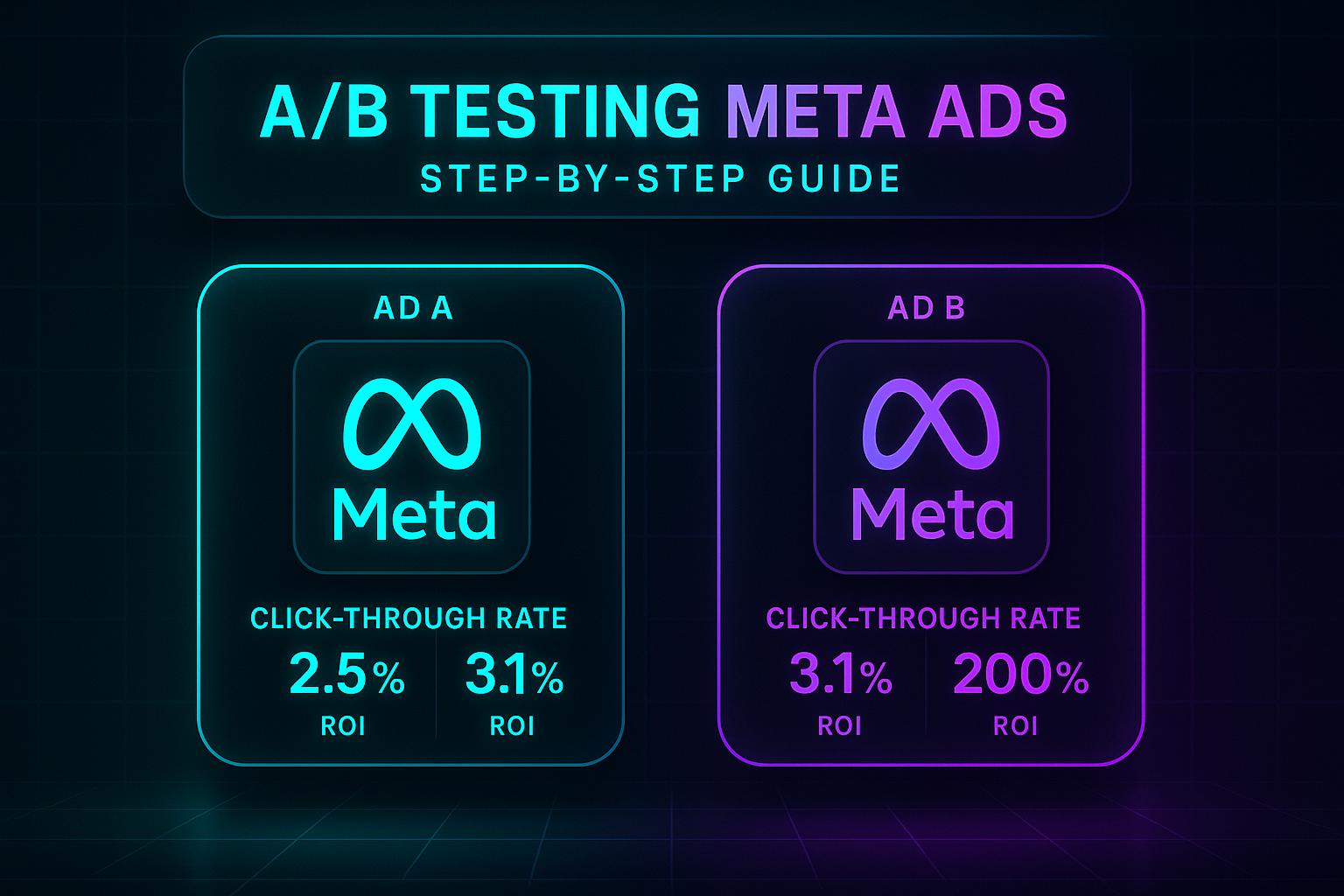
A/B testing for Meta ads helps you find the best-performing ad by comparing variations of a single element, like a headline or image. It’s a data-driven way to improve ad performance, reduce costs, and maximize ROI. Here’s what you need to know:
- Why it matters: A/B testing removes guesswork by showing what resonates with your audience, boosting metrics like CTR and CPA.
- How to start: Set clear goals, plan your budget, and prepare ad variations.
- Key steps: Use Meta Ads Manager to configure tests, isolate one variable at a time, and track performance until results are statistically meaningful.
- Avoid mistakes: Don’t overlap audiences, end tests too early, or ignore ad fatigue.
- Use AI tools: Platforms like ADEN'S LAB can generate hundreds of ad variations quickly, saving time and increasing testing efficiency.
A/B testing, when done right, ensures your ad spend delivers results and helps you stay ahead in a competitive market.
How to Create an A/B Test in Experiments of Meta Ads Manager
Put the playbook to work
Apply this playbook to your page
Paste your website and the Lab will turn the strategy you are reading into a ready-to-test ads.
Free to try No prompt writing
Why A/B Testing Meta Ads Matters
The success of your Meta ad campaigns often comes down to one key factor: understanding what resonates with your audience. A/B testing takes the guesswork out of the equation by providing clear, data-backed insights, ensuring every dollar you spend is working as hard as possible.
How A/B Testing Improves Ad Performance
When you test different ad variations, you gain a direct view of how changes affect key metrics like click-through rates (CTR), cost per acquisition (CPA), and return on investment (ROI). In fact, marketers have reported increases in conversion rates by up to 30% and reductions in CPA ranging from 10% to 40% by isolating a single variable in their creatives. Whether it’s tweaking the headline, adjusting the image, refining the ad copy, changing the call-to-action, or experimenting with audience targeting or placement, isolating one element ensures that any performance shifts are tied to that specific change.
Cost Savings and Market Advantage
With ad costs on the rise and competition growing fiercer, there’s no room for wasted spend. A/B testing allows you to quickly identify underperforming ads and redirect your budget toward the ones that deliver results. By systematically cutting out creatives that don’t convert, you can stretch your budget further, ensuring every dollar is spent on strategies that drive success. In a crowded market, brands that fail to test risk falling behind, while those that embrace continuous testing can refine their strategies and maintain a competitive edge. This approach ensures smarter, faster decision-making, especially when paired with AI tools.
Faster Testing with AI Tools
Traditional A/B testing methods can be time-consuming and labor-intensive, but AI-powered tools like ADEN'S LAB are changing the game. Instead of manually creating and testing ads, ADEN'S LAB enables you to generate hundreds of ad variations and test them up to 10 times faster. This rapid iteration process not only identifies the best-performing creatives but also scales campaigns efficiently by removing manual delays. The rise of AI-driven A/B testing platforms is reshaping the way brands optimize their advertising, helping you discover not just what works - but what works best - in record time.
What You Need Before Starting A/B Tests
Effective A/B testing doesn’t just happen - it requires careful planning and preparation. Without a solid foundation, you risk wasting time and money. To make the most of your efforts, focus on setting clear objectives, allocating resources wisely, and preparing your creative assets. Let’s break it down.
Set Clear Test Goals and Hypotheses
Every successful A/B test starts with a well-defined hypothesis. Instead of vaguely aiming to "improve performance", get specific about what you're testing and why. A good hypothesis might look like this: "If I change [specific element], then [specific metric] will improve because [logical reason]."
For instance, rather than simply testing "headlines", you could hypothesize: "If I change the headline from a feature-focused message to a benefit-focused one, then click-through rates will increase because our audience responds more to emotional appeals than technical details." This clarity helps shape your test design and ensures you can interpret the results effectively.
Some common elements to test include:
- Headlines
- Primary text
- Call-to-action buttons
- Images or video thumbnails
- Audience segments
- Ad placements
Always tie your test to a primary metric, such as click-through rate (CTR), cost per acquisition (CPA), conversion rate, or return on ad spend (ROAS). This keeps your efforts focused and measurable.
Plan Your Budget and Timeline
Budget and timing are critical to ensuring your test results are statistically significant - meaning they’re unlikely to be due to chance. For Meta A/B tests, aim to run your campaigns for at least 7 days. This duration accounts for natural fluctuations in user behavior and ad delivery.
To collect reliable data, you’ll need enough budget to generate meaningful results. A general rule of thumb: aim for at least 100 conversions per variation. For example, if your conversion rate is 2%, you’ll need about 5,000 clicks per variation. At an average cost-per-click (CPC) of $1.50, this translates to roughly $7,500 per variation.
Avoid making sudden budget increases during the test. Meta’s algorithm needs time to optimize, and abrupt changes can distort your results. Instead, set a consistent daily budget that supports steady data collection over the testing period.
Create Multiple Creative Versions
A/B testing relies heavily on having diverse creative assets ready to go. The more variations you can test, the better your chances of finding what resonates with your audience. However, traditional creative development can be slow and limit the number of variations you can produce.
That’s where tools like ADEN'S LAB come in. This platform can generate hundreds of creative variations in seconds. Simply input your product link, and it will create options with different headlines, copy angles, visuals, and call-to-action styles. This automation allows you to test far more combinations than manual methods, increasing your odds of identifying high-performing ads.
When crafting creative variations, keep these principles in mind:
- Consistency matters: If you’re testing headlines, keep all other elements - like visuals and call-to-action buttons - consistent across variations. Similarly, if you’re testing images, use the same copy and call-to-action.
- Combat creative fatigue: Audiences can quickly tire of seeing the same ad repeatedly. By preparing multiple tested variations, you can rotate fresh creatives to maintain performance over time.
With a strong library of creative assets and a clear plan in place, you’ll be ready to set up your A/B tests in Meta Ads Manager efficiently.
How to Set Up A/B Tests for Meta Ads
With your goals, budget, and creative assets in place, it's time to dive into setting up your A/B tests. Meta Ads Manager provides multiple ways to configure these tests, each tailored to different needs. The key is selecting the method that aligns with your objectives and following a structured process to gain actionable insights.
Configure Your A/B Test in Meta Ads Manager
Meta Ads Manager offers three main methods for setting up A/B tests:
-
Using the Experiments Tool
Start by navigating to the hamburger menu on the left side of your dashboard. Under the "Analyze and Report" section, select "Experiments." Click "Get Started" on the A/B test option, then input your test details and define your winning criteria (e.g., "cost per result" for the lowest cost per landing page view). Once everything looks good, click "Create Test" to finalize the setup. -
Duplicating an Existing Campaign or Ad Set
If you have a campaign that’s already performing well, select it in Ads Manager and click "Duplicate." Then, choose "New A/B test" and proceed to the Test Setup section. Here, you’ll name your test, pick the variable to test, set your winning criteria, and publish the test. -
Creating a New Campaign
From the Campaign tab in Ads Manager, click "A/B Test" and select "Get Started" in the pop-up. Then decide whether to "Make a copy of an ad" or "Select two existing ads." Continue to the Test Setup section to configure your parameters.
You can test variables like creative elements, ad copy, audiences, placements, call-to-action buttons, or landing pages. For the clearest results, stick to testing one variable at a time.
Once you’ve chosen your method, it’s time to build your ad variations and prepare for launch.
Build and Launch Your Ad Variations
Manually creating ad variations can be time-consuming, especially when testing multiple combinations. That’s where automation tools, like ADEN'S LAB, come in handy. By analyzing your product link, the platform generates variations with different headlines, primary text, visuals, and call-to-action strategies, saving you significant time and effort.
When building your variations, ensure all non-variable elements remain consistent. For instance, if you’re testing headlines, keep the images, primary text, and call-to-action buttons the same across all variations. This approach isolates the variable, so any performance changes are directly tied to what you’re testing.
Also, plan ahead to avoid creative fatigue. Even the best-performing ads lose their edge over time as audiences grow familiar with them. Having multiple variations ready ensures you can rotate fresh creatives without disrupting your campaign’s momentum.
Track and Review Test Performance
Once your ads are live, monitoring their performance in real-time is crucial. Allow Meta’s algorithm some time to optimize delivery, but don’t rush to conclusions. Early data can be misleading if the sample size is too small. Wait until your test gathers enough data to reach statistical significance.
Focus on your primary metric - whether that’s click-through rate, cost per acquisition, or return on ad spend. This metric should guide your decision-making throughout the test.
Meta’s A/B testing tool will notify you when your test has reached statistical significance. Use the Experiments tool to track performance data for both active and past tests in real-time.
After the test ends, implement the winning variation and consider using it as the baseline for your next test. This iterative process helps you continually refine your campaigns, leading to steady improvements over time.
A/B Testing Best Practices That Work
If you want your A/B test results to be accurate, you need to isolate variables carefully. By sticking to these best practices, you can trust your data and make smarter decisions.
Change Only One Thing Per Test
The number one rule of A/B testing? Test one thing at a time. If you tweak multiple elements - like switching up both the headline and the image - you won’t know which change made the difference. This muddles the results and leaves you guessing. Instead, focus on a single variable, whether it’s the headline, call-to-action button, image, or ad copy. For example, if you’re testing headlines, keep everything else - like visuals, primary text, and targeting - exactly the same. This approach gives you clear, actionable insights. And don’t forget: split your audience evenly to avoid bias creeping into your data.
Split Your Audience Evenly
Dividing your audience equally between test versions is key. This ensures minimal variance and boosts the reliability of your results. Balanced audience distribution not only reduces the number of participants you need but also speeds up the time it takes to reach statistically significant results. Platforms like Meta offer automated tools to help you avoid audience overlap, so it’s better to use these features instead of manually segmenting your audience. Uneven splits can slow things down and make your results less reliable, so aim for a 50/50 split every time.
Use AI to Test More and Test Faster
Want to speed things up? AI can help you test faster and more efficiently. Manually creating ads takes time and limits how much you can test. That’s where tools like ADEN'S LAB come in - they automate creative generation, allowing you to run multiple A/B tests simultaneously. This means you can test more variables while still following best practices, like isolating one element and evenly splitting your audience. The result? You’ll uncover winning ad combinations much faster without sacrificing data quality.
Common A/B Testing Mistakes to Avoid
To make the most of your A/B testing efforts, it’s crucial to steer clear of common mistakes that can derail your results. Even seasoned marketers can fall into traps that waste both time and money.
Audience Overlap Issues
When the same users are exposed to multiple ad versions due to overlapping audience segments, your test results can become unreliable. Meta offers an Audience Overlap Tool in the Audiences section of Ads Manager to help you identify how much your target groups intersect. If you find significant overlap, adjust your targeting settings or use the Audience Exclusions feature to keep your test groups distinct. This ensures Meta’s algorithm doesn’t end up competing against itself, which can inflate costs and skew performance data. And remember, tests should be given enough time to yield meaningful results.
Ending Tests Prematurely
Cutting tests short before reaching statistical significance is one of the most common - and costly - mistakes. This often leads to false positives caused by random fluctuations or the Novelty Effect. Shockingly, at least 80% of tests that are declared "winners" are actually meaningless because they’re stopped too soon. Allow your tests to run long enough to account for daily, weekly, and even seasonal patterns before making any decisions.
Overlooking Creative Fatigue
A/B testing isn’t a one-and-done process. Even the best-performing ads lose their effectiveness over time as your audience becomes too familiar with them. Signs of creative fatigue include declining click-through rates and increasing costs per acquisition. To stay ahead, refresh your creatives regularly. Use the insights from your tests to create updated variations. Tools like ADEN’S LAB can simplify this process by automatically generating new ad creatives to keep your campaigns fresh and engaging.
Conclusion: Scale Your Success with A/B Testing
A/B testing is the cornerstone of smart, data-driven marketing. It’s how top marketers move beyond guesswork and ensure their budgets are spent on strategies that actually work. By methodically testing different creative elements, you can uncover what truly clicks with your audience and double down on the ideas that deliver results.
The beauty of this approach? It’s not just a one-time thing. Consistent testing keeps you in sync with evolving audience preferences and ever-changing platform algorithms. Each test adds to your knowledge, helping you refine future strategies and build momentum. Over time, this creates a ripple effect, making your campaigns stronger and more effective.
To get the most out of A/B testing, focus on best practices: test one variable at a time, avoid overlapping audiences, and let your tests run until you reach statistical significance. These principles are the bedrock of successful, data-driven campaigns. And don’t forget to document your results - this growing knowledge base will become a valuable guide for future decisions.
Tools like ADEN'S LAB take A/B testing to the next level. By automating the creation of ad variations, you can generate hundreds of options in a single day, cutting down production time and costs. This means you can test at lightning speed - up to 10x faster than traditional methods - while scaling your efforts without burning out your creative team. It’s a game-changing approach that turns creative testing into a powerful engine for growth.
The takeaway is simple: speed and efficiency win. Brands that master quick, effective testing will stay ahead of the competition. A/B testing, when paired with AI-driven tools, isn’t just about fine-tuning campaigns - it’s about creating a repeatable system for growth that keeps you ahead of the curve.
FAQs
How do I know if my A/B test results are statistically significant?
To figure out if your A/B test results hold up statistically, look at the p-value. If it’s below your chosen threshold - usually 0.05 - you can reject the null hypothesis with confidence. This means the difference between your test variations likely isn’t just random chance.
However, don’t overlook the importance of sample size. Without enough data, your results might be misleading. Use tools like statistical calculators or analytics platforms to double-check significance and plan your next move wisely.
What should I focus on when choosing elements to test in a Meta ads A/B test?
When planning a Meta ads A/B test, it's essential to focus on testing one variable at a time. This approach helps you pinpoint the exact impact of that specific element. You might test creative components like images, videos, call-to-action buttons, or even audience targeting. By keeping all other factors consistent, you’ll ensure your results are accurate and meaningful.
It's smart to prioritize testing elements that have the biggest influence on engagement or conversions. For instance, try experimenting with different headlines, ad copy, or visuals to determine what grabs your audience's attention the most. Always ground your tests in clear, measurable hypotheses so you can make informed, data-backed decisions to improve your ad performance.
How can AI tools like ADEN'S LAB improve the way marketers run A/B tests for Meta ads?
AI tools like ADEN'S LAB are changing the game for A/B testing by automating the production of top-notch ad variations on a large scale. This means marketers can test a wider range of creative options faster, cutting down on manual work and accelerating the process of identifying successful ads.
With AI-driven insights, ADEN'S LAB enables smarter, data-based decisions to fine-tune campaigns, boosting the chances of achieving higher conversion rates. This streamlined approach not only conserves time and resources but also lets marketers concentrate on expanding their campaigns efficiently.
Your next ad batch starts here
Finish with a ready-to-test ad batch
Paste your website to generate static creatives. Drop the link → get ads in about 90 seconds → upload them to Meta → scale.
Free to try No prompt writing