The Affiliate Ad Creative Framework That Turns Cold Traffic Into Instant Commissions
Turn the strategy into creatives
Create Meta ads for your product
Paste your product page. ADEN'S LAB turns the offer, audience, and positioning into complete ready-to-use Meta static ads.
Free to try No prompt writing

Cold traffic - people unfamiliar with your brand - is hard to convert. They scroll past ads quickly, skeptical of unfamiliar products or claims. Many affiliate campaigns fail because they skip essential steps: grabbing attention, building trust, and connecting the product to the audience's needs. Without a structured approach, ads blend in, leading to low click-through rates (CTR) and high costs.
This article introduces a simple 4-part framework to turn cold traffic into paying customers:
- Problem Hook: Grab attention by addressing a specific frustration.
- Proof Stack: Build trust quickly with testimonials, data, or reviews.
- Benefit Bridge: Show how the product solves their problem.
- Commission Close: Use a clear, direct call-to-action (CTA).
Tools like ADEN's LAB simplify ad creation by generating ad variations in seconds, saving time and cutting costs. By testing multiple ads, pausing underperformers, and refreshing content regularly, you can avoid ad fatigue and maximize results.
This framework, combined with fast execution and constant testing, ensures your campaigns stay effective while keeping costs low.
Why Cold Traffic Doesn't Convert
What Cold Traffic Actually Means
Cold traffic refers to people who have never encountered your brand before. They're casually scrolling through their social feeds, distracted, when your ad suddenly appears. You’ve got just 2–3 seconds to grab their attention.
The challenge? Trust is practically nonexistent. These are strangers who naturally approach unfamiliar ads with skepticism. Without any prior interaction with your business, they have no reason to believe your claims or feel compelled to click. Naomi Powell, Founder of The Lifestyle Edit, explains it well:
"Cold traffic refers to people who don't know anything about your business and haven't interacted with your brand before. They're at the very top of your sales funnel and need to be nurtured before they're ready to make a purchase".
This lack of familiarity directly impacts performance metrics. Conversion rates for cold traffic typically range between 1% to 5%, varying by industry. High bounce rates and minimal engagement are common because these visitors need more information and reassurance before they’ll even consider making a purchase. It’s a mindset issue: cold audiences aren’t actively searching for solutions. They’re passively consuming content when your ad interrupts their scrolling.
Where Most Affiliate Ads Go Wrong
One of the biggest missteps? Treating strangers like loyal fans. Jumping straight into a product pitch without addressing the critical question - "Why should I care?" - is a surefire way to lose them. If your hook doesn’t clearly identify a pain point or disrupt their scrolling pattern, they’ll just keep scrolling.
Poor visuals and vague messaging are another major issue. If your ad doesn’t specify what problem it solves or why someone should care about your product, cold traffic quickly disengages. Many affiliate ads also fail to include essential trust-building elements like testimonials, case studies, or credible endorsements. Without these trust signals, clicking feels like a gamble to cold leads.
Even if your ad performs well, a poorly matched landing page can ruin everything. If the messaging on your landing page doesn’t align perfectly with your ad, visitors will leave as soon as they arrive. In fact, nearly 50% of failed cold outreach efforts are due to poor preparation or mismatched messaging. Add to that the fact that 55.25% of all online sales now occur on mobile devices, and failing to optimize for mobile can turn wasted ad spend into a massive problem.
These common pitfalls underscore the importance of using a clear, structured approach to turn cold traffic into paying customers. A solid creative framework is essential to bridge the gap between skepticism and conversion.
Put the playbook to work
Apply this playbook to your page
Paste your website and the Lab will turn the strategy you are reading into a ready-to-test ads.
Free to try No prompt writing
Why most brands fail with cold traffic (and how to fix it)
The 4-Part Ad Creative Framework
Turning cold traffic into buyers isn't about luck or random copywriting tricks. It’s about leading people through a psychological journey - from being complete strangers to becoming motivated customers. This framework focuses on four crucial stages: attention, trust, desire, and action. Each step is vital - skip one, and the entire process falls apart.
1. Problem Hook: Stop the Scroll
You’ve got just 3–5 seconds to grab someone’s attention before they scroll right past your ad. That’s where the hook comes in. Its sole purpose? To make them pause. One of the most effective ways to do this is by asking a specific question that directly addresses a frustration they’re experiencing.
Marketing strategist Adam Erhart puts it like this:
"The objective is always the same… To get someone's attention and get them to pay attention."
Questions work because our brains are wired to want answers. Instead of a vague question like, “Struggling with low conversions?”, go for something laser-focused, such as, “Spending $500/day on ads and getting zero sales?” This kind of specificity resonates with people facing that exact pain. Pair the question with bold text overlays or unexpected visuals to break the monotony of their scrolling feed. Ads that speak directly to specific pain points can increase engagement by up to 78%.
2. Proof Stack: Build Trust Quickly
Once you’ve got their attention, the next hurdle is trust. Cold audiences are naturally skeptical. This is where a strong proof stack comes in - combining elements like testimonials, star ratings, specific data, or before-and-after visuals. For products, having at least 20 solid reviews is often a tipping point.
Transparency also matters. Acknowledging both the pros and cons of your solution, or even disclosing affiliate connections, can make your pitch feel more credible. Keep introductions brief and focused only on achievements that show you can solve their problem.
3. Benefit Bridge: Connect the Problem to the Solution
With attention and trust established, it’s time to connect the dots. Show how your product or service bridges the gap between their current struggles and their ideal outcome. Adam Erhart explains:
"The product or service you're presenting should be positioned as the solution to whatever pain you dug up."
Spend 30–60 seconds emphasizing the problem so the solution feels essential. Use visuals like comparison charts, lifestyle imagery, or quick demos to illustrate how your offer works. Focus on outcomes, not features. For example, instead of saying “AI-powered automation tool,” say “Cuts your ad production time from 3 hours to 3 minutes.” Once they see how your solution addresses their pain, they’ll be ready for the final step.
4. Commission Close: Make the Click Simple
Even if you’ve nailed attention, trust, and desire, a weak call-to-action (CTA) can ruin your chances. A confusing or absent CTA leaves viewers unsure of what to do next. As Adam Erhart warns:
"When your call to action is confusing or worse, doesn't even exist, your viewer is left hanging and trying to figure out what's next on their own and that's not good for anyone."
Your CTA should be clear, direct, and impossible to miss. Focus on one action, such as “Click the link below,” “Grab your discount now,” or “Start your free trial.” Use high-contrast visuals, clear placement, and urgent language to make the decision effortless. The goal? Remove any mental barriers so clicking feels like the natural next step.
How ADEN's LAB Scales This Framework
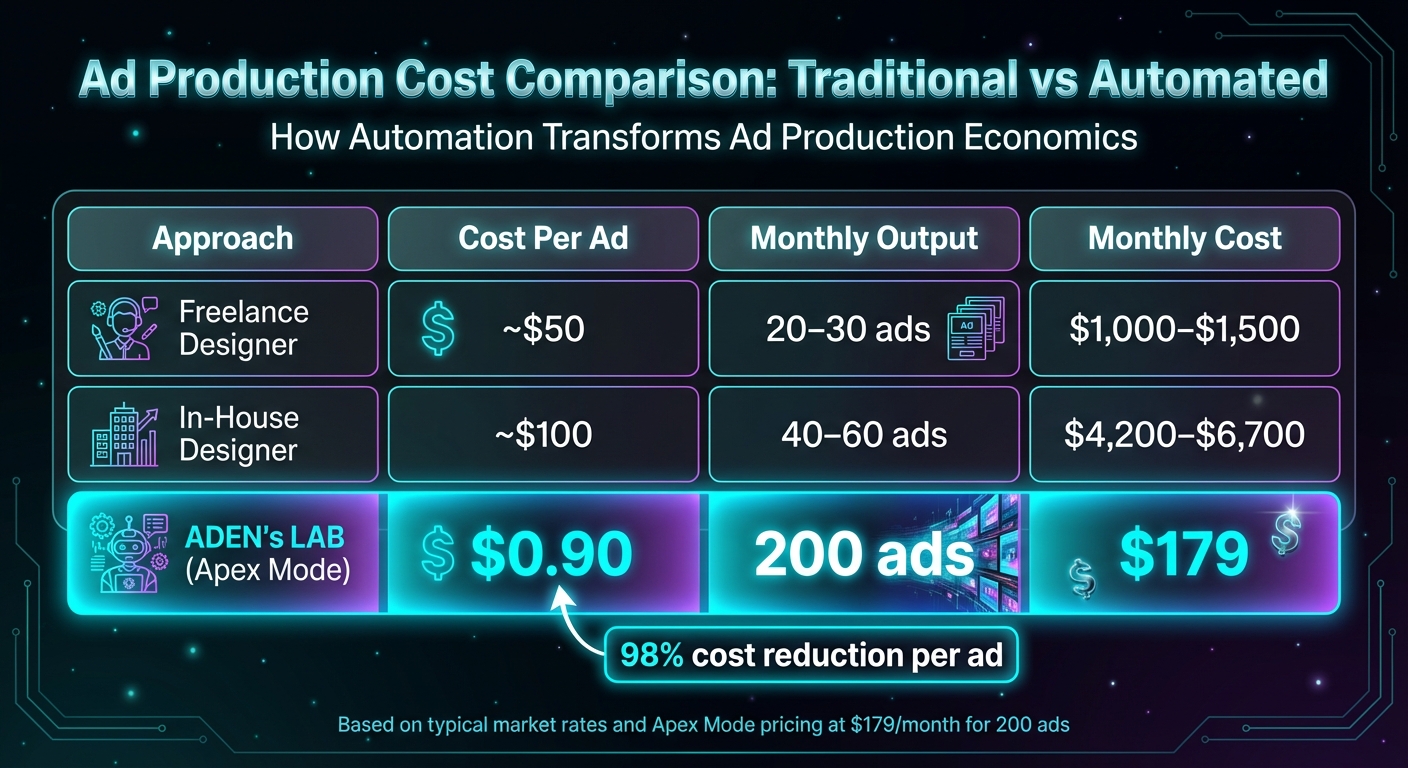
Cost Comparison: Traditional Ad Design vs ADEN's LAB Automated Production
Drop a Link, Get Ads
Creating ads manually can be a slow and expensive process. Typically, you’d need a designer, a detailed creative brief, rounds of feedback, and revisions. Each ad might take a couple of days to complete and cost around $50 or more. If you’re testing 15 variations to find the best performer, you’re looking at spending $750 and waiting weeks just to get started.
ADEN's LAB changes the game entirely. All you need to do is drop in a product or landing page link, and the system creates static Meta ads in under 90 seconds. No need for creative briefs, feedback loops, or advanced design skills. The platform analyzes your page - digging into your offer, social proof, and value proposition - and automatically generates ads following the problem-hook, proof stack, and benefit-bridge structure. You get instant downloads with full commercial rights, ready to upload to Facebook or Instagram immediately.
What once took days or weeks can now be done in an afternoon. You can generate 30 ads and launch them the same day. This speed is a huge advantage for cold traffic campaigns, allowing you to test ideas quickly, identify winning angles, and cut underperformers. Not only does this save time, but it also slashes creative costs, as we’ll see next.
The Math Behind Automated Ad Production
Faster ad creation doesn’t just save time - it significantly lowers costs. Traditionally, working with a freelance designer costs about $50 per ad. If you’re running five affiliate campaigns and testing 15 variations per campaign, that’s 75 ads, costing around $3,750 in design fees. Hiring an in-house designer is no small expense either. With an annual salary of $50,000–$80,000, they can produce 10–15 polished ads per week, averaging about $100 per ad.
ADEN's LAB offers a much more cost-effective approach. The Apex Mode plan, priced at $179 per month, generates 200 ads - bringing the cost per ad down to just $0.90. Even the entry-level Lift Off plan, at $59 per month, produces 30 ads for only $1.97 each. These prices are a fraction of what you’d pay using traditional methods.
| Approach | Cost Per Ad | Monthly Output | Monthly Cost |
|---|---|---|---|
| Freelance Designer | ~$50 | 20–30 ads | $1,000–$1,500 |
| In-House Designer | ~$100 | 40–60 ads | $4,200–$6,700 |
| ADEN's LAB (Apex Mode) | $0.90 | 200 ads | $179 |
Beyond cost savings, the platform’s ability to produce 200 ads a month instead of just 30 significantly boosts your testing capacity. Testing 6–7 times more angles increases your chances of finding high-performing ads that can improve your return on ad spend (ROAS) by 20%, 30%, or more. A single winning ad could generate an extra $5,000–$10,000 in commissions over its lifetime. For cold traffic campaigns, this combination of lower costs and expanded testing potential transforms risky experiments into profitable ventures.
Testing and Improving Your Ads
Launch Multiple Versions and Pause Underperformers Quickly
Relying on a single ad and waiting days to see results is a missed opportunity. Instead, launch 4-8 ad variations at the same time and let the data guide your decisions. Experiment with different problem hooks, proof elements, and benefit angles. Allocate a daily budget of $20-$50 per variation and monitor their performance closely within the first 24-48 hours.
The early numbers matter. If an ad shows a CTR (Click-Through Rate) below 1% after 1,000 impressions or a ROAS (Return on Ad Spend) under 1.5x after spending $50, it’s time to pause that ad. Continuing to fund underperformers drains your budget and takes away from ads that could actually deliver results. For example, an ad with a 0.5% CTR could burn $200 on 400 clicks without any revenue, while a higher-performing ad with a 2.5% CTR might generate $450 on the same spend.
Testing multiple ads simultaneously allows for direct performance comparisons under the same conditions. This approach speeds up the process of identifying winners by 3-5x compared to testing one ad at a time. Once you find a top performer, scale it by increasing the budget incrementally - 10-20% daily - and redirect the funds saved from underperformers. But even after finding a winning ad, keeping your creative fresh is essential.
Refresh Ads Before They Stop Working
After identifying winning ads, the next hurdle is ensuring they remain effective over time. Even the best ads lose their edge. This decline, known as creative fatigue, occurs when your audience sees the same ad too often. What was once attention-grabbing becomes easy to ignore. Signs of fatigue include a CTR drop of 50-70% or a ROAS decline of 30-50%. You can also track metrics like a CTR that falls more than 20% week-over-week or an ad frequency (average views per user) exceeding 3-5 in Meta Ads Manager.
The fix? Rotate fresh creatives before fatigue sets in. For cold traffic affiliate campaigns, aim to introduce 3-5 new ad variations every 5-7 days. This doesn’t mean starting from scratch each time. Instead, tweak your top-performing ads - try new proof elements, adjust the problem hooks, or reframe the benefits. The core structure stays intact, but the changes keep the content feeling new to your audience.
This constant need for fresh creatives is where many marketers struggle. Producing 3-5 new ads weekly involves endless designer briefs, feedback, and revisions, which often means your new ads are ready too late. By then, your current ads may have already lost their effectiveness. Tools like ADEN's LAB streamline this process, allowing you to generate ad variations in under 90 seconds. Drop your affiliate link, create 10 fresh versions, and launch them before your current ads hit an average frequency of 4 views per user. In today’s competitive landscape, consistently producing new creatives isn’t optional - it’s the standard for staying ahead.
Turning Cold Traffic Into Buyers
Converting cold traffic into buyers is all about building trust - and doing it quickly. The four-part framework we discussed earlier takes care of this by addressing the key elements: grabbing attention, establishing trust, creating a connection, and offering an easy next step. This approach aligns with how people actually make buying decisions, especially on platforms like Meta, where 80–90% of your budget is likely targeting audiences who are encountering your brand for the very first time.
But here's the catch: success doesn't just depend on the framework itself - it’s about how fast you can execute it. Rapid ad creation and constant updates are critical to staying ahead of creative fatigue. Too often, affiliate marketers hit a wall waiting for designers or wasting money on ads that just don’t perform.
This is where automation steps in to save the day. ADEN's LAB eliminates those roadblocks entirely. All you have to do is drop in your affiliate link, and within 90 seconds, you’ll have 5–10 ready-to-launch Meta ad variations. No prompts, no revisions, no delays. And at just $0.90 per ad on the Apex Mode plan, you can afford to test multiple options without the financial strain of custom-designed ads.
Once the framework is in place, speed becomes the name of the game. Testing and iteration are what drive results. Launch several ad variations based on the framework, track their performance, and cut the ones that underperform after spending $50–$100. For the ads that work, scale them up by 10–20% daily. To stay ahead of ad fatigue, refresh your top-performing ads every 5–7 days by adding new proof elements or exploring different benefit angles. The goal is to ensure no single user sees the same ad more than four times.
With this aggressive, automated strategy, you can keep your creatives fresh, avoid fatigue, and turn cold traffic into consistent commissions. Just drop your link, generate your ads, and let the data guide your scaling. Keep testing, scaling, and refreshing - success is in the speed and the strategy.
FAQs
What’s the best way to grab the attention of cold traffic with my ads?
To grab the attention of people unfamiliar with your brand, focus on striking visuals and straightforward, engaging messaging that connects instantly. Your ad needs to either address a problem, pique curiosity, or offer something worthwhile within the first few moments.
Since cold audiences aren’t familiar with you, steer clear of overly complicated or unclear messages. Use vibrant imagery, conversational language, and a direct call-to-action to make sure your ad catches their eye in a busy feed. The ultimate goal? Stop their scroll and spark enough interest for them to click or engage.
How can I quickly build trust with a skeptical audience?
Earning trust from a skeptical audience starts with being honest and genuine. When something feels too good to be true, people naturally hesitate. That’s why it’s essential to be upfront. Share real-world examples like testimonials, case studies, or actual results to show how others have benefited from what you offer. This kind of social proof helps make your message more credible.
Being clear and open is just as crucial. Avoid making promises you can’t keep or using overly flashy language. Instead, address potential concerns head-on and use simple, relatable words to show you truly understand their point of view. When you communicate like a person - not a sales pitch - it becomes much easier to connect.
And don’t forget: consistency is key. Make sure your messaging stays aligned across everything - ads, your website, even customer service interactions. When people see you consistently delivering on what you say, trust naturally follows.
How do I avoid ad fatigue while testing different ad creatives?
Ad fatigue occurs when your audience gets tired of seeing the same ads repeatedly, causing engagement and performance to drop. To combat this, it's crucial to refresh your ad creatives regularly with new, eye-catching designs. While testing multiple variations is a smart move, you also need to ensure your audience isn’t bombarded with the same creative too often.
Leveraging automated tools can be a game-changer. These tools let you quickly produce fresh ad creatives, saving time while maintaining quality. This approach keeps your campaigns lively and effective without the hassle of constant manual updates.
Your next ad batch starts here
Finish with a ready-to-test ad batch
Paste your website to generate static creatives. Drop the link → get ads in about 90 seconds → upload them to Meta → scale.
Free to try No prompt writing