What High-Converting Meta Ads Have in Common (Prompt-Level Breakdown)
Use the prompts on your real offer
Generate these ad angles for your product
Skip the blank prompt box. Paste your product page and ADEN'S LAB applies the angles to your offer, images, headlines, and copy.
Free to try No prompt writing

The secret to winning on Meta Ads in 2026? It’s all about producing attention-grabbing ads that deliver results. After managing over $100M in ad spend, one thing is clear: the quality of your ads determines your success - not targeting hacks or big budgets. Weak ads cost more, fatigue faster, and fail to convert. Strong ads, on the other hand, can turn $50K into $500K in revenue. Here’s the formula for ads that work:
- Strong Hooks: Grab attention in the first 3 seconds or users scroll past.
- Mobile-Optimized Visuals: Bold, clean designs that stand out on small screens.
- Clear CTAs: Tell users exactly what to do next - no confusion.
- Fast Testing: Quickly identify winners and cut underperformers.
The problem? Most teams can’t keep up with the demand for fresh ads due to slow production and bottlenecks. That’s where tools like Aden’s Lab come in, automating ad creation in minutes and letting you scale faster while saving time and money.
If you’re not testing new ads weekly, you’re falling behind. The brands winning today are faster, more efficient, and better at keeping their campaigns fresh. Want to stay competitive? Focus on delivering better ads, faster.
How to make Meta Ad Creatives (in 2026)
Put the playbook to work
Apply this playbook to your page
Paste your website and the Lab will turn the strategy you are reading into a ready-to-test ads.
Free to try No prompt writing
Why Most Meta Ads Fail to Convert
When Meta ads underperform, it's often due to weak hooks, overused visuals, and unclear calls-to-action (CTAs). These issues compound quickly, leading to poor metrics and wasted ad spend.
Weak Hooks That Get Ignored
The first three seconds of your ad are critical. If your hook doesn’t grab attention immediately, users will scroll past - especially on mobile, where 94–98% of Meta traffic originates.
Phrases like "Introducing our new product" or "Check out our latest offer" fail to spark curiosity or convey value. If your click-through rate (CTR) drops below 0.72%, Meta’s algorithm notices. It then pushes your ad to broader, less-targeted audiences, which drives up your cost-per-thousand impressions (CPM) by 30–50% and lowers the quality of conversions.
Using misleading hooks might increase initial clicks, but they backfire if the ad doesn’t deliver on its promise. This erodes trust and tanks conversion rates. High click rates mean nothing if the traffic doesn’t convert into paying customers.
Repetitive Visuals That Blend Into the Feed
Even if your hook grabs attention, outdated or generic visuals can kill engagement.
Stock photos - like the classic handshake - immediately signal “advertisement”. When users see visuals they’ve encountered countless times before, they’re likely to scroll past without a second thought, no matter how compelling your offer is.
Cluttered designs with too much text, busy backgrounds, or unclear focal points make it harder for viewers to process your message - especially on mobile. High-contrast visuals optimized for mobile screens are a must.
Reusing the same visuals also contributes to creative fatigue. When your audience sees the same ad repeatedly, engagement drops, and ad frequency rises above 3.0. This can increase your cost-per-acquisition (CPA) by 10–25%. For smaller audiences (under 100,000 people), fatigue sets in even faster - within one to two weeks. CPMs that start at $25 can climb past $50 as engagement plummets.
Unclear CTAs That Miss the Mark
Even with strong visuals, a vague or confusing CTA can derail your ad’s effectiveness.
CTAs like "Learn More" or "Discover" leave users guessing. They don’t clarify what happens after a click - whether it’s a product page, signup form, or video. This hesitation is especially damaging on mobile, where decisions are made in a split second.
On the other hand, clear, benefit-focused CTAs like "Get 30% Off Today" or "Start Free Trial" remove uncertainty. When the CTA aligns with the landing page’s content, bounce rates drop. Meta’s algorithm tracks user behavior post-click; if people leave immediately, it flags the ad as low quality and reduces its reach, driving up costs.
These issues don’t just waste your budget - they also create roadblocks for future ad performance, which we’ll explore further in upcoming sections.
What High-Converting Meta Ads Actually Look Like
Creating Meta ads that convert isn’t about luck - it’s about strategy. After years of refining ad campaigns, certain elements consistently emerge as the backbone of successful Meta ads. These ads are crafted to align with how users scroll and make decisions on mobile devices.
Benefit-Driven Headlines That Promise Value
A great headline doesn’t just introduce a product - it promises a result. Compare these two examples: “Introducing Our New Skincare Line” versus “Get Clearer Skin in 14 Days Without Harsh Chemicals.” The second headline works because it immediately answers the user’s unspoken question: What’s in it for me? By highlighting a specific benefit, including a timeframe, and addressing a common concern, you create a headline that grabs attention and compels clicks. Pair this with visuals that reinforce the promise, and you’re off to a strong start.
High-Contrast Visuals Built for Mobile Scrolling
Your visuals need to stop users mid-scroll. To do that, focus on bold colors, clean backgrounds, and a single focal point - often the product itself. Avoid cluttered designs or excessive text overlays, as Meta’s algorithm doesn’t favor them. Instead, a simple product image on a vibrant background often performs better. And since 88% of Meta users browse on mobile devices, your visuals must be optimized for smaller screens. Think eye-catching simplicity.
UGC-Style Content That Builds Trust
Authenticity sells. Ads that mimic user-generated content (UGC) feel relatable and trustworthy. For instance, a casual iPhone video showing someone unboxing your product or sharing their before-and-after story resonates more than a slick, overly produced brand video. These raw, relatable moments make your ad feel more like a recommendation from a friend than a sales pitch. Trust is built through genuine experiences, not flashy production.
Single-Focus CTAs That Remove Friction
The simpler the call-to-action (CTA), the better. Whether it’s “Shop Now” or “Start Free Trial,” stick to one clear action to guide users. A dedicated CTA button can boost click-through rates (CTR) by 2.85 times. Consistency is key - your ad copy, button text, and landing page should all align to create a seamless experience. Since users often skim content in under two seconds, eliminating distractions or extra steps can make all the difference.
Modular Layouts That Enable Fast Testing
Flexibility in design is your secret weapon. Break your ads into modular components - headline, visual, body text, and CTA - so you can easily test variations and see what resonates. This approach not only saves time but also ensures you can quickly adapt when engagement starts to dip. By continuously testing and tweaking, you keep your campaigns performing at their peak.
How Aden's Lab Eliminates Creative Bottlenecks
Scaling Meta ads isn't just about throwing more money at campaigns or tweaking targeting - it’s about keeping up with the demand for fresh, high-performing creative. Many advertisers struggle to produce new, engaging ads fast enough. You end up waiting on designers, spending hours crafting briefs, or recycling old visuals. This slows everything down, drains your budget, and leaves you stuck in a frustrating cycle.
Aden's Lab changes the game by simplifying creative production. No more endless revisions, brainstorming marathons, or guessing which concept might work. It tackles these challenges head-on with automated creative production.
Drop a Link → Get Ads → Launch on Meta
Here’s how it works: just drop your product URL or landing page link into Aden's Lab. It analyzes your page, pulls out the key selling points, and generates multiple static ad variations. These ads come complete with bold visuals, benefit-driven headlines, and clear, single-focus CTAs. No design expertise, prompts, or lengthy setup required. In minutes, you’ll have mobile-ready ads that are good to go.
This speed gives you a critical edge. Traditional workflows can take days to produce one ad, but Aden's Lab lets you test multiple creative variations in a single day. This faster pace helps you spot winning ads, avoid creative fatigue, and scale campaigns without hitting roadblocks. Plus, by automating tasks that used to take 20+ hours a week, you can focus on scaling your strategy instead of getting bogged down in production.
And it’s not just about speed - it’s about using a format that works.
Why Static Ads Still Outperform on Meta
Even with the rise of video, static ads remain a powerhouse for Meta campaigns. They load faster on mobile, make it easier for Meta’s algorithm to deliver results, and account for 60–70% of conversions - all without the higher costs and delays tied to video production. Static ads also let you quickly test different hooks, keep CPMs steady during scaling, and avoid the frequency caps that often come with repetitive video content.
Manual Design vs. Aden's Lab
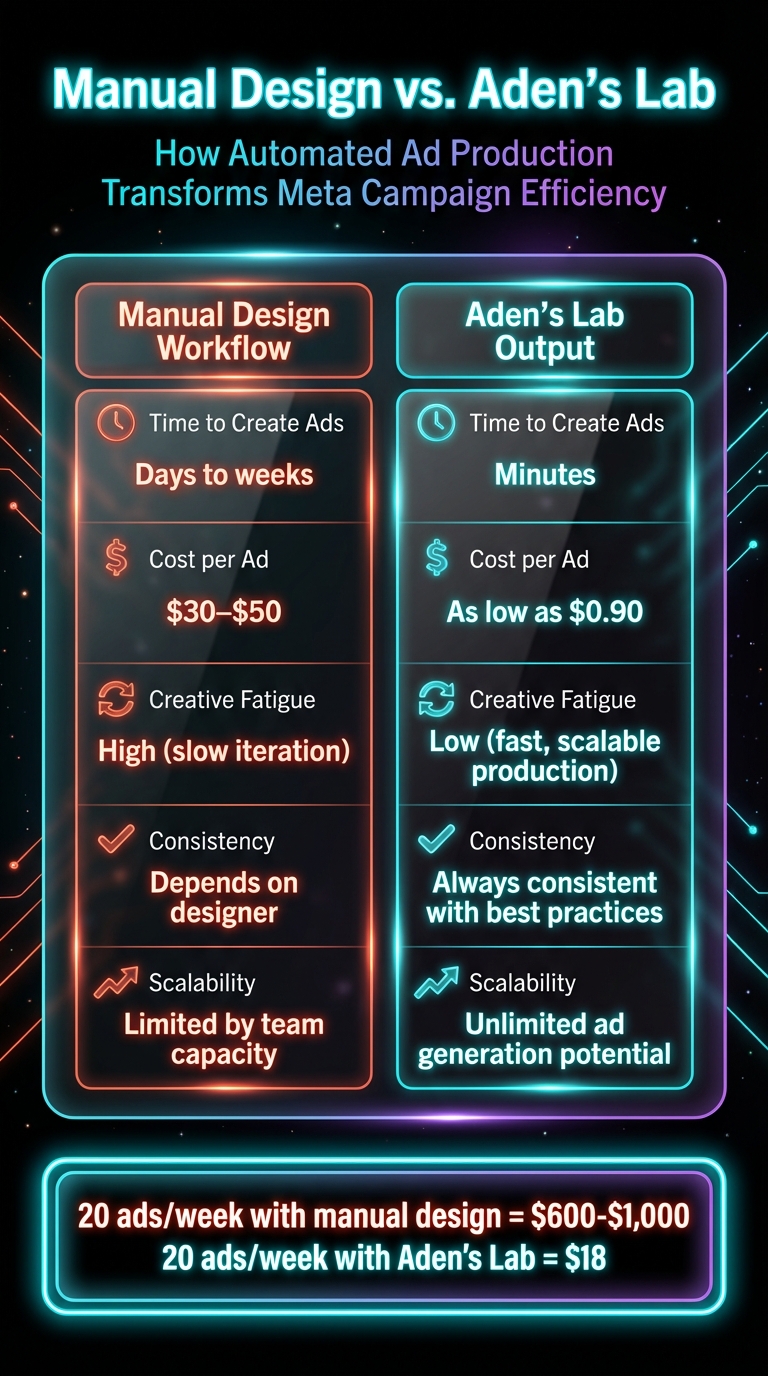
Manual Design vs Aden's Lab: Cost and Time Comparison for Meta Ad Creation
Many advertisers overlook how much a slow creative process can really cost. While you're waiting days - or even weeks - for a designer to deliver a single ad, your competitors might already be testing and refining their third round of creative. The gap between manual design and automated production isn't just about speed; it's about whether you can scale effectively or get stuck in endless delays. Here's a direct comparison to make the difference crystal clear:
Side-by-Side Comparison
Take a look at how traditional design workflows stack up against Aden's Lab:
| Feature | Manual Design Workflow | Aden's Lab Output |
|---|---|---|
| Time to Create Ads | Days to weeks | Minutes |
| Cost per Ad | $30–$50 | As low as $0.90 |
| Creative Fatigue | High (slow iteration) | Low (fast, scalable production) |
| Consistency | Depends on designer | Always consistent with best practices |
| Scalability | Limited by team capacity | Unlimited ad generation potential |
The numbers speak for themselves. If you're producing 20 ads a week with a traditional design team, you're spending between $600 and $1,000 just on production costs - without any guarantee those ads will perform. With Aden's Lab, that same batch of ads costs just $18.
But the real edge isn't just about saving money. It's about giving yourself the freedom to test more aggressively. You can experiment with different ideas, identify winning ads faster, and cut underperforming ones quickly - without worrying about blowing your budget or waiting on revisions. Plus, the consistent quality and unlimited scalability mean you're always ready to refresh your campaigns and stay ahead of creative fatigue.
With Aden's Lab, you're not just saving time and money; you're gaining the ability to adapt and scale at a pace that manual workflows simply can't match.
Building a Repeatable Meta Ad System
Once you’ve sped up your creative production, the next step is building a system that keeps up with the pace - and beats creative fatigue.
Here’s the deal: the difference between advertisers who scale profitably and those who burn through budgets boils down to repeatability. You need a system that consistently produces high-performing ads fast enough to stay ahead of creative fatigue. Think about it: strong hooks that grab attention, bold visuals designed for mobile, social proof to build trust, and clear, single-focus CTAs. But none of this matters if your production process can’t keep up.
The problem? Most advertisers hit a wall because their creative process is just too slow. You find a winning ad, scale it, and within days or weeks, it’s fatigued. The brands that thrive on Meta aren’t necessarily smarter - they’re just faster. They test more ideas, refresh their creatives more often, and ensure the algorithm always has something new to work with. This speed is what separates winners from everyone else. And this is where Aden’s Lab changes the game.
Aden’s Lab eliminates the bottleneck entirely. Instead of waiting on designers or spending hours crafting prompts, you simply drop in a product link. In under 90 seconds, you’ll have static ads ready to launch. This means faster testing, quicker identification of winning ads, and seamless scaling - all without delays in production.
Here’s the kicker: with this system, you can generate 200 ads per month for $179 - that’s just $0.90 per ad. No more worrying about high production costs or slow turnarounds. You can test 10 hooks, 5 different visual styles, and multiple CTAs without blowing your budget before launch. And because the process is automated, you’re not spending 20+ hours a week managing designers, writing briefs, or chasing revisions. Instead, you’re focused on strategy and letting the data guide your decisions.
The real win here isn’t just about cost or speed. It’s having a system that scales effortlessly with your budget. Whether you’re spending $5,000 or $500,000 a month, you’ll always have fresh creatives for Meta without breaking your workflow.
FAQs
How do I create hooks that grab attention for my Meta ads?
When crafting hooks for your Meta ads, the goal is simple: stop the scroll. The best hooks grab attention by sparking curiosity, stirring emotions, or making bold, relatable statements. Think of a question that makes people pause or a surprising fact that demands a second look.
To make your hook effective, keep it clear and relevant. Highlight a key benefit or tackle a specific problem your product solves. Hooks that promise quick solutions or showcase standout features often perform well because they connect directly to what your audience cares about.
One important tip? Skip the gimmicks. Authentic, human-centered messaging resonates more deeply and is much more likely to drive real engagement.
What are the advantages of using automated tools like Aden's Lab for creating Meta ads?
Automated tools like Aden's Lab take the hassle out of creating high-performing Meta ads. Instead of pouring hours - or even days - into manual ad production, you can generate polished, effective creatives in seconds by simply dropping in a product link. This means you can test and scale campaigns much faster, which is a game-changer in competitive markets.
Consistency is another standout advantage. Aden's Lab relies on proven frameworks to produce ads that are not only visually appealing but also strategically effective. This minimizes the chances of wasting ad spend on poorly designed creatives. Plus, automation addresses common challenges like creative fatigue and scaling bottlenecks by continuously delivering fresh ads as your campaigns grow. That way, you can focus on strategy and optimization rather than getting bogged down by repetitive tasks.
In short, tools like Aden's Lab make ad creation faster, more consistent, and easier to scale - giving you the upper hand in today’s fast-paced advertising world.
Why do static ads often perform better than video ads on Meta?
Static ads have a knack for grabbing attention in Meta's fast-scrolling environment. Their simplicity and clarity make them ideal for stopping users mid-scroll, while videos demand more time and focus to engage. A well-crafted static image - especially one that's visually striking, brightly colored, and highlights a product or testimonial - can deliver impressive results. These often translate into lower costs-per-purchase and higher engagement rates.
Another advantage? Static ads are easier for Meta’s algorithm to process and optimize. Unlike videos, which come with more layers of complexity, static images allow the platform to quickly identify which audiences are responding best. This leads to faster optimization and better ad performance over time. While video ads have their strengths, static ads stand out for their ability to cut through the noise and deliver quick, consistent results - making them a go-to choice for seasoned advertisers.
Your next ad batch starts here
Finish with a ready-to-test ad batch
Paste your website to generate static creatives. Drop the link → get ads in about 90 seconds → upload them to Meta → scale.
Free to try No prompt writing