AI Tools for Facebook Ad Copy: Hooks, Angles, and Headlines That Convert
Turn the idea into a testing batch
Generate new hooks and angles from your product page
Paste your URL to create multiple ready-to-test concepts instead of adapting generic examples by hand.
Free to try No prompt writing

Want better results from your Facebook ads? The secret lies in following Meta ad copy best practices. Strong hooks, angles, and headlines can drastically improve click-through rates (CTR) and lower cost per acquisition (CPA). But creating enough variations to avoid ad fatigue is a challenge - and that’s where AI tools come in.
Here’s what you need to know:
- Ad Copy Drives Performance: Even with perfect targeting, weak copy can sink your campaign. Ads that address pain points and highlight benefits can boost CTR by up to 200%.
- Creative Fatigue Kills Results: Repeating the same ads lowers engagement. AI helps solve this by generating dozens of variations in minutes.
- AI Tools Save Time and Money: Platforms like Aden’s Lab analyze your product page and create ready-to-launch ads in seconds, cutting production costs and speeding up testing.
- Key Elements That Convert:
- Hooks: Bold statements or emotional triggers that grab attention.
- Angles: Positioning your product to match buyer psychology.
- Headlines: Clear, benefit-focused messaging under 40 characters.
Brands using AI for ad creation report higher CTRs, lower CPAs, and faster scaling. For example, Sarah Chen at Fashion Forward Co. generated 200 ad variations in a day, increasing ROAS by 340% and reducing CAC by 67%.
If you’re struggling to keep up with creative demands, AI can help you test more, learn faster, and scale smarter.
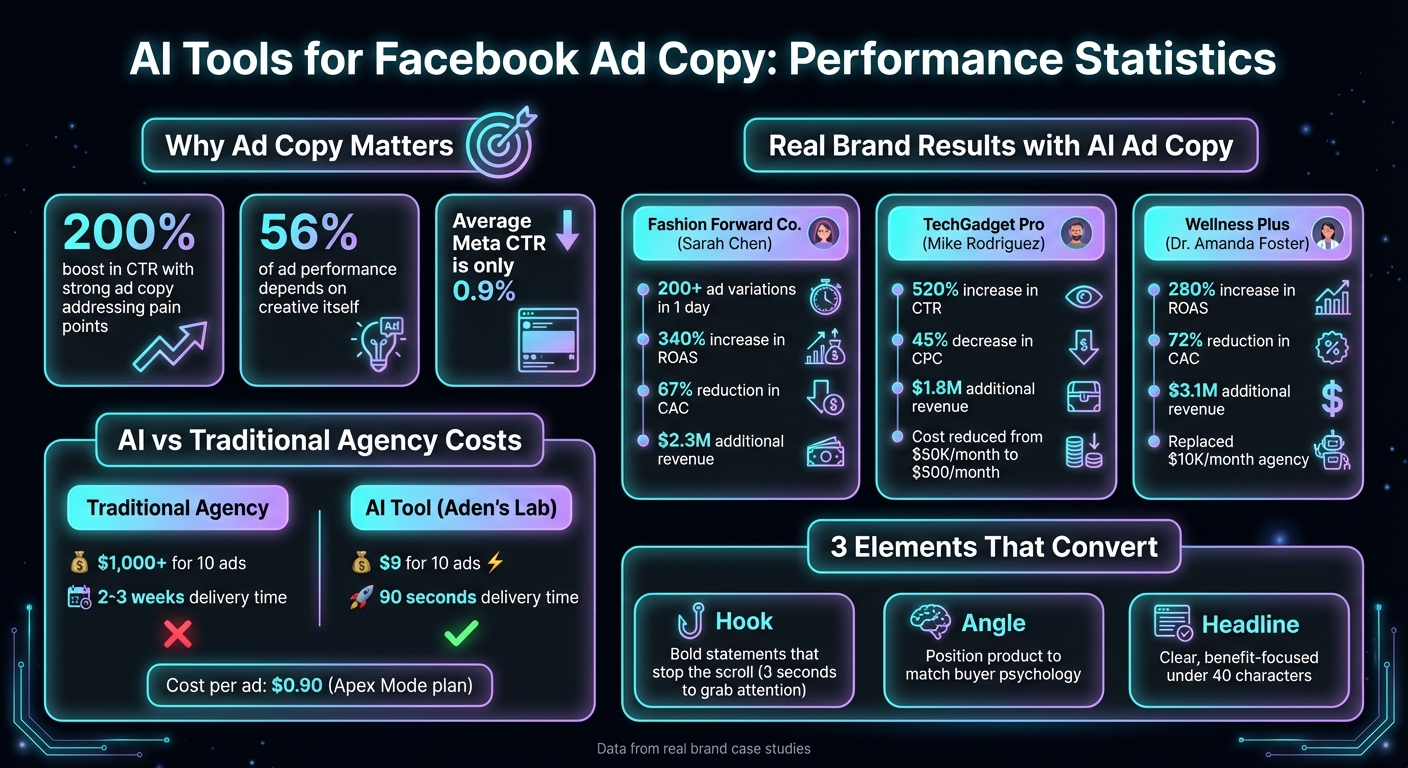
AI-Powered Facebook Ad Copy Performance Results and ROI Comparison
AI Helped Me Write a $1M Facebook Ad (Here’s How)
Put the playbook to work
Apply this playbook to your page
Paste your website and the Lab will turn the strategy you are reading into a ready-to-test ads.
Free to try No prompt writing
What Makes Meta Ad Copy Actually Convert
Effective ad copy grabs attention and drives action. After managing millions in Meta ad spend, I’ve found that three elements make or break an ad: the hook, the angle, and the headline. Miss the mark on any of these, and you’re essentially burning money on impressions that won’t convert. Let’s dive into how these components work together to create ads that perform.
How to Write Hooks That Stop the Scroll
A hook’s job is simple: disrupt the endless scrolling. People swipe through their feeds on autopilot, so your hook needs to jolt them out of that rhythm with an emotional punch.
Here’s how you can do it:
- Bold statements challenge expectations. For example, “Most Facebook ads fail in the first 3 seconds” makes readers stop and think.
- Questions tap into frustrations. Something like, “Still paying $10,000/month for 10 ads?” resonates with anyone tired of high agency costs.
- Emotional triggers highlight desires or fears, such as, “Your competitors are launching 100+ ads per day,” which creates urgency.
The secret? Use your product’s benefits and your audience’s pain points as the foundation for your hooks, or generate ad copy ideas to jumpstart the process. Take Sarah Chen from Fashion Forward Co., for example. She used AI to analyze customer reviews and landing pages, uncovering real objections and desires. This approach allowed her to create over 200 ad variations in one day, leading to a 340% boost in ROAS and $2.3M in additional revenue. The magic wasn’t in fancy wordplay - it came from using customers’ own words to address their concerns.
Now, let’s talk about angles and how they align with buyer psychology.
Angles That Match How Buyers Think
An angle is how you position your product to align with a buyer’s mindset. Different people, at different stages of the buying journey, require different approaches. Someone new to your product might need education, while someone ready to buy needs reassurance.
Understanding buyer behavior is the key here. TechGadget Pro, for instance, shifted their focus from broad demographic targeting to analyzing how their audience behaved - what caught their attention, what made them hesitate. This shift resulted in a 520% increase in CTR and $1.8M in additional revenue. As their Growth Director, Mike Rodriguez, put it:
"The AI understands our tech audience better than any human designer ever could".
Angles should address the psychological drivers behind a purchase. For example, a project management tool might use one angle focusing on efficiency (“Cut project turnaround time by 40%”) and another on frustration relief (“Tired of chasing updates across Slack, email, and spreadsheets?”). Both promote the same product but appeal to different motivations. Testing multiple angles allows Meta’s algorithm to figure out which message resonates best with each audience segment.
Once you’ve nailed the angle, the next step is crafting a headline that seals the deal.
Headline Structures That Get Clicks
Your headline has one job: communicate value instantly. On mobile, you’ve got less than 40 characters to get your point across. That constraint forces you to be direct and specific.
Here are three headline structures that consistently work:
- Benefit-driven headlines focus on outcomes: “Launch Campaigns 3x Faster” tells readers exactly what they’ll gain.
- Question-based headlines highlight frustrations: “Still Managing Marketing Assets Across Multiple Tools?” speaks directly to a common pain point.
- Urgency-based headlines create a sense of scarcity: “Early Access Ends Friday: Lock in Preferred Pricing” encourages immediate action.
Your headline should also complement your CTA (call-to-action). For example, if your CTA is “Shop Now,” a headline like “Try 100 Nights Risk-Free” eases concerns. If your CTA is “Get Started,” a headline such as “Join 10,000+ Marketers Using This Tool” adds credibility with social proof.
Wellness Plus saw massive success using this approach. By pairing emotionally charged hooks with precise, benefit-focused headlines, they achieved a 280% increase in ROAS and $3.1M in additional revenue. Founder Dr. Amanda Foster remarked:
"The AI-created health and wellness ads are incredibly persuasive. They understand the emotional triggers that drive our customers to buy better than our $10k/month agency ever did".
The game-changer wasn’t flashy visuals - it was copy that spoke directly to what buyers cared about. This level of precision is exactly what Aden’s Lab delivers with just one link drop.
How AI Changes the Way You Create Meta Ad Copy
Creating ads manually can feel like a grind: you brief your designer, wait for mockups, go back and forth on revisions, and finally launch a few ads weeks later. By the time those ads are live, you’ve already spent money on creatives that might not even work. AI completely reimagines this process, cutting out delays, guesswork, and the bottlenecks that slow advertisers down. Let’s dive into how AI reshapes each step of ad creation.
Generate Multiple Variations in Minutes, Not Days
AI brings speed and scale to the table. In traditional workflows, you’d spend hours brainstorming hooks, writing copy, and coordinating with designers. A single campaign could take days to churn out 10 ads. AI flips this script, analyzing your product page and generating dozens of ad variations - hooks, angles, and headlines - in just minutes.
This isn’t about flooding your campaigns with random options. It’s about testing smarter and faster than your competition. If you can launch 50 ad variations in the time it used to take for five, you’re giving Meta’s algorithm a bigger pool to work with. While others are stuck waiting for approvals, you’re already testing, learning, and iterating.
Maintain Quality Even at High Volume
Worried that speed might lead to sloppy ads? It doesn’t have to. The best AI tools for Meta ads are built to follow proven performance frameworks. Every ad they produce sticks to benefit-driven, concise structures that have already been shown to work. So, instead of random creative ideas, you get ads that are designed for results.
Here’s the thing: manual workflows often lead to inconsistent output. One team member might nail the tone, while another misses the mark. AI eliminates this issue by sticking to high-performing principles every single time. You’re not gambling on whether the latest batch of ads will work - you’re consistently producing ads that are optimized to convert, and at a scale no human team can match.
Measured Results: Higher CTR and Lower CPA
When you combine speed and consistency, the results speak for themselves. Faster testing means better data. Launching 100 variations instead of 10 uncovers the winners quicker, giving Meta’s algorithm more signals to optimize around. This boosts click-through rates (CTR) and drives down cost per acquisition (CPA).
Brands making the switch to AI-driven ad creation are seeing these benefits firsthand. Higher CTRs come from testing more angles and hooks in less time. Lower CPAs follow because you’re reallocating budget to the ads that work, instead of wasting spend on underperformers. And all of this happens at a speed that manual workflows just can’t keep up with.
ADEN'S LAB: How to Solve Creative Fatigue and Scale Faster
Creative fatigue can lead to plummeting CTRs and soaring CPAs. The problem often isn’t your targeting or budget - it’s the struggle to churn out winning creatives fast enough to keep up with Meta’s algorithm. That’s where Aden's Lab simplifies everything.
Drop a Link → Get Ads → Launch on Meta
Aden's Lab makes the process simple: just paste your product URL, and within 90 seconds, you’ll have ready-to-launch static Meta ads. No need for prompts, briefs, or endless back-and-forth with designers. The platform automatically pulls your product images, reviews, and key messaging to create ads based on proven frameworks.
Take Sarah Chen, CMO at Fashion Forward Co., as an example. Her previous agency took three weeks to deliver 10 ads. With Aden's Lab, she produced over 200 ad variations in a single day. The result? A 340% jump in ROAS, $2.3 million in additional revenue, and a 67% reduction in CAC. It’s not just about speed - it’s about completely transforming your creative output.
Why Static Ads Scale Better on Meta
Once your ads are ready, the format itself gives you an edge in scaling.
Static ads are the workhorses of high-budget Meta campaigns. They’re cheaper to produce, quicker to test, and easier for Meta’s algorithm to optimize. When you’re scaling beyond $10,000 per day, you need creatives that maintain cost efficiency. Data shows that static ads typically cost under $0.50 per thousand impressions, compared to over $1.00 for video ads. At higher budgets, this cost difference becomes even more significant.
Mike Rodriguez, Growth Director at TechGadget Pro, is a great example. He shifted from spending $50,000 a month on a creative agency to just $500 a month with Aden's Lab. The impact? A 520% boost in CTR, a 45% drop in CPC, and $1.8 million in additional revenue. Static ads gave him the volume and speed he needed to test aggressively without blowing his creative budget.
Produce More Ads Than Your Competitors at Lower Cost
For just $9, you can generate 10 ad variations in an afternoon - more than many brands manage in a month. Compare that to traditional agencies, which charge over $1,000 for the same output and take two weeks to deliver. When creative fatigue sets in, speed is your greatest weapon. The faster you launch new concepts, the quicker Meta’s algorithm can identify your next winning ad.
Dr. Amanda Foster, founder of Wellness Plus, leveraged this speed to target emotional triggers with dozens of ad variations. The payoff? A 280% rise in ROAS, $3.1 million in additional revenue, and a 72% reduction in CAC - all while spending far less than her previous $10,000-per-month agency. More variations mean more chances to win, allowing you to scale without hitting performance plateaus.
Ad Copy Mistakes That Waste Your Budget
Many advertisers unknowingly burn through six-figure budgets by making the same three mistakes. Surprisingly, the problem isn’t with targeting or spending - it’s poor ad copy that prevents Meta’s algorithm from doing its job. Let’s break down the three key mistakes that could be draining your ad budget.
Making the Message Too Complicated
Your ad has just three seconds to grab someone’s attention mid-scroll. If your message isn’t immediately clear, you’ve already lost them. The biggest issue? Overcomplicating the message. Trying to sound overly "professional" or "creative" often backfires, making the ad feel like a generic sales pitch that users ignore. Ads that fail to address a specific pain point in simple terms might get impressions, but they rarely convert.
In fact, some of the most effective campaigns ditch flashy designs and clever wordplay altogether. Plain-text ads that clearly explain what a product does and why it matters often outperform their more polished counterparts.
"You can do everything right with targeting, but with a dull ad creative people will scroll your advertisement in a second." - Hannah Longman, Communications Liaison, Fashion Week Online
AI tools excel here because they cut through the noise. Instead of adding unnecessary layers of “brand voice” or jargon, they focus on the product’s core benefit. The result? A clean, straightforward hook that grabs attention without overcomplicating things. But simplicity alone isn’t enough - you also need variety.
Not Testing Enough Variations
Here’s a hard truth: 56% of your ad’s performance comes down to the creative itself. That’s more than your audience or budget. Yet, many advertisers test just one or two ad variations, pick a “winner,” and stick with it until it stops working. This approach wastes potential. Meta’s algorithm thrives on variety, meaning you should test multiple hooks, angles, and headlines simultaneously - not one at a time over weeks.
When testing cycles are slow, your winning ads lose their edge before you can refresh them. Waiting weeks for 10 new variations isn’t just inefficient - it’s costly. Without fresh ideas, you risk falling into the next trap.
Letting Creative Fatigue Kill Your Performance
Creative fatigue sneaks up on you, driving up your cost per acquisition (CPA) and lowering your click-through rate (CTR) as users grow tired of seeing the same ad. For reference, the average CTR on Meta is just 0.9%. If your CTR starts dropping and your CPA rises, it’s likely because your audience is tuning out - not because your targeting is off.
The mistake? Holding onto an ad that’s “still profitable” for too long. By the time you notice the decline, it’s often too late. The solution is to constantly rotate your creatives, ensuring fresh ads are ready to go as soon as performance dips. While this can be a logistical nightmare with manual workflows, AI makes it seamless. Imagine generating 200 ad variations in a single day instead of waiting weeks for just 10. With that kind of speed, creative fatigue becomes a non-issue.
Conclusion: Scale Meta Ads by Solving the Creative Problem
Scaling Meta ads isn’t just about increasing budgets - it’s about outpacing competitors by producing effective ad creatives faster. The brands that thrive on platforms like Facebook and Instagram don’t necessarily rely on superior targeting or larger budgets. Instead, they’ve cracked the code by consistently testing new hooks, refreshing ads before they lose their impact, and launching fresh angles that drive down CPAs while boosting CTRs.
The real challenge has always been production. Relying on agencies for new ads often means waiting weeks, leaving your campaigns vulnerable to creative fatigue. By the time those ads are ready, your previously successful ones may already be losing effectiveness, leading to higher CPAs and stalled growth. AI changes the game entirely. It enables brands to create dozens - or even hundreds - of static ad variations in just minutes. Brands that have adopted AI-driven creative workflows report dramatic improvements in performance, showing how automating Meta ad production can directly impact results.
ADEN'S LAB makes this process seamless. Upload a link, receive ready-to-launch ads - no complicated prompts, no setup, no learning curve. The platform delivers static ads optimized from billions of dollars in ad spend data, not generic templates. And at just $0.90 per ad on the Apex Mode plan, you can generate more creatives in a week than many brands manage in months. This volume allows for aggressive testing, quick elimination of underperformers, and the ability to scale winners before they lose their edge.
By accelerating production, you’re not just saving time - you’re dramatically increasing the chances of finding winning creatives. More tests mean more opportunities to discover ads that drive lower CPAs and higher ROAS. Leading brands have proven that rapidly generating fresh creative variations is key to maintaining campaign momentum and staying ahead of creative fatigue.
If you’re serious about scaling your Meta ads, it’s time to stop letting creative production hold you back. Turn your process into a fast, efficient system that keeps your campaigns running strong and your competition struggling to keep up.
FAQs
How many ad variations should I test at once on Meta?
You should aim to test 2 to 5 ad variations within a single ad set. Meta allows up to five creatives per ad set, which makes it simple to compare performance without stretching your budget too thin. Testing more than five creatives isn't supported within one ad set, so staying within this range helps you test efficiently and quickly spot the top-performing ads.
How can I tell if performance dropped due to creative fatigue?
When you notice declining click-through rates (CTR), rising ad frequency, and lower engagement, it’s a strong indicator of creative fatigue. For instance, if your CTR is dropping while your ad frequency climbs and engagement continues to fall - even though your budget remains steady or increases - your audience might be tuning out. Keeping a close eye on these metrics allows you to spot fatigue early and address it before your campaign’s performance takes a bigger hit.
What should I change first: the hook, the angle, or the headline?
To make your ad stand out, start with a hook - this is your chance to grab attention right away. A great hook zeroes in on something your audience cares about: a problem they want to solve, a benefit they desire, or something that sparks curiosity. Once you've nailed the hook, focus on the angle. This is where you shape your message to feel fresh, relatable, or intriguing. Finally, craft a headline that ties everything together. It should amplify the hook and angle, ensuring your message is clear and compelling.
Your next ad batch starts here
Finish with a ready-to-test ad batch
Paste your website to generate static creatives. Drop the link → get ads in about 90 seconds → upload them to Meta → scale.
Free to try No prompt writing