Meta Ad Optimization: Common Questions Answered
Turn the strategy into creatives
Create Meta ads for your product
Paste your product page. ADEN'S LAB turns the offer, audience, and positioning into complete ready-to-use Meta static ads.
Free to try No prompt writing
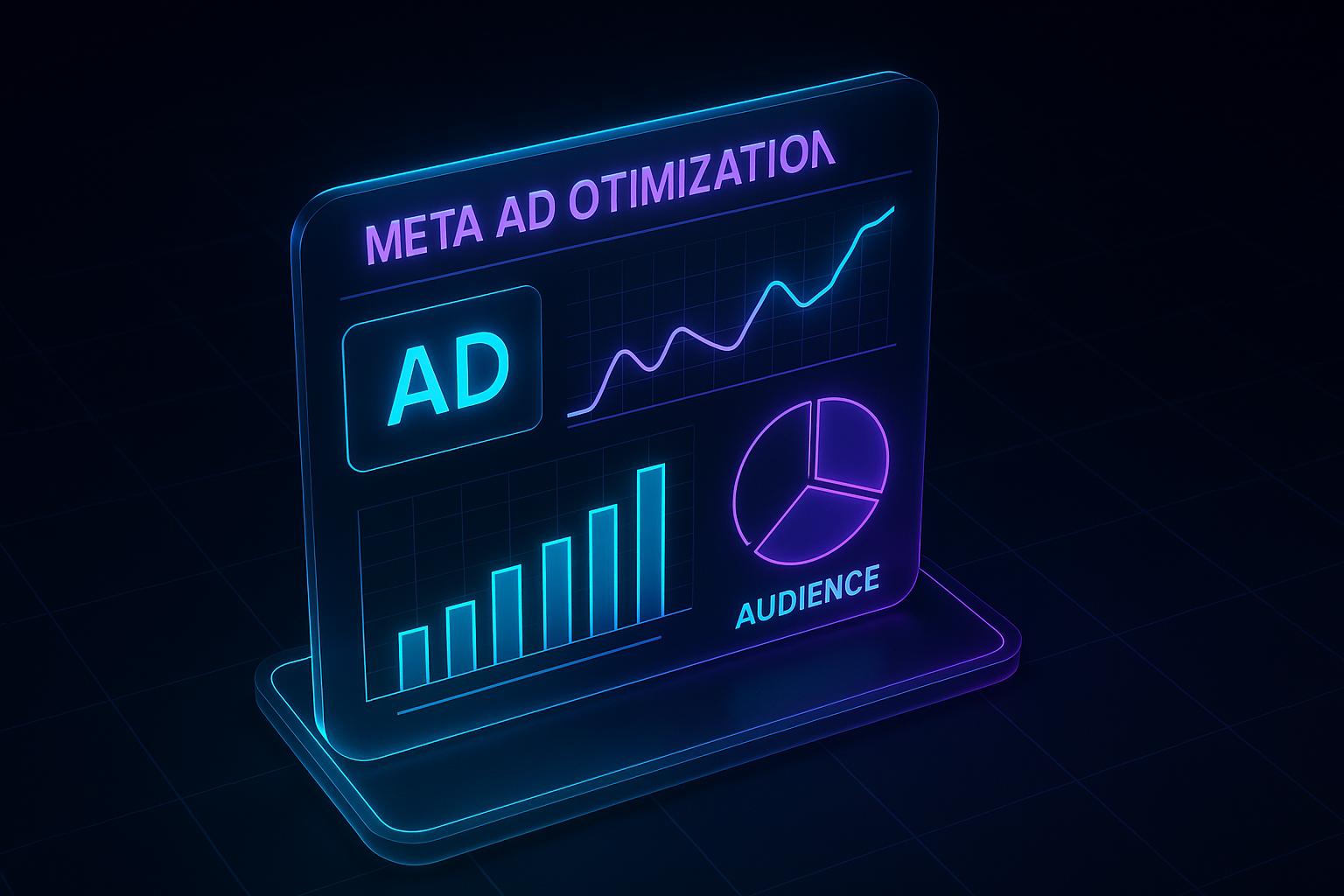
Meta ads are challenging, but AI tools are transforming how marketers tackle common issues like rising costs, creative fatigue, and targeting restrictions. Here's what you need to know:
- AI-Powered Creative Testing: AI automates ad creation and testing, producing variations tailored to audience behavior. Tools like ADEN'S LAB can generate up to 1,000 ads daily, helping marketers test and refine campaigns efficiently.
- Advanced Audience Targeting: Meta's AI analyzes user behavior to create precise audience profiles, enabling better click-through rates and conversions. Features like lookalike audiences and dynamic retargeting personalize ad delivery at every stage of the customer journey.
- Smarter Budget Management: Meta's Campaign Budget Optimization (CBO) reallocates funds in real-time to high-performing ad sets, reducing waste and improving ROAS. Key metrics like CTR, CPA, and ROAS guide better decisions.
AI-driven tools simplify ad management, offering faster insights, better targeting, and more efficient budgets. Whether you're creating ads or reallocating spend, automation makes campaigns more effective.
How to Use Meta's New AI Features for Facebook Ads (Without Ruining Your Results!) 🚀
Put the playbook to work
Apply this playbook to your page
Paste your website and the Lab will turn the strategy you are reading into a ready-to-test ads.
Free to try No prompt writing
AI-Driven Creative Optimization for Meta Ads
The creative aspect of Meta advertising often feels like a bottleneck for marketers. Traditional methods, while reliable to a degree, can be slow and limiting. Enter AI-powered creative optimization - a game-changer that automates both the creation and testing of ads. With this technology, marketers can quickly produce high-performing ads, cutting down on time and effort.
Modern AI platforms analyze thousands of successful ad patterns, identifying what works for specific audiences. They then generate new ad variations based on proven formulas. This approach removes much of the trial-and-error guesswork that has long slowed down creative development. The result? Faster transitions from concept to campaign and a smoother creative testing process.
Using AI for Creative Testing and Iteration
AI has revolutionized creative testing, turning what was once a manual, time-consuming task into an automated, efficient process. AI-driven platforms generate hundreds of creative combinations and test them across various audience segments simultaneously.
One of the biggest advantages here is speed. Where traditional A/B testing might take weeks to yield actionable insights, AI can pinpoint winning creative elements in just days - or even hours. These platforms analyze performance data in real-time, automatically pausing ads that underperform and scaling those that succeed.
Dynamic asset optimization takes this to the next level. AI combines different headlines, images, and calls-to-action, tailoring them to what works best for each audience segment. Over time, the AI learns which elements perform well together and generates new combinations, ensuring a steady stream of effective ads.
Tools like ADEN'S LAB showcase the potential of AI in action. ADEN'S LAB, for example, can generate Meta ads in just 90 seconds from a simple product link. It’s capable of producing up to 1,000 ads per day, each tailored to specific audience psychology and brand requirements. This kind of output, unimaginable for traditional creative teams, allows marketers to test extensively across multiple campaigns at once.
Best Practices for Creative Diversity
One of the toughest challenges in Meta advertising is creative fatigue. When audiences see the same ad repeatedly, engagement inevitably drops, and costs rise. AI solves this problem by ensuring a steady flow of fresh, diverse creative assets that keep audiences engaged while staying true to the brand.
The most effective strategy involves creating variations across several dimensions, such as visual style, messaging, format, and emotional tone. AI systematically explores these variations, ensuring that content resonates with audience preferences and behaviors.
Format diversity is especially critical on Meta platforms. AI can take a single product concept and adapt it into multiple formats - static images, carousel ads, videos, or collections - catering to different engagement styles.
Personalizing messages for segmented audiences is another powerful capability. For example, AI can craft ads that emphasize quality for premium-conscious consumers, highlight savings for budget-focused buyers, or underline convenience for busy professionals. Achieving this level of personalization at scale would be nearly impossible without AI.
Successful campaigns strike a balance between brand consistency and creative variety. AI platforms are designed to learn brand guidelines and apply them consistently across all generated content. For instance, ADEN'S LAB ensures every ad aligns with a brand’s style while exploring different creative approaches to keep things fresh.
Finally, testing cadence plays a crucial role in AI-driven campaigns. Instead of launching massive batches of ads all at once, marketers can use AI to maintain a continuous flow of new creative assets. This keeps campaigns fresh, provides steady learning opportunities, and avoids the performance dips that come with creative fatigue. By constantly iterating and testing, marketers can stay ahead of audience preferences and maintain strong engagement.
Advanced Targeting and Audience Strategies
Advanced targeting is all about connecting with the right audience at the right time. Meta’s AI-driven tools have taken this to a new level, moving beyond basic demographic filters to provide marketers with the ability to pinpoint and engage valuable audiences with incredible accuracy.
This shift from manual audience selection to AI-powered targeting has transformed how campaigns perform. Instead of relying on guesses, marketers can tap into behavioral data, purchase habits, and engagement trends to zero in on their ideal customers. The result? Better click-through rates, higher conversions, and less wasted ad spend. These insights fuel advanced techniques like lookalike modeling and precise retargeting strategies.
AI-Powered Audience Insights
Meta’s algorithms analyze an immense amount of data every day, building detailed audience profiles based on user behavior, interests, and interactions. This goes far beyond traditional demographic data, diving into how users interact with content, what they share, their activity patterns, and the types of posts that drive their actions.
For instance, Meta’s AI can determine the best times to engage users or identify overlapping interests, refining audience profiles for better targeting. The platform also excels at tracking users across devices. Someone might discover a product on their phone but complete the purchase on a desktop later. Meta’s AI connects these dots, giving marketers a full picture of the customer journey and highlighting the touchpoints that matter most.
Lookalike Audiences and Retargeting
Lookalike audiences are a game-changer for reaching new customers. Meta’s AI analyzes data like purchase history, engagement habits, and demographics to find users who share traits with a brand’s best customers. This approach allows marketers to expand their reach while maintaining a high likelihood of conversions.
The quality of the source audience is key here. Focusing on high-value customers - such as those who make repeat purchases or generate consistent revenue - leads to stronger lookalike audiences. Marketers also need to decide on the size of these audiences. Smaller, more targeted groups offer precision but limit reach, while broader groups can extend reach at the cost of some accuracy.
Retargeting, too, has evolved well beyond basic abandoned cart campaigns. AI now tailors messages to each stage of the customer journey. For example:
- A user who only browsed a product page might see an ad highlighting its benefits.
- Someone who added items to their cart but didn’t check out might get a limited-time discount offer.
Sequential retargeting takes this a step further by adjusting messages over time to keep users engaged without overwhelming them. AI determines the best timing and frequency for follow-ups, often incorporating elements like social proof or additional product details to overcome objections.
Dynamic retargeting adds another layer of personalization. Instead of generic ads, users see ads featuring the exact products they viewed, often paired with related items or special offers. Meta’s AI decides which products to highlight and tailors the messaging to resonate with different audience segments.
Matching Creative Messaging to Audience Segments
Targeting only works when paired with messaging that truly connects with the audience. Different groups respond to different motivations, emotional triggers, and communication styles, and AI-powered creative matching ensures that the right message reaches the right people.
Psychographic matching, which focuses on values, interests, and lifestyles, often delivers the best results. For example:
- Price-conscious shoppers respond to clear savings messages.
- Quality-focused buyers look for detailed product information and premium branding.
- Convenience-seekers appreciate messaging that highlights time-saving benefits.
Meta’s AI identifies these preferences by analyzing past behaviors and engagement patterns.
Emotional triggers also play a big role. Some audiences might respond to a sense of urgency or fear of missing out, while others are more motivated by aspirational messages that align with their goals. The AI continuously refines these insights to ensure creative elements align with each group’s emotional profile.
Context matters, too. Ads that feel natural in their environment are more likely to resonate. For example, someone browsing during work hours might respond better to productivity-focused messages, while evening browsers may prefer content centered on relaxation or entertainment. Meta’s AI factors in these contextual details to make ads feel relevant.
Finally, testing creative variations across audience segments is crucial. What works for one group might fall flat for another. Meta’s AI dynamically optimizes ad delivery, learning which creative elements perform best for specific audiences. When combined with advanced targeting strategies, this approach ensures campaigns consistently improve and deliver results.
Budget Allocation and Performance Optimization
Smart budgeting is the backbone of a successful Meta ad campaign. To get the most out of your efforts, you need to tap into Meta's AI tools while staying focused on the metrics that truly matter. Since 70–80% of ad performance on Meta is tied to creative quality, optimizing your budget requires a careful mix of automation and hands-on strategy.
The trick lies in knowing when to let Meta’s algorithms take the lead and when to step in manually. Understanding how to interpret performance data and make informed adjustments is crucial. This section dives into real-time budget tweaks, essential performance metrics, and the balance between manual and AI-driven budget strategies to help you get the best results.
Real-Time Budget Optimization
Meta’s AI tools are designed to make budget management faster and more effective. By continuously analyzing campaign performance, the system reallocates funds to high-performing ad sets while scaling back on those that aren’t delivering results. This happens automatically and far quicker than any human could manage.
One of the key tools for this is Campaign Budget Optimization (CBO). When you enable CBO, Meta’s algorithms distribute your campaign’s total budget across ad sets based on their potential to achieve your goals. The system evaluates factors like audience engagement, conversion likelihood, and cost efficiency to make these decisions.
For instance, if an ad set performs exceptionally well during a specific timeframe, the algorithm shifts more budget toward it to maximize returns. Conversely, if performance dips, the system reduces spending to avoid waste.
To make the most of real-time optimization, your campaigns need to be structured correctly. CBO works best for prospecting campaigns aimed at reaching new audiences. For retargeting efforts, where precise budget control is essential, Ad Set Budget Optimization (ABO) might be a better fit.
It’s worth noting that Meta’s AI requires roughly 50 optimization events - like purchases or leads - per ad set to function at its best. For optimal results, it’s important to set up campaigns properly from the start and give the system time to stabilize.
Key Metrics for Campaign Adjustments
Knowing which metrics to monitor and when to act can make all the difference in your campaign’s success. Three key metrics to focus on are Click-Through Rate (CTR), Cost Per Acquisition (CPA), and Return on Ad Spend (ROAS).
- CTR reflects how well your ads resonate with your audience. A higher CTR means your creative and targeting are hitting the mark, though benchmarks can vary depending on your industry.
- CPA measures the cost of acquiring a single conversion. While CPA may fluctuate during the learning phase, it’s best to wait until around 50 conversions have occurred before making major conclusions.
- ROAS gives you a clear view of profitability by showing how much revenue is generated for every dollar spent. For example, a ROAS of 4:1 means $4 in revenue for every $1 spent. Your target ROAS will depend on your business model and profit margins, but it should play a central role in your budget decisions.
Timing is also critical. During the learning phase, performance may seem weaker than it will be once the algorithm stabilizes. Meta advises against making major adjustments during this phase unless performance is significantly underwhelming. Waiting until ad sets exit the learning phase ensures more accurate data for decision-making.
Context matters, too. For example, a higher CPA might be acceptable if those customers bring higher lifetime value. Similarly, a lower ROAS might be fine for campaigns focused on brand awareness rather than immediate sales.
By understanding these metrics, you can make better decisions about whether to rely on AI-driven strategies or take a more hands-on approach.
Manual vs. AI-Driven Budget Allocation Comparison
Meta’s AI doesn’t just simplify creative testing and audience targeting - it also streamlines budget management by making data-driven decisions. But how does it stack up against manual allocation? Here’s a comparison:
| Feature | Manual Budget Allocation | AI-Driven Budget Allocation |
|---|---|---|
| Control Level | Full control over spend distribution | Automated with strategic oversight |
| Time Investment | High - requires constant monitoring | Low - minimal daily effort once set up |
| Optimization Speed | Limited by manual checks | Real-time adjustments all day |
| Data Processing | Relies on human analysis | Uses Meta’s advanced data and AI |
| Learning Phase Impact | Manual changes can disrupt learning | Stable when left uninterrupted |
| Best Use Cases | Specialized campaigns with strict constraints | Scaling campaigns and broad targeting |
| Expertise Required | High level of knowledge needed | Moderate setup knowledge required |
| Performance Consistency | Varies with skill and attention | Generally stable after optimization |
Manual allocation gives you full control but demands expertise and time, making it ideal for experienced advertisers working on niche campaigns. On the other hand, AI-driven allocation excels at handling large-scale campaigns efficiently. Meta’s algorithms process vast amounts of data, making rapid, informed decisions that would be impossible to replicate manually.
A hybrid approach often works best. For example, you can use CBO to handle the heavy lifting while setting guardrails like minimum and maximum spend limits to ensure alignment with your business goals.
Take the case of a direct-to-consumer (DTC) e-commerce brand that switched from manual allocation to CBO. Over 30 days, they saw a 20% increase in ROAS and a 15% drop in CPA. By letting Meta’s AI identify high-performing audience segments and creative combinations, they achieved more efficient spending and better profitability.
Whether you lean on manual or AI-driven strategies depends on your campaign’s scale and your team’s expertise. For most advertisers managing multiple campaigns, AI-driven tools like CBO offer a simpler path to stronger results with less effort.
How ADEN'S LAB Supports Meta Ad Campaigns
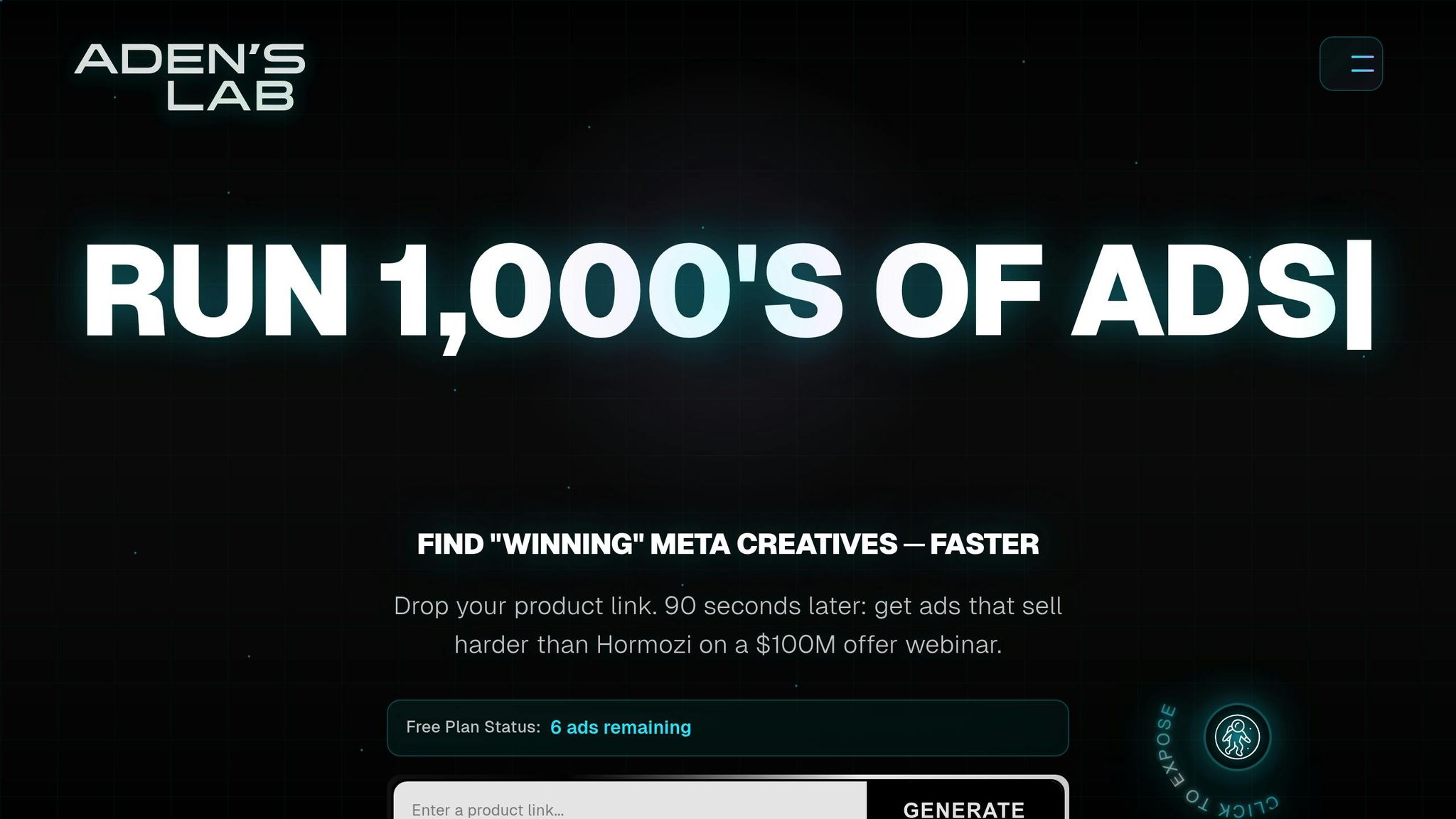
Meta's native tools are great for optimizing budgets and targeting, but ADEN'S LAB takes things a step further by automating the creative process. By producing high volumes of ads quickly, this platform ensures your campaigns stay fresh and engaging, tackling one of the biggest hurdles in Meta advertising: creative fatigue.
ADEN'S LAB doesn’t just churn out ads - it does so without compromising on quality. Its automation tools complement Meta’s optimization strategies, giving you both the reach and the creative edge to maximize campaign performance.
Key Features of ADEN'S LAB
ADEN'S LAB redefines how Meta ads are created with its AI-powered automation. In just 90 seconds, the platform can generate eye-catching ads tailored for Facebook and Instagram, all from a single product link.
What sets ADEN'S LAB apart is its focus on buyer psychology. Instead of just resizing images or tweaking headlines, the platform dives into consumer behavior, crafting creatives designed to convert.
Here’s what makes ADEN'S LAB standout:
- Brand Consistency: The platform uses advanced style-matching technology to ensure every ad aligns with your brand’s visual identity, including colors, tone, and overall style.
- High Volume Ad Creation: With the ability to generate over 1,000 ads per day, ADEN'S LAB enables constant creative testing and quick adjustments to market trends.
- Commercial Usage Rights: Every ad comes with full commercial rights, removing the legal headaches tied to stock images or third-party design elements.
Pricing Plans and Value Proposition
ADEN'S LAB offers flexible pricing to suit different business needs. Its free plan is perfect for trying out the platform, allowing users to create up to 6 ads without any cost.
For businesses looking to scale, the paid plans unlock unlimited ad generation, complete with full commercial rights and access to optimized ad kits. The platform claims to cut creative production costs by 100x, saving businesses significant amounts on design teams and endless revisions. And the results speak for themselves:
- Sakura Sport: Achieved a +61% ROAS improvement in 6 months.
- The Ascott: Boosted sales by +44%.
- CartoucheMania: Increased conversions by +10% in just 3 months.
- Pharmashop Discount: Recorded a +70% jump in sales.
For larger businesses or those with unique needs, custom plans provide dedicated support and scalable ad volumes.
Integration with Meta's Ecosystem
ADEN'S LAB fits seamlessly into Meta’s ad ecosystem. All assets generated by the platform meet Meta’s specifications, ensuring smooth integration. Plus, with its rapid 90-second ad creation time, marketers can quickly refresh creatives, keeping campaigns dynamic while leveraging Meta’s robust performance tracking tools. This combination of speed, compliance, and creativity makes ADEN'S LAB a powerful ally for Meta advertisers.
Conclusion and Key Takeaways
Tired of dealing with creative burnout or inefficient budgets? AI-driven tools can completely reshape how you manage campaigns. From testing ad creatives to refining audience targeting and even reallocating budgets, the strategies shared here show how automation can make your campaigns more effective.
Meta's advanced features and automation tools are game-changers for streamlining creative workflows. These tools allow you to quickly generate and test multiple ad variations, keeping your content fresh and engaging without extra hassle.
Here’s a practical plan based on these insights: Check your creative rotation for signs of fatigue, use AI insights to fine-tune audience segmentation, and adjust budgets in real time to maximize return on ad spend (ROAS).
Marketers who embrace faster testing and smarter scaling gain a clear edge. Automation offers the speed and adaptability necessary for campaigns to grow and thrive.
FAQs
How is AI-powered creative optimization more efficient and effective than traditional ad creation methods?
AI-driven creative optimization brings a whole new level of efficiency and precision to ad creation, leaving traditional methods in the dust. By leveraging advanced algorithms, these tools analyze data and tailor ads to specific audiences, often resulting in a 30% boost in conversion rates and higher average order values. This means businesses can deliver the right message to the right people, exactly when it matters most.
On top of that, AI enables faster testing of creative ideas, helping marketers quickly identify which campaigns perform best - far quicker than old-school A/B testing. By automating key processes and making smarter use of budgets, AI not only cuts costs but also maximizes ROI. The result? Marketers can achieve impressive results without stretching their resources thin.
What are the main advantages of using AI for audience targeting, and how can it boost ad campaign performance?
Using AI for audience targeting allows for more accurate precision, helping you identify high-value audiences who are more likely to engage with your content or make a purchase. This not only boosts your ROI but also minimizes wasted ad spend. By analyzing massive amounts of data, AI can detect patterns and behaviors that manual methods might overlook, ensuring your ads are shown to the right people at the right time.
AI also offers the advantage of real-time optimization. It reacts quickly to shifts in user behavior, automatically fine-tuning campaigns to maintain strong performance. The result? Higher engagement rates, smarter budget allocation, and campaigns that deliver better outcomes.
How can AI-powered tools like Campaign Budget Optimization (CBO) improve the return on ad spend (ROAS) for Meta ad campaigns?
AI-driven tools such as Campaign Budget Optimization (CBO) are designed to improve ROAS by dynamically adjusting bids and distributing budgets based on real-time performance insights. This approach ensures your advertising dollars are directed toward the most effective ads and target audiences, reducing waste and increasing returns.
These tools work by constantly monitoring campaign performance, shifting funds to better-performing segments while cutting back on those that aren’t delivering results. By using AI for budget management, marketers can often see noticeable gains in revenue generated for every dollar spent.
Your next ad batch starts here
Finish with a ready-to-test ad batch
Paste your website to generate static creatives. Drop the link → get ads in about 90 seconds → upload them to Meta → scale.
Free to try No prompt writing