The D2C Ad Creative System Behind Brands That Scale Without Blowing ROAS
Turn the strategy into creatives
Create Meta ads for your product
Paste your product page. ADEN'S LAB turns the offer, audience, and positioning into complete ready-to-use Meta static ads.
Free to try No prompt writing

Scaling D2C brands without tanking ROAS boils down to one thing: keeping your ad content fresh and effective. Here's the reality: ads lose steam fast - often within 10–14 days. If you're not testing and launching new ad concepts regularly, your costs skyrocket, and performance plummets.
Key takeaways:
- Creative fatigue kills ROAS: Ads stop working when people see them too often, leading to higher CPMs and acquisition costs.
- Winning brands test constantly: Successful brands produce 15–20 ad variations per cycle and refresh 25–30% of their content monthly.
- Static ads are underrated: They're quick and cheap to produce, making them perfect for testing new ideas or filling gaps between video campaigns.
- Speed matters: A slow production process can cripple your campaigns. Fast, simple workflows outperform drawn-out, polished designs. Many teams are now automating Meta ad production to maintain this speed without increasing headcount.
- Data drives success: Metrics like hook rate (3-second views) and CTR are early indicators of ad performance. Use them to spot winners fast.
The solution? Treat ad production like a system, not a one-off task. Tools like Aden's Lab streamline the process, generating Meta-optimized ads in seconds for as little as $0.90 per ad. This lets you outpace competitors by consistently launching and testing new ads, keeping ROAS healthy as you scale.
The D2C Reset: Creative Strategy, Incremental Reach, and What’s Working Now
Put the playbook to work
Apply this playbook to your page
Paste your website and the Lab will turn the strategy you are reading into a ready-to-test ads.
Free to try No prompt writing
What a Scalable Ad Creative System Actually Looks Like
Brands that grow successfully don’t rely on a single standout ad - they build systems to consistently produce new creatives on autopilot before performance drops. It’s not about having a bigger budget or more talented designers. Instead, it’s about treating creative production as a core system rather than a one-off task. As previously mentioned, stale creatives hurt ROAS, and this system is designed to prevent that.
A scalable creative system revolves around three key elements: consistency in understanding what drives ad performance, speed in producing new creatives, and data-driven testing to identify winners early. These components don’t operate in isolation; they work together to ensure campaigns remain profitable as budgets grow. This approach guarantees a steady pipeline of fresh, high-performing creatives.
"The best-performing ecom brands don't rely on a handful of UGC clips and pray for ROAS. They build creative like product teams: fast feedback loops, data analysis, and content that gets better with each iteration." - Creative Ad Lab
Top-performing accounts typically run 8–12 active creative variations per campaign and refresh 25–30% of their creative library each month. Meta’s algorithm thrives on fresh content to maintain engagement and distribution.
Consistency: Winning Ads Follow Patterns
Ads that consistently deliver strong ROAS share common traits. They grab attention within the first three seconds, focus on a single problem or benefit, and include a clear, direct call-to-action. These elements signal to Meta’s algorithm that the ad is worth distributing widely.
Consistency doesn’t mean every ad looks the same. It’s about identifying the components that drive results and applying them across different concepts. For example, if product demos outperform lifestyle shots, focus on demos but continue testing other formats. The idea is to lean into what works without completely abandoning variety.
The 60-30-10 budget rule helps maintain this balance:
- 60% of your budget goes to proven winners.
- 30% is allocated to variations of those winners.
- 10% is spent on entirely new concepts.
This approach ensures stability while leaving room for experimentation. You’re not gambling your entire budget on untested ideas, but you’re also not letting your creative library grow stale.
Winning ads typically achieve a CTR that’s 25–35% higher and a CPC that’s 15–20% lower than your account’s baseline. These benchmarks help define what “consistent performance” looks like. If a new ad hits these numbers within 48 hours, it’s a strong candidate for scaling. If not, it’s a sign that the creative needs adjustment.
Once you’ve identified what works, the next challenge is delivering those elements quickly enough to stay ahead of fatigue.
Speed: Staying Ahead of Fatigue
On average, UGC ads lose effectiveness within 14–18 days. If you’re only producing one new ad every three weeks, you’re already falling behind. Speed doesn’t mean rushing - it’s about setting up a workflow that reliably delivers new creatives before performance declines.
Traditional production workflows often create delays due to multiple revisions and design bottlenecks. Meanwhile, campaigns suffer because they can’t be refreshed in time. Brands that scale efficiently remove these hurdles by simplifying production and focusing on what drives results.
Simple, authentic videos often outperform polished ads by up to 35%. Raw iPhone clips, founder demos, or straightforward product shots can be created in hours rather than days. Meta rewards authentic, engaging content over high-production value. If a concept works in a lo-fi format, you can always invest in higher-quality production later. Prioritizing speed gets you actionable data faster, and that data informs your next steps.
Top-performing mobile app advertisers generate over 5,000 ad variations per month. Achieving this volume isn’t possible with traditional workflows. It requires systems that streamline production, test efficiently, and scale winning creatives without manual intervention. These brands aren’t working harder - they’re leveraging processes that remove friction between ideation and launch.
Fast production feeds into rapid testing, which refines your creative strategy over time.
Data-Driven Testing: Let the Numbers Lead
Testing isn’t about randomly launching ads and hoping for the best. It’s a structured process to identify which elements drive conversions, so you can focus on those. The three-layer testing framework simplifies this:
| Testing Layer | Objective | Spend % | Performance Metric |
|---|---|---|---|
| Layer 1: Hook | Identify scroll-stoppers | 40% | Hook Rate (3s views) |
| Layer 2: Message | Validate value prop | 35% | CPA / ROAS |
| Layer 3: Scale | Combat fatigue | 25% | Frequency / Cost Stability |
Early performance indicators like CTR and CPC can guide decisions within the first 48 hours. However, Meta’s algorithm needs 10–15 conversions to optimize delivery for a new creative effectively.
"High engagement ≠ high conversions. Meta can't distinguish 'this ad gets clicks' from 'this ad gets profitable sales' until it has conversion data." - Rahul Mondal, Product & Strategy, Ideon Labs
In late 2025, a supplement e-commerce brand tested six new ads simultaneously. Meta prioritized a new ad with a 44% hook rate over a proven winner with 41%, even though the new ad had a $68 CPA compared to the winner’s $43 CPA. This caused ROAS to drop from 1.35 to 0.75, leading to $18,000 in losses. The brand recovered within five days by pausing all tests and focusing on 10 proven concepts.
Volume matters because not every test will succeed. Launching only two or three ads per week limits your chances of finding winners. Brands that scale consistently test 15–20 variations per cycle, knowing that most won’t outperform existing ads. However, the few that do can make the entire process worthwhile.
Mistakes That Kill ROAS
Overcomplicating the Production Process
Dragging out the approval process can kill your momentum faster than mediocre ad creative ever could. If every single ad has to go through endless rounds of revisions and sign-offs before it launches, you're already falling behind. Meanwhile, your competitors are busy testing new ideas and refining what works.
The real problem isn’t just the time you’re wasting - it’s what happens when your current ads hit a performance wall. Once ad fatigue sets in, frequency spikes past 4.0, and click-through rates nosedive, you're left spending money on an audience that's overexposed and uninterested.
The solution? Keep it simple. Smart advertisers start with low-production tests. Think quick iPhone clips, raw product demos, or short founder videos. These lo-fi versions let you test hooks and messages in days instead of weeks, giving you actionable data fast.
"Smart teams don't wait for the perfect edit. Instead, they test lo-fi ads first... because performance is feedback." - Creative Ad Lab
If your workflow isn’t built for speed, it becomes a bottleneck. And focusing entirely on design instead of performance only makes things worse.
Prioritizing Design Over Performance
A beautifully designed ad might look great, but that doesn’t mean it’ll drive results. In fact, polished, studio-quality ads often scream “advertisement” to viewers, who scroll right past them. And when people ignore your ad in those crucial first seconds, platforms like Meta limit its reach, driving up costs and sinking your ROAS. On the other hand, raw, user-generated content (UGC)-style ads tend to outperform their polished counterparts by 35%.
"Audiences are skeptical of high-production ads. They scroll past anything that looks like advertising. But real people sharing real experiences? That stops the scroll." - Paul Grisel, Founder, VIDEOAI.ME
The key takeaway? Prioritize performance over aesthetics. A clear hook, one focused benefit, and a strong call-to-action will outperform the most visually stunning ad if its message doesn’t land. Chasing vanity metrics like likes and shares while your acquisition costs soar means you’re optimizing for the wrong goals.
Even beyond design, failing to understand how Meta's algorithm works can further derail your ROAS.
Ignoring How Meta's Algorithm Works
Meta’s algorithm is quick to judge your ad. If users scroll past without engaging, the system reduces its distribution, and your performance takes a hit. What many advertisers miss is that creative itself now acts as a targeting signal. Meta evaluates your text, visuals, and audio to decide who should see your ad. If your creative doesn’t grab attention immediately, it loses reach.
Certain formats perform better within Meta’s system. For instance, vertical video in a 4:5 aspect ratio outperforms square formats by 15% in the Feed. Similarly, ads without captions often underdeliver since over 85% of users watch videos with the sound off.
Another critical factor: the algorithm requires 50 optimization events to exit its learning phase. Constantly tweaking budgets, changing audiences, or stopping and restarting campaigns resets this process, leading to unstable results and higher costs.
| Creative Type | Algorithmic Performance Boost |
|---|---|
| UGC Testimonials | +35% CTR |
| Before/After | +40% Conversion |
| Comparison Ads | +31% CTR |
| Founder Stories | +28% Engagement |
| Face-to-Camera | +25% Conversion |
Successful brands know the algorithm isn’t neutral. It favors content that aligns with user behavior. Relying too heavily on high-production ads or ignoring format preferences means you're fighting an uphill battle. Instead, adopting a streamlined, data-driven process - like Aden's Lab - can help you avoid these pitfalls and maximize your ROAS.
How Aden's Lab Fixes the Creative Bottleneck
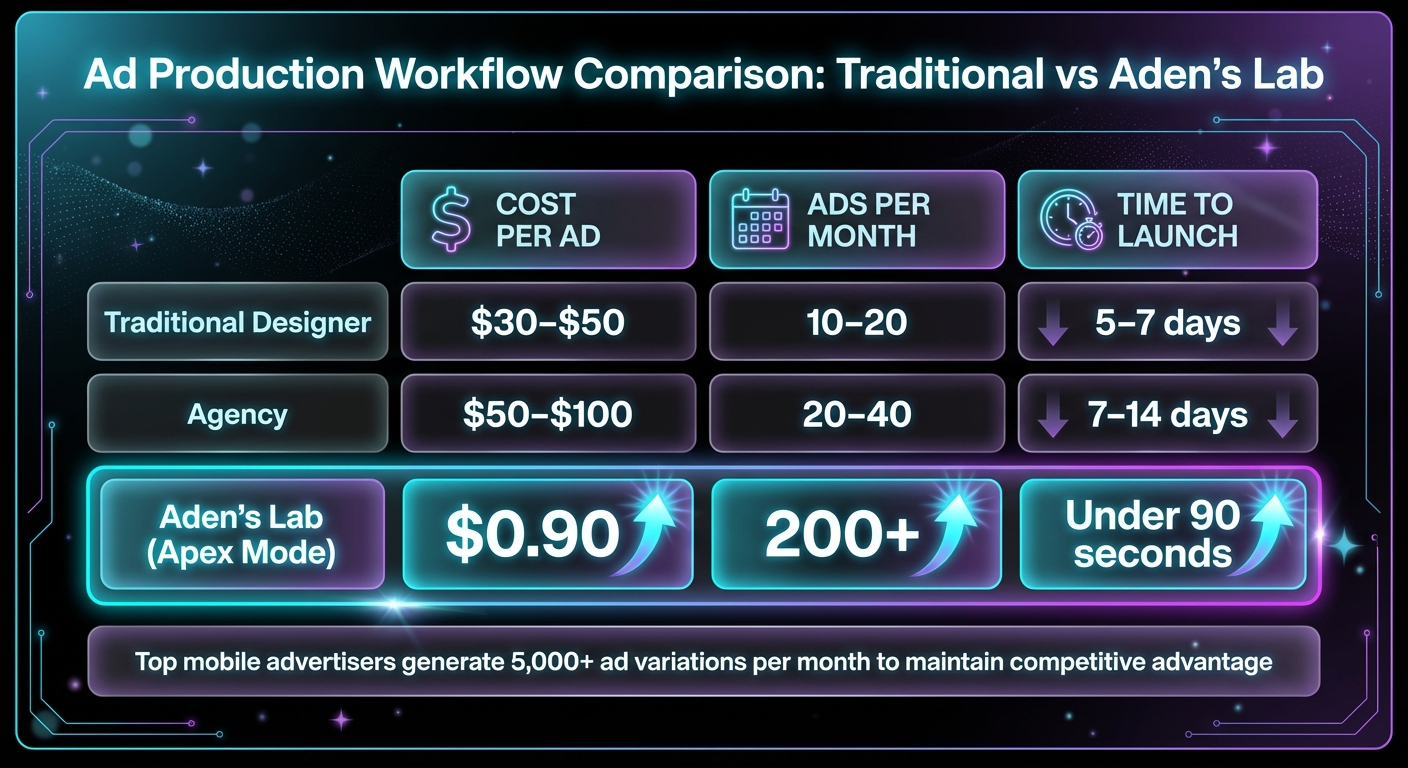
D2C Ad Creative Production: Traditional vs Aden's Lab Workflow Comparison
How It Works: Drop a Link → Get Ads → Launch
Aden's Lab takes the hassle out of ad creation. All you need to do is paste your product or landing page URL, and in less than 90 seconds, the platform generates fully optimized Meta ads. No complicated prompts. No manual setup. Everything is handled behind the scenes, automatically aligning the ads with your brand identity and optimizing them for Meta's algorithm.
This isn't your typical design tool where you spend hours dragging and tweaking elements. It's a seamless, URL-to-ad system that delivers complete ad variations - including visuals, copy, and formatting. The process is built to bypass the inefficiencies of manual vs automated ad creation workflows entirely.
Why Aden's Lab Beats Traditional Workflows
Traditional ad creation can feel like a slog. It often involves a Performance Marketer, a Creative Producer, and a Video Editor just to churn out enough ad variations to compete. That setup isn’t just slow - it’s expensive. Aden's Lab eliminates the need for this entire team, offering a streamlined process that cuts through the delays of traditional methods.
Here’s where the numbers really shine: at just $0.90 per ad, you could generate 200 ads a month for a fraction of the cost. Compare that to hiring a designer, who charges $30–$50 per ad, or an agency, which can cost $50–$100 per ad. When you’re testing at scale to find winning creatives, that cost difference becomes a game-changer.
Speed is another crucial factor. Top mobile advertisers launch over 5,000 ad variations every month. With Aden's Lab, you can hit those numbers without building a full creative team or waiting weeks for approvals. If an ad stops performing, you can replace it the same day, bridging the gap between identifying creative fatigue and launching fresh content.
Outproducing Competitors at Scale
Meta’s algorithm thrives on variety. Brands that rely on the same ads for too long end up paying a "monotony tax" - higher CPMs and reduced reach. Winning campaigns typically run 8–12 active creative variations per campaign and refresh 25–30% of their ad library every month. Aden's Lab makes this level of output accessible to any brand, no matter the budget.
By continuously delivering fresh content, Aden's Lab helps brands avoid the creative fatigue that slows down traditional campaigns. While older workflows delay testing and scaling, Aden's Lab allows for near-instant ad refreshes that keep up with Meta's rapid pace. The result? Faster learning, quicker iteration, and the ability to uncover profitable ads before competitors even get their first tests live. The formula for success is simple: more ads × more diversity. Aden's Lab delivers both without the heavy lifting.
Here’s how the numbers stack up:
| Workflow Type | Cost Per Ad | Ads Per Month | Time to Launch |
|---|---|---|---|
| Traditional Designer | $30–$50 | 10–20 | 5–7 days |
| Agency | $50–$100 | 20–40 | 7–14 days |
| Aden's Lab (Apex Mode) | $0.90 | 200+ | Under 90 seconds |
Scaling Without Destroying ROAS
Scaling your Facebook ad spend is only effective if your creative production can keep up. Many brands hit a wall - not because their product loses its appeal, but because they run out of fresh ad content before the ad algorithm can effectively utilize the increased budget. As mentioned earlier, creative fatigue not only increases your cost per acquisition but also weakens your ROAS (Return on Ad Spend). When ad frequency exceeds 4, cost per acquisition can double, while ROAS takes a hit. The key to avoiding this? Producing new creative faster.
"A 10% improvement in creative performance delivers the same results as a 10% increase in media budget, but without spending more money." – Darkroom Agency
Once your targeting and bidding strategies are fine-tuned, creative becomes the main driver of growth. The most successful brands approach creative like a product - they iterate quickly, rely on fast feedback, and let data guide their decisions. Instead of recycling the same few ads, they launch 20–50 fresh assets every month.
This fast-paced iteration requires tools that eliminate traditional production bottlenecks. Enter Aden's Lab. With just a single URL, you can instantly generate optimized static Meta ads, cutting out design delays entirely. This allows you to test new ideas aggressively, replace underperforming creatives immediately, and maintain the 8–12 active variations per campaign that top-performing accounts depend on. This speed and flexibility give you a lasting edge over competitors stuck in slower production cycles.
FAQs
How can I tell my ads are fatigued before ROAS drops?
You can identify ad fatigue by keeping an eye on key indicators like dropping engagement rates, rising CPMs (cost per thousand impressions), or falling click-through rates (CTR). These shifts signal that your ad is no longer resonating with your audience. Acting quickly to refresh your creative can prevent wasted ad spend and help maintain consistent performance.
How many new creatives should I launch each week to scale safely?
Launching 1 to 3 new creatives per week is a smart way to keep your ads engaging while scaling effectively. This steady pace ensures your campaigns stay fresh, reducing the risk of audience fatigue or oversaturation. By consistently testing and updating your creatives, you can sustain performance without overwhelming your strategy.
What metrics should I use to pick winners in the first 48 hours?
In the first 48 hours, pay close attention to early engagement metrics such as click-through rate (CTR) and initial conversion data. These metrics offer quick feedback on how well your creative content is resonating with the audience, helping you identify which elements are performing effectively right from the start.
Your next ad batch starts here
Finish with a ready-to-test ad batch
Paste your website to generate static creatives. Drop the link → get ads in about 90 seconds → upload them to Meta → scale.
Free to try No prompt writing