How Top Affiliates Launch 50+ New Ads Per Offer Without Burning Budget
Turn the strategy into creatives
Create Meta ads for your product
Paste your product page. ADEN'S LAB turns the offer, audience, and positioning into complete ready-to-use Meta static ads.
Free to try No prompt writing

Top affiliates know that running out of effective ads can destroy a campaign. To avoid this, they launch 50+ ads per offer upfront, preventing creative fatigue and keeping costs down. This approach isn’t about spending more - it’s about testing smarter. By producing ads in bulk, automating workflows, and analyzing performance metrics, you can scale campaigns efficiently without wasting budget. Here’s how it works:
- Creative Fatigue Hurts Campaigns: Repeated ads lose engagement fast, doubling your costs almost overnight. Combat this by rolling out fresh ads regularly.
- Manual Ad Creation is Expensive: Paying $50 per ad adds up quickly. Automation tools can cut costs to under $2 per ad, saving time and money.
- Test More, Fail Less: Launching 50+ ads increases your chances of finding winners before fatigue sets in. Start small with testing budgets, then scale successful ads.
- Budget Allocation Matters: Avoid wasting money on underperforming ads. Monitor metrics like CTR, CPA, and ROAS, and pause ads that don’t deliver results.
- Refresh Ads Regularly: Update hooks, visuals, and headlines every 2–4 weeks to maintain performance and avoid high frequency penalties.
What Stops Most Advertisers from Scaling Ad Volume
Creative Fatigue and Why It Hurts Your Campaigns
Creative fatigue happens when your audience sees the same ads too often and starts to lose interest. Meta's algorithm is quick to notice this drop in engagement, and the ripple effects can be brutal: your click-through rate (CTR) takes a hit, your cost per acquisition (CPA) climbs, and a campaign that was profitable yesterday can suddenly start losing money.
You’ll notice this fatigue in three main ways: fewer clicks as your audience tunes out, higher costs to acquire customers, and a reduced return on ad spend (ROAS) because you’re paying more but converting less. The solution? Roll out fresh creatives before your current ones lose their edge. That’s why leading advertisers aim to produce anywhere from 50 to 200 new ads every month. It’s a proactive way to combat creative fatigue, but it also highlights why automating Meta ad production can overcome the manual processes that make scaling so difficult.
Why Manual Ad Creation Holds You Back
Creating ads manually is expensive, slow, and inconsistent. Waiting on designers or agencies can throw off your launch timelines, and the quality of work can vary dramatically. One ad might perform well, while another flops - and it’s hard to pinpoint whether the problem lies in the concept or execution.
Even worse, manual workflows have a ceiling. Agencies often max out at around 25 to 30 clients because their processes just can’t scale beyond that. Without a steady flow of diverse, high-quality creatives, your testing efforts lose effectiveness, and you’re left spending more money without better results.
How Poor Testing Structures Waste Money
If you’re only testing a handful of creatives, you’re likely missing out on winning ad angles. Worse, you might end up wasting money on underperforming ads while waiting for a standout to emerge. The problem gets worse if you’re splitting your budget evenly across all ads without closely tracking performance. Underperforming creatives end up draining your ad spend, while promising ones don’t get the budget they need to thrive.
This kind of inefficiency highlights why a high-volume approach is critical. By testing more creatives, you can quickly identify the ads that resonate with your audience and allocate your budget where it matters most. It’s not just about spending more - it’s about spending smarter.
Put the playbook to work
Apply this playbook to your page
Paste your website and the Lab will turn the strategy you are reading into a ready-to-test ads.
Free to try No prompt writing
Full Creative System For Scaling Facebook Ads To $10k+ Days
How to Create and Launch 50+ Ads Without Wasting Money
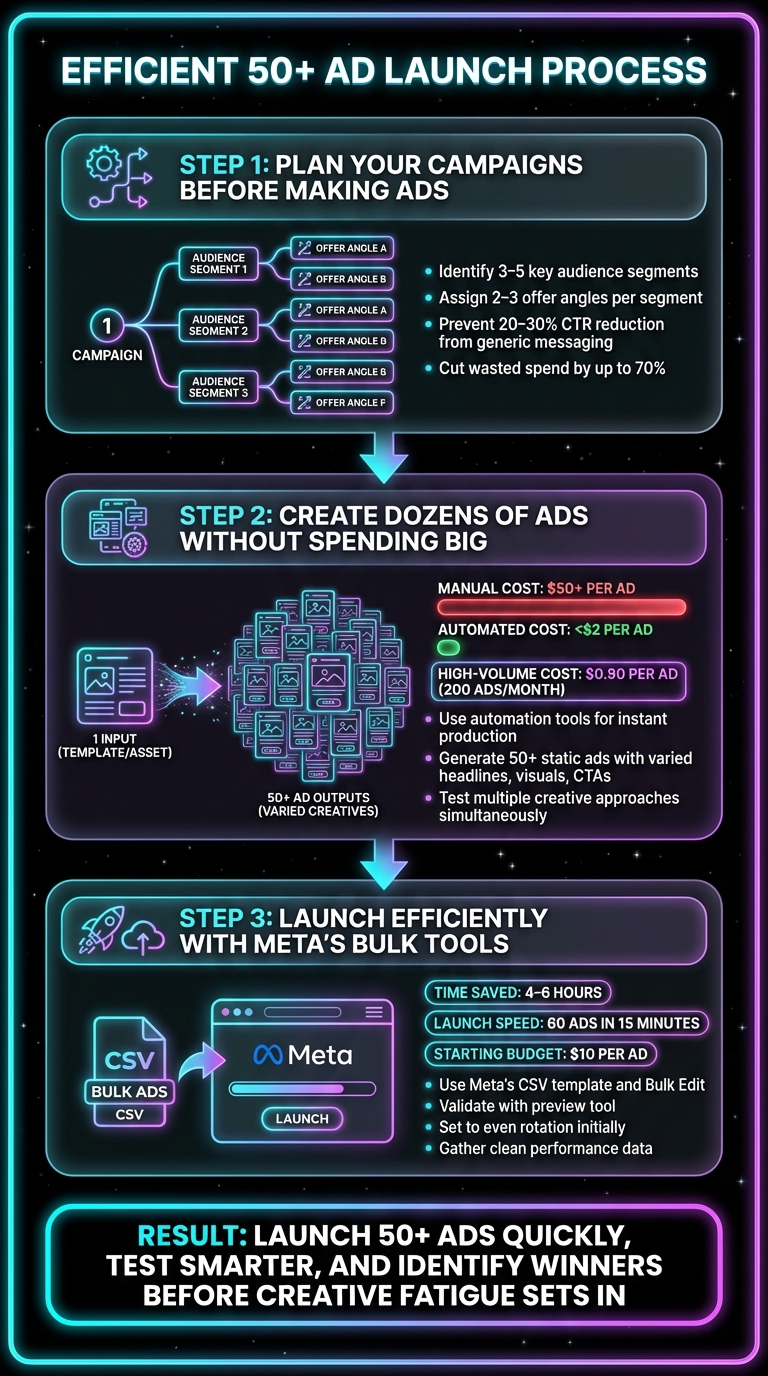
3-Step Process to Launch 50+ Ads Without Wasting Budget
Step 1: Plan Your Campaigns Before Making Ads
Before diving into ad creation, take time to organize your campaign structure. Start by identifying 3–5 key audience segments based on factors like interests, behaviors, or demographics. For example, you might target "fitness enthusiasts aged 25–34" or "busy parents looking for quick meal solutions." Then, assign 2–3 specific offer angles to each segment, such as "save time" for parents or "build muscle fast" for fitness fans. This ensures your ads are tailored to each audience, avoiding the trap of generic messaging that can reduce click-through rates by as much as 20–30%.
The goal? Prevent wasted impressions. For instance, an ad focusing on "weight loss for moms" within a parenting-specific ad set can perform 2–3 times better than a general weight loss ad. Misaligned ads can burn $50–$100 daily on low-engagement impressions before you even realize it. By planning your structure upfront, you could cut that waste by up to 70%. Plus, this approach sets the stage for automating ad creation, which is crucial to avoid creative burnout. Once your campaign structure is in place, you’re ready to start producing ads.
Step 2: Create Dozens of Ads Without Spending Big on Designers
Once your campaign is mapped out, the next hurdle is producing ads quickly and affordably. Manually creating ads can be slow and expensive, especially if you rely on designers. This makes it tough to generate the volume of ads needed for effective scaling. The answer? Automation. Tools like Aden's Lab let you drop in your website link and instantly produce 50+ static ads with varied headlines, visuals, and calls-to-action.
Static ads are a smart choice for high-volume testing. They load quickly, and when generated automatically, they cost less than $2 each - far cheaper than the $50+ you’d pay for custom designs. This lets you test multiple creative approaches in no time. For example, if you’re promoting a supplement, you could generate ads focused on testimonials, problem-solving, or urgency to cover all your bases. With this method, producing 200 ads per month could bring your cost per ad down to just $0.90.
Step 3: Launch Ads Efficiently with Meta's Bulk Tools

After creating your ads, use Meta's bulk tools to streamline the upload process. Start by downloading Meta’s CSV template, fill it with the campaign details you’ve planned in Steps 1 and 2, and upload it via Bulk Edit. This eliminates the need for manual entry, saving you 4–6 hours and reducing errors like mismatched creatives.
Before uploading, use Meta’s preview tool to validate your CSV file and stick to clear naming conventions - something like "Offer1_Fitness_SaveTime_Ad1" - to keep things organized. Double-check for common issues like oversized images or excessive text overlays (over 20%), which can lead to rejections and wasted time. Set your ads to even rotation initially, ensuring each one gets fair exposure during testing. Using this approach, you could launch 60 ads in just 15 minutes, each with a $10 budget, allowing you to gather clean performance data without manual hassle.
How to Allocate Budget Across 50+ Ads
With your ads up and running, the next step is managing your budget effectively to get the most out of your campaigns.
Testing Budgets vs. Scaling Budgets
Not all ads deserve the same budget from the start. Begin by assigning each creative a small, equal testing budget - just a few dollars per day. This approach helps you gather enough data to see which ads are connecting with your audience. Once an ad achieves 50–100 conversions at an acceptable cost-per-acquisition, you can confidently increase its budget by 2–5× to capitalize on its performance.
For example, if you have a $500 daily budget spread across 50 ads, each ad starts with about $10. While many ads might fail to perform, the few that succeed can justify much larger investments. Using cost-efficient creatives from Aden's Lab, you can afford to test aggressively and shift your funds toward the ads that are delivering results.
In the first 24–48 hours, use even rotation to give all ads equal exposure. This structured approach is a core part of A/B testing Meta ads to ensure statistical significance. Once you've gathered enough data, switch to optimized rotation, allowing Meta to prioritize the ads showing the strongest early performance signals. This ensures your budget isn’t wasted on underperformers during the critical learning phase.
After identifying the winners, the next step is to cut the ads that aren’t working.
Stopping Underperforming Ads Before They Waste Budget
Act quickly when it comes to eliminating ads that aren’t delivering. During the testing phase, check your ad performance every 12–24 hours. Focus on key metrics like click-through rates and conversion data from the first 100–200 impressions. Any ad that’s clearly underperforming should be paused immediately to prevent further budget waste.
Set a strict rule: no ad should use more than 10–20% of your total testing budget unless it’s showing meaningful results. If an ad burns through its share of the budget without driving conversions, cut it. The money saved can then be redirected to the top-performing 20% of your ads.
Keep a close eye on your ad manager for signs of poor performance. Ads with high impressions but low engagement or conversions can quickly drain your budget. By identifying and pausing these ads early, you free up funds to scale the creatives that are delivering results - helping you maximize efficiency without overspending.
What to Do After Launch: Scaling Winners and Refreshing Losers
Once your ads are live and the underperformers are cut, the real challenge begins. This is where staying hands-on and focusing on the right metrics becomes critical. Managing a large volume of ads - 50 or more - requires constant attention to performance data and knowing when to step in before results take a nosedive.
Which Metrics Actually Matter When Running 50+ Ads
With so many ads running at once, it’s easy to get distracted by vanity metrics. Instead, focus on essential Meta ad metrics like CTR (Click-Through Rate), CPA (Cost Per Acquisition), and ROAS (Return on Ad Spend). These metrics give you a clear picture of how well your ads are attracting clicks, how efficiently those clicks are converting into customers, and whether your ad spend is delivering value.
Meta Ads Manager can help you stay on top of these numbers. Pay close attention to the Delivery column, which flags issues like "Creative limited" when costs start to rise. If your costs double compared to past performance, it’s a clear signal to refresh your creative.
Another key metric to watch is frequency - how often the same audience sees your ad. High frequency can lead to fatigue, causing engagement to drop by 20–30% week over week. To keep all these metrics in check, set up custom columns in Ads Manager for quick access to CTR, CPA, frequency, and spend velocity. This saves you from digging through each ad individually.
How to Refresh Ads Before Performance Drops
Use these metrics as early warning signs to refresh your creatives before performance starts to slide. Creative fatigue doesn’t happen overnight - it builds gradually. By refreshing your assets every two to four weeks, you can keep performance steady.
A quick and effective way to breathe new life into an ad is by switching up the hook. This could mean changing the opening visual, tweaking the headline, or testing a different angle. You don’t need a complete overhaul; small adjustments, like shortening a headline or swapping out a testimonial for a product demo, can make a big difference.
"Creative fatigue is not solved by adjusting money. It is solved by refreshing your assets." – Ivan Teh, Advisible
When you refresh an ad, always use a new ad ID. This resets the learning phase, allowing Meta to treat it as fresh content. Tools like Aden’s Lab can speed up this process by generating new static ads in minutes. Instead of waiting days for a designer and spending $50 or more per ad, you can quickly test new ideas and replace underperformers. At scale, this gives you a competitive edge - letting you iterate faster than others can even submit a brief to their design team.
Conclusion: How to Scale Ad Creation Without Bottlenecks
Running 50+ ads per offer isn’t about throwing money at Meta - it’s about breaking free from the creative bottlenecks that slow down scaling. If you can’t produce ads fast enough, your performance takes a hit while competitors who churn out creatives faster grab a bigger slice of the market.
The key is to streamline your process. Start by structuring campaigns thoughtfully, produce ads in bulk without waiting on design delays, and use Meta’s bulk tools for efficient launches. Set aside separate budgets for testing and scaling, cut underperformers quickly, and scale winning ads before high frequency starts dragging down results. It’s all about staying disciplined.
The game-changer? Automated static creatives. Tools like ADEN'S LAB can slash production costs to just $0.90 per ad on high-volume plans, making it easy to test new creatives daily without worrying about blowing your budget.
Experienced affiliates understand that scaling isn’t about perfect efficiency - it’s about profitable volume. They know that scaling often drops ROAS by 20–40%, but they offset that by finding enough winning ads to drive overall profits. And the only way to uncover those winners is by testing relentlessly.
Once you automate creative production, the next step is optimizing budget allocation and analyzing data in real time. This often involves using real-time bid adjustments to protect margins while scaling. This shift can take you from spending $10,000 a month to scaling profitably at $100,000 a month.
FAQs
How can I automate ad creation to save money and scale faster?
Automating your ad creation process is one of the easiest ways to save both time and money while scaling your campaigns effectively. Instead of spending hours crafting ads or coordinating with designers, AI-powered tools can do the heavy lifting for you. Take platforms like Aden’s Lab, for instance. All you need to do is drop a product link, and within seconds, you’ll have ready-to-launch Meta ad creatives - no complicated setup, no steep learning curve, and absolutely no manual effort.
This approach lets you test multiple ad variations for each offer without blowing through your budget. You’ll avoid wasting money on ineffective ads, reduce creative fatigue, and scale your campaigns much faster - all while keeping costs under control. And with prices as low as just a few dollars per ad, it’s a much cheaper alternative to hiring a designer or sticking to traditional workflows.
What key metrics should I track to avoid wasting ad spend?
To ensure your budget is working hard for you, keep an eye on cost per acquisition (CPA), click-through rate (CTR), ad frequency, and return on investment (ROI). These metrics provide valuable insights into your ad performance and help pinpoint areas for improvement.
For instance, if your CPA is higher than expected, it could mean your targeting or ad creative isn’t connecting with your audience. A low CTR might suggest that your ad isn’t catching attention or matching user intent. Keeping track of ad frequency is also crucial - showing the same ad too often can lead to ad fatigue, which wastes money and reduces effectiveness. And, of course, ROI is your ultimate gauge of success, ensuring you’re making more than you’re spending.
How often should I update my ads to avoid creative fatigue?
When you notice your Meta ads losing steam - whether it's through falling click-through rates, rising costs, or dwindling audience engagement - it’s time for a refresh. This drop-off often signals creative fatigue, which happens when your audience grows tired of seeing the same ad repeatedly, making it less effective.
To stay ahead, aim to update your ads every few weeks or as soon as performance starts to slip. When making changes, focus on testing one element at a time - such as the image, headline, or call-to-action. This approach helps the algorithm adapt smoothly and makes it easier to figure out which tweaks drive better results.
Your next ad batch starts here
Finish with a ready-to-test ad batch
Paste your website to generate static creatives. Drop the link → get ads in about 90 seconds → upload them to Meta → scale.
Free to try No prompt writing