The Ad Creative System Successful Dropshippers Use to Test Products Faster
Turn the strategy into creatives
Create Meta ads for your product
Paste your product page. ADEN'S LAB turns the offer, audience, and positioning into complete ready-to-use Meta static ads.
Free to try No prompt writing

Want to test products faster and avoid wasting your budget? In dropshipping, speed is everything. The faster you test ad creatives and identify winning products, the better your chances of staying ahead of trends and competitors. Here's how successful dropshippers do it:
- Focus on static ads: They’re quick to produce, easy to test, and deliver clear data within 24-48 hours.
- Use key metrics early: Track CTR (>1.5%) and CPC (<$1.50) in the first 48 hours. Wait for 10-15 conversions before evaluating ROAS or CPA.
- Automate ad creation: Tools like Aden's Lab let you generate multiple ad variations in minutes, saving time and increasing testing volume.
- Run broad campaigns: Test 10-20 creatives in a single ad set with Ad Set Budget Optimization (ABO) for cleaner data and less budget waste.
- Scale winners smartly: Allocate 60% of your budget to proven ads, 30% to variations, and 10% to new concepts. Refresh creatives every 7-10 days to combat audience fatigue.
how to run facebook ads for dropshipping in 2026. (testing & scaling)
Put the playbook to work
Apply this playbook to your page
Paste your website and the Lab will turn the strategy you are reading into a ready-to-test ads.
Free to try No prompt writing
How Ad Creatives Control Product Testing Outcomes
Meta’s algorithm prioritizes engagement over product quality, which can complicate ad testing. When you launch a campaign, the algorithm immediately looks for engagement signals - clicks, likes, comments, and shares - to predict which ads will drive conversions. But here’s the catch: high engagement doesn’t guarantee high conversions. An ad might rack up clicks but still lose money, which is why relying solely on engagement metrics can be risky.
Take this example: From November 18 to December 16, 2026, a supplement brand saw its ROAS drop from 1.35 to 0.75 after launching six new ads at once. The algorithm favored an ad with a 44% hook rate (the percentage of viewers drawn in by the opening visual) over a proven performer, leading to a steep decline in ROAS before enough purchase data was gathered. The brand managed to recover to a 2.50 ROAS and $29 CPA within five days by pausing all tests and running a single ad set with 10 proven concepts for seven days without interruption.
"High engagement ≠ high conversions. Meta can't distinguish 'this ad gets clicks' from 'this ad gets profitable sales' until it has conversion data." - Rahul Mondal, Product & Strategy, Ideon Labs
This highlights the importance of creative quality in ad testing. If your ads don’t provide clear performance signals quickly, the algorithm may waste your budget chasing engagement rather than conversions. Your creatives need to deliver actionable data so you can identify winners and cut losses before the algorithm drains your testing budget.
Why Static Ads Beat Other Formats for Testing
When it comes to testing, the format of your ads matters. Static ads stand out because they provide quick, clear results - often within 24 to 48 hours. Unlike videos, which take longer to produce and involve multiple variables like music, pacing, and editing, static ads are straightforward and easy to analyze.
In 2024, Boston Proper conducted a year-long A/B test on Facebook and Instagram, comparing video ads to static image ads. The static ads, which featured on-image text and concise messaging, consistently outperformed videos and GIFs. They delivered a 37% boost in CTR and an 11% increase in ROAS. Why? Static ads communicate their value instantly. In fast-scrolling feeds, you have about three seconds to grab attention. A clean static ad with a strong visual and clear offer can do that without requiring viewers to watch a video.
Another advantage of static ads is their simplicity in testing. You can tweak individual elements - like the background color, headline, or product angle - and immediately see what impacts performance. In contrast, videos test multiple elements simultaneously, making it difficult to pinpoint what’s driving results.
For dropshippers testing new products in 2026, static ads are a no-brainer. You can create dozens of variations in minutes, launch them the same day, and start gathering data by the next morning. This speed can make the difference between riding a trend and missing it entirely.
Which Metrics Actually Matter During Testing
During the testing phase, not all metrics carry the same weight. In the first 24 to 48 hours, focus on CTR (click-through rate) and CPC (cost per click). These metrics indicate whether your creative is grabbing attention and driving clicks. Aim for a CTR above 1.5% and a CPC below $1.50 to ensure you’re engaging users efficiently.
Avoid judging ROAS or CPA too early. Meta’s algorithm needs at least 10 to 15 conversions to optimize ad delivery effectively. If you pull the plug on an ad after spending $20 because the ROAS looks bad, you’re acting on incomplete data. Wait 48 to 72 hours and ensure you’ve hit at least 10 conversions before evaluating metrics like cost per acquisition and return on ad spend.
Once you have enough data, here’s what to look for:
- ROAS of 2.5x or higher
- Conversion rate of 2–3% from click to purchase
If an ad meets these benchmarks, it’s ready for scaling. If not, cut it and move on.
| Metric | Testing Phase | Target Benchmark |
|---|---|---|
| CTR | Early (24-48h) | >1.5% |
| CPC | Early (24-48h) | <$1.50 |
| ROAS | Mature (48-72h+) | 2.5x+ |
| Conversion Rate | Mature (48-72h+) | 2–3% |
| Conversions | Evaluation | 10–15 minimum |
Static creatives are particularly effective because they deliver clean, actionable metrics. The key is to let the data guide your decisions. If an ad looks great but loses money, turn it off. If it looks unpolished but drives results, scale it. Testing is about numbers, not aesthetics.
Mistakes That Waste Time and Money During Creative Testing
Most dropshippers don’t fail because their products are bad. They fail because they test too slowly, rely on inefficient methods, and don’t give the algorithm enough options to identify what works. These errors can be avoided. Let’s break down the common pitfalls that can derail your creative testing process.
Using Manual Design Workflows
Relying on manual design slows everything down - testing can be delayed by as much as a week. That’s an entire testing cycle gone while competitors are already collecting valuable data. Beyond the delay, manual workflows also limit how much you can produce. To stay competitive, you need to scale up your output. Some advertisers, for instance, run as many as 100 Meta ads every month. Achieving this volume is nearly impossible if you’re stuck with traditional design methods.
Interestingly, about 80% of the best-performing ads aren’t brand-new ideas - they’re remixed versions of older creatives. If you’re waiting on manual design, you’ll test fewer variations per product, which means the algorithm doesn’t get the variety it needs to find the winning approach. This lack of variety disrupts the rapid feedback loop that’s essential for scaling successful products.
Running Ads with Inconsistent Quality
Inconsistent ad quality is another major issue. Meta’s algorithm depends heavily on engagement signals during the learning phase. If an ad generates high initial interest but fails to convert, it can pull budget away from proven winners.
Take this example from late 2025: a supplement brand tested six new ads at once. One ad achieved an impressive 44% hook rate, outperforming the proven winner’s 41%. But here’s the catch - it had a $68 cost per acquisition (CPA), compared to the winner’s $43. Over four weeks, the account’s return on ad spend (ROAS) dropped from 1.35 to 0.75, and the CPA jumped from $48 to $87.
The lesson? Consistent, high-quality creatives help the algorithm zero in on your target audience faster. This leads to lower CPMs and clearer performance signals. Stable creatives ensure the algorithm gets clean, actionable feedback to optimize effectively.
Testing Too Few Creatives Per Product
Limiting your testing to just one or two creatives per product is a recipe for missed opportunities. Ad performance often follows a heavy-tail distribution, where only a small percentage of creatives drive the majority of results. The odds of finding a true winning ad are slim - only 6.6% of ads are successful, and just 2% become scalable winners.
The performance gap can be massive. One ad might outperform another by 19× to 53× simply because it resonates better with the audience.
"One ad can outsell another by 19x simply due to a stronger appeal. Not 19% better. Nineteen times better." - David Ogilvy
If you’re testing only a few creatives, you’re unlikely to uncover that “unicorn” ad or gather enough data to benchmark performance. For instance, without enough variations, you won’t know whether a 1.2% click-through rate (CTR) is good or if a different approach could hit 2.5%. Testing 3 to 5 creative variations at a time, with each receiving a budget of $100 to $150, can help you counter audience fatigue and identify top performers. Without this pipeline of options, your campaigns risk losing momentum once your initial winners start to fade.
The System Successful Dropshippers Use to Test Faster
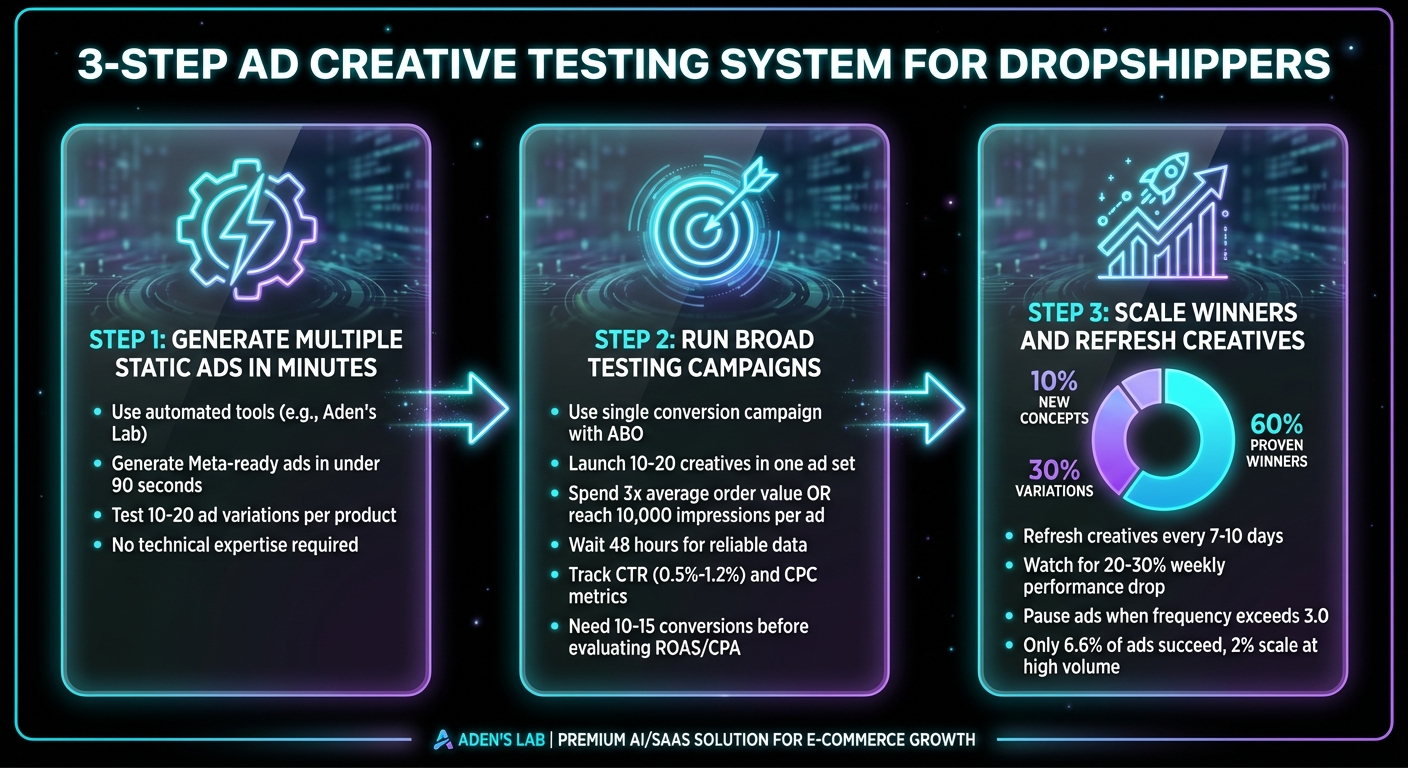
3-Step Ad Creative Testing System for Dropshippers
The issues we just discussed - manual workflows, inconsistent quality, and low creative volume - are all tied to one core challenge: production speed. Without the ability to produce creatives quickly, you’ll struggle to meet the algorithm’s constant demand for fresh content. Here’s a system that solves this problem by speeding up creative production and streamlining testing.
Step 1: Generate Multiple Static Ads in Minutes
The first hurdle is the creative production process. Traditional manual design is slow, often taking days and costing hundreds of dollars for just one batch of ads. To overcome this, successful dropshippers are turning to automated tools like Aden's Lab. With this tool, you can input a product link and generate Meta-ready static ads in under 90 seconds - no technical expertise required.
This isn’t about replacing creativity but eliminating delays. Automation allows you to test 10 to 20 ad variations per product instead of just a handful. Static ads are particularly effective for testing because they load quickly, cost less to produce, and provide clean data during the learning phase. By drastically reducing production time, you can focus on testing and scaling rather than waiting for creatives.
Step 2: Run Broad Testing Campaigns
Once your creatives are ready, the next step is to structure your testing. Instead of running multiple small campaigns, use a single conversion campaign with Ad Set Budget Optimization (ABO). This approach keeps your auction signals clear, avoiding competition between your own ads. Launch 10 to 20 creatives within a single ad set, allowing each to spend at least three times your average order value or reach 10,000 impressions before making decisions.
Give the campaign at least 48 hours to gather reliable data, as Meta’s algorithm needs time to identify the right audience segments. During this period, focus on metrics like click-through rate (CTR) and cost per click (CPC). A strong CTR for testing typically falls between 0.5% and 1.2%. Ads with a CTR that’s 25% to 35% above your baseline and a CPC that’s 15% to 20% lower are good candidates for scaling. However, avoid relying on cost per acquisition (CPA) or return on ad spend (ROAS) too early - wait until the ad generates at least 10 to 15 conversions.
Case studies back this up: consolidating multiple creatives into one ad set avoids budget waste and lets the algorithm optimize across a wider range of options. This prevents it from prematurely favoring high-engagement ads that may not convert.
Step 3: Scale Winners and Refresh Creatives
Once you’ve identified high-performing ads, it’s time to scale them effectively. Use a 60-30-10 budget structure: allocate 60% of your budget to proven winners, 30% to variations of those winners (e.g., different hooks or thumbnails), and 10% to entirely new concepts. This strategy balances stability with ongoing experimentation, keeping your campaigns fresh by introducing new creatives every 7 to 10 days.
Scaling isn’t just about increasing budgets. Even top-performing ads lose engagement over time, with a typical drop of 20% to 30% per week as they reach audience saturation. Ads often decline in performance once their frequency exceeds 3.0. To combat this, maintain a steady flow of new creatives. When moving winning ads to new ad sets, use the same Post ID to retain social proof - likes, comments, and shares - which helps sustain conversion rates.
It’s important to recognize that only a small percentage of ads become true winners. On average, just 6.6% of ads succeed, and only 2% can scale at high volume. For example, one advertiser spending $30,000 per day tested 100 ads with a $10,000 testing budget. They found a 6% to 7% success rate, resulting in six or seven winning ads. Those winners were then moved into dedicated scaling campaigns while the testing pool was replenished with fresh ideas. This cycle is key to staying ahead of creative fatigue and ensuring the algorithm continues to work in your favor.
What Performance Numbers to Expect
Once you've identified winning creatives, it's essential to set clear benchmarks to manage your expectations. Many dropshippers get anxious when early ads don't immediately hit big, but understanding the typical performance metrics can help you stay grounded. Here's what you can expect when testing products effectively.
During the initial testing phase, aim for a CTR (Click-Through Rate) between 1.2% and 2.0%. If your CTR exceeds 1.5%, that's usually a good sign that your creative resonates with your audience. CPC (Cost Per Click) often ranges between $0.80 and $1.40, though some niches, like apparel, might see rates as low as $0.45. For ROAS (Return on Ad Spend), the industry average is approximately 2.79x. These numbers provide a solid foundation for evaluating your ad performance during testing.
It's worth noting that only about 20% of your ads will deliver meaningful returns. This isn't a flaw in your process - it's just how creative testing works at scale. The key is producing a high volume of ads quickly. Even with a modest success rate, you'll still identify enough winners to make the effort worthwhile. Rapid testing not only saves time but also minimizes wasted budget by scaling ad testing to identify underperforming ads before they drain resources. These metrics help you assess creative performance early on, without diving too deeply into the funnel yet.
For example, the European brand Dyut.eu saw impressive results after adopting AI-driven creative automation in late 2024. They achieved a 23% boost in ROAS and a 67.8% increase in purchases. This success came from generating a wide variety of ad creatives, allowing them to confidently pinpoint the ones that worked. By leveraging tools like Aden's Lab to produce and test multiple creatives, you can improve your chances of hitting these benchmarks.
If you notice a strong CTR but low conversions, the issue likely lies further down the funnel - whether it's the landing page, the offer, or the checkout process. Address those problems before scaling your ad spend on new creatives.
Conclusion: Speed Wins in Dropshipping
In dropshipping, speed isn't just helpful - it’s everything. The difference between thriving and struggling often boils down to how quickly you can test products, cut underperformers, and scale your winners. With trend cycles shortening and CPMs climbing, every extra day spent on a failing product is money you won’t get back.
This approach works because it’s rooted in data-driven decision-making. Test multiple static ads within 72 hours, focus on key metrics like a CTR above 1.5% and a CPC under CPC under $1.00.00, and act fast. Drop the low performers and double down on the ones showing promise. To succeed, you need speed - not just in decision-making but also in creating new ads.
Traditional design processes just can’t match this pace. When it takes days to produce creatives, you’re already falling behind. Tools like Aden's Lab eliminate the creative bottleneck - you simply drop a link, get ads within minutes, and launch them on Meta without waiting for designers or revisions. This streamlined workflow - drop a link, get ads, launch - keeps you ahead of the competition. It allows you to test more products, refresh campaigns quickly, and avoid letting creative delays eat into your margins.
FAQs
What’s the difference between static ads and video ads for dropshipping?
Static ads and video ads each bring something different to the table in dropshipping, and the right choice really depends on what you’re aiming to achieve and where you are in your testing process.
Static ads are straightforward, image-based creatives that are quick and inexpensive to produce. They’re great for testing products at scale because they let you measure audience interest without sinking time or money into video production. Plus, they’re handy for retargeting campaigns and can be fine-tuned with A/B testing to improve results.
Video ads, by contrast, are all about grabbing attention and showing off a product’s features and benefits in a visually dynamic way. They tend to generate higher click-through rates and conversions by building a stronger emotional connection with viewers. The downside? Creating high-quality video ads requires more time and money, which can slow down your testing phase.
A smart approach is to start with static ads to quickly figure out which products and audiences work. Once you’ve nailed that down, you can step it up with video ads to drive more engagement and conversions.
What metrics should I track when testing new ad creatives?
When evaluating new ad creatives, prioritize metrics like engagement rate and click-through rate (CTR). These early indicators reveal how well your content is resonating with your audience.
Instead of focusing on one-off results, look for consistent trends. For instance, if an ad repeatedly delivers higher CTR or engagement, it’s a clear sign that it could perform well on a larger scale. Leveraging this early performance data helps you allocate your budget effectively and steer clear of spending on creatives that miss the mark.
What’s the best way to scale ad creatives that are performing well?
Scaling high-performing ad creatives is all about figuring out what makes them successful and then expanding their reach in a smart, cost-effective way. Once you’ve pinpointed a creative that consistently drives strong engagement and ROAS (return on ad spend), the challenge is to replicate and tweak it for a wider audience.
A good starting point is to create variations of the winning ad. Experiment with different audiences, placements, and formats to see what works best on a larger scale. Automation tools can be a huge help here, allowing you to quickly produce variations and optimize the mix of visuals, headlines, and calls-to-action. This approach also helps combat creative fatigue - when an ad’s performance dips because people have seen it too many times.
The trick is to keep a steady pipeline of fresh creatives while continuously testing and learning. By using an efficient system to produce and launch new ads, you can scale your top-performing campaigns faster and more effectively, without getting bogged down by the delays of manual production.
Your next ad batch starts here
Finish with a ready-to-test ad batch
Paste your website to generate static creatives. Drop the link → get ads in about 90 seconds → upload them to Meta → scale.
Free to try No prompt writing