How Winning Dropshippers Generate New Ads Daily Without Hiring Designers
Try the workflow instead of comparing it
See what an AI ad generator makes from your product
Paste your product page and get a complete Meta ad batch—creative concepts, images, headlines, and copy—without another tool stack.
Free to try No prompt writing

If you're running Meta ads and spending over $500 a day, your campaigns might stop performing - not because your product or targeting is bad, but because your audience gets bored. Meta's data shows that ad performance can drop by 45% after just four exposures. To stay profitable, successful dropshippers focus on one thing: producing more ads, faster.
Here’s the secret: instead of hiring expensive designers, they use automated tools like Aden's Lab to generate up to 200 ads a month for as little as $0.90 per ad. This method keeps costs low and ads fresh, helping avoid fatigue and improving campaign performance. By automating ad creation, you can test more variations, cut underperformers quickly, and scale winners without slowing down.
Key Takeaways:
- Ad fatigue hurts performance: CTR drops and costs rise after repeated exposure.
- More ads = better results: High-volume testing identifies what works faster.
- Automation beats manual design: Tools like Aden's Lab save time and money, producing ads in seconds.
Scaling Meta campaigns isn’t about spending more - it’s about staying ahead with new ads daily. Let’s break it down.
Step 1: Drop Your Product Link
Many dropshippers make things harder than they need to be. They think they have to write long creative briefs, organize folders of assets, or explain their brand's vision before an ad can even take shape. This old-school approach slows everything down, creating delays while competitors are already launching fresh ads. As we’ve already touched on, these delays can lead to creative fatigue, which directly impacts performance.
Here’s the simple fix: just drop a product link. That’s it. The system does the heavy lifting by pulling everything it needs - images, product descriptions, pricing, and offers - straight from your product page. No forms. No back-and-forth. No extra steps. This approach ensures all the key assets are ready to go without wasting time.
Your Product Page Is a Goldmine of Assets
Your landing page already has everything needed to create effective ads. It’s packed with high-quality product images, benefit-focused descriptions, clear pricing, and even social proof. Did you know that 75% of online shoppers heavily rely on product images when deciding to buy? If your page is converting visitors into customers, it’s proof that the content resonates.
With Aden's Lab, these assets are pulled directly from your page and turned into Meta-ready ads in less than 90 seconds. This process allows dropshippers to create up to 200 ads per month - no designers required.
Time-Wasting Mistakes to Avoid
Even though your landing page holds all the essentials, automating Meta ad production helps avoid common missteps often found in manual creation. Long creative briefs and endless tweaks not only eat up time but also drive up costs. Things like picking fonts or adjusting layouts may seem small but quickly add unnecessary delays.
Another frequent issue? Overloading your product page with technical details instead of focusing on clear, benefit-driven messaging. If your page is full of jargon and specs, the ads generated from it won’t connect with your audience. Stick to highlighting benefits - what your product does for the customer. Following proven Meta ad copy frameworks can help ensure your messaging hits the mark.
And let’s talk dollars. Testing 10 new ads manually each week could set you back about $500. By automating the process, you can generate ads instantly for just $0.90 to $1.97 per ad. That’s a huge difference in both time and cost.
Put the playbook to work
Apply this playbook to your page
Paste your website and the Lab will turn the strategy you are reading into a ready-to-test ads.
Free to try No prompt writing
Step 2: Generate Ads Automatically
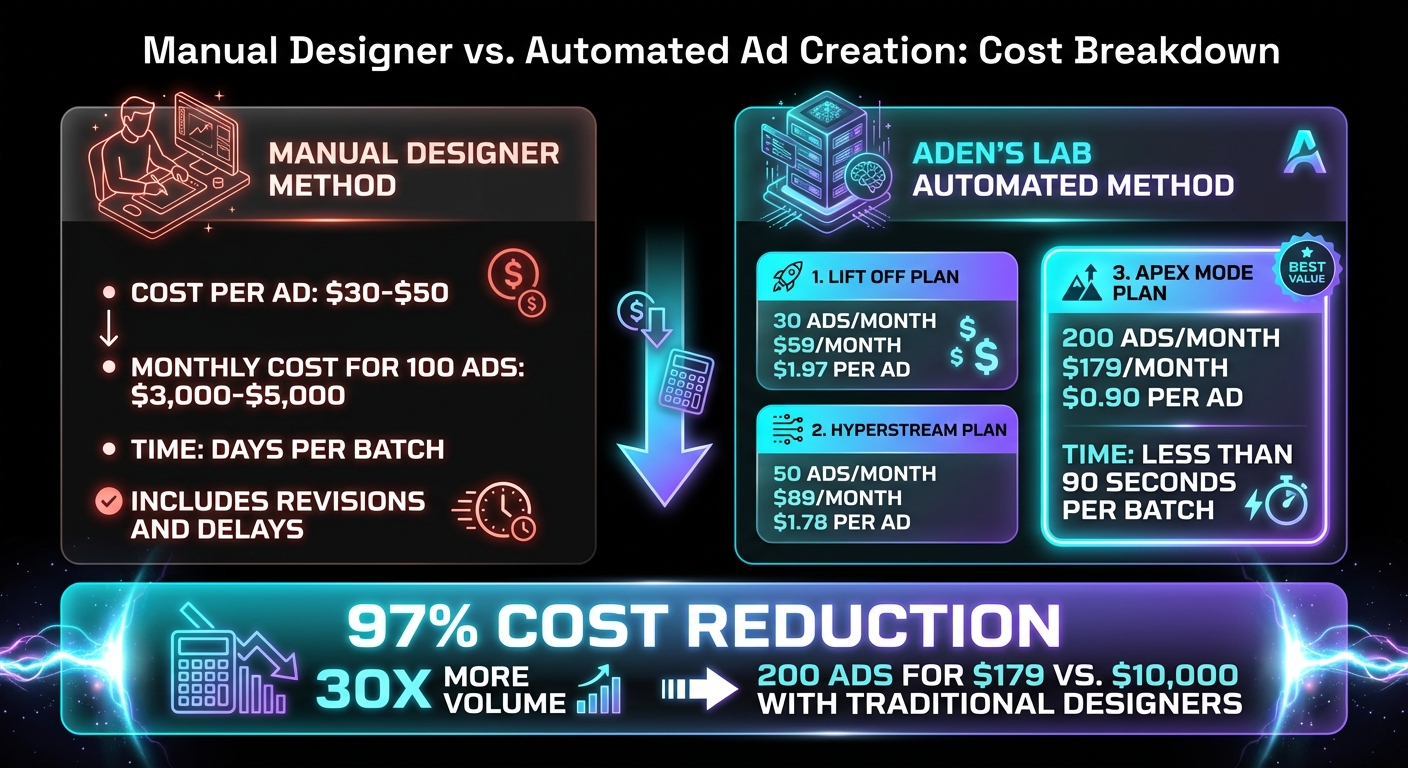
Cost Comparison: Manual Designer vs Automated Ad Creation for Dropshippers
Drop in your product link, and Aden's Lab takes it from there. In just seconds, the system scans your page, pulling product images, descriptions, pricing, and key features. It then uses these assets to create multiple static ad variations - complete with headlines, body text, and calls-to-action - all tailored to Meta's ad specs. The whole process takes less than 90 seconds. No manual input. No delays.
How the System Works
After you provide a product link, the system handles everything. It processes your product page and delivers ready-to-use ads. It identifies eye-catching images for crowded feeds, extracts benefit-focused copy from your descriptions, and formats everything to Meta's requirements (like 1080x1080 images and 120-character headlines). You don’t have to tweak layouts, adjust fonts, or do anything else. Just download and launch.
This approach tackles a major bottleneck: speed at scale. Manual workflows are slow and drain momentum, but automation changes the game. With Aden's Lab, you can generate 20 to 50 ad variations from a single product link in the time it takes to grab a coffee. This lets you test more ads with A/B testing strategies and fight off creative fatigue - one of the biggest threats to Meta campaign performance.
What It Actually Costs to Produce Ads at Scale
Beyond saving time, this automated process dramatically reduces production costs. Let’s break it down. Hiring a freelance designer typically costs $30 to $50 per static ad. If you’re testing 100 ads a month - a common scenario when scaling - that’s $3,000 to $5,000, not including revisions. For many dropshippers, that’s unsustainable, especially when profit margins are tight.
Aden's Lab flips the script. The Lift Off plan costs $59 per month for 30 ads, bringing your cost per ad to $1.97. The Hyperstream plan offers 50 ads for $89, or $1.78 per ad. And for those scaling aggressively, the Apex Mode plan delivers 200 ads for $179, dropping the cost to $0.90 per ad. That’s a 97% reduction in cost compared to manual production, while delivering 30 times the volume. No revisions. No delays. Just ads ready to launch.
| Plan | Ads per Month | Monthly Cost | Cost per Ad |
|---|---|---|---|
| Lift Off | 30 | $59 | $1.97 |
| Hyperstream | 50 | $89 | $1.78 |
| Apex Mode | 200 | $179 | $0.90 |
If you’re spending $10,000 to $50,000 a day on Meta ads, refreshing 10% of your creatives daily without breaking the bank on production can give you a serious edge. High ad volume doesn’t just cut costs; it improves performance by reducing ad fatigue. Keeping your audience engaged lowers CPMs and helps your campaigns stay profitable.
Step 3: Launch and Test New Ads Every Day
Once your ads are ready, it’s time to go live and trust the data. Waiting for everything to be perfect only slows you down. With the low cost of producing ads, you can afford to test aggressively without worrying about overspending on creative development. The focus isn’t on perfection - it’s about generating as much volume as possible, as quickly as possible.
The key is to launch multiple ads every day, monitor performance, and quickly cut the ones that don’t work. This approach keeps your campaigns fresh, prevents ad fatigue from tanking your performance, and ensures you’re constantly testing new angles. By rolling out 10 to 20 new ads each week, you’re not just hoping for a winner - you’re actively creating one. This rapid launch strategy is a natural antidote to the creative fatigue discussed earlier, feeding directly into a fast-paced campaign structure.
How to Structure Campaigns for Fast Testing
Simplicity is key when structuring your campaigns. Stick to 3 to 5 ad sets, each containing multiple creatives. Each ad set should target a similar audience, whether that’s a broad interest group, a lookalike audience, or a retargeting segment. Within each ad set, include 5 to 10 different ad creatives. This setup gives Meta’s algorithm enough variety to optimize delivery while keeping your testing process manageable.
Start with a daily budget of $20 to $50 per ad set, depending on your total ad spend. For five ad sets, this means allocating $100 to $250 per day. This budget range provides enough data to make informed decisions without overspending on untested creatives. Let the ads run for 24 to 48 hours before making decisions. If your click-through rate (CTR) drops below 2.5% or your cost per click (CPC) exceeds $1.92 during this window, it’s time to pull the plug on that ad. You’re not waiting for miracles - the data will quickly show what’s working.
One of the most important metrics to track is Net Profit on Ad Spend (NPOAS). Unlike return on ad spend (ROAS), which only measures revenue, NPOAS accounts for product costs, shipping, transaction fees, and ad spend. If your net profit is in the red after 48 hours, stop the ad. If it’s breaking even or slightly positive, give it a little more time. And if it’s generating profit, scale it immediately by increasing the budget or duplicating the ad set.
Testing Mistakes That Burn Budget
One of the biggest pitfalls? Keeping ads live just because they look good. If an ad isn’t converting, it’s dead weight - cut it. Another common mistake is letting poor performers run for too long. If an ad hasn’t gained traction after spending $50 to $100, it’s not going to magically turn into a winner. Stop wasting money and move on.
Another issue is testing too few ads. If you’re only launching one or two ads a week, you’re not testing - you’re guessing. The 80:20 rule applies here: typically, only 2 out of every 10 ads will become major successes. If you’re not testing enough, you’re reducing your chances of finding those winners and leaving potential revenue untapped. High-volume testing isn’t optional - it’s essential.
Lastly, don’t underestimate creative fatigue. Even your best-performing ads will eventually lose their edge. When CTR starts to drop or CPC creeps up, it’s time to refresh your creative. This is where daily ad generation gives you a major advantage. Instead of waiting for new designs from a creative team, you can generate 10 new variations, drop them into your campaign, and launch them the same day. This speed keeps your campaigns running smoothly while keeping costs under control.
Step 4: Scale Winners Without Burning Out Your Audience
When you find ads that perform well, the natural instinct is to pour more money into them. But here's the catch: showing the same ad too many times can backfire. Once ad frequency goes above 4, performance takes a nosedive - click-through rates drop, and costs per click shoot up. This can turn a once-profitable ad into a money pit. Instead of stopping your scaling efforts altogether, try duplicating your successful ads and making small tweaks.
By duplicating a winning ad set and increasing the budget by 2–3 times, you send a signal to Meta's algorithm that you're expanding rather than just recycling the same creative. This approach gives the duplicate ad a fresh start, opening up new audience segments or delivery times that the original ad might have already exhausted.
The goal here is to tweak without losing the magic that made the ad work in the first place. Keep the headline that resonates but adjust the image or the opening text. This way, you can pinpoint which elements are driving results while keeping your campaign effective.
As Reggie Paquette, Marketing Leader at Bïrch, puts it: "The value of duplication lies in how you apply it. Done well, it gives you a controlled way to adapt campaigns without disrupting proven setups."
Here’s another pro tip: when duplicating ads in Meta Ads Manager, choose the option to "Show existing reactions, comments and shares." This carries over the social proof from the original ad, maintaining its credibility and giving the new version a head start. Watch the performance closely during the first 72 hours. If the duplicate performs at less than 70% of the original's efficiency, it might be competing with the original ad or overlapping with the same audience, which can hurt your results over time.
Keeping Ads Fresh While Staying On-Brand
Staying consistent doesn't mean repeating the same thing over and over. Your brand's voice, colors, and messaging should remain familiar, but your creative execution needs to evolve. This is where tools like Aden's Lab can make a difference. Just drop in your product link, and the system generates multiple variations that stay on-brand - adjusting headlines, layouts, or visuals without losing your core identity. You're not starting from scratch; you're building on what already works.
Refreshing your creative assets every two to four weeks - even if performance hasn’t dropped yet - helps you avoid fatigue before it sets in. If you're running broad targeting campaigns, try experimenting with new formats like carousel ads, video content, or other visuals to give your audience something fresh to engage with. By keeping your ads fresh while staying true to your brand, you’ll see the payoff in lower costs and better results.
How High Ad Volume Lowers Your Costs Over Time
Let’s break it down: producing 200 ads a month at $0.90 each costs $179. Compare that to hiring a traditional designer at $50 per ad, which would cost around $10,000. That kind of savings changes the game for creative testing and scaling.
When you can produce ads for less than a dollar each, you can afford to test aggressively without worrying about creative costs eating into your profits. Launch dozens of new ads in a week, cut the ones that don’t perform, and scale the ones that do. Traditional design processes, with their endless revisions and delays, just can’t keep up.
High-volume ad production also gives you an edge when scaling your campaigns. By constantly rotating in fresh variations, you avoid ad fatigue and keep the frequency low, allowing you to scale your budget more confidently. This ability to produce low-cost ads with tools like Aden's Lab has already proven to be a game-changer, helping advertisers reduce fatigue and grow their campaigns efficiently. The secret lies in maintaining momentum without overloading your audience.
Conclusion
The most successful dropshippers scale profitably by producing new ads faster than their competitors - not by throwing more money at bigger budgets or fine-tuning targeting endlessly.
The traditional approach of manual resizing, countless revisions, and fragmented feedback loops slows down ad creation and drives up costs. When it takes days to generate just a few ads, aggressive testing becomes nearly impossible, and ad fatigue creeps in, further inflating your expenses.
Aden's Lab simplifies this entire process, turning creative production into a fast, repeatable system. Drop in your product link, and within minutes, you’ll have ads ready to launch on Meta. With their Apex Mode plan, you get 200 ads for just $179 - that’s about $0.90 per ad. This kind of efficiency allows you to test continuously without stretching your budget thin.
Producing a high volume of ads doesn’t just save money; it also accelerates campaign optimization. Rolling out dozens of fresh ads weekly keeps frequency issues at bay, lets you test multiple angles, and helps you identify winning creatives faster. By automating every step, this AI-driven ad creation streamlines the entire process, making it easier to stay ahead of your competition while keeping costs under control.
Creative production is no longer just a support function - it’s now a key driver of campaign growth. Done right, it becomes a strategic advantage that boosts performance and supports sustainable scaling, all while protecting your budget and audience engagement.
FAQs
How do I know if I’m hitting ad fatigue?
If you’re seeing a decline in key metrics like click-through rates (CTR), a rise in ad frequency, higher costs (like CPM or CPC), or fewer engagements and impressions, you might be dealing with ad fatigue. These shifts often mean your audience has grown tired of seeing the same ads repeatedly and is starting to tune them out.
How many new ads should I launch each day?
Start by launching 1–3 new ads daily. This allows you to test and tweak your campaigns without overspending or bombarding your audience with too many messages. Once you identify which ads perform well, you can slowly ramp up the volume to grow your reach effectively. This method keeps your efforts efficient and minimizes wasted budget on ads that haven’t proven their value yet.
What should I track besides ROAS to decide what to kill or scale?
When analyzing performance metrics, don't just focus on ROAS. Keep an eye on cost per result, click-through rate (CTR), and conversion rate as well. It's important to track these numbers over several days to identify trends and patterns. This approach helps you avoid making hasty decisions based on short-term changes and ensures that any scaling or adjustments are driven by consistent, dependable data.
Your next ad batch starts here
Finish with a ready-to-test ad batch
Paste your website to generate static creatives. Drop the link → get ads in about 90 seconds → upload them to Meta → scale.
Free to try No prompt writing