FB Ad Scaling: The 2026 Blueprint Everyone Copies
Turn the strategy into creatives
Create Meta ads for your product
Paste your product page. ADEN'S LAB turns the offer, audience, and positioning into complete ready-to-use Meta static ads.
Free to try No prompt writing

Scaling Facebook ad campaigns is about increasing reach and budget while maintaining or improving performance metrics like ROAS and CPA. This article breaks down the key strategies:
- Two Scaling Methods: Vertical scaling (increasing budget on high-performing campaigns) and horizontal scaling (expanding to new audiences or creatives).
- Foundations First: Ensure consistent performance, proper tracking (e.g., Facebook Pixel), and readiness for increased demand before scaling.
- Data-Driven Decisions: Use metrics like CPA, ROAS, and audience overlap to guide scaling efforts.
- Budget Tips: Gradual increases and Campaign Budget Optimization (CBO) help maintain performance during scaling.
- Audience Expansion: Leverage lookalike audiences, broad targeting, and incremental demographic or geographic tests.
- Creative Scaling: Tools like ADEN'S LAB can automate ad creation, ensuring a steady flow of effective ads.
- Compliance: U.S.-focused campaigns must align with data privacy laws like CCPA and Facebook’s advertising policies.
Scaling isn’t just about spending more - it’s about spending smarter. By combining automation, data insights, and proper preparation, you can grow campaigns efficiently without sacrificing results.
How To Scale Meta Ads To $100k/Day
Put the playbook to work
Apply this playbook to your page
Paste your website and the Lab will turn the strategy you are reading into a ready-to-test ads.
Free to try No prompt writing
Foundations for Effective Scaling
Rushing into scaling can quickly burn through your advertising budget without delivering meaningful results. Before you start increasing your spend or expanding your audience, it’s crucial to establish a strong foundation that supports steady growth. These core principles set the stage for the scaling strategies outlined below.
Key Requirements Before Scaling Campaigns
Start by ensuring your ads are consistently performing well for at least a week. Accurate conversion tracking is non-negotiable - make sure the Facebook Pixel is properly installed, iOS updates are configured via the Conversions API, and you’ve gathered enough conversions to make informed decisions.
Data volume is another critical factor. Campaigns generating only a handful of daily conversions won’t provide enough insights to confidently identify what’s working. Waiting until you see consistent patterns over several days ensures you’re scaling based on reliable data.
Pay attention to audience engagement. High ad frequency or declining interaction rates could mean your audience is saturated. In such cases, consider horizontal scaling - targeting new audiences - rather than simply increasing the budget on an overused group.
Lastly, make sure your fulfillment and customer service systems are ready for the increased demand. Scaling your campaigns without the ability to deliver a seamless customer experience can lead to missed opportunities and dissatisfied buyers.
Using Data to Make Scaling Decisions
Once your foundation is solid, let data guide your scaling efforts. During the testing phase, establish baseline metrics like average CPA, ROAS, click-through rate, and conversion rate. These benchmarks act as a compass, helping you ensure performance stays steady - or improves - as you scale.
For vertical scaling, increase your daily budget incrementally. This gradual approach allows Facebook’s algorithm to adjust without disrupting performance.
Attribution windows are another key consideration. A 7-day click and 1-day view model often works well, but keep an eye on how different windows affect your overall ROAS and tweak them as needed.
When scaling horizontally, analyze audience overlap using Facebook’s tools. High overlap between ad sets can lead to internal competition in auctions, unnecessarily driving up your costs. Keep overlap to a minimum to avoid this issue.
Monitor your auction competitiveness through delivery insights in Ads Manager. If you’re consistently losing auctions due to bid or budget constraints rather than ad quality, it might indicate room to scale profitably.
Setting Up Simple Campaign Structures
Once you’ve gathered solid data and proven your creative assets perform well, structure your campaigns to maximize scalability. Consolidate similar objectives into broader campaigns. This not only simplifies your account management but also gives Facebook’s machine learning more data to optimize effectively.
Campaign Budget Optimization (CBO) is a great tool for scaling. By letting Facebook allocate your budget across ad sets based on real-time performance, you can often achieve more efficient spending and better results.
A three-tier campaign structure works well for scaling efforts. For instance:
- Awareness campaigns: Target top-of-funnel traffic.
- Consideration campaigns: Retarget website visitors.
- Conversion campaigns: Focus on your most engaged audiences.
This setup captures users at various stages of their journey without overcomplicating your account.
As your campaigns grow, clear ad set naming conventions become essential. Include details like audience type, location, or age range in your names. For example, “Lookalike_Purchasers_US_18-65” quickly communicates the targeting criteria at a glance.
Keep your creative rotation organized by testing multiple variations within each ad set. Group similar styles together so Facebook’s algorithm can optimize more efficiently, and you can easily identify which creative elements resonate most with your audience.
Lastly, choose bid strategies that align with your scaling goals. “Lowest Cost” bidding often works well for efficiency, but if profitability is critical, consider using bid caps or target costs to maintain tighter control over your spending.
Budget Management and Optimization Methods
Managing your budget wisely is crucial for scaling your Facebook ad campaigns successfully. The way you allocate and adjust spending can significantly influence Facebook's algorithm and help you reach a broader audience more effectively. Below, we’ll explore practical methods to manage and fine-tune your budget while maintaining balance between growth and performance.
How to Increase Budgets Gradually
When increasing your daily budget, take it slow. Small, incremental adjustments give Facebook's algorithm enough time to adapt without disrupting your campaign’s performance. Making large, sudden changes can force the algorithm to re-optimize, which might temporarily hurt results.
A good strategy is to plan weekly budget increases that align with your campaign goals and conversion windows. For campaigns using lifetime budgets, adjust the total budget to reflect your average daily spend. This method accounts for natural daily fluctuations while offering flexibility.
Keep a close eye on your cost per result. If you notice costs rising sharply, it’s a sign to pause any further increases. Timing your adjustments to align with periods of high audience activity can also help maintain efficiency and performance.
Campaign Budget Optimization (CBO)
Campaign Budget Optimization (CBO) is a feature that automatically distributes your campaign’s budget across multiple ad sets based on their real-time performance. This automated approach ensures that more funds go toward the best-performing ad sets, often saving you the hassle of manual adjustments.
To get the most out of CBO, set minimum spend thresholds for your ad sets to ensure proper testing. At the same time, use spend limits to prevent any single ad set from monopolizing your budget - especially if its performance starts to plateau. When scaling, increase your overall campaign budget gradually and let CBO handle the reallocation of funds.
Incorporating diverse audience segments - like lookalike audiences, interest-based groups, and retargeting lists - can further enhance performance. This variety allows CBO to dynamically shift the budget to the most effective audience segments, maximizing your campaign’s reach and results.
Manual vs. Automated Budget Management
Once you’ve explored automated tools like CBO, it’s worth considering whether manual controls might better suit your campaign’s needs. Choosing between manual and automated budget management depends on factors like how much control you want, how much time you can invest, and how quickly you want to scale. Here’s a quick comparison:
| Aspect | Manual | Automated (CBO) |
|---|---|---|
| Control Level | Full control over individual ad set spend | Facebook handles budget distribution |
| Time Investment | Requires frequent monitoring | Minimal daily management |
| Learning Curve | More challenging, better for experts | Easier for beginners |
| Scaling Speed | Slower, more deliberate | Faster scaling through automation |
| Budget Efficiency | Relies on marketer’s skills | Dynamic reallocation improves results |
| Audience Testing | Manual testing and allocation | Automated testing and scaling |
| Performance Consistency | Can vary without close oversight | Typically more stable |
Manual budget management gives you greater control, allowing for detailed testing and tailored strategies - especially useful for campaigns with specific goals. On the other hand, automated tools like CBO leverage Facebook’s data to quickly adapt to performance trends, making them ideal for scaling larger campaigns.
No matter which approach you choose, regular performance monitoring is essential. Keep an eye on key metrics like cost per acquisition, return on ad spend, and audience saturation. By identifying potential issues early, you can adjust your strategy and keep your campaigns on track.
Audience Expansion Methods
Once your campaigns are performing well and your budget is stable, the next logical step is to widen your audience. Expanding your reach on Facebook means finding new potential customers who closely resemble your best existing ones, all while maintaining high conversion rates. Here's how you can uncover fresh, profitable audiences.
Using Lookalike Audiences
Lookalike audiences are one of Facebook’s standout features for reaching new people who share traits with your current customers. By analyzing your source audience - those who’ve already engaged with your business - Facebook identifies similar users across its platform.
Start by using high-value customer data as your source audience. Think recent buyers, customers with a strong lifetime value, or users who’ve completed key actions on your site. The better the quality of your source audience, the stronger your lookalike results will be.
When setting up lookalike audiences, size matters. A 1% lookalike audience is the most similar to your source audience but has a smaller reach. As you move to 2%, 3%, or even 5%, you’ll gain access to more users, but they’ll be less closely aligned with your original audience. Test different percentages to strike the right balance between reach and relevance.
Facebook requires at least 100 people to create a lookalike audience, but for the best outcomes, aim for 1,000 to 5,000. Larger source audiences give Facebook more data to work with, resulting in more precise matches.
You can also experiment with layered lookalike strategies. Create separate lookalike audiences based on different behaviors - like recent buyers, email subscribers, or website visitors - and test them individually. This approach helps pinpoint which audience traits lead to the best performance.
Broad Targeting and Meta's AI
Facebook’s AI is incredibly effective at finding relevant users when given the freedom to explore. Broad targeting takes advantage of this by removing detailed filters and allowing the algorithm to identify potential customers based on your campaign goals and historical data.
To get started, strip back your targeting constraints. Focus on basic demographics like age, gender, and location, and let Facebook’s AI do the heavy lifting. This gives the algorithm the flexibility to discover new audience segments that align with your objectives.
As your campaign gathers data, the AI will refine its targeting, identifying patterns that predict conversions. Over time, it can uncover audience groups you might not have thought to target manually.
Conversion data is key for broad targeting to succeed. Facebook recommends at least 50 conversions per week to give the algorithm enough data to optimize effectively. If you’re just starting out or don’t have much conversion history, stick to more specific targeting before transitioning to broader options.
Keep an eye on your cost per acquisition (CPA) during this phase. It’s normal for costs to be slightly higher at first as the AI learns your audience, but give it 7–14 days to optimize before making any major adjustments.
Expanding Audiences Step by Step
Once you’ve tapped into broad targeting, you can gradually expand your audience further to maintain steady growth. Expanding in small, methodical steps helps keep your campaigns stable while increasing your reach.
- Interest expansion: Start by adding related interests to your core audience. For example, if you’ve been targeting “digital marketing,” try adding “social media marketing” or “online advertising” to test new interest groups.
- Geographic expansion: If your campaigns are performing well in certain areas, consider testing similar regions. For instance, success in California might lead you to try Washington or Oregon before venturing into entirely different markets.
- Demographic expansion: Carefully widen your age range or test new genders. For example, if you’ve focused on users aged 25–35, try expanding to 23–40 or 25–45. Keep these tests in separate ad sets for easier performance comparison.
- Behavioral and life event targeting: Use Facebook’s targeting options to reach users based on behaviors like recent purchases, travel habits, or life changes. These signals often indicate readiness to engage with your product or service.
To avoid inefficiencies, use Facebook’s audience overlap tool to ensure your expanded audiences aren’t competing against each other. Overlapping ad sets can drive up costs and hurt campaign performance.
Expand gradually by introducing one new targeting element at a time. Allow a week to gather performance data before making further changes. This step-by-step approach helps you identify what works best without disrupting your campaign’s stability.
Lastly, monitor for audience saturation. If you notice rising costs, declining reach, or lower engagement, it may be time to refresh your strategy or test new creative assets to re-engage your audience effectively. Small tweaks can make a big difference in keeping your campaigns successful.
AI-Powered Creative Scaling with ADEN'S LAB
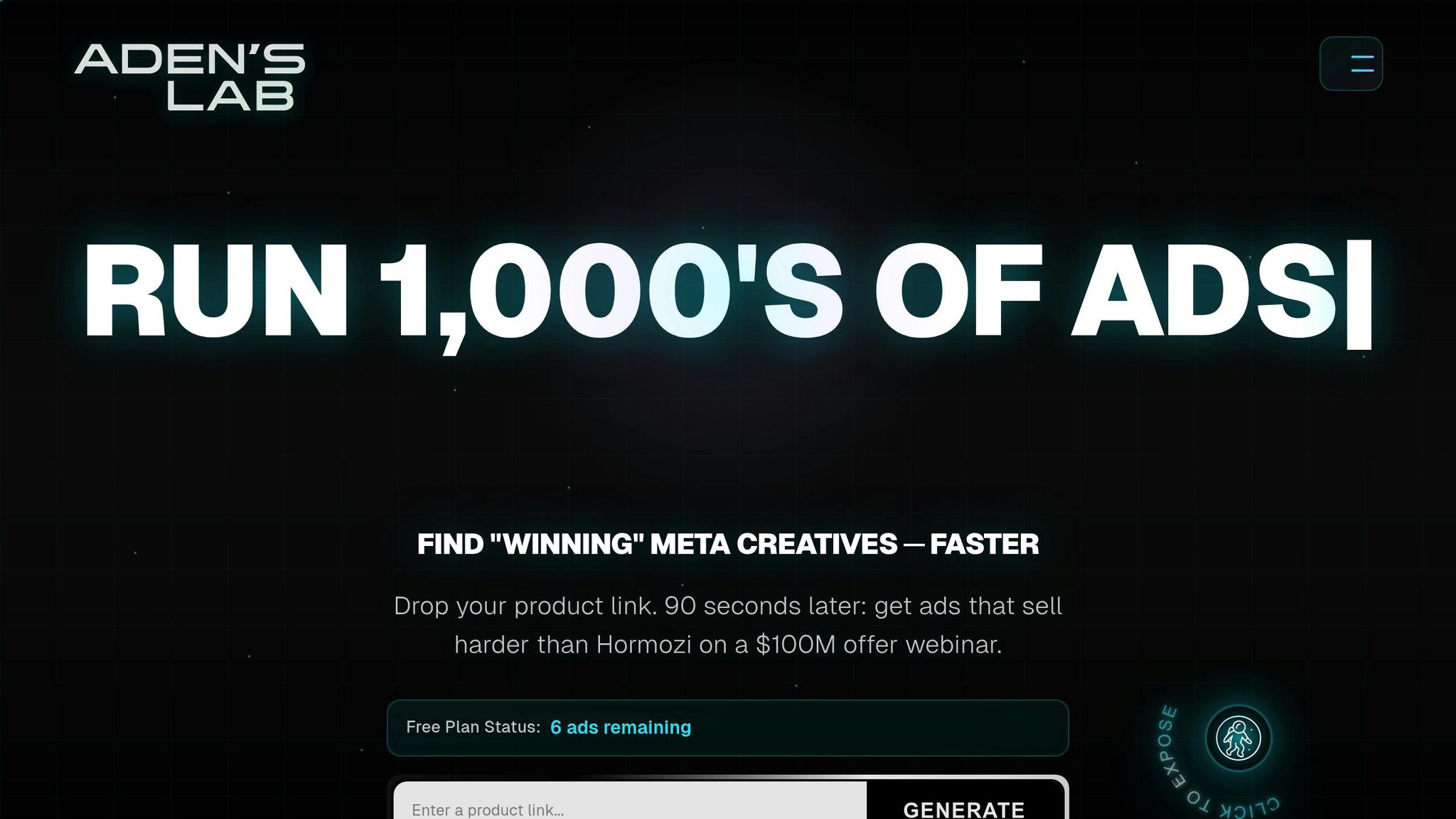
Scaling Facebook campaigns isn’t just about adjusting budgets and targeting the right audience - it also requires a steady stream of high-quality ad creatives. The challenge? Traditional methods often can’t keep up with the sheer volume needed for scaling. That’s where ADEN'S LAB steps in, using AI to revolutionize how ad creatives are produced.
How ADEN'S LAB Simplifies Creative Production
ADEN'S LAB takes the hassle out of ad creation by automating the entire process. In under 90 seconds, the platform generates fully-formed ad creatives, including headlines, body text, images, and calls-to-action - all crafted to drive conversions. Powered by insights from billions of dollars in ad spend and proven buyer psychology principles, the AI ensures each ad is tailored to resonate with your audience. All you need to do is provide your product URL, and the system pulls relevant information - like images, reviews, and product positioning - to create ads that align perfectly with your brand. It’s a process built to deliver data-driven, high-impact ads with minimal effort.
Built for High-Volume Ad Creation
For marketers managing large-scale campaigns, ADEN'S LAB is a game-changer. The platform can produce over 100 Meta ads in a single day, making it easy to test a wide range of creative options. Each ad comes with full commercial rights, so you won’t run into copyright issues. Plus, the ability to generate unlimited variations means you can experiment with different messages and visuals across multiple audience segments. As the AI learns from real-time performance data, it refines its output, ensuring your campaigns consistently improve.
Monitoring Creative Success with ADEN'S LAB
Scaling isn’t just about producing more creatives - it’s about knowing which ones work. ADEN'S LAB includes built-in analytics tools to track the performance of your ads across campaigns. These insights highlight which creative elements resonate most with your audience, allowing you to refresh and refine your assets as needed. With this constant feedback loop, your ad creatives remain dynamic and effective, adapting to your audience’s changing preferences.
Measuring and Maintaining Performance at Scale
Once your campaigns grow in budget and reach, keeping a close eye on performance becomes crucial. Managing larger budgets, reaching broader audiences, and juggling multiple creative variations means you need to track key metrics like ROAS (Return on Ad Spend), CPA (Cost Per Acquisition), CTR (Click-Through Rate), and conversion rate. On top of that, keeping an eye on ad fatigue is equally important. These metrics help you make timely adjustments to ensure your expanded campaigns remain efficient and effective.
Key Performance Metrics to Track
Engagement metrics and costs are your best friends when it comes to identifying patterns. Ad fatigue, for example, happens when your audience sees the same creative too many times, leading to lower engagement and higher costs per result. Platforms like Meta can help monitor this by tracking how often an ad’s image or video is shown. If you notice engagement starting to dip, it’s a sign to revisit your creative approach.
Preventing Ad Fatigue
To keep your campaigns engaging and profitable, avoiding ad fatigue is a must. Regularly updating your creatives and tweaking your messaging can help prevent overexposure. Pay attention to engagement trends - if you catch signs of fatigue early, you can act quickly to refresh your campaign and keep your audience interested.
Ongoing Testing and Optimization
Scaling up doesn’t mean you stop testing - it’s quite the opposite. Keep experimenting with creative elements and targeting strategies to stay in tune with your audience’s evolving preferences. Use your campaign data to guide adjustments, whether that’s tweaking visuals, refining messaging, or shifting your targeting. This constant cycle of testing and optimizing ensures your campaigns stay relevant and responsive to changes in audience behavior.
Compliance and US Market Considerations
When scaling Facebook ad campaigns for US audiences, it’s essential to balance growth with regulatory requirements and cultural alignment. These foundational elements not only protect your campaigns from potential setbacks but also ensure they connect effectively with American consumers.
Adapting for the US Market
To resonate with US audiences, your campaigns must reflect local norms and preferences. This includes using US dollar formatting ($1,234.56), MM/DD/YYYY date formats, and imperial measurements like feet, pounds, and Fahrenheit in your ad content. These small but important details help establish credibility and trust.
Cultural alignment also plays a big role in engagement. American consumers often respond to direct, benefit-driven messaging that highlights value and convenience. Tailor your campaigns to reflect American holidays, seasonal trends, and cultural moments. For example, back-to-school promotions should target August and September, while holiday shopping ads should ramp up around Black Friday and Cyber Monday.
Timing is another critical factor. Adjust your campaign schedules to account for peak engagement times across the four major US time zones - Eastern, Central, Mountain, and Pacific. This is especially important for time-sensitive offers like flash sales or limited-time discounts.
Once your campaigns are tailored for the US market, the next step is ensuring compliance with Facebook’s advertising guidelines.
Following Facebook Advertising Policies
Compliance with Facebook’s advertising policies is non-negotiable, particularly when scaling campaigns. Facebook enforces strict rules around prohibited content, targeting practices, and data usage. Scaling amplifies the impact of even minor violations, potentially leading to ad disapprovals or account restrictions.
One of the biggest challenges for US-focused campaigns is adhering to data privacy regulations. The California Consumer Privacy Act (CCPA) is a key law to consider, as it gives consumers the right to opt out of the “sharing” of their personal data, especially for cross-context behavioral advertising. Facebook Pixel data collection falls under this category.
To address this, Meta offers the "Limited Data Use" (LDU) feature, which helps businesses comply with CCPA. When LDU is enabled, Facebook acts as a Service Provider, restricting its use of data based on its State-Specific Terms. However, this can limit campaign performance by reducing retargeting and measurement capabilities.
If you’re scaling campaigns, implementing LDU is critical. It applies to tools like the Facebook Pixel, Conversions API, App Events API, and more. Additionally, the feature is automatically enabled for Facebook Custom Audiences.
To fully comply with CCPA, your website must also include a “Do Not Sell or Share My Personal Information” link, along with opt-out mechanisms for data sharing, including Lookalike Audiences. California’s regulations often set the tone for other states, so it’s wise to stay ahead of these requirements. Penalties for CCPA violations can reach up to $7,500 per intentional violation.
When scaling your campaigns, it’s crucial to integrate these compliance measures from the outset. Build your audience strategies with privacy laws in mind, and be prepared for potential trade-offs in performance when applying data restrictions. Striking the right balance between compliance and effectiveness will be key to scaling your Facebook ads successfully.
Conclusion
Scaling Facebook ads effectively requires a strategy that balances rapid growth with dependable performance. It starts with a solid foundation: proven campaign results, accurate conversion tracking, and clearly defined KPIs.
At the core of successful scaling lies data-driven decision-making. Gradual budget increases, guided by key performance metrics, help maintain stability as you scale. Tools like Campaign Budget Optimization (CBO) are especially helpful, as they enable Facebook's algorithm to allocate budgets across your best-performing ad sets automatically.
As your campaigns grow, audience expansion becomes crucial. Lookalike audiences are a great starting point, offering a reliable way to scale. But to unlock even greater growth, broad targeting with Facebook's advanced AI can be a game-changer. The platform's machine learning is now advanced enough to identify high-quality prospects without relying on narrow demographic filters.
Creative scaling and performance tracking are equally important. Platforms like ADEN'S LAB streamline creative production, generating hundreds of ads daily at a fraction of the cost of agencies or in-house teams. This approach not only reduces costs but also ensures that your ad creatives remain aligned with buyer psychology, driving conversions at scale. Integrating ADEN'S LAB into your workflow allows for rapid creative production while complementing Facebook's automated optimization tools.
To maintain performance as budgets grow, consistent monitoring and optimization are non-negotiable. Ad fatigue becomes a bigger challenge at scale, making creative rotation and regular performance analysis essential.
Additionally, for campaigns targeting U.S. audiences, compliance with market standards is a critical consideration. Addressing these complexities early in your strategy helps avoid disruptions later.
Ultimately, scaling is about building a system that combines structured testing and precise optimization. This involves launching multiple creative variations, testing various audience segments, and experimenting with campaign structures - all while quickly pausing underperforming elements. The goal isn’t just to increase ad spend but to achieve profitable growth that justifies higher investments.
The most successful scaling strategies rely on systems, not constant manual adjustments. Whether it’s leveraging Facebook's automated bidding tools, using ADEN'S LAB for creative generation, or implementing well-organized testing frameworks, automation plays a key role. By setting up efficient systems, you can shift your focus to strategic planning while letting automation handle the day-to-day execution.
FAQs
What’s the difference between vertical and horizontal scaling in Facebook ad campaigns?
Vertical scaling is all about boosting the budget on your existing, top-performing Facebook ad campaigns. By increasing your investment in these proven campaigns, you can extend their reach and influence without overhauling their structure. This approach keeps things straightforward and offers a more controlled way to maximize results without unnecessary risks.
Horizontal scaling takes a different route. It involves broadening your reach by either duplicating campaigns or creating new ad sets. This method allows you to tap into new or larger audiences, which can significantly increase exposure. However, it often comes with higher initial costs and requires more testing to fine-tune what works best.
Both strategies have their place, and the right choice will ultimately depend on your specific goals, budget, and how you plan to grow your audience.
How can I keep my Facebook ad campaigns compliant with U.S. data privacy laws like CCPA while scaling?
To ensure your Facebook ad campaigns comply with U.S. data privacy laws like the CCPA, consider using tools such as Facebook's Limited Data Use and Meta Consent Mode. These features are designed to help you manage data collection in a way that aligns with privacy regulations, safeguarding both your business and user trust.
It's also important to keep your privacy policy up to date with the latest legal standards. Regularly auditing your data practices can help identify areas that need improvement or adjustments. Staying ahead of changes in state laws and taking full advantage of Facebook's compliance tools can make a big difference in maintaining ethical and lawful advertising practices as your campaigns expand. Prioritizing transparency and obtaining user consent are essential steps for scaling responsibly.
How can I avoid ad fatigue while scaling my Facebook ad campaigns?
To keep your Facebook campaigns fresh and avoid ad fatigue, it’s important to regularly update your creatives - this includes swapping out images, videos, and ad copy. Changing things up helps prevent your ads from feeling repetitive or outdated, keeping your audience engaged.
Pay close attention to key performance metrics, like ad frequency, to ensure your audience isn’t being bombarded with the same message over and over. Tools like dynamic creative optimization can be a game-changer here, as they automatically create multiple ad variations, ensuring your content stays relevant and appealing.
By consistently refreshing your ads and keeping a close eye on performance, you’ll not only sustain your audience’s interest but also get the most out of your campaigns.
Your next ad batch starts here
Finish with a ready-to-test ad batch
Paste your website to generate static creatives. Drop the link → get ads in about 90 seconds → upload them to Meta → scale.
Free to try No prompt writing