The Creative Testing Budget Split That Makes Meta Learn Faster
Turn the strategy into creatives
Create Meta ads for your product
Paste your product page. ADEN'S LAB turns the offer, audience, and positioning into complete ready-to-use Meta static ads.
Free to try No prompt writing

Meta ad performance hinges on one factor: the quality of your ad content. After managing $100M+ in ad spend, it’s clear that content influences 56% of a campaign’s ROI. The secret to success? Regularly testing and updating your ad variations to avoid performance drops caused by content fatigue.
Here’s the method:
- 80/20 Budget Split: Allocate 80% of your budget to proven ads and 20% to testing new ideas. This balance keeps campaigns profitable while finding new winning variations.
- Avoid Fatigue: Ads lose effectiveness in 2–4 weeks. Rotate new content before performance drops.
- Test Smartly: Focus on 3–6 new concepts every two weeks, ensuring each gets enough budget to produce meaningful insights.
- Scaling Strategy: As budgets grow, increase production to meet higher content demands. For example, $150K/month spend requires testing 30–60 ad variations.
Using tools like Aden’s Lab can streamline ad creation, producing Meta-ready ads in minutes for as little as $0.90 each. This approach ensures consistent results while scaling ad spend.
How to Test Facebook Ads Creatives at Every Budget (2026)
Put the playbook to work
Apply this playbook to your page
Paste your website and the Lab will turn the strategy you are reading into a ready-to-test ads.
Free to try No prompt writing
How Meta's Algorithm Works and Why It Needs New Creatives

Meta's algorithm does more than just deliver your ads - it actively learns from them. Every scroll, click, or conversion feeds the system with data, helping it figure out which users are most likely to interact with and purchase from your ad. When targeting broad audiences, the success of your campaign often rests on how well your creative resonates with different user groups.
But here's a key challenge: the algorithm tends to pick an early "favorite" based on initial engagement data, which is gathered from a relatively small sample size. This can lead to a bias where it allocates most of your budget to that variation, even if the choice isn't entirely accurate. In some cases, this early favoritism can skew results and lead to missed opportunities.
To effectively optimize ad delivery, Meta's algorithm needs about 50 conversions per ad set each week. This marks the end of the "learning phase", a 3–7 day window where performance is naturally unstable. If you frequently change creatives during this period, it resets the algorithm's learning process. As Syed Qassim Acabo, a Halal Marketing Strategist, explains:
"When you constantly change creatives, you are not 'optimizing.' You are interrupting the platform's ability to learn".
Without new creative inputs, the algorithm risks falling into a cycle of creative fatigue, which can drag down performance - a topic we'll dive into next.
What Creative Fatigue Does to Your Performance
Creative fatigue occurs when users see the same ad so often that they start to ignore it. This leads to a drop in click-through rate (CTR), an increase in cost per acquisition (CPA), and a noticeable decline in return on ad spend (ROAS). On average, most ads lose their effectiveness within 2–4 weeks.
For example, imagine a high-performing ad set spending $500 daily. After three weeks, if performance drops by 30% due to fatigue, you're wasting about $150 every day. Over two weeks, that adds up to roughly $2,100 in lost potential. Once an ad becomes overexposed, the algorithm struggles to identify fresh audience segments, further compounding the issue.
Early warning signs of fatigue include a declining "thumb-stop rate" (the percentage of users who pause while scrolling) and a drop in outbound CTR. These indicators often come before a sharp rise in CPA. By the time your CPA doubles, you may have already wasted a significant portion of your budget.
Letting ads run too long without updates can seriously hurt performance, making it critical to introduce fresh creatives regularly.
How New Creatives Speed Up Algorithm Learning
Adding new creatives gives the algorithm fresh data to work with. Instead of recycling a fatigued ad, testing new hooks, angles, and formats can uncover audience segments that your previous ads missed.
Interestingly, only about 10% of new ad ideas perform well. This highlights the importance of continuous testing - not just to replace underperforming ads but to keep the algorithm supplied with options. Advertisers who ensure that 30–50% of their active ads are new variations tend to avoid fatigue and maintain better overall performance.
Making bold changes - like entirely new visuals or a shift in messaging - can lead to significant results. These changes often produce a 20–50% variance in performance, giving the algorithm clearer signals to optimize delivery and improve outcomes. Keeping your creative strategy dynamic isn't just a nice-to-have; it's a key driver of sustained success.
The 80/20 Budget Split: How to Test and Scale at the Same Time
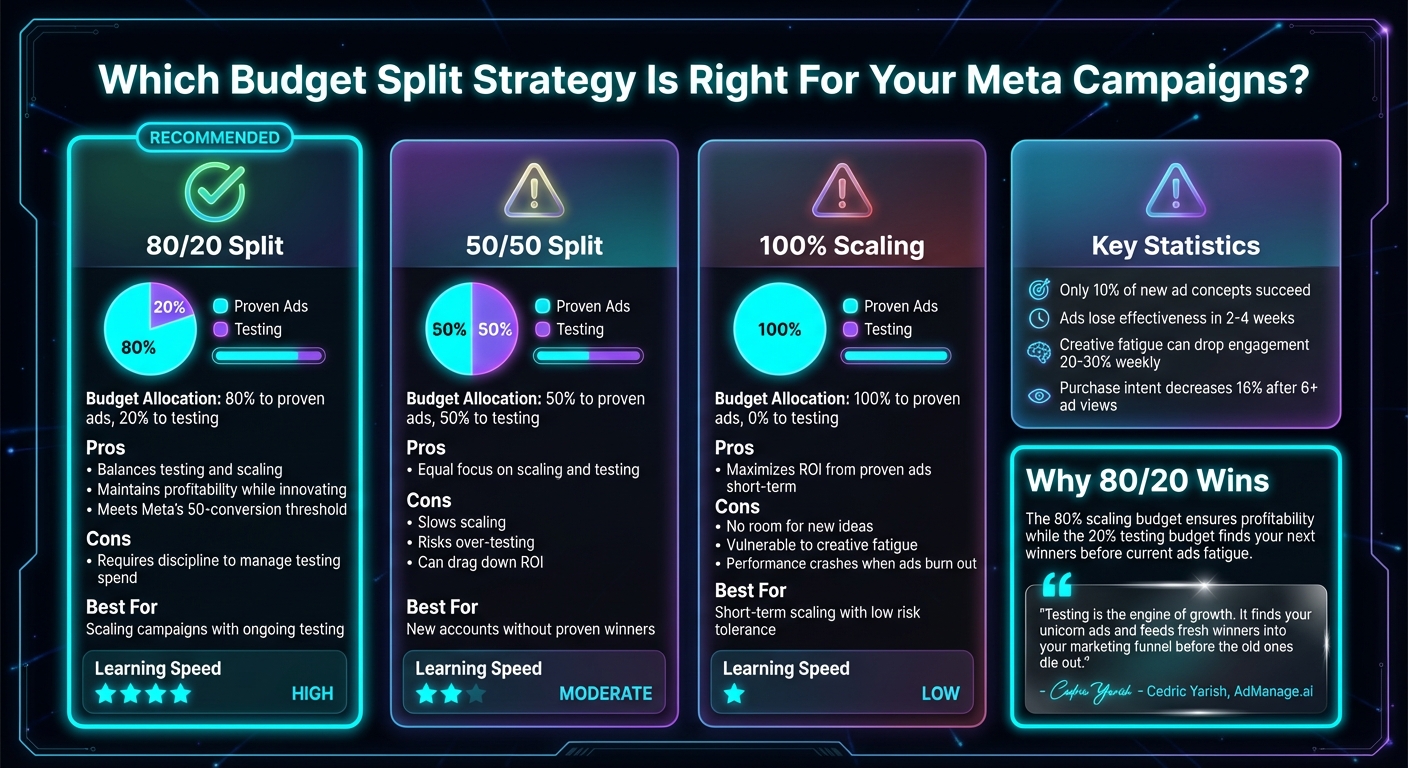
Meta Ad Budget Split Strategies: 80/20 vs 50/50 vs 100% Scaling Comparison
Advertisers often fall into one of two traps: either they pour too much money into proven ads until those ads lose their impact, or they spread their budget too thin across too many test campaigns. The 80/20 budget split offers a smarter way forward by running two campaigns side by side - one designed to generate revenue today and another aimed at finding tomorrow’s top performers.
Here’s how it works: allocate 80% of your budget to ads that are already delivering results at your target cost per acquisition. These are your "control" ads, the reliable performers that keep your campaigns profitable. The remaining 20% of your budget goes toward testing new ideas, ensuring you’re always preparing for the future. Mike Buontempo from Client Accelerators sums it up well:
"We follow an 80/20 rule where we put 80% of our budget towards what is working the best in the present moment and set aside 20% of our budget to prepare for the future".
This strategy helps you avoid "creative stagnation", which can happen when your best-performing ad starts to lose its effectiveness and you don’t have a tested replacement ready to go. Once an ad begins to fatigue, engagement can drop by 20–30% each week, and purchase intent decreases by around 16% after someone has seen your ad six or more times. Most ads lose their punch within 2–4 weeks, making it critical to keep fresh options in the pipeline.
Why 80/20 Outperforms Other Budget Splits
Different budget strategies suit different scenarios, but the 80/20 split strikes a balance between maintaining stability and driving innovation. Here’s a quick breakdown of how it compares to other approaches:
| Split Type | Pros | Cons | When to Use | Learning Speed Impact |
|---|---|---|---|---|
| 80/20 | Balances testing and scaling | Requires discipline to manage testing spend | For scaling campaigns with ongoing testing | High |
| 50/50 | Equal focus on scaling and testing | Slows scaling; risks over-testing | For new accounts without proven winners | Moderate |
| 100% Scaling | Maximizes ROI from proven ads | No room for new ideas | Short-term scaling with low risk tolerance | Low |
The temptation to put 100% of your budget into scaling proven ads can backfire when creative fatigue sets in, leaving you scrambling for a replacement. At the other extreme, a 50/50 split might work for brand-new accounts, but it can drag down ROI once you have winning ads in place. Statistically, only about 10% of new ad concepts succeed, so dedicating too much budget to testing can be wasteful.
The 80/20 split offers the best of both worlds. The 80% scaling budget ensures profitability, while the 20% testing budget allows you to experiment enough to meet Meta’s 50-conversion threshold for exiting the learning phase. As Cedric Yarish from AdManage.ai puts it:
"Testing is the engine of growth. It finds your unicorn ads and feeds fresh winners into your marketing funnel before the old ones die out".
Using Your 20% Testing Budget Wisely
The effectiveness of the 80/20 split hinges on how you allocate your 20% testing budget. A common mistake is spreading this budget too thin. For instance, if you’re working with a $5,000 monthly budget, which you can determine using a Facebook ad budget calculator, your testing allocation would be $1,000. Dividing that across 20 ad variations means each ad gets just $50 - not nearly enough to produce meaningful insights. To gather reliable data, you need at least 5,000–10,000 impressions per ad. Additionally, Meta requires about 50 conversions per ad set to exit the learning phase.
Instead, focus on testing 3–6 distinct concepts every two weeks. For example, with a $1,000 testing budget, you could allocate roughly $330 to each of three new ideas. This approach concentrates your spend, giving each concept a fair shot at generating actionable data.
To maximize your chances of success, prioritize your tests by confidence level. Allocate 70% of your testing budget to variations of proven strategies - like tweaking hooks or angles that have worked before. Reserve the remaining 30% for riskier experiments, such as entirely new formats or messaging angles. This way, even if your bolder tests fail, you’re likely to uncover at least one winner from the safer bets.
It’s also essential to set clear stop rules. If an ad spends 2–3 times your target CPA without delivering results, pause it. Don’t get emotionally attached to a creative - let the data guide your decisions.
When a new ad from your 20% testing pool outperforms your current control ads, move it into the 80% scaling budget. Use the Post ID method to preserve any social proof, and retire the ad it replaces. This rotation keeps your scaling budget fresh while your testing budget continues to search for the next big winner.
Up next, we’ll explore how to structure test campaigns to make every dollar count.
How to Set Up Test Campaigns That Don't Waste Money
Running test campaigns effectively requires a streamlined approach. Many advertisers either overcomplicate their tests by trying too many variables at once or fail to allocate enough budget to gather meaningful insights. The objective is straightforward: spend just enough to figure out what works, then stop wasting resources on what doesn’t.
Picking the Right Variables to Test
Begin with big creative shifts - completely different concepts or hooks - before diving into smaller tweaks like button colors or font styles. For instance, testing whether AI-generated UGC videos outperform a polished product demo will yield more actionable insights than swapping out a headline on an ad that already performs well. Once you’ve nailed down a winning concept, you can experiment with smaller details such as call-to-action (CTA) buttons or variations in copy.
Stick to testing one variable at a time. Changing both the image and the headline in the same test will muddle the results, making it hard to pinpoint what drove any change in performance. Keep all other factors constant - audience, placement, and budget - so the data stays clean. For example, if you’re testing three different hooks, ensure the visuals and CTAs remain the same across all three ads. This way, any performance difference can be confidently attributed to the hook.
Leverage broad audience targeting during the testing phase. Narrow audiences can limit Meta’s algorithm, making it harder for the platform to identify the best-converting segments quickly. Let the algorithm do its job - it’s better at finding your buyers than you are at predicting them.
Budget Rules That Prevent Overspending on Tests
Set your daily test budget at 1–2 times your target cost per acquisition (CPA). For example, if your target CPA is $40, allocate $40–$80 per day per ad set. This ensures you gather enough data to make informed decisions without overspending. Importantly, this approach also prevents Meta’s algorithm from being reset during its critical learning phase.
Use Ad Set Budget Optimization (ABO) instead of Campaign Budget Optimization (CBO) when running tests. ABO ensures each variation gets an equal share of the budget, avoiding situations where Meta prematurely favors one variation before enough data has been collected. While CBO is great for scaling campaigns, it’s not ideal for testing because it shifts budgets toward early winners, often skewing results.
Set up an automatic pause rule to cut off underperforming ads. For instance, pause any ad that spends 2–3 times your target CPA without generating a conversion. Don’t let gut feelings or emotional attachment keep a poor-performing ad active. If an ad reaches $80–$120 in spend without results (based on a $40 CPA target), it’s time to pause it.
By following these budget guidelines, you can avoid overspending while still gathering actionable insights.
Reading Test Data and Finding Winners
Give your test campaigns 48–72 hours to stabilize before making adjustments. Meta’s algorithm needs this time to settle, and making changes too early can disrupt its learning process. During this initial period, focus on real-time performance tracking of click-through rate (CTR) and cost per click (CPC) as early indicators. A CTR that’s 25–35% above your baseline often signals a potential winner, even if conversions haven’t started coming in yet.
After 72 hours, shift your attention to CPA (cost per acquisition) and ROAS (return on ad spend). An ad is ready to scale if it maintains a CTR 25–35% above baseline and delivers at least 10–15 conversions at or below your target CPA. When you’re ready to move the ad into your scaling campaign, use the Post ID method to preserve social proof like likes, comments, and shares that the ad has already accumulated.
To keep your testing organized, track results in a simple table:
| Testing Phase | Key Metrics | Decision Window |
|---|---|---|
| Early (24–48h) | CTR, CPC, Hook Rate | Identify promising ads |
| Mid (48–72h) | CPA, ROAS | Pause clear losers |
| Late (7+ Days) | Stable CPA, Frequency | Graduate winners |
Once you’ve identified a winning ad, document the details. Save the hook, visual style, and messaging angle in a centralized “winners library.” This becomes your go-to resource for future campaigns, helping you build on proven strategies rather than starting from scratch every time.
Scaling from $10K to $100K+ Monthly Spend
When you're increasing your ad spend from increasing your ad spend from $10,000 to over $100,000 per month0,000 to over increasing your ad spend from $10,000 to over $100,000 per month00,000 per month using AI-driven budget allocation, it's not just about throwing more money into the mix. The real challenge lies in keeping up with the demand for fresh creatives. At smaller budgets, a single creative might perform well for weeks. But when you're spending thousands of dollars daily, that same creative could lose its effectiveness in just a few days.
The bottom line? As your budget grows, you need to ramp up creative production. For example, if you're scaling from $30,000 to $150,000 per month but still testing only 10–15 ads, you're already behind. Meta’s algorithms will quickly exhaust your top-performing creatives, and if you’re not ready with replacements, your campaign performance will drop. Keeping up with this pace is crucial to avoid creative fatigue.
Adjusting the 80/20 Split for Larger Budgets
The 80/20 rule - where 20% of your budget goes toward testing - still works as a strategy, but the stakes change as your spending increases. At $10,000 per month, allocating 20% (about $2,000) might allow you to test 10–20 creative variations. But when your budget hits $100,000, that 20% becomes $20,000, which can support 20–40 tests. And if you’re spending $150,000 or more, you should aim for 30–60 active creative tests at any given time.
Think of this testing budget as your creative R&D department. The more you spend, the more you need to scale both the number of creatives and how quickly you produce them. Here's a quick breakdown to help you plan:
| Monthly Spend | Daily Budget | Active Testing Creatives | Creative Backlog Needed |
|---|---|---|---|
| Under $30,000 | Under $1,000 | 10–20 ads | 30–50 ads |
| ~$150,000 | ~$5,000 | 30–60 ads | Large production pipeline |
| $300,000+ | $10,000+ | 50–100 ads | Continuous creative factory |
The takeaway? As budgets increase, so does the urgency to combat creative fatigue by constantly testing and refreshing ads.
Managing Creative Fatigue in High-Spend Campaigns
When you're spending at higher levels, creative fatigue happens faster. For example, purchase intent can drop by about 16% once a user sees the same ad six or more times. At $10,000+ daily spend, an ad that might last two weeks at lower budgets could burn out in just three days.
The solution isn’t to pause your campaigns - it’s to ensure a steady flow of fresh creatives. If your monthly spend exceeds $50,000, aim to test 6–20 new creative concepts every two weeks. Keep a close eye on ad frequency; once it hits 3.0 for cold audiences, performance usually starts to decline. At that point, you need a new ad ready to go - waiting for production delays isn’t an option.
To address this bottleneck, you need tools that scale creative production efficiently. For instance, Aden’s Lab offers a fast, cost-effective way to generate high-quality static Meta ads. Just drop in your product or landing page link, and it produces scroll-stopping ads optimized for Meta in minutes - no designers, no endless revisions. On their Apex Mode plan, you can create 200 ads per month for only $179 (just $0.90 per ad). When your spend surpasses $100,000 per month, this kind of speed and affordability is crucial for keeping your campaigns agile and profitable.
Testing Mistakes That Burn Thousands of Dollars
Running ad campaigns can be expensive - especially if you're making common testing mistakes. These aren't just minor missteps; they can drain your budget and prevent you from scaling effectively. A/B testing Meta ads is essential, but avoiding these pitfalls is just as crucial to ensure you get clear, actionable results.
Testing Too Many Things at Once
Trying to test everything at once might seem efficient, but it’s a recipe for confusion. When an ad performs well (or fails), how do you pinpoint the reason? Was it the headline, the image, or something else? Without isolating variables, your data becomes a mess.
For example, if you're experimenting with a new headline, keep everything else - like the visuals and call-to-action - the same. Similarly, if you're testing a new visual, don’t tweak the copy. This way, any performance shifts can be directly tied to the change you made.
Launching multiple ads with completely different concepts at the same time can also backfire. In November 2025, a supplement brand spent $9,000 per month testing six new ads simultaneously. One ad achieved a 44% hook rate (higher than the previous winner’s 41%), but its CPA jumped to $68 compared to the winner’s $43. Meta’s algorithm prioritized the ad due to its engagement, even though it wasn’t profitable. The result? The brand’s ROAS dropped from 1.35 to 0.75, burning $18,000 in four weeks before they paused the test and made adjustments.
"High engagement ≠ high conversions. Meta can't distinguish 'this ad gets clicks' from 'this ad gets profitable sales' until it has conversion data." – Vibemyad
Stick to testing 3–6 distinct creative concepts every two weeks. This keeps your budget focused and ensures you gather reliable insights without spreading your resources too thin.
Putting All Your Budget Into One Creative
Betting everything on one creative is like putting all your eggs in one basket - it’s risky. When that ad inevitably experiences creative fatigue, your campaign could crash overnight. Accounts have gone from profitable to unprofitable in less than 48 hours because they didn’t have backup creatives ready.
The algorithm thrives on variety. If you’re only running one ad, there’s nothing for Meta to compare it to, and no alternative when performance drops. This issue becomes even more pronounced as budgets increase. An ad that works for two weeks at $1,000/day might burn out in just three days at $5,000/day.
To stay ahead, use the 60/30/10 budget split:
- 60% for proven winners
- 30% for variations of those winners
- 10% for completely new concepts
This strategy ensures you’re prepared when your top-performing creative starts to lose steam.
Ignoring Data and Trusting Your Gut Instead
Personal opinions don’t drive results - data does. Whether it’s your preference, your team’s favorite, or even your CEO’s pick, none of that matters if the numbers don’t back it up. Hard data should always guide your decisions.
One of the biggest traps is assuming high engagement equals high conversions. An ad might get plenty of clicks, but if it’s paired with a CPA that’s 58% higher than your best performer, it’s costing you money. Meta’s algorithm often prioritizes engagement signals during the learning phase, which can lead to unprofitable ads getting more budget.
"If an ad dies after €10 of spend, you didn't test - you tossed a coin." – Three Chapter Media
To make informed decisions, wait until you’ve spent 2–3x your target CPA and gathered 5,000–10,000 impressions per ad. For most campaigns, this means a minimum testing period of 48–72 hours and at least 10–15 conversions. Anything less than that is just noise.
Here’s a quick guide to help you decide when to evaluate your ads:
| Budget Level | Wait Time Before Judging | Minimum Data Required |
|---|---|---|
| Under $100/day | 48–72 hours | CTR + hook rate (CPA data too thin) |
| $100–$500/day | 48–72 hours + 10+ conversions | CPA and ROAS |
| $500+/day | 7–10 days | Full funnel metrics at 95% confidence |
The reality is that only about 10% of ad ideas actually succeed. If you’re making decisions based on gut instinct instead of solid data, you’re essentially gambling with your budget - and the odds aren’t in your favor. Avoid these mistakes, and you’ll be on your way to building smarter, more effective testing strategies.
How Aden's Lab Speeds Up Creative Testing
The real challenge in creative testing isn’t your budget or strategy - it’s how fast you can produce new ads. Slow production leads to creative fatigue, cutting into Meta’s ability to learn and optimize. Even if you’re sticking to the ideal 80/20 testing-to-scaling split, it’s wasted if you can’t generate fresh ads quickly.
That’s where automation changes the game. Aden's Lab removes the need for manual back-and-forth by creating Meta-ready static ads directly from a product or landing page link. No briefs, no designer revisions - just drop in the link, and within minutes, you’ll have ads ready to test.
Creating High-Quality Static Ads in Minutes
Traditional creative workflows eat up a big chunk of your testing timeline - sometimes as much as 20–30% - just on campaign setup and asset production. If you’re following a testing framework based on your monthly spend, you’re likely stuck in a constant loop of designing, reviewing, and revising ads. Aden’s Lab simplifies this entire process, generating ads in under 90 seconds. By analyzing your input link, it automatically creates visuals and messaging that align with Meta’s delivery system. This streamlined approach can cut your testing cycle time by 40–60%, letting you test and scale faster.
Producing More Creatives Without Extra Designers
Here’s a reality check: only about 10% of ad ideas actually perform well. If you’re spending $50,000 a month on ads, with $10,000 allocated for testing under an 80/20 split, you’ll need dozens of variations to find the next winning concept. Testing often requires spending 2–3 times your target CPA per concept, which means producing a high volume of ads is essential. Hiring more designers to keep up isn’t always realistic - agencies often charge $30–$50 per ad.
Aden’s Lab offers a cost-effective alternative. With the Apex Mode plan, you can get 200 ads a month for just $0.90 per ad. This efficiency allows a single media buyer to handle 4–8 times more campaigns without delays in production.
| Monthly Ad Spend | Recommended Testing Volume |
|---|---|
| Under $10,000 | 1 major concept |
| $10,000–$25,000 | 3–4 major concepts |
| Over $50,000 | 6–20 major concepts (often requiring AI) |
(Source:)
When creative fatigue sets in, typically within 2–4 weeks, there’s no need to scramble for designers or wait for approvals. Instead, you can instantly generate new variations of your best-performing ads, keeping your scaling budget productive while your testing budget identifies the next standout concept.
Why Static Ads Work Better for Meta’s Algorithm
Static ads aren’t just faster to produce - they’re also incredibly effective for quick testing. Unlike video ads, which take more time and resources, static ads allow you to zero in on the essentials: the hook, the problem/solution framing, and the offer. This efficiency boosts both production speed and ad performance.
Meta’s algorithm needs about 50 conversion events within a 7-day period to exit the learning phase. By launching multiple static ad variations at once, you can reach that threshold faster. User-generated-style static ads, which Aden’s Lab specializes in, often deliver a 50% lower cost-per-click compared to traditional branded content, making your testing budget go further.
On top of that, Aden’s Lab builds a “winners library” of proven headlines, hooks, and visuals. Each test adds to this database, so future campaigns can start with strategies that are already proven to work. The platform’s automation keeps this library up-to-date while feeding Meta’s algorithm with fresh creative data. Brands using AI-driven creative testing have reported a 12–18% reduction in CPA and the ability to scale campaigns 2–3 times faster while maintaining ROI. This isn’t just theory - it’s how you break through the creative bottleneck.
Conclusion
The 80/20 split is straightforward: allocate 80% of your budget to proven ads and 20% to testing new ideas. This approach ensures your account remains stable while providing Meta's algorithm with the fresh creative data it needs to improve delivery. Without a structured testing strategy, you risk wasting money on unproven concepts or watching performance dip as your existing creatives lose their impact.
The real challenge, however, lies in executing this strategy quickly enough. After overseeing more than $100 million in ad spend, one thing is clear: balancing testing with scaling Facebook ad campaigns is essential for consistent growth. Advertisers often recognize the need for more creatives, but slow production cycles frequently hold them back. To break through this bottleneck, speed in creative generation is non-negotiable.
That’s where Aden's Lab comes in. With their tool, you can input a link and receive Meta-ready static ads in under 90 seconds. At just $0.90 per ad on the Apex Mode plan, you can produce enough creatives to test aggressively, identify winning ads faster, and ensure your scaling budget stays effective. This speed matters - because in the fast-paced world of scaling, even minor delays can lead to significant missed opportunities.
"Testing 100 variations instead of 10 can mean the difference between stagnant performance and breakthrough scale." - AdStellar AI
Every day you delay producing new creatives is another day your competitors gain an edge, experimenting with fresh ideas you haven’t explored yet.
Stick to the 80/20 split, test relentlessly, and automate your creative production. This is how you keep Meta's algorithm working in your favor and avoid the creative burnout that stops so many advertisers in their tracks.
FAQs
How do I run an 80/20 split with a small budget?
To make the most of an 80/20 split with a small Meta ads budget, focus on testing 3-6 targeted concepts every two weeks. This approach ensures you don’t dilute your budget across too many ideas. Keep an eye on performance, and pause any ads that underperform after spending 2-3 times your target CPA.
Take advantage of Meta’s free tools, like Text Variations and Advantage+ Shopping Campaigns, to refine your ad delivery. These tools help you gather useful data and optimize your campaigns without overspending, making it easier to scale effectively, even with limited resources.
How can I tell if an ad is fatigued before CPA increases?
If you notice signs like falling engagement, fewer conversions, or rising costs despite steady impressions, your ad might be wearing out. Pay attention to metrics like a dropping click-through rate (CTR) or conversion rate, paired with an increasing cost per acquisition (CPA). These are clear indicators of ad fatigue. To stay ahead of this, consistently test fresh creatives and swap out underperforming ones before they start driving up your expenses.
When should I move a test ad into my scaling budget?
When a test ad demonstrates consistent daily sales - such as at least one purchase per day over a week - along with a strong ROAS that’s comfortably above your break-even point, and reliable key metrics like a steady cost per purchase, it’s ready to move into your scaling budget. Once these benchmarks are met, start increasing the budget gradually, typically by 50-100% at a time, and give it a few days to adjust and stabilize before making further changes.
Your next ad batch starts here
Finish with a ready-to-test ad batch
Paste your website to generate static creatives. Drop the link → get ads in about 90 seconds → upload them to Meta → scale.
Free to try No prompt writing