Creative Testing Engine for Meta: Bulk-Generate Winning Facebook Ad Variations With AI
Turn the strategy into creatives
Create Meta ads for your product
Paste your product page. ADEN'S LAB turns the offer, audience, and positioning into complete ready-to-use Meta static ads.
Free to try No prompt writing

Tired of wasting ad spend on stale Facebook ads? Here's the truth: outdated ads lose effectiveness fast - up to 38% in just five weeks. Meta's algorithm rewards ad freshness, so the key to success isn’t just your budget - it’s how quickly you can test and launch new ads.
What’s the problem? Traditional ad creation is slow and expensive. Designers take days (or weeks), costing $50–$200 per ad, with revisions adding even more delays. By the time your new ads are ready, performance has already plummeted.
The solution? AI-powered ad generation. Tools like Aden's Lab create hundreds of Meta-ready ads in minutes for less than $0.50 each. This means faster testing, lower costs, and better campaign performance.
Key takeaways:
- Creative fatigue kills engagement, driving up costs. Rotate ads frequently to stay competitive.
- AI reduces ad production time by 99% and costs by 90–95% compared to manual design.
- Test one variable at a time (e.g., headline, image) to pinpoint what works.
- Scale proven ads cautiously - boost budgets by only 20% every 48–72 hours to maintain performance.
Stop relying on slow, manual processes. AI tools let you outpace competitors, keep campaigns fresh, and maximize return on ad spend.
How to Make 100+ Static Ads Using AI (Fastest Method)
Put the playbook to work
Apply this playbook to your page
Paste your website and the Lab will turn the strategy you are reading into a ready-to-test ads.
Free to try No prompt writing
How Meta's Algorithm Actually Rewards New Creatives
Meta's ad delivery system isn’t impartial - it actively favors advertisers who keep their campaigns fresh with new content. When you launch a new ad, the algorithm runs small-scale tests on audience segments. If users engage - whether through clicks, comments, or conversions - Meta responds by lowering costs and improving placements.
Regularly testing new creative isn’t just a nice-to-have; it’s directly tied to better performance metrics. Advertisers often see lower Cost Per Acquisition (CPA), higher Click-Through Rates (CTR), and improved Return on Ad Spend (ROAS) when they prioritize fresh ads. Why? New ads grab attention. By contrast, stale ads not only fail to engage but also drive up costs.
Here’s the bottom line: no matter your budget or brand size, engaging creative is the only way to keep costs down. That’s why testing speed - or how quickly you can launch new ad variations - matters so much. The faster you test, the more opportunities Meta has to identify winning combinations. Next, we’ll dive into how creative fatigue can derail campaigns and why staying ahead with rapid testing is non-negotiable.
What Creative Fatigue Does to Your Campaigns
Creative fatigue happens when users are repeatedly exposed to the same ad. Over time, they stop noticing it entirely. This is why Meta’s algorithm prioritizes fresh creative - engagement drops sharply when ads grow stale. And when engagement dips, Meta increases delivery costs, leading to higher CPAs and lower CTRs.
The solution is straightforward: swap out aging creative with fresh content before performance declines start to snowball. Waiting too long to refresh ads can make it harder (and more expensive) to recover lost momentum.
Why Meta Rewards Advertisers Who Test Fast
Speed is critical in combating creative fatigue. Advertisers who quickly launch and refine new creatives give Meta’s algorithm the fresh data it needs to learn what resonates with audiences. Every new ad variation is another chance to capture attention and optimize performance.
Delaying creative testing, on the other hand, not only keeps outdated ads running but also leaves money on the table. While you’re waiting, competitors are rolling out fresh ads, engaging users, and driving their costs down.
In short, testing fast isn’t just a competitive advantage - it’s a necessity in a system where creative fatigue is inevitable.
Manual Designers vs. AI: The Real Cost of Making Ads
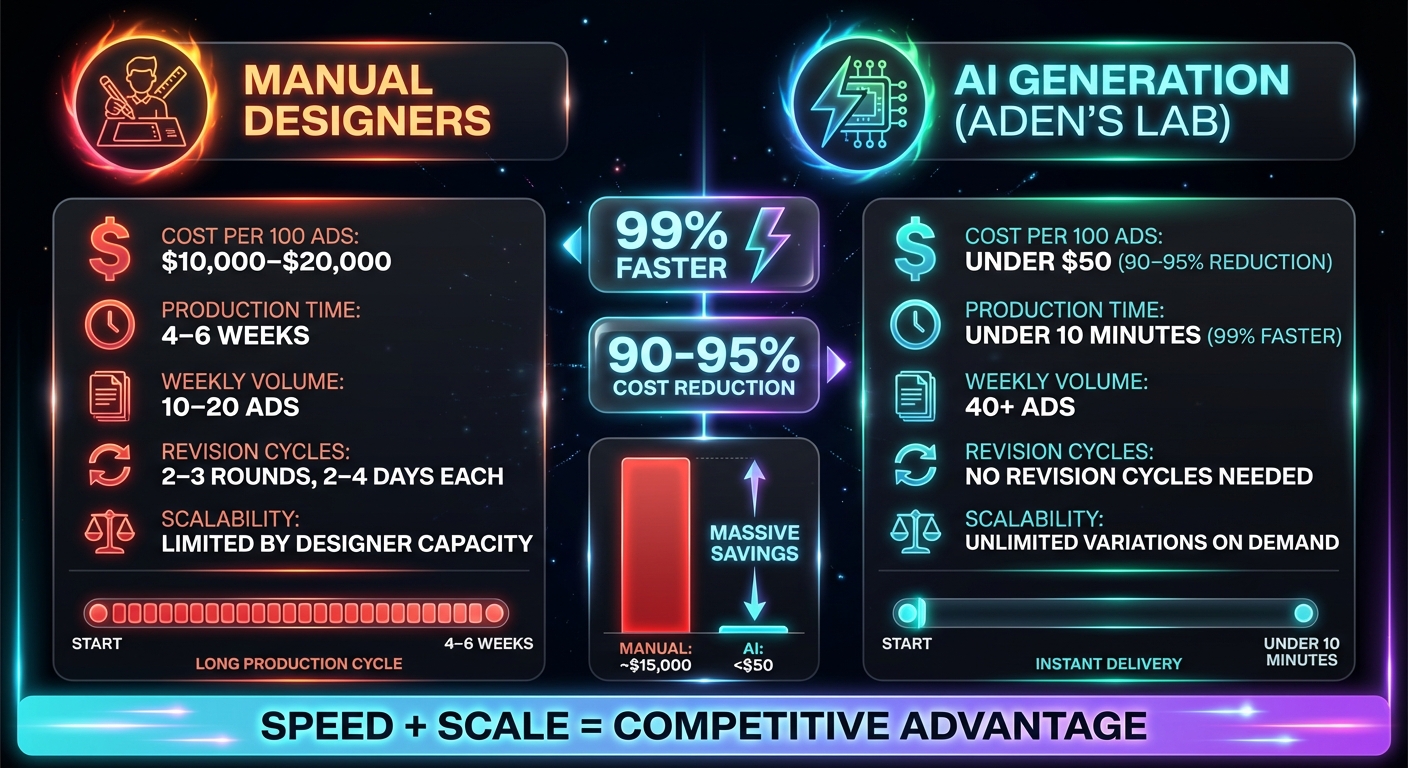
Manual vs AI Ad Creation: Cost and Time Comparison
Everyone in advertising knows the drill: fresh ads are essential. But when you're relying on manual production, you're often stuck in a cycle that's both time-consuming and expensive.
Why Manual Production Slows You Down
Hiring a freelance designer to create a static Facebook ad typically costs anywhere from $50 to $200, depending on the complexity. Beyond the cost, the timeline can stretch out. Designers usually need 1–2 days for the first draft, followed by 2–3 rounds of revisions, which add another 2–4 days. In total, you're looking at 3–7 days per ad.
Here’s a real-world example: In a campaign I worked on with a $500,000 monthly Meta budget, our manual designers managed to produce just 8 ad variations in 5 days. This delay pushed back testing new creatives by 2 weeks, resulting in a 40% drop in click-through rates and wasting $15,000 in ad spend.
Revisions also bring their own headaches. Feedback gets interpreted differently, leading to inconsistencies in style or tone. This often results in 20–30% rework. If you’re paying $100 for the initial design and $50 per revision, three rounds of edits can quickly bring the total cost to $250 per ad. For 100 ads a month, that’s $25,000. Factor in the delays, and mid-scale campaigns can end up wasting 20–30% of their budget - anywhere between $10,000 and $50,000 monthly - on ads that just don’t perform.
This is where automation changes everything.
How AI Cuts Production Time and Cost by 90%
Manually creating 100 static ads can take anywhere from 4 to 6 weeks and cost between $10,000 and $20,000. Enter AI. With tools like Aden's Lab, the same number of ads can be generated in under 10 minutes - often for less than $0.50 per ad. That’s a 99% time savings and a 90–95% cost reduction.
Here’s how it works: Simply drop a website link into Aden's Lab, and it automatically generates hundreds of Meta-ready static ads. No prompts, no setup - just instant results. This means you can test dozens of ad variations every week. In the earlier campaign example, switching to AI allowed us to produce 40 variations weekly, refresh our ads faster, and maintain a 2.5× return on ad spend.
Here’s a breakdown of how manual design stacks up against AI:
| Aspect | Manual Designers | AI Generation (Aden's Lab) |
|---|---|---|
| Cost per 100 ads | $10,000–$20,000 | Under $50 (90–95% reduction) |
| Production time | 4–6 weeks | Under 10 minutes (99% faster) |
| Weekly volume | 10–20 ads | 40+ ads |
| Revision cycles | 2–3 rounds, 2–4 days each | No revision cycles needed |
| Scalability | Limited by designer capacity | Unlimited variations on demand |
Manual production is slow, expensive, and often bogged down by revisions. AI, on the other hand, offers speed and scale, allowing you to test more variations and keep campaigns fresh. This kind of agility is exactly what Meta's algorithm rewards, giving you a clear edge over slower, manual processes.
How to Build a Testing System That Actually Works
Churning out ads without a solid testing plan often leads to wasted money. Sure, you can create hundreds of ads in no time, but without proper testing, you're essentially throwing cash at noise instead of gathering actionable insights.
The key isn't testing every little detail - it's about isolating the elements that truly make a difference. If you change too many variables at once, you’ll never know what caused a 30% boost in CTR. Was it the headline? The image? The call-to-action? Without clarity, you're just guessing, not optimizing.
What to Test (And What to Skip)
The golden rule: test one variable at a time. For example, if you're trying a new image, keep the headline and copy the same. If you're testing a fresh hook, stick with the same visual. This approach ensures you can pinpoint what’s driving the results.
Here are the variables worth focusing on:
- Creative assets: Images, videos, carousels
- Ad copy: Headlines, hooks, angles
- CTAs: For example, "Shop Now" vs. "Learn More"
- Audience segments: Targeting specific demographics or interests
- Placements: Facebook Feed vs. Instagram Stories
Research shows that creative elements and angles account for 70–80% of your results, while technical tweaks like bidding strategies contribute the other 20–30%.
"I have seen one advertisement actually sell not 2x as much, not 3x as much but 19.5x as much as another... The difference was that one used the right appeal (angle) and the other used the wrong appeal."
– David Ogilvy
Skip wasting time on minor tweaks like button colors or font sizes. Instead, focus on the product offer, creative angle, and visual hook - these are the real game-changers.
Another pitfall to avoid: mixing ad formats in a single test. Meta’s algorithm prioritizes formats in a hierarchy, favoring Dynamic Catalogs over Reels, then Carousels, and finally Static Images. Keep formats consistent within each test.
Once you’ve nailed down what to test, the next step is figuring out how long your tests should run.
How Long to Run Tests Before Making Decisions
To get reliable results, aim for 50 to 100 conversions per ad variation. Anything less, and you risk basing decisions on incomplete data.
Meta advises running tests for at least 7 days, but a 7 to 14-day window often works best. This timeframe balances collecting enough data while avoiding overspending on ads that start to fatigue.
Here’s how to budget for testing: multiply your average Cost Per Acquisition (CPA) by the number of variations. For instance, if your CPA is $25 and you’re testing 10 ads, you’d need a budget of at least $2,500. This ensures each ad variation gets 1–2 conversions per day, giving them a fair shot.
One crucial tip: wait 48–72 hours after launching a test before analyzing results. Meta’s algorithm needs time to stabilize after any changes, so let the dust settle before drawing conclusions.
Once your tests are complete, it’s time to dig into the data and refine your strategy.
Using Performance Data to Guide Your Next Batch
A well-structured testing process, combined with tools like Aden’s Lab, allows you to quickly refine and iterate your ads.
Focus on key metrics like CTR, CPA, and ROAS:
- CTR (Click-Through Rate): Measures how engaging your creative is.
- CPA (Cost Per Acquisition): Shows how efficiently you're converting users.
- ROAS (Return on Ad Spend): Indicates overall profitability.
Look for patterns among your top-performing ads. For example, if multiple winners use a similar headline or visual style, that’s a clear signal to double down on those elements. Keep a testing log to document your hypotheses, changes, and results - it’ll save you time and headaches down the road.
This is where AI tools like Aden’s Lab shine. Found a winning angle? Drop your product link into Aden’s Lab, and it can generate 40+ variations in minutes. No need for lengthy back-and-forth with designers - just instant outputs based on your data.
Here’s a quick guide to tracking metrics:
| Metric | What It Measures | When to Prioritize |
|---|---|---|
| CTR (Click-Through Rate) | Ad engagement and creative appeal | Brand awareness or top-of-funnel tests |
| CPA (Cost Per Acquisition) | Efficiency of spend per conversion | Sales and lead generation campaigns |
| ROAS (Return on Ad Spend) | Overall financial return | E-commerce and direct response scaling |
| Conversion Rate | Effectiveness of the landing page/offer | Testing offer framing or post-click experience |
The quickest way to derail your testing efforts is by changing too many things at once. Stay focused, take it step by step, and let your data guide the way forward.
Scaling Winning Creatives Without Killing Performance
So, you've found ads that deliver results. Now comes the tricky part: scaling up without watching your CPA soar or your ROAS plummet. Many advertisers simply crank up their budgets without a clear plan, which can backfire. This can reset Meta's learning phase, increase costs, and ultimately derail your campaign's growth. The real challenge lies in knowing the right time to scale, how much to increase, and when to refresh your creatives before they lose their edge. With proven ads in hand, it's all about scaling smartly.
When to Stop Testing and Start Scaling
Once you've gathered enough data from testing, you can use those insights to guide your scaling efforts. Only scale when your CPA has remained stable (within ±15%) over 7–14 days, and your ROAS consistently exceeds your break-even point. Additionally, each ad set should generate around 25 to 50 conversions per week to provide Meta's algorithm with a strong signal.
Another key step is ensuring your ad set has exited the learning phase, which requires about 50 optimization events within a 7-day period. Scaling too early is like trying to sprint before warming up - you risk wasting your budget without gaining meaningful results.
Once your performance metrics stabilize, apply the 20% rule: increase your daily budget by no more than 20% every 48 to 72 hours. If performance drops by more than 20% within 48 hours of a budget increase, roll back the changes and allow the system to recalibrate. Scaling, like testing, is a gradual process that requires patience to maintain momentum.
"Scaling is about amplifying proven performance - not a shot in the dark. It's systematically amplifying what's already proven to work - verified performance, identified winners, and sufficient data for the algorithm to find more of the right people." – Angrez Aley, Senior Paid Ads Manager, Ryze AI
Budget allocation plays a critical role here. Follow the 70-20-10 rule: dedicate 70% of your budget to proven winners, 20% to scaling experiments (like testing new audiences or placements), and 10% to testing bold new creative ideas. In the testing phase, use Ad Set Budget Optimization (ABO) to ensure each creative gets enough spend. Once you identify winners, transition them to a Campaign Budget Optimization (CBO) setup. CBO allows Meta's AI to dynamically allocate your budget to top-performing ads in real time, which is essential as you scale.
Once your budget and performance metrics are steady, the focus shifts to managing creative fatigue as you increase spending.
How to Rotate Creatives Before Fatigue Hits
Scaling often accelerates creative fatigue. An ad that performs well at a lower spend can quickly lose its effectiveness as its audience becomes oversaturated. Frequency is a key indicator to watch - when it exceeds 3.0 in prospecting campaigns, it’s time to refresh your creative. If it continues climbing, you need to act quickly.
Engagement typically drops by 20% to 30% week-over-week as ads approach the end of their lifecycle. A 2022 study found that performance could drop by 45% after just four exposures to the same ad.
Refreshing your creative doesn’t mean starting from scratch. Small changes - like updating a headline, changing a background color, tweaking the call-to-action, or swapping in a new opening shot - can breathe new life into an ad without losing its core appeal.
"Refreshing doesn't have to mean reinventing. Sometimes a new headline, a different opening shot, or an updated call to action is enough to restore performance." – Ann Robison, Digital Marketing Consultant, VereNorth
For campaigns with higher budgets, aim to refresh creatives every three days to keep Meta's algorithm supplied with fresh options. Best practices suggest running 20 to 50 diverse ads per ad set, allowing the system to allocate spend based on real-time performance across different audience segments.
This is where tools like ADEN's LAB come into play. When you notice fatigue - rising CPMs, declining CTRs, or increasing frequency - you don’t have the luxury of waiting for a designer to create new variations. With ADEN's LAB, you can generate 40+ fresh creative variations in minutes by simply dropping in your product link. Instead of starting from scratch, you’re iterating on what’s already working, staying ahead of fatigue.
One case study showed that adding eight new creatives to a fatigued campaign reduced the cost per conversion from $86 to $13.87 - an 83.9% drop in just 24 hours. Keep a rotation calendar to track ad launches, monitor frequency, and have your next batch of creatives ready before the current set becomes stale. This disciplined approach turns scaling into a reliable, repeatable process rather than a gamble.
Mistakes That Waste Ad Spend During Testing
When testing ad campaigns, missteps can lead to wasted budgets and unclear results. Let’s break down some common mistakes and how to avoid them with a pre-launch testing checklist.
Testing Too Many Things at Once
Trying to test multiple elements simultaneously can scatter your budget and muddle your insights. For instance, if you tweak both the headline and the call-to-action in one go, it becomes nearly impossible to pinpoint which change actually impacted performance. Plus, when each ad gets a smaller share of your budget, Meta's algorithm struggles to gather enough data, leaving your ads stuck in the learning phase.
"Only 2% of creatives actually become winners - meaning ads that can efficiently scale with strong performance." – Brkfst.io
The solution? Test one element at a time. If your budget is tight or your cost-per-acquisition (CPA) is high, limit yourself to testing two or three variations before expanding.
Ignoring Audience Segments and Placements
Using generic creatives for all audiences is a quick way to waste money. Different audience segments respond to different messages. For example, existing customers might be drawn to discounts, while new customers may need ads that focus on your brand's benefits to build trust. Ignoring these nuances can lead to missed opportunities - warm audiences might feel underwhelmed, and new ones might get confused.
Placements are just as critical. A creative designed for the Facebook Feed might not perform well in vertical formats like Stories, resulting in lower engagement. A great example comes from Bombas: in April 2024, they diversified their ad placements by incorporating the Facebook Audience Network, boosting their return on ad spend by 20%.
To avoid these pitfalls, segment your audiences into groups like "New", "Engaged", and "Existing", tailor your creatives to fit native placements (e.g., square or vertical formats), and run A/B tests to identify the most effective placements.
"Existing customers may convert more often when a discount is present, but new customers may be more likely to convert when presented with a brand benefit message." – Sam Russo, Marpipe
Running the Same Winners Until They Stop Working
Even the best-performing ads have a shelf life. Running them indefinitely can lead to audience fatigue, declining engagement, and rising costs. Instead of waiting for performance to drop, adopt a proactive approach by rotating your creatives regularly. Keep an eye on metrics and have fresh variations ready to roll out before your audience loses interest.
Tools like Aden's Lab can make this process easier. By simply uploading your product link, you can quickly generate polished, high-performing Meta ads, ensuring your campaigns stay fresh and effective.
Conclusion: How AI Fixes the Creative Bottleneck
Creating ads manually takes time - usually 3 to 7 days - and costs anywhere from $500 to over $2,000 per batch. Compare that to AI-powered tools, which can generate hundreds of Meta ads on autopilot in about 90 seconds for under $10 per batch. This isn’t just a cost-saving measure - it’s a massive time advantage. In advertising, speed is everything, especially when battling creative fatigue.
The real challenge for most advertisers isn’t poor targeting or tight budgets. It’s the inability to produce enough effective ads fast enough. While traditional designers focus on crafting a handful of variations, advertisers using AI can churn out and test dozens - or even hundreds - of ads in the same amount of time. This gives them a critical edge in identifying what resonates with their audience.
When your production pace limits you to testing just 10–15 new creatives a month, it takes much longer to uncover winning strategies. Meanwhile, an advertiser generating 500+ variations in the same period will likely find successful patterns far more quickly.
This is where Aden's Lab steps in to eliminate the bottleneck. By automating the creative process, it simplifies everything: drop in a product link, and within minutes, you’ll have Meta ads ready to launch. No back-and-forth revisions, no delays from designers. With higher-tier plans, each ad costs just $0.90, ensuring a constant flow of fresh, effective creatives to keep your campaigns optimized and ahead of the competition.
FAQs
How many ad variations should I test each week?
Testing 3–5 ad variations per ad set each week is usually the sweet spot. This approach gives Meta’s algorithm enough choices to identify top-performing ads while minimizing wasted spend on underperformers.
If you’re working with a smaller budget or targeting a niche audience, testing 1–3 variations might be more effective. On the flip side, larger budgets can handle more testing, but pushing beyond 6–8 ads often leads to diminishing returns and inefficient delivery.
How can I tell if an ad is fatigued?
You can identify ad fatigue by keeping an eye on certain performance metrics. Look out for falling click-through rates (CTR), a drop in likes, comments, or shares, rising costs per click (CPC), and an increase in frequency - which is how often an individual sees the same ad. If the frequency climbs to 3 or higher, it’s a clear sign your audience might be growing tired of the ad. Additionally, platforms like Meta may display warnings such as 'Creative Fatigue,' indicating it’s time to refresh your ad content.
What budget do I need for a fair creative test?
When setting a creative testing budget on Meta, a good starting point is $50–$100 per variation. This amount allows you to collect enough data to determine which ads perform well without going overboard. Overall initial budgets can range from a few hundred to several thousand dollars, depending on the size of your campaign. The key is to invest enough to get meaningful results while minimizing waste on ads that don't deliver.
Your next ad batch starts here
Finish with a ready-to-test ad batch
Paste your website to generate static creatives. Drop the link → get ads in about 90 seconds → upload them to Meta → scale.
Free to try No prompt writing