How Scaled D2C Brands Produce Conversion-First Ads Without Creative Bottlenecks
Turn the strategy into creatives
Create Meta ads for your product
Paste your product page. ADEN'S LAB turns the offer, audience, and positioning into complete ready-to-use Meta static ads.
Free to try No prompt writing

To grow beyond $50,000–$100,000 in monthly revenue, D2C brands must address a major challenge: slow ad production. Without enough ad variations, ad fatigue sets in, doubling acquisition costs in under 15 days and dragging down ROAS. Meta’s algorithm demands a constant flow of new ads, yet traditional workflows can’t keep up, leaving brands stuck in costly, designer-heavy processes.
Here’s the solution: Automate ad production and focus on static ads. Static ads are faster, cheaper, and ideal for rapid ad testing. Tools like Aden’s Lab can generate hundreds of high-performing ads in minutes - no designers needed. Top-performing brands test 10–20 ad variants at once, refresh 25–30% of their creatives monthly, and scale winning ads gradually to avoid performance drops.
Key Takeaways:
- Creative fatigue doubles acquisition costs in 15 days and drops conversions by 45% after 4 exposures.
- Static ads outperform video for scalability and quick iteration.
- Automated platforms like Aden’s Lab eliminate delays, allowing brands to produce 5,000+ ad variations monthly.
- Test extensively, refresh ads frequently, and scale winners incrementally to maintain growth.
If you can outproduce your competitors, you’ll lower costs, boost ROAS, and scale faster - all without bottlenecks.
The New Meta Ad Playbook: Avoiding Creative Similarity on Meta
Put the playbook to work
Apply this playbook to your page
Paste your website and the Lab will turn the strategy you are reading into a ready-to-test ads.
Free to try No prompt writing
How Creative Bottlenecks Destroy Ad Performance
Creative Fatigue Impact on D2C Ad Performance: Key Metrics and Costs
Slow creative production doesn’t just frustrate - it directly impacts your metrics and drains your budget. Creative fatigue is a real, measurable issue that can quickly eat into your ad spend.
What Creative Fatigue Actually Costs You
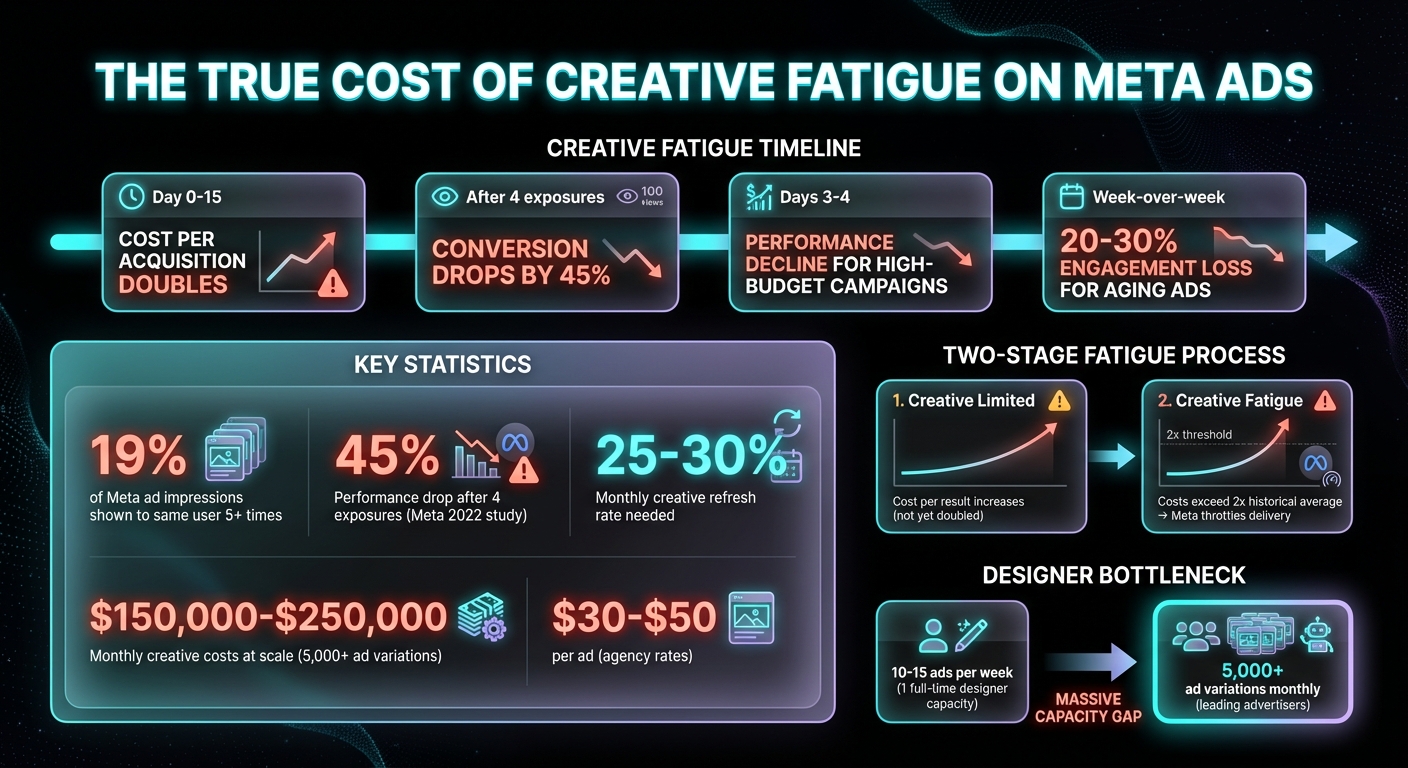
When creative fatigue sets in, the numbers tell a grim story. For instance, your cost per acquisition can double in less than 15 days. Even worse, once your audience sees the same ad four times, the likelihood of conversion drops by about 45%. Meta categorizes this into two stages: Creative Limited, where your cost per result increases but hasn’t doubled yet, and Creative Fatigue, which kicks in once costs exceed double your historical average. At that point, Meta’s algorithm starts throttling your ad delivery.
The impact is fast and brutal. A 2022 Meta study revealed that ad performance can drop by up to 45% after just four exposures to the same viewer. For campaigns with hefty daily budgets, this decline can happen in as little as 3–4 days. Even the best-performing ads lose 20–30% of engagement week-over-week as they near the end of their lifecycle. Shockingly, over 19% of ad impressions on Meta have already been shown to the same user more than five times.
"Creative fatigue occurs when an audience has seen the same creative too many times. People may be less likely to engage with your ad which can lead to a higher cost per result." - Meta Business Help Center
The real loss here isn’t just the rising costs - it’s the wasted budget spent on ads that have already run their course. And while you’re waiting on fresh creative, the inefficiency compounds, leaving brands stuck in outdated, designer-heavy workflows.
Why Designer-Dependent Workflows Don't Scale
When creative fatigue drives up costs, relying on manual design processes only makes matters worse. Agencies often charge $30–$50 per ad, but leading mobile app advertisers now launch over 5,000 ad variations monthly to stay competitive. At that scale, creative production costs can balloon to $150,000–$250,000 every month.
However, the bigger issue is speed. Traditional workflows - filled with lengthy briefing processes, endless revisions, and back-and-forth approvals - mean brands are waiting days or even weeks for new ads. Meanwhile, Meta’s algorithm demands fresh creative in hours. A full-time designer can realistically produce just 10–15 quality ads per week, far short of the 25–30% monthly refresh rate required to keep up with Meta’s demands.
"The formula for scaling in 2025 = quantity × diversity of ads. Growth comes from consistently feeding the system fresh inputs and letting it learn." - Sasha, Co-founder, Spiral.ad
The cycle is predictable: brands find a winning ad, scale it, watch it fatigue, and then scramble to create replacements. The solution isn’t hiring more designers - it’s breaking free from designer dependency altogether. Automating creative production eliminates the delays and skyrocketing costs, giving you the agility to keep your campaigns running strong.
Why Static Ads Win on Meta
Static ads might not have the flashiness of video, but they offer something even more crucial - scalability. They’re cheaper, quicker to produce, and perfect for rapid testing. When creative fatigue sets in, static ads allow you to churn out fresh ideas by automating Meta ad production to avoid delays or budget blowouts that come with video production. This makes them an ideal solution for tackling the challenges of rising costs and production slowdowns.
Static vs. Video: What Actually Performs Better
Static ads shine when it comes to fast and cost-efficient testing. Unlike video, which often requires a full team - a Performance Marketer, Creative Producer, and Video Editor - static ads can now be created effortlessly with AI, eliminating the need for even a Graphic Designer. This is a game-changer for top advertisers running 5,000+ ad variations each month to stay ahead.
Another advantage? Static ads can be updated and iterated in minutes. You can tweak headlines or test new angles without the hassle of reshoots or extensive edits. Video, on the other hand, demands more time and money for adjustments like reworking hooks or changing lengths. Considering that the most successful 5% of ads on Meta account for around 80% of total spending, the ability to test and refine quickly can determine whether your campaign thrives or fizzles.
"This is also the first year you can skip having a dedicated Graphic Designer, since AI can now generate high-quality static ads at scale." - Sasha, Co-founder, Spiral.ad
Static ads also benefit from their straightforward format. With 1:1 or 4:5 aspect ratios, they’re easier to create and optimize for mobile screens compared to 9:16 video formats. When launching hundreds of ad variants to combat creative fatigue, this simplicity becomes a huge advantage. You’re not stuck waiting for lengthy renders or approvals - you’re testing, learning, and iterating in real time. Aden’s Lab exemplifies this streamlined process: drop a link, get your ads, and launch on Meta without the usual creative roadblocks.
Building Static Ads That Convert
The best static ads feel like a natural part of a user’s feed. They follow direct-response principles by delivering clear benefits, bold visuals, and strong calls-to-action. The goal is simple: grab attention in under a second and communicate value instantly. Big typography, high-contrast colors, and a focused message are key.
Interestingly, iPhone photos often outperform polished studio shots because they blend seamlessly into users’ feeds. Pictures of people holding a product can increase purchase intent by 70% on Instagram. Positioning matters too - show the product in a way that feels natural, like placing it for right-handed use, as 90% of users are right-handed.
"Static doesn't mean boring. It means fast-loading, cost-efficient and creatively agile - especially when executed with precision." - Roger Match, Content Marketer
For mobile ads, the 4:5 aspect ratio is a must. It takes up more screen space than 1:1 or landscape formats, making it more effective. Meta recommends using at least 1,200 x 1,500 pixels to ensure your images don’t appear distorted. With over 90% of Facebook users accessing the platform via mobile, optimizing for vertical space isn’t optional - it’s essential.
Your call-to-action (CTA) should be crystal clear. Use direct phrases like "Shop Now", "Get a Demo", or "See Pricing". You’ve got about 8 seconds to hold someone’s attention, and your brand needs to be recognizable within the first 3 seconds. Lead with the benefit, make the CTA obvious, and let Meta’s algorithm do the heavy lifting. The faster you can produce and test these ads, the quicker you’ll find what works - and scale without hitting creative roadblocks.
How Automated Ad Generation Fixes the Bottleneck
The old-school creative process - writing a brief, waiting for drafts, providing feedback, and waiting again - falls apart when you need to roll out dozens of ads every week. Automation steps in to replace these slow, manual workflows with a faster, data-driven system. Instead of juggling timelines and approvals, you're focusing on performance, tracking key creative signals, cutting out the delays that let creative fatigue eat into your ad budget. This isn't just about speeding things up - it's a completely new way of working.
From Link to Launch in Minutes
Aden's Lab simplifies everything into three steps: paste your product page URL, and the platform instantly generates static ads tailored for Meta. No templates, no back-and-forth with designers - just paste, and you're ready to go. The system analyzes your product and creates conversion-focused ads in minutes, not days.
For the first time, brands can operate without needing a dedicated graphic designer, as AI now produces high-quality static ads at scale. This marks a major shift in how creative work gets done. The role that once slowed down your testing schedule is now fully automated. You can move from pasting a link to launching ads without ever opening Figma or waiting for Slack updates. This streamlined process means you can handle a higher volume of ads faster than ever before.
Producing Hundreds of Ads Without Hiring Anyone
Ad volume is more critical than many advertisers realize. On Meta, the top 5% of ads account for roughly 80% of total ad spend. To uncover those top-performing ads, you need to scale winning creatives at scale. Automation makes it possible to ramp up creative output far beyond what manual design can achieve.
Aden's Lab addresses this challenge by generating the volume necessary to combat creative fatigue. You're no longer held back by the limits of human output. With this platform, you can create hundreds of ads each month - or even more - without adding to your team. This isn't about sacrificing quality for quantity. It's about producing enough variety to discover what truly works. The system automatically applies different angles, headlines, and visual styles to your product, ensuring you're testing meaningful differences - not just tweaking colors. The winning formula for scaling in 2025 is simple: quantity × diversity of ads.
How to Test and Scale Ads That Convert
Creating ads is just the starting line; the real challenge lies in testing and scaling them effectively. Many advertisers falter not because they lack creativity but because they test without a clear plan or scale without a reliable strategy.
Testing Multiple Variants at Once
When testing ads, volume matters. Instead of experimenting with just a handful of variations, aim to test 10–20 ad versions simultaneously. These versions should differ in meaningful ways - like the hook, visual style, or messaging - rather than minor tweaks like changing colors. Use Ad Set Budget Optimization (ABO) to allocate specific budgets to each creative. Campaign Budget Optimization (CBO), on the other hand, might disproportionately favor an ad with early high engagement, even if it doesn't lead to strong conversions.
Keep a close eye on metrics like CTR (click-through rate) and CPC (cost per click) within the first 24–48 hours. Once an ad generates 10–15 conversions within 48–72 hours, assess its CPA (cost per acquisition) and ROAS (return on ad spend). A CTR that outperforms your baseline by 25–35% indicates a promising creative. Conversely, if an ad spends 3–7 times your target CAC without hitting benchmarks, it’s time to pause it.
To maintain balance, structure your ad spend strategically:
- 60% on proven winners.
- 30% on variations of those winners (e.g., new hooks or thumbnails).
- 10% on entirely new, riskier concepts.
This distribution prevents "algorithm chaos" from overwhelming your campaign with too many new inputs. As a general rule, avoid launching more than 25% of your total active ads in a single day. Once you've gathered enough performance data, focus on keeping your creatives fresh to maintain momentum.
Refreshing Creatives Before They Burn Out
Creative fatigue can derail even the best campaigns. Warning signs include ad frequency climbing above 4.0 or a CTR dropping by more than 20% over two weeks. When these red flags appear, it’s time to refresh your creatives.
This is where tools like Aden's Lab shine. With its automated creative engine, you can quickly generate new ads without the delays of traditional design workflows. Simply provide your product or landing page link, and you'll have fresh creatives ready to launch in minutes. High-performing campaigns typically run 8–12 active creative variations and refresh 25–30% of their creative library monthly. Staying ahead of fatigue ensures your ads remain effective without missing a beat.
Once you've identified your top-performing creatives, scaling them carefully is the next step.
Scaling What Works Without Losing Performance
When a creative proves successful, resist the temptation to dramatically increase its budget all at once. Instead, scale gradually - boost your spend by about 20% every three days or 5–7% daily. Scaling too quickly can reset Meta's learning phase, which needs around 50 optimization events to stabilize. A reset wastes both time and money as the algorithm relearns your ad’s performance signals.
A safer approach to scaling is to create slight variations of your winning ad. Change just one element at a time - like the hook, headline, or visual angle - to avoid creative fatigue while expanding reach. This method also enables horizontal scaling, so you're not overly reliant on a single ad. With Aden's Lab, these variations can be generated on demand, eliminating the delays of manual edits.
Interestingly, in many high-performing accounts, the top 5% of ads account for about 80% of total spend. The key is to identify those standout ads early, scale them steadily, and replace them before their performance dips. Automated tools make this cycle manageable and sustainable, ensuring you stay ahead in the game.
Conclusion
The brands that thrive on Meta aren't necessarily the ones with the deepest pockets or the most dazzling campaigns. Instead, success often comes down to their ability to outproduce the competition. If you can churn out fresh, conversion-driven static ads faster than creative fatigue sets in, you shift from playing catch-up to setting the pace.
"When time is disproportionately spent on producing and reviewing creatives, it leaves little room to be strategic. And the delay in going live with the campaign also means lost revenue." - Filip Matekovic, Hunch
Creative bottlenecks don’t just slow you down - they limit your growth potential. Every day spent waiting on designers or stuck in endless revision cycles is a day your competitors are testing new ideas, refreshing their ads, and driving down their acquisition costs. The formula is simple: more ads tested = more chances to find winners = lower CAC and higher ROAS.
Static ads tackle this production challenge head-on. They’re quick to create, simple to test, and consistently deliver results. Aden’s Lab takes it a step further by automating the entire process. Just drop in your product link, and in minutes, you’ll have conversion-ready Meta ads - no prompts, no back-and-forth, and no need for a creative team. Brands using this method have seen game-changing results, like Ruokaboksi’s 82% reduction in CPL and 62% lower CAC after producing over 1,500 creatives at scale.
The true game-changer isn’t just speed - it’s scale. When you can produce hundreds of ad variations each month without adding to your team, you gain the freedom to test relentlessly, refresh before fatigue sets in, and double down on what works. That’s how leading D2C brands stay ahead of the curve.
FAQs
How can I tell if my ads are fatigued or just poorly targeted?
Fatigued ads usually exhibit telltale signs like declining engagement, rising costs, and higher ad frequency. On the flip side, poorly targeted ads often result in low relevance, weak click-through rates (CTR), or reaching an audience that doesn’t align with the campaign goals, even if the creatives are new. Watch for these indicators to pinpoint the problem and make the necessary adjustments.
How many static ad variants should I launch per product each week?
To maximize ad performance, roll out multiple static ad variations for each product weekly. This approach allows for rapid testing to determine which creatives resonate best. Instead of sticking to a set number of tests, prioritize testing as many variations as possible. This not only helps fine-tune performance but also combats creative fatigue, ensuring your ads stay effective and engaging. The ultimate goal? Pinpoint the top-performing ads quickly and maintain steady results.
What should I pull from my product page to make better static ads?
Pull essential elements from your product page to create ads that grab attention and drive action. Use high-quality visuals to make your product stand out, pair them with clear and descriptive product titles, and include concise descriptions that highlight key features. Ensure pricing is visible to set expectations and build trust, and showcase customer reviews to emphasize credibility and value. These details work together to present your product effectively and encourage conversions.
Your next ad batch starts here
Finish with a ready-to-test ad batch
Paste your website to generate static creatives. Drop the link → get ads in about 90 seconds → upload them to Meta → scale.
Free to try No prompt writing