Offer-Testing Prompts for Meta Ads: 25 Angles to Try Before You Raise Budget
Use the prompts on your real offer
Generate these ad angles for your product
Skip the blank prompt box. Paste your product page and ADEN'S LAB applies the angles to your offer, images, headlines, and copy.
Free to try No prompt writing

When your Meta ads perform well, it’s tempting to increase your budget right away. But before spending more, testing your offer can help you achieve better results for less. This article outlines 25 proven prompts to test your ads and refine your campaigns. These are split into five key approaches:
- Scarcity & Urgency: Use FOMO-driven tactics like inventory countdowns or time-sensitive offers.
- Value Stacks & Bundles: Highlight savings, free gifts, or convenience to boost conversions.
- Risk Reduction & Guarantees: Alleviate buyer hesitation with money-back guarantees or cancel-anytime policies.
- Social Proof & Personalization: Match testimonials and proof to your audience’s decision stage.
- Outcome & Use Case: Focus on how your product delivers results or solves specific problems.
Testing these angles can lower CPA by 20–30% and improve ROAS by 3x to 8x. Tools like ADEN's LAB simplify the process, letting you create ads quickly and affordably. By focusing on data-driven testing, you can scale your campaigns with confidence.
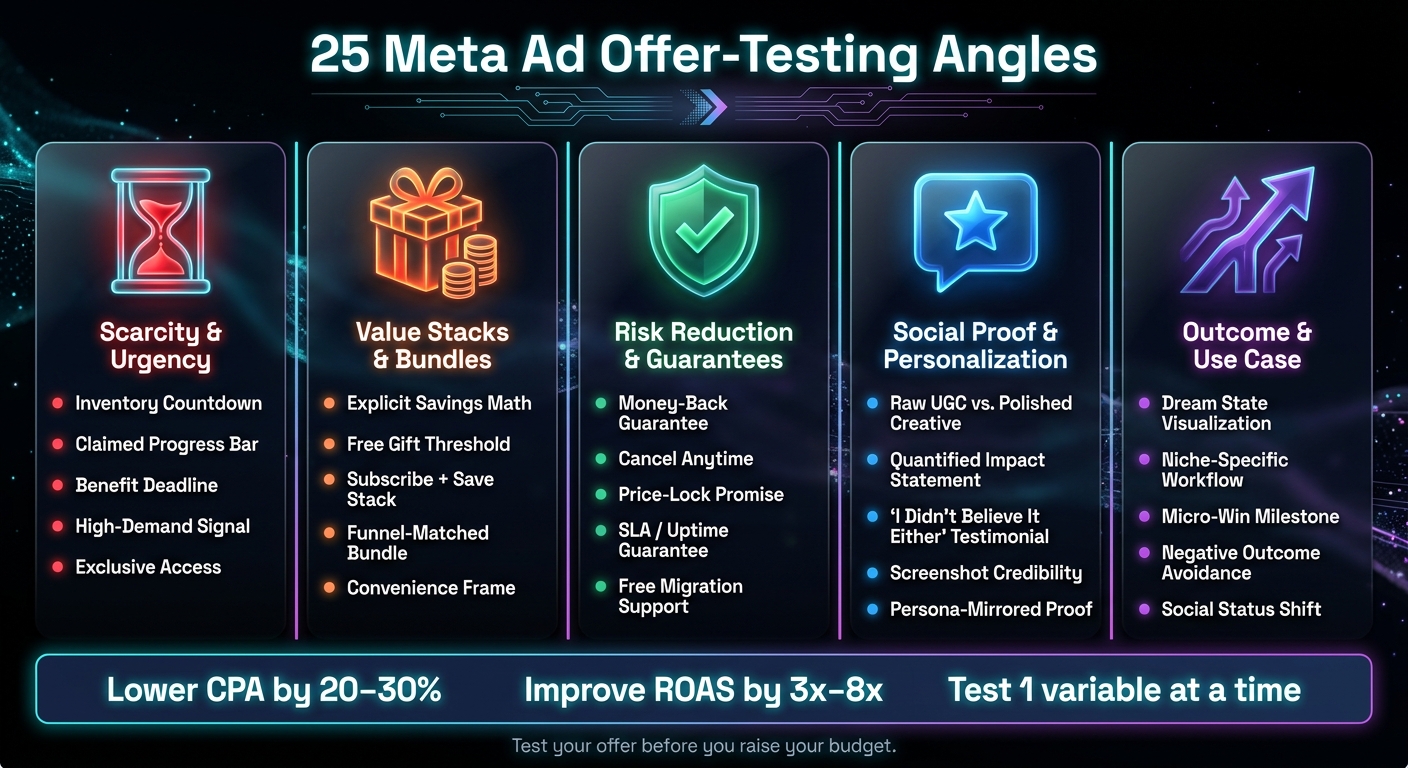
25 Meta Ad Offer-Testing Angles: 5 Proven Strategies to Lower CPA & Boost ROAS
How To Run A/B Tests on Meta Ads (Step-by-Step for Beginners)
Put the playbook to work
Apply this playbook to your page
Paste your website and the Lab will turn the strategy you are reading into a ready-to-test ads.
Free to try No prompt writing
1. Scarcity and Urgency
Scarcity and urgency are powerful tools in direct-response advertising. Scarcity focuses on limited quantity (like "only 3 left"), while urgency emphasizes time-sensitive offers (such as "offer ends tonight"). Both strategies leverage the fear of missing out (FOMO). As AB Tasty explains:
"Urgency is a psychological trigger that is deeply rooted inside our brain: it relates to the human loss aversion or the so-called 'fear of missing out' (FOMO)."
However, trust is crucial. Fake countdown timers or endless "last chance" sales can damage credibility. Instead, use genuine inventory limits or actual shipping deadlines to engage your audience effectively. Below are five prompts you can test to integrate scarcity and urgency into your campaigns:
- Inventory Countdown: "Only [X] left in stock - grab yours before they're gone." Real-time stock updates make this approach impactful. For example, Amazon's "33% claimed" progress bar on Today's Deals clearly shows demand without appearing overly aggressive.
- Claimed Progress Bar: "[X]% of this limited-time offer has been claimed." This combines scarcity with social proof, giving users a compelling reason to act. Compare its performance against a plain discount headline to see how it resonates.
- Benefit Deadline: "Order within the next [X] hours to guarantee delivery by [Date]." When urgency is tied to a clear benefit - like faster shipping - it feels helpful rather than pressuring.
- High-Demand Signal: "This item was purchased [X] times in the last 24 hours." This tactic works especially well for retargeting campaigns aimed at users who have already shown interest.
- Exclusive Access: "Invite-only: Join the waitlist for early access to our next drop." OnePlus effectively used this strategy, presenting exclusivity as a privilege. They sold 1 million units and drove 25 million website visits through this approach.
To ensure accurate results, keep all other elements - such as images, calls-to-action, and overall copy frameworks - consistent while testing these prompts. This will help isolate the effectiveness of the scarcity and urgency elements.
2. Value Stack and Bundles
Scarcity may drive immediate action, but value stacks and bundles offer a way to create lasting appeal. When selling a single product feels like an uphill battle, a well-crafted bundle can transform its value into an offer that's hard to pass up. The key? Make the value crystal clear. Just as scarcity tactics test urgency, testing bundles ensures your deals deliver clear benefits while boosting conversion rates. This strategy pairs well with urgency-based methods by emphasizing measurable savings.
One simple and effective tactic is using specific savings math. Instead of vague phrases like "save big", spell it out: "Save $40 when you buy 3." This kind of clarity consistently outperforms generic claims in Meta ad copy. Combine this with bold text overlays on static images for retargeting campaigns. Experiment with different savings thresholds (like $50 versus $75) to find the sweet spot for increasing Average Order Value (AOV).
Angad Singh from Segwise sums it up perfectly:
"The right angle with mediocre execution usually outperforms the wrong angle with excellent execution."
This insight is directly relevant when framing bundle offers.
Here are five ideas to test for your value stacks and bundles:
- Explicit Savings Math: Use clear examples like, "Get all three for $79 – saving $40 over separate purchases."
- Free Gift Threshold: Offer something like, "Spend $75 and get [Product] free." This encourages higher AOV without reducing your main product's price.
- Subscribe + Save Stack: Highlight long-term savings with a message such as, "Subscribe and save 20% – a clear monthly saving." This approach combines a bundle with subscription perks to make the deal feel more tangible.
- Funnel-Matched Bundle: Tailor offers to your audience with messages like, "New here? Try our Starter Kit for just $29." Use affordable intro bundles for cold audiences and shift to higher-value bundles for retargeting.
- Convenience Frame: Appeal to simplicity with messaging like, "Everything you need, in one box - no guesswork." Focus on convenience or completeness instead of price, then A/B test this against a cost-savings angle to see what resonates more.
To ensure fair testing of bundle variations, use Ad Set Budget Optimization (ABO) instead of Campaign Budget Optimization (CBO). This ensures equal spending across different bundle options. Aim to test 3–5 variations per cycle, and measure success based on CPA (Cost Per Acquisition) and AOV - not just click-through rates.
3. Risk Reduction and Guarantees
Once you've established urgency and value, the next step is addressing potential buyers' hesitations. Guarantee messaging plays a crucial role here by directly reducing the perceived risk of making a purchase.
When prospects reach the consideration stage, they often wonder, "What if this doesn’t work for me?" Guarantee messaging tackles this hesitation head-on. Research on Meta ad performance reveals that risk-reduction language in ad creative significantly influences conversion rates. Since creative elements account for 56% of auction outcomes, the specific words you use to ease concerns can make or break a sale.
How to Test Guarantee Messaging Effectively
The key to success is isolating your guarantee line while keeping other elements - hooks, visuals, and supporting copy - consistent across variations. To ensure reliable results, follow a pre-launch ad testing checklist and run tests for 7–14 days to move past Meta’s learning phase.
Here are five guarantee angles worth testing:
- Money-Back Guarantee: "Not happy? Get a full refund within 30 days - no questions asked." This approach appeals to loss-averse audiences who are already familiar with your product.
- Cancel Anytime: "No contracts. No commitments. Cancel whenever you want." Ideal for SaaS and subscription products, this line alleviates fears of being locked into long-term agreements.
- Price-Lock Promise: "Lock in today’s rate. Your price never increases." This reassurance addresses concerns about rising costs and pairs well with subscription-based offers.
- SLA / Uptime Guarantee: "99.9% uptime guaranteed - or we credit your account." Particularly effective for B2B buyers, this builds trust in the reliability of your service.
- Free Migration Support: "We’ll move your data for free. Zero disruption, zero hassle." This reduces the friction of switching from a competitor, making it easier for hesitant buyers to take the leap.
These guarantees complement urgency and value-driven messaging by directly addressing anxiety about the purchase.
Expert Tip: Keep It Short and Mobile-Friendly
Christopher Good of Everworker.ai offers this advice:
"Produce 5 guarantee lines (≤70 chars) that reduce perceived risk for [persona], each testing a different angle (trial, cancel-anytime, price-lock, SLA)."
Why keep it under 70 characters? Because most Meta impressions happen on mobile devices, where clarity and brevity are essential. Use Meta’s native Experiments tool to test each guarantee angle individually, ensuring a clean traffic split. Aim for 95% statistical confidence before declaring a winner.
4. Social Proof and Personalization
Social proof plays a huge role in boosting Meta ad performance, but here's the catch - it needs to match where the buyer is in their decision-making process. Generic testimonials usually fall flat with cold audiences. What works? Tailoring your proof to the buyer's stage.
Here are five angles you should try:
- Raw UGC vs. Polished Creative: Take an unedited, authentic testimonial and pit it against a sleek, studio-produced graphic. For cold audiences, the raw version often comes out on top. Creative performance data shows that just testing formats can lead to a 15–40% difference in costs.
- Quantified Impact Statement: Swap out vague compliments for concrete numbers. For instance, phrases like "10,000+ customers served" or "$1M+ in revenue generated for clients" immediately establish authority. This is especially effective for SaaS or service-based offers.
- "I Didn't Believe It Either" Testimonial: Use customer quotes that tackle skepticism head-on. These work wonders for audiences who are already aware of your product but still hesitant to buy. It’s like addressing their doubts before they even voice them.
- Screenshot Credibility: Include screenshots of customer DMs or reviews in your ad copy. These unpolished, spontaneous messages feel more genuine than overly polished testimonials, making them highly persuasive.
- Persona-Mirrored Proof: Take an existing testimonial and tweak it to reflect the language, goals, or pain points of your ideal customer profile (ICP). This makes the testimonial feel personal and aligns perfectly with your overall ad strategy.
When testing these approaches, focus on one variable at a time to pinpoint its impact. Use ABO (Ad Set Budget Optimization) or AI budget allocation to ensure each variant gets an equal budget. Relying on CBO (Campaign Budget Optimization) can skew results, as it may favor one format too early based on initial delivery signals rather than actual conversions.
Here’s another important tip: High engagement doesn’t always mean high conversions. An ad with tons of likes and shares can still deliver a poor cost-per-acquisition (CPA). Always measure social proof tests based on CPA after at least 10 conversions. Early vanity metrics won’t give you the full picture. Combine this tailored social proof with previously tested urgency and guarantee tactics to build a well-rounded offer framework.
5. Outcome and Use Case
The best Meta ads don’t just pitch a product - they sell the transformation it brings. By focusing on how your product changes the user’s life, you can drive higher conversions before even thinking about increasing your ad spend. This ensures you have a solid foundation before scaling your campaigns. As Angad Singh from Segwise explains:
"Specificity beats vague - 'Lost 11 lbs in 28 days' beats 'lose weight fast'"
Here are five angles to emphasize outcomes and practical uses:
- Dream State Visualization: Paint a picture of the ideal "after" scenario. Show how life looks once the transformation happens, without introducing the product right away. Let the results speak for themselves.
- Niche-Specific Workflow: Share a tailored example, like how an Etsy seller cut their shipping time in half. Highlighting specific use cases makes your ad more relatable and appealing to high-intent buyers.
- Micro-Win Milestone: Focus on an achievable, short-term success. For instance, a quick win builds trust and reduces the hesitation of committing to a larger promise.
- Negative Outcome Avoidance: Show what users can avoid - like hidden fees, wasted hours, or missed opportunities. This approach is especially effective for tools and SaaS products, where the cost of doing nothing can be significant.
- Social Status Shift: Showcase how your product improves the buyer's standing, such as helping freelancers attract bigger clients or enabling marketers to deliver standout results. Status-driven outcomes often resonate on a deeper level than just convenience.
When testing these approaches, keep the offer, call-to-action, and format consistent. This way, you can clearly measure how focusing on transformation impacts your results without overspending.
Conclusion
Boosting your Meta ad budget without testing your offers first can drain resources fast. The 25 offer-testing angles outlined here - like scarcity, bundles, guarantees, social proof, and outcome-focused messaging - serve as a solid foundation to discover what resonates with your audience before you scale up spending. These strategies help pinpoint what drives conversions and improve performance in measurable ways.
Focus on testing one variable at a time and track it against clear KPIs - such as CAC (Customer Acquisition Cost), ROAS (Return on Ad Spend), or CPL (Cost Per Lead). Let the data guide your decisions. This testing approach is especially crucial when dealing with practical hurdles like creative production.
That’s where tools like ADEN's LAB come into play. They simplify high-volume offer testing, even if you don’t have a full creative team. For example, instead of waiting on a designer to tweak a "Buy 2, Get 1 Free" bundle ad, you can automate ad creation to quickly generate multiple static creatives with different hooks, headlines, or visuals. With costs starting at just $0.90 per ad on the Apex Mode plan, testing becomes both fast and affordable, no matter the scale.
The value of Meta testing doesn’t stop at Ads Manager. Winning angles - like a strong guarantee or a niche-specific use case - can transform other parts of your marketing. Think landing page headlines, email campaigns, or even sales pitches. By treating offer testing as a system, you create insights that benefit the entire business, not just your paid ads.
Make testing an ongoing process. Set a weekly routine, track your results, and use each winning offer as the benchmark for future tests. Over time, this habit builds both the confidence and the data you need to scale your budget with certainty. This is especially effective when preparing to scale seasonal campaigns where timing and offer relevance are paramount.
FAQs
How do I know when to test offers vs. raise budget?
Testing offers is essential when figuring out which message, appeal, or strategy clicks with your audience before committing to a larger ad budget. Creative angles play a huge role in this process, accounting for 70%-80% of performance variation.
Only increase your budget after you've identified a winning offer or creative angle through thorough testing. This ensures your ad spend focuses on messaging that’s already proven to work effectively.
What’s the fastest way to test one offer variable at a time?
The quickest method is to focus on a single variable - such as messaging, framing, or appeal - while leaving everything else unchanged. This approach allows you to measure its impact precisely, without distractions from other adjustments. By taking a systematic, data-driven approach and testing one element at a time, you can gain clearer insights into what influences performance. This makes it easier to refine your strategy before scaling your Meta ad campaigns.
Which KPIs should decide the winning offer angle?
The best-performing offer angle hinges on critical metrics like click-through rates, conversion rates, and return on investment (ROI). These numbers reveal how well your ads are resonating with your audience. On Meta ads, creative performance plays a huge role, impacting 56% of auction results. By relying on data-driven insights, you can pinpoint the angle that delivers the strongest results.
Your next ad batch starts here
Finish with a ready-to-test ad batch
Paste your website to generate static creatives. Drop the link → get ads in about 90 seconds → upload them to Meta → scale.
Free to try No prompt writing