Copy-Paste AI Prompts to Turn Competitor Ads Into Fresh Meta Creative Ideas
Use the prompts on your real offer
Generate these ad angles for your product
Skip the blank prompt box. Paste your product page and ADEN'S LAB applies the angles to your offer, images, headlines, and copy.
Free to try No prompt writing

Here’s the deal: Ads running for 60+ days are likely profitable. Tools like the Meta Ad Library show you exactly what’s working for competitors, so you can use proven elements to create your own high-performing ads. No copying - just reverse-engineer the structure, hooks, and triggers.
Key takeaways:
- Headlines: Remix competitor hooks into 10+ ad copy ideas using AI prompts.
- Visuals: Study layouts and colors that grab attention, then rebuild them with your branding.
- Ad Copy: Break down messaging angles (like urgency or social proof) and rewrite them for your audience.
- Social Proof: Use formats like reviews or UGC but tailor them to your product.
- Layouts: Analyze the structure of successful ads - headline, image, CTA - and optimize for your brand.
With automated tools like Aden's Lab, you can generate ad variations in seconds, test faster, and let Meta’s algorithm find your winners. To further improve performance, consider using real-time bid adjustments to optimize your spend. This approach saves time, reduces costs, and boosts results.
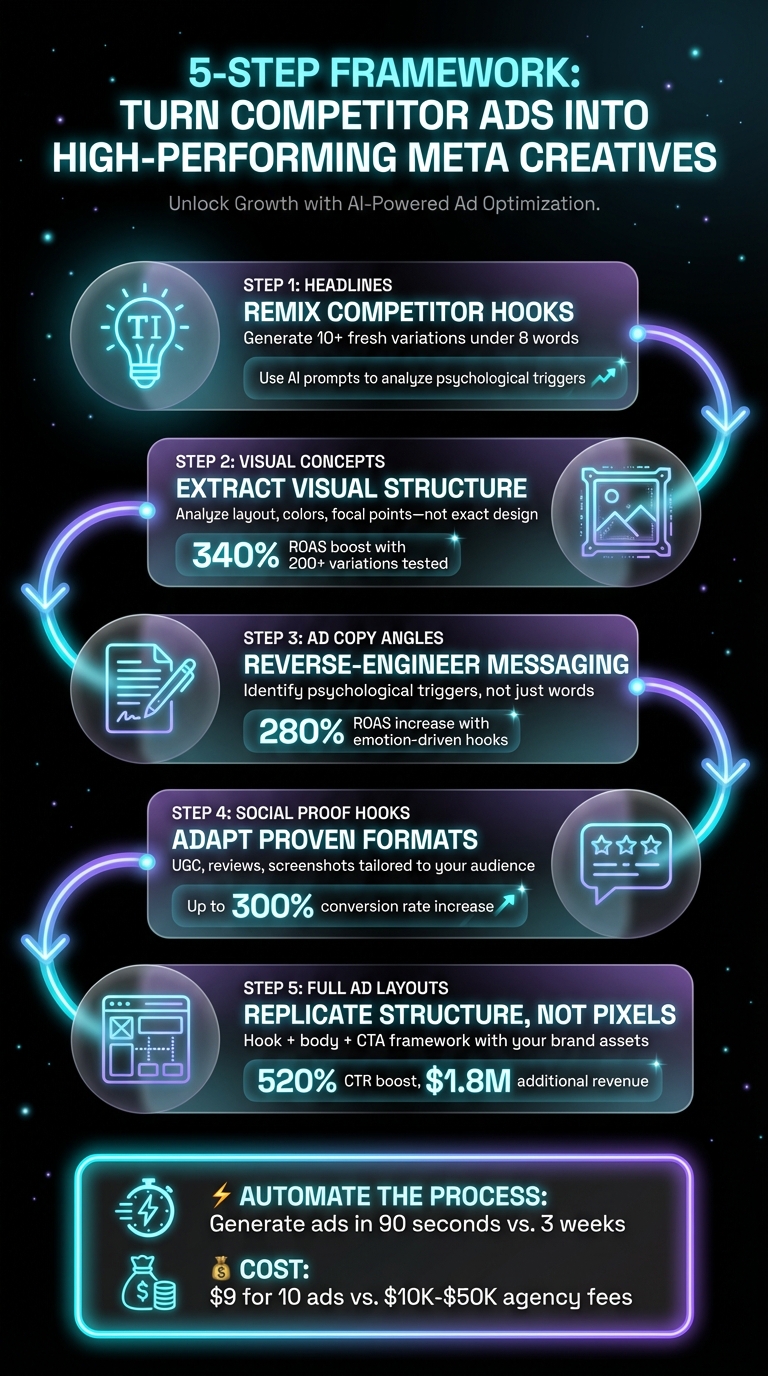
5-Step Framework for Reverse-Engineering Competitor Meta Ads
1. Headlines
Use Competitor Headlines as Inspiration and Elevate Them with This Prompt
Take a competitor's ad headline and use it as a springboard to craft fresh, tailored variations that can increase your click-through rate (CTR). Competitor headlines often highlight hooks that already work - your job is to remix and refine them into something original and engaging.
Here’s a ready-to-use prompt:
"Act as a Meta Ads copywriter who's scaled $100M+ spend. Analyze this competitor headline: [paste headline]. Use our ad headline generator to generate 10 fresh, sub-8-word headlines for [your product] targeting [audience], emphasizing [benefit] with urgency or curiosity. Include call-to-action (CTA). Explain the psychological trigger for each."
Well-crafted headlines are essential for building an automated creative system that drives fast, data-backed ad performance. Using prompts like this ensures your headlines are optimized for engagement and results.
For example, if the competitor headline is "Lose 20lbs Fast!", you could create variations like:
- "Tired of [Competitor] fads? Drop 20lbs with real results" (curiosity gap)
- "Beat [Competitor] - 20lbs gone in weeks" (differentiation and urgency)
- "What if 20lbs vanished overnight? Try now" (question hook)
Each of these examples taps into a different psychological trigger while keeping the headline short and punchy - exactly what works for Meta ads. This approach prevents your creative from going stale and keeps engagement rates high.
The key is to avoid copying outright. Instead, rework the core idea with your unique spin and triggers. For instance, you could transform "Save 50% Now" into "Ditch [Competitor] - Save 50% Today", adding an edge of urgency and differentiation to stand out without mimicking.
Put the playbook to work
Apply this playbook to your page
Paste your website and the Lab will turn the strategy you are reading into a ready-to-test ads.
Free to try No prompt writing
2. Visual Concepts
Extract the Visual Structure, Not the Exact Design
When it comes to visuals, the goal isn't to copy a competitor's design outright but to break down the structure - the layout, composition, and visual elements that make it effective. From there, you can rebuild it using your brand's unique assets.
Competitor ads are a goldmine for spotting visual patterns that grab attention. For instance, does a particular layout stop the scroll? Does a specific color scheme or focal point draw the eye? These insights can help you craft visuals that pop in your audience's feed.
Here’s a prompt to guide this process:
"Act as a Meta Ads creative strategist with $100M+ spend experience. Analyze this competitor ad visual - describe its layout, color scheme, and focal points (e.g., side-by-side before/after images, yellow text overlay, direct eye contact). Generate 5 visual concepts for [your product] targeting [audience]. Include the psychological hook each visual triggers and why it works on mobile feeds."
For example, if you notice a competitor using a split-screen comparison - their product versus a generic alternative - you could adapt that structure by showcasing your product alongside the "old way" of solving the problem. The layout remains effective, but the content becomes uniquely yours. Similarly, if they use direct eye contact paired with bold text overlays, replicate the eye-contact strategy but with your own model, branding, and message.
Certain visual formats are effective because they disrupt the feed or pique curiosity. Take the case of Fashion Forward Co. In early 2026, they leveraged AI to create over 200 ad variations in a single day, testing multiple visual structures. This rapid experimentation resulted in a 340% ROAS boost and $2.3M in additional revenue - all within a timeline that traditional methods couldn’t match.
This approach not only combats creative fatigue but also eliminates wasted ad spend. By quickly identifying what works, you stay ahead of competitors stuck in slower creative cycles. Pairing this strategy with automation ensures your visuals remain fresh, engaging, and optimized for performance.
3. Ad Copy Angles
Reverse-Engineer the Messaging, Not the Words
Competitor ad copy isn't just about the words they use - it's about the angle they take to grab attention. Are they highlighting a key benefit? Tackling objections right off the bat? Maybe they're leaning on social proof to establish credibility. The trick is to break down the structure, not just the phrasing, and rebuild it with your product's unique value in mind.
It's not enough to simply swap out a few words. You need to dig deeper and identify the psychological trigger at play. Is the ad creating a sense of urgency? Offering relief? Playing on FOMO or status? Once you pinpoint the mechanism - like scarcity, authority, or targeting a specific pain point - you can adapt it to fit your brand’s voice and message.
Here’s a practical prompt to get started:
"As a seasoned Meta Ads copywriter, analyze this competitor ad copy - identify the core benefit, objection being addressed, and psychological trigger (e.g., scarcity, social proof, authority). Deliver 5 distinct ad copy angles for [your product] aimed at [audience], each using a different hook type: Problem/Solution, Benefit-Driven, Testimonial-Led, Contrarian, and Curiosity-Driven."
Take this example: A competitor runs an ad saying, "Finally, a skincare routine that actually works for sensitive skin." It's addressing a pain point (frustration with ineffective products) while also tackling objections (will it work for sensitive skin?). You could apply this structure to a completely different product, like writing, "Tired of workout plans that ignore your schedule? This one fits into 20 minutes." The angle stays the same, but the product and pain point shift to match your audience.
Here’s proof this approach works. In early 2026, Wellness Plus, founded by Dr. Amanda Foster, transitioned from a $10,000/month agency to AI-generated ads that focused on emotional triggers and persuasive hooks tailored to their health-conscious audience. The result? A 280% increase in ROAS and $3.1 million in additional revenue. Dr. Foster shared:
"The AI-created health and wellness ads are incredibly persuasive. They understand the emotional triggers that drive our customers to buy better than our $10k/month agency ever did".
Just like diverse visuals and headlines improve ad performance, using multiple ad copy angles can take your strategy to the next level. Don’t rely on a single hook - test multiple approaches simultaneously, like benefit-driven, objection-focused, or proof-based angles. Meta's algorithm will do the heavy lifting, surfacing the most effective creative. This way, you’re not guessing - you’re making data-driven decisions that scale. By leveraging this strategy, your campaigns can adapt in real time, delivering results that stand out in competitive markets.
4. Social Proof Hooks
Use Proven Social Proof Formats That Resonate
When you notice a competitor's ad sticking around for months, take a closer look at how they're presenting social proof. Are they highlighting star ratings prominently? Maybe they're showcasing DM or WhatsApp screenshots that hint at high engagement. Some brands lean on raw user-generated content (UGC) that feels like a recommendation from a trusted friend.
The way social proof is framed matters because different audiences respond to different styles. For example, a skincare brand might thrive with before-and-after UGC videos, while a B2B SaaS company could see success with LinkedIn screenshots featuring real customer feedback. The trick is to pinpoint the format your competitor has been using consistently - that's a clear sign it's driving results. In fact, ads leveraging social proof can increase conversion rates by up to 300%. This understanding can help you sidestep common mistakes.
A common error advertisers make is overloading cold traffic with too much social proof. Things like reviews, "best seller" badges, and detailed testimonials can actually hurt return on ad spend (ROAS) during prospecting. Why? Because people who are new to your brand need to first understand why your product matters to them. Save the heavy-hitting social proof for retargeting campaigns, where audiences already recognize your brand and just need that final nudge to convert.
To apply this strategy, try this approach:
"Review three competitor Meta ads and identify the social proof formats they use (e.g., UGC video, star ratings, DM screenshots, testimonial quotes). For each format, create five variations tailored to [your product] and [your audience], addressing objections like [objection 1] and [objection 2] using real customer language."
Don't overlook the comments section on competitor ads. Customer feedback often highlights pain points or praise that can be repurposed into new hooks. For instance, if someone comments, "Finally, something that doesn’t irritate my skin", you've just found a potential hook to test. The quickest way to build effective social proof is to study what’s already working and adapt it for your audience. You can also use AI tools for Meta ads to speed up the creative analysis and generation process.
5. Full Ad Layouts
Reverse-Engineer the Structure, Not the Pixels
When a competitor's ad has been running for over 30 days, it’s worth studying the entire layout - not just the headline or image. Look closely at how the hook, body copy, and call-to-action (CTA) come together. For instance, does the headline highlight benefits while the body copy tackles objections? Does the image integrate the product naturally into the feed, avoiding the appearance of a generic template?
One common misstep advertisers make is focusing on superficial tweaks like fonts and colors while ignoring the deeper structure of the ad. Performance often hinges on how well the layout taps into psychological triggers. Take the example of Fashion Forward Co., led by CMO Sarah Chen. By using AI to adapt competitor-proven layouts with their brand assets, they created over 200 ad variations in a single day. This is how many brands now produce Meta ads on autopilot to maintain creative freshness. The results? A 340% boost in ROAS, $2.3M in additional revenue, and a 67% drop in CAC.
"ADEN'S LAB created 200+ ad variations in one day. Our previous agency took 3 weeks for 10 ads. The AI-created ads outperformed our human-created ones by 340%." – Sarah Chen, CMO, Fashion Forward Co.
To replicate this success, dissect competitor layouts for essential elements like headline placement, visual framing, copy length, CTA style, and the positioning of social proof. Then, rework these components with your unique hooks, testimonials, and customer pain points. The quickest path to high-performing layouts is adapting proven frameworks with your brand’s distinct angles. Just as polished headlines and visuals are key to performance, a well-structured ad layout can significantly boost conversions - especially when scaled through automation.
With Aden's Lab, the heavy lifting is handled for you. It generates static Meta ads from a single product link in just 90 seconds, seamlessly incorporating effective layout elements. No need for prompts or endless revisions - just drop in your link and launch ads designed to deliver results.
Meta Ads just got a LOT easier. Scrape & analyse competitors ads (free template)
Conclusion
Repurposing competitor ads with automated insights isn’t about copying - it’s about understanding what works and tailoring it to your needs. The examples shared here demonstrate how you can pull headlines, visual elements, and copy angles, social proof, and even complete ad layouts from successful competitor campaigns. This approach saves you from guesswork, minimizes wasted ad spend on unproven ideas, and avoids the delays of traditional creative workflows.
The real game-changer lies in scaling your testing efforts. Instead of relying on a single "hero ad" and hoping it performs, you can instantly create dozens of variations - each with unique hooks, angles, and formats - and let Meta’s algorithm identify the top performers. For instance, TechGadget Pro reduced their agency costs from $50,000 to just $500 per month by adopting automated systems. The result? A 520% boost in CTR and $1.8M in additional revenue. This highlights how a streamlined, data-driven approach can transform ad performance.
However, manual creative processes often slow things down. Writing, editing, and coordinating between tools, designers, and platforms takes time - time you might not have if you’re battling creative fatigue or trying to scale quickly.
That’s where Aden’s Lab comes in. By simply dropping in a product link, the system automates the entire ad creation process in just 90 seconds. It pulls data from your product page, incorporates reviews and positioning, and produces static creatives based on billions of dollars in tested ad spend. At $9 for 10 ads, it’s not only faster than agencies - it’s 95% cheaper. Better yet, it allows you to test over 100 variations daily, which aligns perfectly with what Meta’s algorithm rewards.
If scaling Meta ads is your priority, this approach eliminates the usual bottlenecks. Test more, spend less, and let the results guide your strategy.
FAQs
How do I reverse-engineer a Meta ad without copying it?
Reverse-engineering a Meta ad involves dissecting its structure, message, and creative elements to understand what works - not duplicating it. Start by examining the key components: the hook that grabs attention, the offer that appeals to the audience, the visuals that draw the eye, and the call-to-action that drives engagement. Pay close attention to how these pieces come together to connect with the target audience. Once you've identified why these elements work, use the same principles to craft your own original ads that are tailored to your brand and audience.
What should I look for in the Meta Ad Library to find profitable ads?
When evaluating ads, prioritize those with strong engagement and lasting impact. Ads that have been running for weeks typically suggest they’re performing well. High levels of interaction - such as likes, comments, and shares - are clear signs the content connects with its audience. Take a closer look at how these ads are structured: notice the hooks that grab attention, the visuals that captivate, and the calls-to-action that drive responses. Breaking down these elements can provide valuable insights to guide the creation of your own impactful ads.
How many ad variations should I launch at once to test quickly?
When testing ads on Meta, begin with 10-20 variations as a starting point. If your budget permits, consider scaling up to around 50 variations to pinpoint the best-performing ads more quickly. Testing this range of variations helps you gather actionable insights while staying within your budget. The key is to balance variety and cost efficiency to discover what resonates most with your audience.
Your next ad batch starts here
Finish with a ready-to-test ad batch
Paste your website to generate static creatives. Drop the link → get ads in about 90 seconds → upload them to Meta → scale.
Free to try No prompt writing