25 Cold-Traffic Meta Ad Prompts That Turn Product Pages Into Static Ads
Build the ads while the examples are fresh
Turn your product page into static ad creatives
Paste your product URL and generate scroll-stopping images, headlines, and primary text—ready for your next Meta creative test.
Free to try No prompt writing

Want to turn complete strangers into paying customers on Meta? Static ads are your secret weapon for cold-traffic audiences - people who've never heard of your brand. They load fast, are cost-effective, and deliver consistent results. But the real challenge? Crafting ad copy that grabs attention and converts.
This guide offers 25 ready-to-use prompts for e-commerce, SaaS, and lead generation campaigns. Each one is designed to help you transform product page details into scroll-stopping ads for U.S. audiences. Whether you're highlighting a unique feature, building trust with social proof, or creating urgency, these prompts give you a head start. Plus, tools like ADEN's LAB can automate the process in under 90 seconds.
Key Highlights:
- E-commerce: Focus on bundles, customer reviews, and problem-first hooks.
- SaaS: Address frustrations, show clear outcomes, and avoid jargon.
- Lead Generation: Hook with pain points, offer free resources, and tackle objections upfront.
With these prompts, you can quickly test multiple creative angles and find what resonates with cold audiences on Facebook and Instagram. Ready to start scaling your campaigns? Let’s dive in.
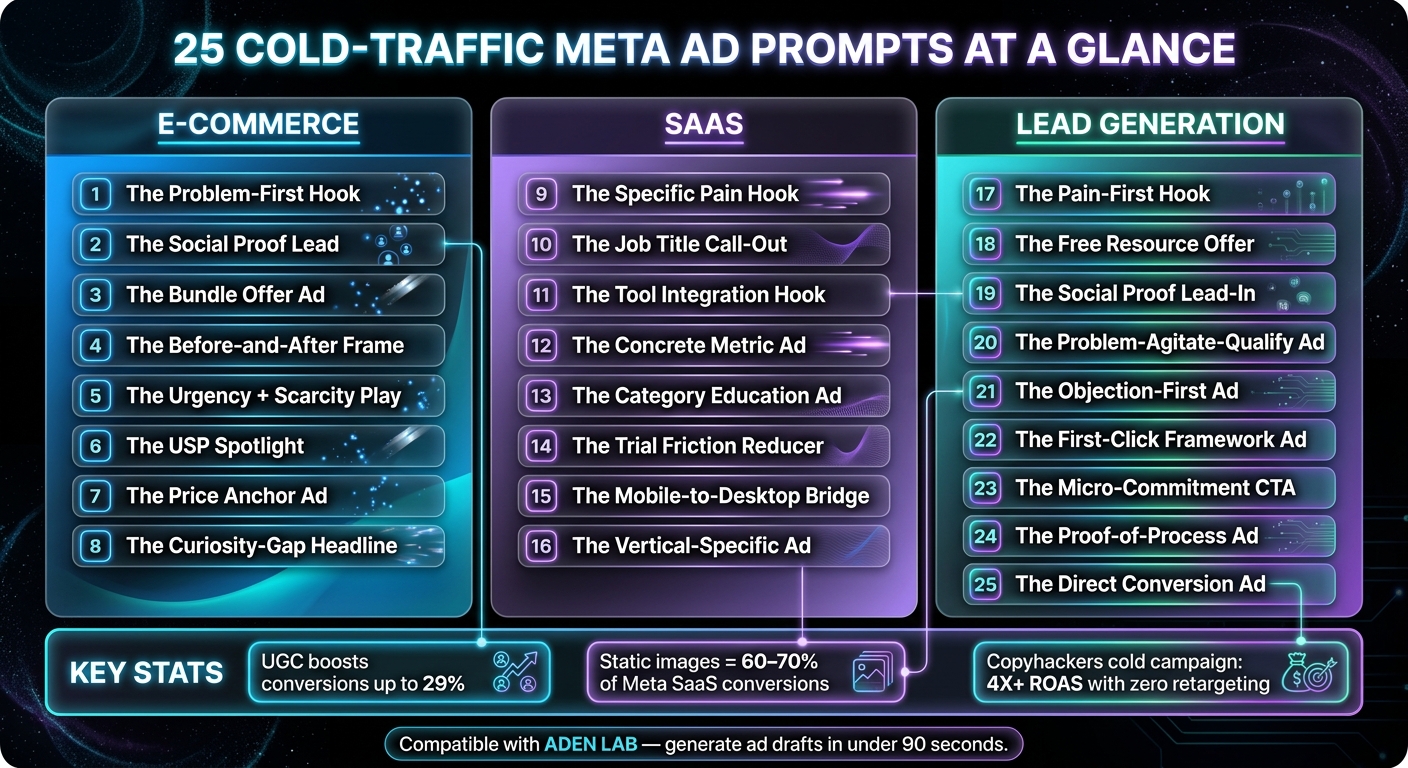
25 Cold-Traffic Meta Ad Prompts: E-commerce vs SaaS vs Lead Gen
5 Minute Tutorial - How to Convert Cold Audiences on Meta
Put the playbook to work
Apply this playbook to your page
Paste your website and the Lab will turn the strategy you are reading into a ready-to-test ads.
Free to try No prompt writing
1. E-commerce Prompts
When advertising to cold-traffic audiences - people unfamiliar with your brand - your message needs to hit home fast. These prompts are designed to help you craft e-commerce ads that grab attention, engage viewers, and convert those who stumble upon your ad on Meta platforms. By focusing on turning product details into persuasive, scroll-stopping static ads, these strategies ensure your message resonates with new audiences.
"Cold traffic needs cold-friendly offers. Bundles. Guarantees. Urgency. Social proof. When you fix the offer first, conversion rates jump 2-3x immediately." - Nick Ivanenko, E-commerce Specialist
Note: Each prompt below requires inserting your product page URL where indicated. They're ready to use as they are - just plug in your details.
1. The Problem-First Hook
Prompt: "Using [URL], create a static Meta ad beginning with a relatable customer problem, then position this product as the obvious fix. Keep the headline under 8 words using a headline generator. Include a risk-reversal element like a money-back guarantee."
This approach connects with people on an emotional level. By addressing their frustrations upfront, you stop the scroll and set the stage for your product as the perfect solution.
2. The Social Proof Lead
Prompt: "From [URL], extract the strongest customer review or testimonial and build a static Meta ad around it. The review should be the visual centerpiece. Add a short supporting line that reinforces the benefit and a direct CTA with the price in USD."
Why this works: User-generated content can boost conversion rates by up to 29% compared to brand-created ads. A glowing review builds trust faster than any polished tagline.
3. The Bundle Offer Ad
Prompt: "Using [URL], create a static Meta ad that highlights a bundle or multi-unit offer. Emphasize the per-unit savings in USD. Write copy for someone who has never heard of this brand and needs a clear reason to act now."
Bundles appeal to deal-seekers and give potential customers an extra incentive to buy more, especially when savings are front and center.
4. The Before-and-After Frame
Prompt: "From [URL], write a static Meta ad structured as a before-and-after contrast. Show the customer's situation without the product versus with it. Keep the copy tight - no more than 3 lines of body text. Target a U.S. audience aged 25–45."
Visualizing a transformation makes the benefit of your product crystal clear. This method is quick to understand and highly relatable.
5. The Urgency + Scarcity Play
Prompt: "Using [URL], generate a static Meta ad that creates urgency without sounding fake. Use a limited-time offer, low-stock signal, or time-sensitive discount in USD. The ad should feel direct and honest, not pushy."
Urgency motivates action, but it’s important to strike the right tone. A genuine reason to act now can make all the difference.
6. The USP Spotlight
Prompt: "From [URL], identify the single most unique feature or benefit that no generic competitor offers. Build a static Meta ad around that one thing. Assume zero brand awareness. Lead with the differentiator, not the brand name."
Standing out in a crowded market means highlighting what sets you apart - and making it the star of your ad.
7. The Price Anchor Ad
Prompt: "Using [URL], write a static Meta ad that anchors the product price against a more expensive alternative or the cost of the problem it solves. Frame the USD price as a smart, low-risk decision. Suitable for cold Facebook or Instagram feed placement."
Positioning your product as the cost-effective choice can make it irresistible, especially when compared to pricier options.
8. The Curiosity-Gap Headline
Prompt: "From [URL], generate a static Meta ad with a curiosity-driven headline that teases a surprising benefit or unexpected use case. Do not reveal the full payoff in the headline - make the viewer want to read more. Keep body copy under 20 words."
Curiosity is a powerful motivator. By hinting at something intriguing, you encourage people to click and learn more.
These prompts are fully compatible with ADEN's LAB, which can auto-extract product details and refine your ad drafts in under 90 seconds.
2. SaaS Prompts
Selling SaaS to cold traffic is a whole different ballgame compared to e-commerce. You're not just pitching a product; you're asking people to rethink how they work. That means your ad needs to do more than just catch their eye - it has to tap into the frustrations of their current, inefficient workflows, even if they’ve never heard of your brand before.
Here’s a key insight: static images still account for 60–70% of Meta conversions for SaaS, even in 2026. Meta’s algorithm now prioritizes the creative itself over targeting settings. As Ekaterina Zotkova, Content Strategist at Aimers, explains:
"Your creative now tells Meta who to find, not the other way around. Generic creative finds a generic audience."
To cut through the noise, avoid overused, jargon-filled terms like "leverage", "streamline", or "all-in-one solution" by using an ad copy idea generator. Instead, focus on clear, relatable messaging. Below are prompts designed to address common SaaS challenges by highlighting specific frustrations, delivering precise outcomes, and directly engaging your audience. The goal? Clarity and concrete results that turn strangers into customers. Achieving this often requires A/B testing Meta ads to see which specific pain points resonate most with your cold audience.
Here are seven prompts to help transform your SaaS product page into a compelling static ad.
9. The Specific Pain Hook
Prompt: "Write a static Meta ad that opens with a clear description of a specific daily frustration your user faces - something like 'Still copying data between tools every Monday morning?' Avoid vague benefit statements. The hook must feel like you're reading the user's mind."
Zeroing in on a hyper-specific problem immediately signals who the ad is for. It grabs the attention of the right audience and stops their scroll - breaking through their initial resistance to cold outreach.
10. The Job Title Call-Out
Prompt: "Create a static Meta ad that directly names the job title or team this product is built for in the first line. Follow with one specific, numerically backed outcome they'll get (e.g., 'Cut onboarding from three weeks to four days'). Avoid jargon."
Directly addressing a specific role makes the ad feel relevant and ensures it resonates with the right professionals. It gives your audience a clear reason to engage, even if they’ve never encountered your brand before.
11. The Tool Integration Hook
Prompt: "Write a static Meta ad that mentions a familiar tool your product integrates with or replaces. Frame the ad around the frustration of using that tool alone. Target a cold audience with zero prior brand awareness."
Referencing a tool your audience already knows creates instant familiarity. It positions your product as the logical next step, bridging the gap between what they’re used to and what you offer.
12. The Concrete Metric Ad
Prompt: "Generate a static Meta ad built around one specific, verifiable metric your product delivers - such as time saved, error rate reduced, or revenue recovered. Express it as a before-and-after number. Avoid adjectives like 'powerful' or 'robust,' and keep the headline under 10 words."
Concrete numbers build trust and credibility. They give potential customers a clear, measurable reason to believe in your product, even before they’ve explored it further.
13. The Category Education Ad
Prompt: "Write a static Meta ad that educates a cold audience on why the category of problem your product solves matters - before introducing the product itself. Assume the viewer has never considered this type of solution and keep the tone conversational."
By first explaining why the problem matters, you can engage audiences who may not even realize they need a solution. This approach is perfect for breaking through cold-traffic barriers.
14. The Trial Friction Reducer
Prompt: "Create a static Meta ad that addresses the most common hesitation someone has before starting a free trial. Acknowledge the concern and neutralize it with a specific, honest response. Include a clear call-to-action that lowers the perceived commitment."
Tackling objections head-on builds trust. By removing mental roadblocks, you make it easier for new users to take that first step with your product.
15. The Mobile-to-Desktop Bridge
Prompt: "Write a static Meta ad for someone scrolling on their phone who will eventually need to use your product on a desktop. Address mobile users by offering a low-friction step (e.g., email signup or save link) to transition to desktop engagement."
This approach creates a seamless path from mobile discovery to desktop use - critical for SaaS tools designed for desktop functionality.
16. The Vertical-Specific Ad
Prompt: "Generate a static Meta ad written exclusively for one specific industry vertical (e.g., healthcare, logistics, or e-commerce operations). Use language and examples native to that industry, making the ad feel built especially for that type of business."
Tailoring your ad to a specific industry makes it feel personal and relevant. It also helps Meta’s algorithm connect your ad with the right audience, turning cold leads into qualified prospects.
3. Lead Generation Prompts
Generating leads from cold traffic is no walk in the park. You're essentially asking complete strangers to share their contact details before they've had a chance to trust your brand. To make this work, your messaging has to hit home immediately. These prompts are designed to extract the most compelling aspects of your product and craft static ads that grab attention and overcome the challenges of cold traffic. The strategy revolves around four key angles: Problem, Proof, Product, and Persona. Each prompt aims to hook the audience within 8 seconds and spark immediate interaction.
These prompts build on proven techniques for e-commerce and SaaS, focusing on turning casual browsers into valuable leads.
As Onat Aksaray says:
"Scaling cold traffic isn't about fancy account structures, it's about creative that makes total strangers stop scrolling."
17. The Pain-First Hook
Prompt: "Craft a static Meta ad for a cold audience that opens with one hyper-specific pain point your offer resolves. Do not mention the brand name in the first sentence. Ensure the reader feels understood before introducing your offer."
Starting with a pain point creates an instant emotional connection. It signals to the right audience that this ad is speaking directly to them.
18. The Free Resource Offer
Prompt: "Create a static Meta ad offering a free resource (checklist, guide, or template) to a cold audience. The headline must communicate the specific outcome the resource delivers, not just its format. Keep the CTA friction-free - no credit card language."
Offering something free is a great way to lower the barrier for engagement. The trick is to emphasize the outcome of the freebie, not just what it is.
19. The Social Proof Lead-In
Prompt: "Write a static Meta ad that leads with a specific number - total customers served, leads generated, or results achieved - before introducing your offer. Use real figures. Avoid vague claims like 'thousands of happy clients.'"
For cold traffic, putting social proof at the very top of the ad works better than burying it at the bottom. Numbers immediately establish credibility.
20. The Problem-Agitate-Qualify Ad
Prompt: "Generate a static Meta ad that names a specific problem, briefly agitates why it gets worse without action, and then qualifies the reader by stating exactly who this solution is for. End with one low-commitment CTA."
This approach weeds out unqualified leads and pulls in those who are already considering action - helping you save on unnecessary ad spend. You can further optimize efficiency by scaling Meta ads with AI budget allocation to ensure your spend goes toward the highest-performing creative.
21. The Objection-First Ad
Prompt: "Write a static Meta ad that opens by acknowledging the most common reason someone wouldn't sign up for your offer - then immediately neutralizes it with a direct, honest response. Keep the tone conversational, not defensive."
Addressing doubts upfront builds trust quickly. It shows you understand the audience's concerns, which is vital when dealing with people unfamiliar with your brand.
22. The First-Click Framework Ad
Prompt: "Create a static Meta ad where the headline promise is mirrored exactly on the landing page. Ensure a seamless transition by matching the ad headline, language, and tone with the landing page. Include above-the-fold social proof in your copy description."
When your ad and landing page don't align, conversions drop. This prompt ensures consistency from the first click to the form submission.
23. The Micro-Commitment CTA
Prompt: "Write a static Meta ad that replaces a high-friction CTA like 'Book a Call' with a low-friction alternative - such as 'See If You Qualify' or 'Get Your Free Plan.' Frame the next step as something the reader receives, not something they give."
Reframing the call-to-action as a benefit flips the dynamic. Instead of feeling like they're being asked for something, the audience feels like they're gaining something.
24. The Proof-of-Process Ad
Prompt: "Generate a static Meta ad that shows how your lead generation process works in three steps. Use plain language. Avoid technical jargon. The goal is to make the process feel easy enough that the reader thinks, 'I can do that.'"
Breaking your process into three simple steps makes it feel approachable and removes any intimidation factor.
25. The Direct Conversion Ad
Prompt: "Write a static Meta ad designed to convert cold traffic directly - no nurture sequence, no retargeting dependency. Assume this is the only touchpoint. Lead with your strongest benefit, include one credibility signal, and close with a single, specific CTA."
This method focuses on closing the deal right away. If your offer is strong enough, there's no need for a long lead-nurture process.
"Go for the cold conversion. There's no reason to believe it won't work if your offer is solid." - Erin Steele, Acquisition Lead, Copyhackers
In 2021, Copyhackers ran a campaign targeting cold traffic with no retargeting or nurture strategy. The result? They achieved over 4X return on ad spend, making it their most successful launch to date. Sometimes, the direct approach is all you need when the creative does its job.
Conclusion
When it comes to cold traffic, you only have a brief window to build trust and inspire action. The prompts outlined in this article aren’t just brainstorming tools - they’re proven methods designed to address specific pain points, showcase credible proof, and create straightforward, low-barrier calls to action. Success in this area requires sharp, focused messaging.
AI-generated prompts take the guesswork out of the equation , much like how AI optimizes Meta ad costs through automated creation, offering a system to test 3–5 hooks per concept. This approach helps identify what strikes a chord with your audience, allowing you to refine and expand on winning ideas before they lose their impact. As Adam Taylor, who scaled a brand to $400,000 per month on Meta, explains:
"Scaling cold traffic on Meta is the hardest thing you'll ever do... It's about finding messaging that actually resonates with strangers."
Crafting messages that connect is the key. Research shows that the quality of creative content accounts for about 70% of an ad’s success. By tapping into customer reviews, Reddit discussions, and survey feedback, you can extract authentic language and feed it into your prompt framework. This enables quick testing, cutting underperformers by analyzing your Meta CPA at 1.3× your target, and scaling winners at 0.7× - building campaigns with the potential to thrive for a year or more. These prompts transform overlooked product features into compelling ad copy that speaks to cold audiences.
FAQs
Which prompt should I try first for my offer?
A good place to begin is ADEN'S LAB's 'Best Direct-Response Prompts to Generate High-Converting Meta Ad Text.' This tool is designed to help craft ad copy that grabs attention and drives results, particularly for cold-traffic campaigns. It's easy to use, delivers attention-grabbing outcomes, and is tailored to increase both engagement and conversions. By focusing on this prompt, you can quickly create Meta ads that make an impact and resonate with your audience.
What product-page details do I need to feed these prompts?
To craft effective AI prompts for product-page ads, include essential details like the product page URL, standout features, unique selling points, and any visuals you have. These components enable the AI to generate engaging static ad creatives that align with your product and target audience. The more clear and relevant the information, the better the chances of boosting engagement and driving conversions.
How do I test and scale the winning static ads?
To fine-tune and expand successful static ads, start by digging into performance data. Look for creatives that generate the highest engagement and conversions. Once you spot the top performers, gradually increase your budget for those ads while keeping the creative elements and targeting consistent.
Experiment with various formats, such as images and videos, to see what resonates best with different audiences. Keep a close eye on key metrics like CTR (Click-Through Rate), conversion rate, and CPA (Cost Per Acquisition). This will help you adjust your strategy and scale your efforts without sacrificing performance.
Your next ad batch starts here
Finish with a ready-to-test ad batch
Paste your website to generate static creatives. Drop the link → get ads in about 90 seconds → upload them to Meta → scale.
Free to try No prompt writing