7 Meta Ad Angles You Can Pull From Any Product Page
Turn the idea into a testing batch
Generate new hooks and angles from your product page
Paste your URL to create multiple ready-to-test concepts instead of adapting generic examples by hand.
Free to try No prompt writing

Your product page is a goldmine for creating effective Meta ads. By leveraging the details already available - features, benefits, customer pain points, and more - you can craft ads that resonate with your audience at every stage of their buying journey. Here’s a quick breakdown of the seven ad angles you can use:
- Feature-Focused: Highlight specific product details to appeal to comparison shoppers.
- Benefit-Driven: Show how the product improves life or solves problems.
- Problem-Solution: Address customer frustrations and position your product as the fix.
- Price and Value: Use pricing, discounts, or ROI to attract cost-conscious buyers.
- Proof and Credibility: Include reviews, ratings, and testimonials to build trust.
- Before-After: Showcase transformations to demonstrate product impact.
- Limited Availability: Create urgency with stock limits or time-sensitive offers.
Each angle aligns with different customer needs, helping you systematically test and refine your ads for maximum impact. Before going live, follow an e-commerce ad checklist to ensure your campaigns are fully optimized. Instead of relying on guesswork, this approach ensures your ads stay relevant and effective.
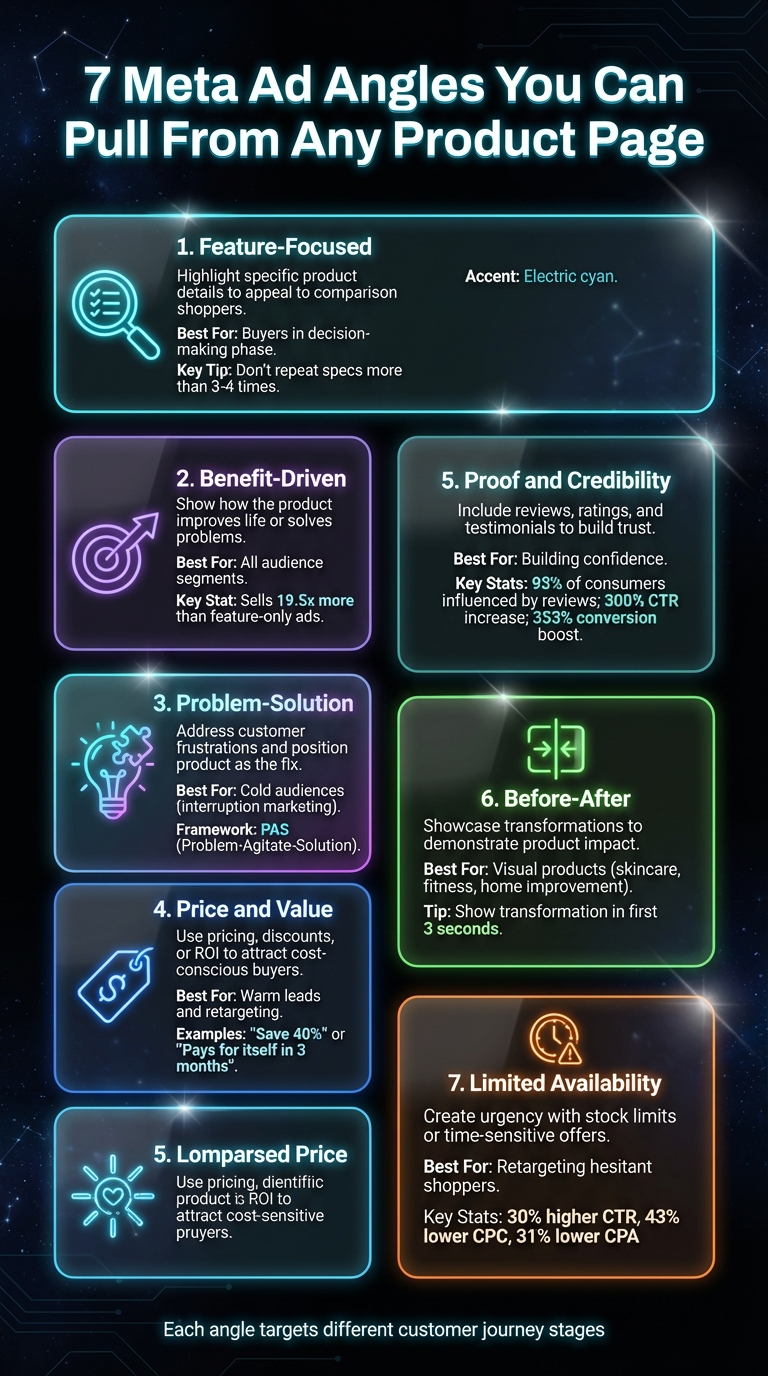
7 Meta Ad Angles for Product Pages: Features, Benefits & Use Cases
Facebook ad angles that scale (use these for $30k days)
Put the playbook to work
Apply this playbook to your page
Paste your website and the Lab will turn the strategy you are reading into a ready-to-test ads.
Free to try No prompt writing
1. Feature-Focused Angle
Zero in on a specific product and highlight its technical details and main promise. This approach works well for buyers who already know what they need and are comparing options based on specific features.
Start by scanning your product feed for the basics - titles, prices, availability, and descriptions. These elements are the backbone of your ad. Then, look for dynamic details like "Free Shipping", discounts, price drops, or labels like "Best Seller" or "New Arrival" to make your product stand out.
Decide what will best showcase your product: is it a demonstration, detailed specs, or functionality? For instance, if you're selling a laptop with 32GB of RAM and a 15-hour battery life, those specs are your selling points. Similarly, if it's a kitchen blender with a 1,200-watt motor and 10 speed settings, lead with those numbers - they catch attention.
To save resources, test with a minimum viable creative strategy. Add branded frames or dynamic overlays to your product image to emphasize key features. You can even automate ad creation to generate these variations at scale. Make sure the text is easy to read on mobile devices, and ensure images load quickly. However, don't overdo it - repeating technical specs more than 3–4 times can cause engagement to drop.
This angle is all about appealing to shoppers who are already in the decision-making phase. Once you've captured their attention with features, you can move on to showcasing the product's benefits to build a stronger connection.
2. Benefit-Driven Angle
Highlighting product features is a good start, but it's the benefits that make those features meaningful. Features explain what the product is, but benefits answer the critical question: "How does this improve my life or business?" This approach shifts the focus from technical jargon to practical, real-world outcomes.
A great way to achieve this is by building a feature-benefit matrix. Take each product feature and translate it into a clear, tangible result. For example, instead of saying "AI-powered bulk ad creation", reframe it as "Generate 100+ ad variations in just 3 minutes." Similarly, replace "OAuth-connected integration" with "Automatically sync performance data without manual entry". The idea is to replace vague descriptions with measurable, impactful outcomes that resonate with your audience.
"The customer cares less about the feature itself and more about the outcome it creates." - AdStellar.ai
This method also lets you tailor your messaging using Meta ad copy frameworks for different audience segments. For instance, an agency owner might value time-saving benefits like "Reduce Slack and email clutter by 60%", while an e-commerce owner might prioritize metrics like ROAS or cost savings. The same product can be presented in multiple ways, depending on the audience's specific priorities. Always quantify benefits - specific metrics like "cut approval time by 50%" or "launch campaigns in 5 minutes" are far more persuasive than vague claims.
The results of this approach speak for themselves. Ads that effectively emphasize benefits have been shown to sell 19.5x more than ads focusing solely on features, even when using identical visuals. To make this strategy even more compelling, back up these benefits with solid proof in your next step.
3. Problem-Solution Angle
The strongest ad strategies don’t begin by showcasing your product - they begin by addressing your customer’s frustrations. Every product page holds valuable clues about the challenges your audience faces, and uncovering these insights can help you craft ads that grab attention instantly. The trick lies in knowing where to find these pain points and how to turn them into captivating copy.
Start with customer reviews, particularly the one-star and two-star ratings. These reviews are treasure troves for identifying common frustrations - what didn’t work, what took too long, or what caused unnecessary hassle. Next, dig into your FAQ section. The questions people ask often highlight obstacles they encounter before purchasing. For instance, if you see queries like, "Does this work with X?" or "How long does setup take?", you’ve uncovered a pain point worth addressing. Lastly, take a closer look at your product’s features. Many of them inherently hint at the problems they solve, giving you more material to work with.
Once you’ve identified these pain points, it’s time to structure your ad using proven techniques. A great method is the PAS framework: start by stating the problem, amplify its impact, and then present your product as the solution. For example, you could ask, "Are you spending too much time on manual ad variations?" Agitate the issue by emphasizing how much time is wasted, and then position your product as the fix. This approach works because people are naturally more motivated to avoid pain than to seek pleasure, making the agitation step crucial for creating urgency.
"People don't buy products - they buy solutions to their problems." - PainOnSocial
To hook your audience, lead with the pain point in the first few seconds of your video or the opening line of your copy. Lines like "Stop wasting hours on manual ad creation" immediately resonate with your audience, prompting them to think, "That’s me!". This is especially effective on platforms like Meta, where you’re interrupting someone’s scroll through personal updates. As Courtney Fritts from Foxwell Digital explains:
"Meta traffic is interruption marketing at its core. You're not catching someone searching for 'blue running shoes size 10.' You're interrupting their cousin's wedding photos with your product. This demands a different level of immediate, obvious value."
Your ad needs to make the problem unmistakably clear and the solution so compelling that clicking feels like the only logical choice.
4. Price and Value Angle
Price is one of the most powerful tools to turn casual browsers into paying customers. Whether you're promoting a $19 subscription or a $1,999 software package, your pricing can be a strategic asset. Your product page already holds the key details - actual price, discounts, payment options, and value proposition. These elements can shape a convincing narrative for your ads.
The key is to find the pricing angle that speaks to your audience. Some buyers are drawn to cost savings, while others focus on return on investment (ROI). For example, phrases like "Save 40% compared to competitors" or "Pays for itself in 3 months" can provide the hook you need. As Angad Singh from Segwise explains:
"A creative angle is the fundamental appeal or framing strategy behind an ad (e.g., 'Convenience' vs 'Cost-savings'). It is the underlying reason the ad should resonate with your audience."
Consider how different pricing messages resonate with different groups. An ad that says "Only $0.90 per ad" appeals to budget-savvy buyers, while "Generate 200 ads per month" might attract those focused on maximizing output. By testing these pricing cues, you can discover what truly persuades your audience.
When testing price-focused ads, isolate the pricing variable to see what works. Keep visuals, audience, and budget consistent, and use Ad Set Budget Optimization (ABO) to ensure each pricing angle gets an equal chance. For example, compare "$59/month" with "Under $2 per ad", ensuring your budget supports 2 to 3 conversions per day per ad set. This gives Meta's algorithm enough data to identify winners.
Price-focused strategies work best when targeting audiences who already recognize their need for your product. Offering a discount code to someone who doesn’t yet see the value won’t be effective. Instead, save offers like time-limited discounts, payment plans, or cost-per-unit deals for retargeting campaigns, cart abandoners, or warm leads. These audiences are often just one step away from converting, and a clear pricing benefit can provide the final nudge they need.
5. Proof and Credibility Angle
Reinforcing trust through proof signals can turn casual scrollers into confident buyers. To further protect your margins, combine these trust signals with exclusion strategies that prevent showing ads to existing customers who have already converted. By incorporating elements like reviews, star ratings, testimonials, and success metrics into your ads, you build credibility that resonates with potential customers. For instance, 93% of consumers say online reviews influence their buying decisions. Ads featuring user-generated content and reviews on platforms like Facebook have shown impressive results, with click-through rates increasing by 300%.
The trick lies in using specific, results-focused testimonials instead of generic praise. Swap vague compliments for impactful statements like, "Saved $500 in the first month" or "Cut workflow time in half." A great example comes from Leroy Merlin Poland, which used Cropink to integrate live star ratings and review counts into their Meta catalog ads. The result? A 353% jump in conversion rate and a 79% boost in ROAS in March 2026. Similarly, MediaMarkt saw a 9× ROAS by embedding product-level social proof and real-time popularity badges into their ad creatives.
When displaying ratings, aim for a range between 4.2 and 4.5 - a perfect 5.0 can sometimes seem too good to be true. Pair these ratings with review volumes to add weight. For example, "4.8/5 from 1,240 reviews" feels far more reliable than a standalone score. As Waseem Bashir, CEO of Apexure, explains:
"Platform ratings are independently verified. A visitor who sees '4.8 on the App Store (12,000+ reviews)' knows that number is real in a way that a handpicked quote can never be."
Video testimonials are another powerful tool, driving an 80% increase in conversions compared to text-only reviews. The trend is moving toward unscripted, authentic customer videos that feel genuine and avoid the polished look that often triggers ad fatigue. Pairing customer quotes with real names and photos (with permission) can increase credibility by around 40%. To further reduce doubts, focus on reviews that tackle common concerns like price, quality, or delivery speed.
For maximum impact, place your social proof signals - like star ratings and badges - directly next to or above your call-to-action button. Avoid burying them at the bottom of your ad, and ensure they’re clearly visible on mobile devices, which account for 60% of social ad views. You can also stack proof signals for added urgency, such as combining "12,000 sold" with "Only 3 left". This approach seamlessly sets the stage for integrating urgency and scarcity in your next strategy.
6. Before-After Angle
Transformation ads are all about visually demonstrating how your product can make a difference, taking viewers on a journey from frustration to relief. This approach adds a powerful visual story to the credibility and benefits already discussed, tying everything together with a compelling narrative.
Start by reviewing your product descriptions and customer reviews for any timeline details like "within 3 weeks" or "after 4–8 weeks." These phrases can highlight the transformation period. Then, look for testimonials that describe initial struggles - these can form the foundation of your "before" story.
Take Eight Sleep as an example. They ran an ad for 107 days in February 2026 with the hook "Up to 34% more deep sleep", paired with the visual contrast of "Less sweating, more sleeping." By combining clinical data with relatable frustrations, they created a strong before-and-after narrative that resonated with their audience.
When creating visuals, think about using AI tools for ad asset creation to generate split-screen images or side-by-side comparisons to clearly show the problem versus the solution. User-generated content works well for cold audiences because it feels authentic and approachable, while polished studio visuals are ideal for retargeting campaigns. To grab attention quickly, feature the most dramatic part of the transformation within the first three seconds of your video ad.
Pair these visuals with measurable proof from your product page. For example, include clinical trial results or customer feedback like "90% saw clearer skin" to back up your claims. Circle, a community platform, ran an ad for 110 days in February 2026 that highlighted a "before" state of "Spending hours… reaching a small fraction" and an "after" state of "Reach 100% of your audience." They used dark colors for the problem and bright colors for the solution, along with a "Results may vary" disclaimer to stay compliant with regulations.
This transformation angle works across a variety of industries - from skincare and fitness to home improvement and cleaning products - because it taps into the universal desire for visible, tangible change. Including diverse before-and-after examples can help your ad resonate with a broader audience.
7. Limited Availability Angle
Urgency can transform straightforward product details into ads that drive action. Scarcity is a powerful motivator. Chances are, your product page already includes urgency signals. Look for stock indicators like "Only 4 left" or inventory progress bars. Check for time-sensitive cues such as "Sale ends tonight", countdown timers, or specific deadlines like "Valid until June 30th." Other hints might include "Selling Fast" badges or disclaimers like "While supplies last" or "Limited quantities available" in the footer. These elements, much like benefit-driven strategies, can be repurposed into ad copy that encourages immediate action.
Why does this work? Humans tend to react more strongly to the fear of missing out than to the possibility of gaining something. In fact, this fear is about twice as motivating. To amplify urgency, combine stock limits with a deadline. For example, "Only 3 left – Sale ends at midnight" creates a double layer of urgency that pushes people to act fast. Just make sure your message reflects reality: use "Low stock" for 6-10 units, but escalate to "Last one!" when inventory drops to 1-2 items.
A good example of this approach is IKEA's April 2023 IKEA Family offers. Their digital ads featured a white bottom bar that highlighted both the expiration date and the phrase "while supplies last." This combination of a clear deadline and stock messaging encouraged quick purchases. And it worked: catalog ads with limited-time or stock-specific offers saw a 30% higher click-through rate, a 43% lower cost per click, and a 31% lower cost per action on average.
"It's the end date that creates the urgency, not the start date." - Confect.io
When running retargeting campaigns, focus on the deadline to convert hesitant shoppers. For instance, "Your cart expires in 24 hours" can nudge potential buyers to complete their purchase. To make your ads even more compelling, consider layering scarcity with social proof. For example, "Only 3 left - 800+ sold this month" not only creates urgency but also reassures buyers of the product's popularity and quality.
One important tip: keep your scarcity claims honest. Fake countdown timers or inflated stock numbers might give you a short-term boost of 5-10% in conversions, but they can erode trust and increase return rates in the long run.
Conclusion
With these tailored strategies, you can effectively target every stage of customer awareness. There are seven distinct angles you can draw from any product page: feature-focused, benefit-driven, problem-solution, price and value, proof and credibility, before-after, and limited availability. Each angle speaks to a specific point in the customer journey, from those unaware of their problem to those ready to make a purchase.
This isn’t about waiting for a flash of creativity - it’s about building a system that delivers consistent results. Instead of relying on random ideas, you create a structured process that ties these angles directly to the customer journey. This way, you move beyond generic "buy now" messaging and craft ads that resonate with buyers at every stage. The focus shifts to what truly matters: the core message, not just its presentation.
By using these seven angles, ADEN'S LAB turns your product details into a creative powerhouse. Simply input your product or landing page link, and the platform generates high-performing static Meta ads in under 90 seconds. At just $0.90 per ad, it allows you to outpace creative teams and combat ad fatigue with ease.
Winning on Meta isn’t about having the largest budget - it’s about producing enough high-performing creatives quickly. These angles provide the framework, and the right tools make it repeatable. With this structured approach, your ads will always align with every stage of the buyer’s journey.
FAQs
Which ad angle should I test first?
Start by crafting an ad angle that zeroes in on the main benefit or directly addresses a major pain point your customers face. Why? Because creative angles account for 70–80% of performance variation, making them a game-changer for success.
Keep your focus on the core message or framing strategy that’s most likely to click with your audience. This primary approach holds the most power to drive engagement and boost conversions.
How do I turn product features into real benefits?
To transform product features into benefits, emphasize how they address customer needs or enhance their daily experiences. Focus on results like saving time, increasing comfort, or improving productivity. Instead of merely listing features, explain what those features mean for the customer - what they’ll gain or how their life will improve. This approach helps craft messaging that connects on a personal level and motivates buying decisions.
How many ad angles should I run at once on Meta?
Testing multiple ad angles at the same time can be a game-changer for your campaigns. Some experts even recommend trying out more than 30 different angles within a short timeframe. Why? It allows you to quickly figure out which strategies resonate best with your audience and deliver the strongest results.
Your next ad batch starts here
Finish with a ready-to-test ad batch
Paste your website to generate static creatives. Drop the link → get ads in about 90 seconds → upload them to Meta → scale.
Free to try No prompt writing