Meta Ad Prompts for Food and Beverage Products
Use the prompts on your real offer
Generate these ad angles for your product
Skip the blank prompt box. Paste your product page and ADEN'S LAB applies the angles to your offer, images, headlines, and copy.
Free to try No signup No prompt writing
If your food or drink ad does not spark a want in seconds, people keep scrolling. This guide shows me one clear way to fix that: use prompt frameworks that turn product details into Meta ad copy, hooks, and visual ideas built for each stage of the funnel.
Here’s the short version:
- I start with one angle at a time: craving, convenience, one problem, one offer, or one product upside
- I use specific details, not vague words: flavor notes, texture, ingredients, use case, price, and proof
- I format everything for the U.S.: $24.99, October 15–31, 12 oz, 400°F, and American English spelling
- I keep mobile in mind, because Meta may cut off text after about 80–125 characters
- I avoid health-condition claims for supplements and functional drinks
- I match the message to the funnel stage: cold traffic, warm traffic, hot traffic, reorder, and win-back
- I test new hooks often, since ad fatigue can show up in 3–7 days
- I build more variations because ad performance can swing hard based on the ad itself, with some studies tying 50%–80% of results to the ad unit
What I like here is how simple the system is. Instead of asking AI for “a good ad,” I give it a job:
- Write for a 5 PM dinner panic
- Sell a 24-hour deal
- Push a starter pack for first-time buyers
- Bring back a shopper who viewed the product but did not buy
- Lead with taste, convenience, clean ingredients, or energy
There’s also a clear production angle. Once I have one winning message, I can turn it into multiple static ad versions, tag each by angle and format, and keep testing without changing the whole campaign.
If I had to sum up the article in one line, it would be this: pick one message, tie it to one buyer moment, add one proof point, and turn it into multiple ads fast.
How to Use These Food and Beverage Meta Prompts
Think of each prompt as a starting draft, not the finished thing. Plug in your actual product details: product type, flavor profile, key ingredients, current offer, and the use case you want to target. The more specific you are, the better the output gets. Instead of vague terms like "delicious", use sensory details like "smoky", "crispy-edged," or "dripping with honey butter." Those kinds of words spark appetite faster and give the model enough context to write hooks, headlines, and primary text you can use. If you need more inspiration, you can also generate ad copy ideas to jumpstart your creative process.
U.S. formatting matters in the output. Use USD prices like $19.99. Use month-day date ranges, imperial units, and Fahrenheit. Spell everything in American English, such as flavor, savory, and color.
After you set the product details, add proof that gives the copy more weight. One proof point per prompt is enough. That can be a quote, a metric, or a press mention. It gives the AI better raw material to work with instead of falling back on generic claims.
For supplement and functional beverage prompts, one area needs extra care. Avoid medical or disease claims. Meta does not allow health-condition targeting or implied claims, so shape prompts around routines, energy, or wellness habits to keep the ad output usable on Meta.
Use these U.S. formatting rules in every prompt and output. The table below keeps things consistent and speeds up ad production, much like using AI tools for Meta ads to streamline your workflow.
| Element | U.S. Convention | Example |
|---|---|---|
| Currency | USD ($) | $24.99 |
| Date Format | Month-Day | October 15–31 |
| Weight/Mass | Imperial Units | 12 oz, 2 lbs |
| Temperature | Fahrenheit | 400°F |
| Spelling | American English | Flavor, Savory, Color |
With those basics in place, you can move into prompts built for acquisition, offers, benefits, and scale.
sbb-itb-628c49f
Put the playbook to work
Apply this playbook to your page
Paste your website and the Lab will turn the strategy you are reading into a ready-to-test ads.
Free to try No signup No prompt writing
1. Acquisition
Acquisition ads need to stop cold traffic in its tracks and win that first click. In food and beverage, the best opening usually isn't a list of features. It's craving, convenience, or one clear problem the product fixes. Single-focus ads outperform feature-led ads by 52% in conversion rate. So when you're writing for cold traffic, start with an angle that makes a stranger feel an immediate want or need.
Use the prompts below to create primary text, headlines, and creative cues for first-touch ads.
- Sensory Hook Prompt
Use this when taste is the main reason someone clicks. Pick one sensory cue and one visual cue.
"Write a Meta ad for [product name], a [flavor/texture descriptor] snack. Open with a sensory detail like [crispy-edged / golden brown]. Include a visual cue such as [rising steam / vibrant color]. Output: primary text, headline, and image concept."
- Problem-First Prompt
Start with one specific daily frustration. Ads built around problem-first storytelling show 34% higher engagement and 28% lower CPC in testing. Put the hook first, then show the fix.
"Write a Meta ad for [product name] that opens on the 5 PM dinner panic. Show how [product] solves it in one step. Output: primary text, headline, and video hook."
- Micro-Moment Prompt
Aim at a moment, not a demographic. Name the exact emotional state your product meets. That's often what makes the ad feel personal instead of generic.
"Write a Meta ad for [product name] targeting [exhausted parent at 8 PM / Monday morning professional]. Speak directly to that moment, not a general audience. Output: primary text, headline, and image concept."
- Risk Reversal Prompt
Cold traffic usually needs a little reassurance. Put a money-back guarantee or trial offer directly in the copy to cut friction for first-time buyers.
"Write a Meta ad for [product name] for a first-time buyer. Lead with a [money-back guarantee / trial offer] to lower purchase risk. Output: primary text, headline, and video hook."
Once the first-click hook is in place, you can start layering in offer-driven angles.
2. Offers & Urgency
After the hook, give hesitant buyers a reason to act now. But here's the catch: urgency only works if the deadline is real. Tie it to an actual limit, like a seasonal rotation, small-batch production, or a holiday bundle that ends for real. Put the offer in the first 80-125 characters because Meta often cuts off primary text on mobile.
These four prompts help move people from interest to purchase.
Flash Deal Prompt
Use this for 24-hour sales or weekend-only discounts. Start with the deadline and a clear scarcity cue in the first line.
"Write a Meta ad for [product name] promoting a [24-hour / weekend-only] flash deal. Open with the deadline, add one scarcity cue, and use a CTA like 'Shop the sale.' Output: primary text, headline, and image concept."
Seasonal Launch Prompt
Connect the product to a specific season or a limited menu run to create urgency.
"Write a Meta ad for [product name] framed as a seasonal limited run. Reference the season plus two flavors or ingredients that signal the limited run. Close with a CTA that reinforces the limited run. Output: primary text, headline, and video hook."
Bundle Value Prompt
Holiday periods are a strong time to push bundles. Focus on added value instead of a straight discount. For example, "price drops when you bundle" can help lift average order value.
"Write a Meta ad for [product name] promoting a holiday bundle. Lead with what's included, then the price. Use a CTA like 'Lock in today's price.' Output: primary text, headline, and image concept."
Retargeting Urgency Prompt
For shoppers who already visited your product page, use a short-window reminder to cut friction and bring them back.
"Write a Meta retargeting ad for [product name] for someone who viewed the product but didn't buy. Open with 'Your discount is active for the next hour.' Lead with the missed flavor, experience, or benefit, not the discount. Output: primary text, headline, and video hook."
3. Product Benefits
Once you've used urgency, move to one clear benefit.
That part matters. A lot.
Benefit-driven ads only work when the promise is specific. Generic terms like "delicious" and "tasty" usually fade into the background. But sensory words like "wood-fired", "charred", or "slow-braised" can spark appetite and memory.
Stick to one benefit per prompt, following proven Meta ad copy frameworks. Then test each angle to see which one gets more clicks and sales.
Taste & Sensory Prompt
Use this for snacks, drinks, or any product where the eating or drinking experience does the heavy lifting.
"Write a Meta ad for [product name] that leads with a sensory-specific taste description. Replace any generic words like 'delicious' or 'tasty' with words like [smoky / zesty / crispy / slow-braised]. Open with a one-sentence sensory hook, then follow with a CTA that mirrors the experience. Output: primary text, headline, and image concept."
Convenience Prompt
This works well for meal kits, ready-to-eat products, or anything built to save time. Start with the friction point, then show the fix.
"Write a Meta ad for [product name] targeting someone staring into the fridge at 5 PM with nothing planned. Open with that specific moment, then position the product as the fix. Keep the primary promise to one sentence. Output: primary text, headline, and video hook."
Clean Ingredients Prompt
If the product has a short ingredient list, no artificial additives, or a better-for-you angle, start with what's not in it before you mention what is. This tends to work well for premium food products and better-for-you items.
"Write a Meta ad for [product name] that leads with what's removed or absent (e.g., no artificial dyes, no fillers, no artificial additives). Follow with one ingredient that signals quality. Close with a proof-led CTA. Output: primary text, headline, and image concept."
Wellness & Energy Prompt
For supplements, functional drinks, or fortified snacks, skip fuzzy health language. Instead, frame the copy around a specific after-state. Keep the promise narrow, and avoid claims you can't support.
"Write a Meta ad for [product name] that helps the reader picture the buyer after using the product (e.g., 'You're the person who actually has energy at 3 PM'). Lead with that outcome, add one supporting ingredient or functional benefit, and close with an outcome-based CTA like 'Get the kit' or 'Start today.' Output: primary text, headline, and video hook."
When one benefit angle starts winning, use that same angle again in your lifecycle and scale prompts.
4. Lifecycle & Scale
Once you've found a good acquisition offer and a message that gets clicks, the next step is simple: carry that same winning angle through the full customer journey. That means from the first purchase to repeat orders to win-back.
The idea here isn't to start from scratch each time. It's to take the benefit that already works and apply it at each stage, with the message adjusted to match where the buyer is.
First-time buyers need a gentle entry point. They're not ready for a hard sell. A starter-size offer can make that first step feel easy, and then the product can do the heavy lifting.
"Write a Meta ad for [product name] targeting someone who has never tried the brand. Lead with a specific daily moment they'll recognize (e.g., 'staring into the fridge at 6 PM with no dinner ideas'). Position the product as a low-risk first taste. Use a soft CTA like 'Try the starter pack' or 'Shop the first bag.' Output: primary text, headline, and image concept."
After that first order comes in, the job changes. Now you're not trying to prove the product is worth trying. You're giving them a reason to come back, whether that's freshness, a new flavor, or a subscription option.
"Write a Meta ad for [product name] targeting existing customers. Open with a line that acknowledges they've bought this before. Then introduce one new reason to reorder, such as a new flavor or subscription. Close with an outcome-based CTA like 'Get the new batch' or 'Start a subscription.' Output: primary text and headline."
If they still don't buy, move them into a win-back flow. At this stage, they already showed intent. They visited the product page or left something in the cart. So don't dance around it. Remind them what they looked at, add a little urgency, and make the next step feel easy.
"Write a Meta retargeting ad for [product name] aimed at someone who visited the product page or abandoned their cart. Open with a direct reminder of what they were considering. Add one line of urgency (limited stock, price going up, offer ending). Close with a frictionless CTA like 'Complete your order' or 'Claim your spot.' Output: primary text, headline, and video hook."
One more thing: don't wait too long to rotate creative. Meta fatigue shows up fast. Swap hooks every 3–7 days before performance starts to slide. And don't just change the image or video. Change the angle.
If a lifecycle prompt starts wearing out, keep the same core offer but switch the opening moment or sensory cue. Maybe the first version leads with the 6:00 PM dinner scramble. The next one could lead with the same product solving a rushed lunch or a late-night snack moment. Same offer. New entry point.
Where ADEN'S LAB Fits in the Prompt-to-Creative Workflow
Once you’ve got the angle, ADEN'S LAB helps you turn it into multiple on-brand static Meta concepts fast. The key is simple: pair each angle with the static format that can test it the fastest.
| Angle | Static Format |
|---|---|
| Acquisition | Packaging-first static |
| Health-benefit | Ingredient callout layout |
| Limited-time offer | Bundle visual |
| Lifecycle/retention | Routine-based lifestyle ad |
Here’s what that looks like in practice. If the angle is "drive first purchases of a new sparkling water flavor," ADEN'S LAB can generate a packaging-first hero, a bundle grid for a launch offer, and an urgency-focused layout with a clear end date. If the angle is "limited-time fall coffee blend," it can produce a seasonal collection image, a packaging-first static, and a countdown-style offer concept.
That’s where the upside comes in: volume. Instead of stopping at one concept, you can generate 3–5 static variations from the same prompt. You might change the headline overlay, shift the visual hierarchy, or swap the hook while keeping the main angle the same. Meta and independent studies attribute 50%–80% of campaign performance variance to creative quality, which helps explain why brands that test more angles, faster, often pull ahead. One documented creative testing system scaled ad spend by 74.6% while cutting CAC by 40% in three weeks, driven by launching and iterating on more static concepts.
For food and beverage brands, two formats often give you the easiest variations to test: comparison-style statics and bundle visuals. Comparison layouts can put your macros, sugar, caffeine, or price per serving next to a typical snack or drink. Bundle visuals make offers and stock-up use cases easy to grasp in a split second. In both cases, Meta gets a clear claim, offer, or price point to work with.
Tag each output by angle and format. A good target is at least 4–6 new static creatives per month and about one new creative per $10,000 in weekly Meta spend to stay ahead of fatigue. If CTR starts to fall or CPC starts to climb, make fresh variants from the same winning angle before you touch targeting or bids.
Tables and Comparison Elements to Strengthen the List
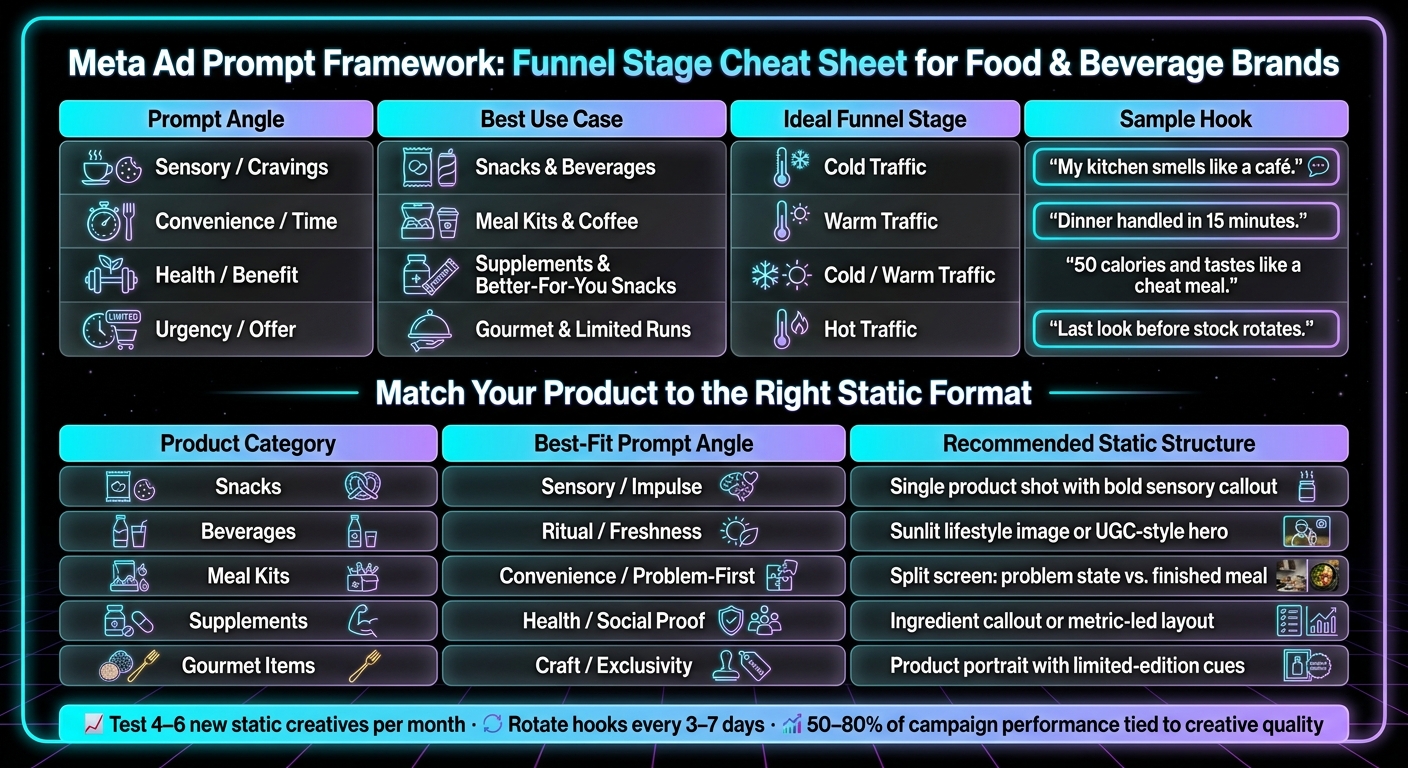
Meta Ad Prompt Framework: Funnel Stage Cheat Sheet for Food & Beverage Brands
After you generate angles and variations, use these tables to pick the right funnel stage and format. If you need more inspiration, use an ad creative idea finder to brainstorm unique concepts.
Keep this part quick. Think of it as a prompt-selection cheat sheet.
| Prompt Angle | Best Use Case | Ideal Funnel Stage | Sample Hook | Testing Objective |
|---|---|---|---|---|
| Sensory/Cravings | Snacks & beverages | Cold | "My kitchen smells like a café." | Thumb-stop rate |
| Convenience/Time | Meal kits & coffee | Warm | "Dinner handled in 15 minutes." | CTR / Add to Cart |
| Health/Benefit | Supplements & better-for-you snacks | Cold/Warm | "50 calories and tastes like a cheat meal." | Hook resonance |
| Urgency/Offer | Gourmet & limited runs | Hot | "Last look before stock rotates." | Conversion rate |
Then match the angle to the static layout most likely to sell it fast.
| Product Category | Best-Fit Prompt Angle | Recommended Static Structure |
|---|---|---|
| Snacks | Sensory / impulse | Single product shot with bold sensory callout |
| Beverages | Ritual / freshness | Sunlit lifestyle image or UGC-style hero |
| Meal kits | Convenience / problem-first | Split screen: problem state vs. finished meal |
| Supplements | Health / social proof | Ingredient callout or metric-led layout |
| Gourmet items | Craft / exclusivity | Product portrait with limited-edition cues |
For supplements, use group framing, not personal-attribute language.
Once you've matched the angle and format, write the prompt.
Conclusion
These prompts help turn product details into ad angles you can test, scale, and use across each funnel stage. The big win here is creative volume. More angles give you more chances to find what clicks, helping you optimize Meta ads for better performance, and these frameworks give you a repeatable starting point so you can keep coming up with new ideas without slowing your campaigns down.
Drop your product link into ADEN'S LAB and generate static ad variations in under 90 seconds. The prompts give you the angle. ADEN'S LAB turns that angle into static Meta ads fast.
FAQs
How do I choose the best ad angle for my product?
Test 3–5 clearly different ad angles with the same audience to find out what hits hardest. The key is to keep each angle separate, not slightly tweaked versions of the same idea.
For example, you might test:
- Problem-first
- Sensory-driven
- Result-led
- Social proof
Once you spot the winner, don't start from scratch. Build on it with small changes. Run A/B tests using one variable at a time so you can tell what actually made the difference.
And here's the part people often miss: the angle should match the customer's current emotional state or micro-moment. Someone who feels stuck may respond to a problem-first message. Someone close to buying may care more about results or proof from other customers.
What details should I include in each AI prompt?
Include the role, product, target audience, and the main pain point or goal. Then spell out the ad piece you need, any length limits, the tone, the emotion you want to tap into, and the visual idea so the copy and design work together.
Also ask for multiple variations. And tell the AI to ask clarifying questions about your offer or audience before writing, so the output fits your campaign goals more closely.
How often should I refresh Meta ad creatives?
There’s no fixed schedule for refreshing Meta ad creative. The better approach is to test on a regular basis and make changes based on the numbers.
Run A/B tests with different ad versions, then use performance metrics to shape your next move. Look at those results in the context of your goals. If performance slips far enough, that’s your cue to refresh the creative.
Your next ad batch starts here
Finish with a ready-to-test ad batch
Paste your website to generate static creatives. Drop the link → get ads in about 90 seconds → upload them to Meta → scale.
Free to try No signup No prompt writing