Ingredient and Feature Callout Prompts for Static Meta Ads
Build the ads while the examples are fresh
Turn your product page into static ad creatives
Paste your product URL and generate scroll-stopping images, headlines, and primary text—ready for your next Meta creative test.
No design brief or prompt writing required.

Static Meta ads work best when I keep them to one message and put the payoff first. This article shows me how to pick one callout angle - ingredient, feature, proof, or differentiator - then tie it to the buyer’s main objection.
Here’s the short version:
- Use one angle per ad. Ads with a single focus can lift conversion rates by 52%.
- Put value first. Meta primary text often gets cut off at around 125 characters, so the main benefit needs to show up early.
- Match the angle to the job:
- Ingredient-focused: when what’s inside the product helps build trust
- Feature-to-outcome: when I need to show how a feature leads to a result
- Proof-led: when buyers already get the offer but still doubt it
- Differentiator-based: when I need a clear reason to choose this over other options
- Write for the funnel.
- Warm traffic: ingredient and feature callouts often fit best
- Hot traffic: proof callouts help remove doubt
- All stages: differentiator angles can work when the market feels crowded
- Keep the visual simple. One image. One message. Short overlay text.
- Focus on outcomes, not specs. “Smooth skin in two weeks” lands faster than “advanced formula.”
- Use numbers when I can back them up. Examples like 40% off or 10,000 more people reached help the message land fast.
Here’s a fast side-by-side view:
| Angle | Best use | Main goal |
|---|---|---|
| Ingredient | Warm audiences | Show quality and transparency |
| Feature | Warm audiences | Turn a product detail into a buyer result |
| Proof | Hot audiences | Lower doubt with data, reviews, or guarantees |
| Differentiator | Any stage | Show why this option wins |
Bottom line: if I want a static Meta ad to land fast, I should pick one angle, answer one objection, and make the benefit obvious in the first glance.
How I Make AI Static Ads (in minutes)
sbb-itb-628c49f
How to Choose the Right Callout Angle Before You Prompt
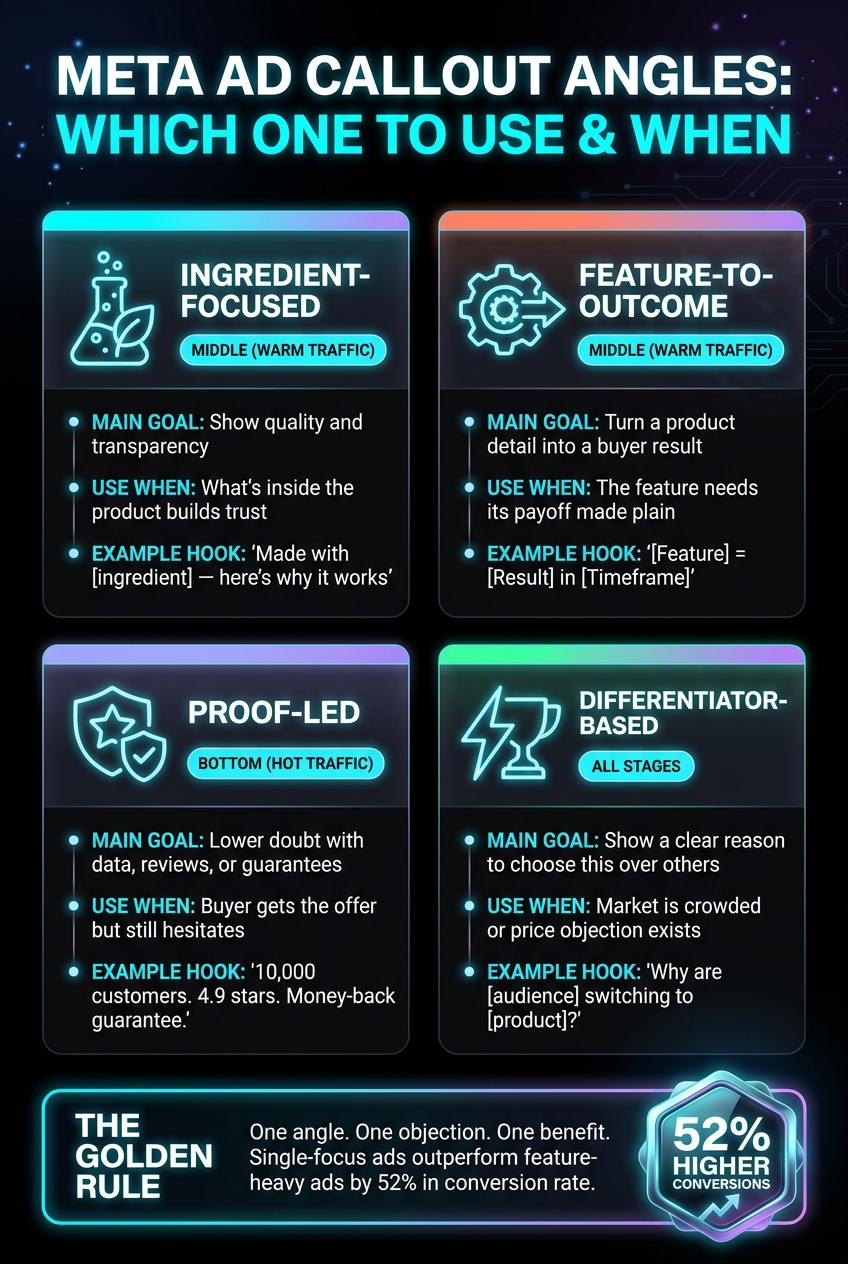
Meta Ad Callout Angles: Which One to Use & When
Choose one callout angle before you start writing. Then tie that angle to the audience’s main objection. After that, turn it into a static callout prompt.
Why keep it to one angle? Because clutter hurts performance. Single-focus ads outperform feature-heavy ads by 52% in conversion rate. So instead of stuffing everything into one ad, pick the main message and let it do the heavy lifting.
Each angle does a different job:
- Ingredient-focused callouts show quality through transparency.
- Feature-led callouts explain how the product works.
- Proof-led callouts lower skepticism.
- Differentiator-based callouts help you stand apart in crowded markets.
The table below shows where each angle tends to work best in the funnel:
| Angle Type | Best Funnel Stage | Use Case |
|---|---|---|
| Ingredient-focused | Middle (Warm) | Composition drives trust or quality |
| Feature-led | Middle (Warm) | Utility needs fast explanation |
| Proof-led | Bottom (Hot) | Skepticism is the main barrier |
| Differentiator-based | All stages | Crowded market or price objection |
For cold traffic, lead with the outcome first. That gives people a quick reason to care. As the audience warms up, you can layer in ingredient, feature, proof, or differentiator detail. Those angle choices should shape the ingredient-focused prompts below.
1. Ingredient-focused
Ingredient callouts work best when they start with the payoff and then name the ingredient. That order matters. Most people care about what the product does for them first, and only then about what’s inside it.
Use these prompt angles when the ingredient is part of the pitch, not just extra background. Put the result up front. Then bring in the ingredient as the reason that result happens.
Here are five ways to turn ingredients into sharper static ad callouts:
- Outcome-first ingredient callout Start with the result, then name the ingredient behind it. This is a good fit when the ingredient name by itself doesn’t mean much to the average buyer. Prompt example: "Write a static Meta ad headline and primary text for [product]. Lead with the result in the first line. Name the key ingredient in the second line. Keep the headline under 40 characters."
- Pain point + material solution Frame the ingredient or material as the direct answer to a problem the customer already wants fixed. Prompt example: "Write a static Meta ad for [product] that names [ingredient/material] as the direct solution for [specific pain point]. Include a one-line trust signal like a money-back guarantee."
- Data-backed ingredient callout Open with the ingredient, then add one proof point to support the claim and help the ad feel more grounded. Prompt example: "Write a static Meta ad for [product] that leads with [ingredient] and supports the claim with a clinical study or data point. Keep the primary text under 125 characters."
- Quality vs. trend contrast Keep the ingredient at the center, then compare it with a common weaker option. This works well when buyers have seen flashy trends and need a plainspoken reason to pick yours instead. Prompt example: "Write a static Meta ad for [product] that leads with [your key ingredient/material] and contrasts it against a common alternative. Frame [your ingredient] as the safer long-term choice."
- Exclusivity + urgency ingredient hook If there’s a limited-edition formula or a recent formula update, use it to give people a reason to act now instead of later. Prompt example: "Write a static Meta ad for [product] that highlights [ingredient or formula update]. Pair it with a short urgency line such as 'Only [X] units left' or 'Available through [date].'"
If the ingredient isn’t the main hook, shift to feature-led prompts next.
2. Feature-to-outcome
Feature-to-outcome prompts turn product specs into customer results. They work best when the feature is legit, but the buyer still needs the payoff made plain.
Here are five feature-to-outcome prompt angles for static Meta ads:
- Single-feature, single-result callout Keep it simple: one feature, one result. No piling on extras. Prompt example: "Write a headline and primary text for [product]. Name one feature in the headline. State the single result it delivers in the primary text. Headline under 40 characters, primary text under 125 characters."
- Time-bound outcome hook A set timeframe makes the benefit feel more concrete and easier to picture. Prompt example: "Connect [feature] to a specific result the customer can expect within [timeframe]. Lead with the timeframe in the first line."
- Future-self mirror Don’t lead with the spec. Start with the after-state instead: what life feels like once the problem is gone. Prompt example: "Open with a one-sentence after-state - what the customer's day looks like once [feature] has solved [problem]. Introduce the feature only in the second line."
- Micro-moment targeting Link the feature to a very specific moment, like the "5 p.m. panic" of not having dinner ready. Prompt example: "Open with a specific moment or emotional state your customer faces at [time of day or situation]. Connect [feature] to the relief or result that follows."
- Curiosity-gap outcome Tease the result without saying it outright. Then bring in the feature on the second line. Prompt example: "Hint at the outcome of [feature] without stating it directly. Use a curiosity-gap opener like 'The simplest way to [result] starts here.' Reveal the feature in the second line."
3. Proof-led
Proof-led prompts work because they let the evidence speak first. Numbers, outside validation, customer wording, and guarantees can make a claim feel believable in a split second.
This angle works best when the buyer already gets the offer but still pauses before taking action. At that point, feature copy often isn't enough. You need proof.
Here are five proof-led prompt angles for static Meta ads:
-
Press quote overlay
Put a known press mention right on the image so people see the proof at once. Bed Threads, for example, uses a text overlay with a direct Vogue quote on its static image.
Prompt example: "Write a headline and primary text for [product] that references a press mention from [publication]. Use the quote as the image overlay. Keep the headline under 40 characters and primary text under 125 characters."
-
Hard-number credibility hook
A clear figure usually lands faster than a vague promise. "Save 40%" or "Reach 10,000 more people" gives the buyer something solid to hold onto.
Prompt example: "Open the headline with one proof number tied to [result] - such as a percentage improvement, a customer count, or a clinical result. State what that number means for the buyer in the primary text."
-
Third-party validation
Outside proof often carries more weight than brand copy on its own.
Prompt example: "Pair [claim] with a study result, certification, or independent validation. Lead with the proof in the headline, then translate it into customer value in one sentence."
-
Peer testimonial mirror
Customer-like wording can work better than a stiff quote. Fly By Jing uses praise from review accounts to back up new product launches.
Prompt example: "Write primary text in a customer voice that describes the result of [feature or ingredient]. Address one specific pain point. Keep it under 125 characters and avoid brand-speak."
-
Risk-reversal proof close
A money-back guarantee lowers friction. It hits even harder when you pair it with a proof point like a star rating, customer count, or result timeline.
Prompt example: "Combine a proof point such as a star rating, customer count, or result timeframe with a money-back guarantee in the primary text. End with the guarantee. Keep total copy under 125 characters."
When proof alone doesn't set the offer apart, the next move is differentiator-based prompts.
4. Differentiator-based
Use differentiator prompts when your offer needs a fast, clear reason to pick you. The difference should be concrete, specific, and easy to grasp at a glance.
This angle works best when the main hook is what makes you different, not just proof.
Start by choosing the differentiator. Then turn that into one static ad hook.
Here are five differentiator-based prompt angles to use:
-
Direct price comparison: Put your price next to the usual market price. Element Brooklyn ran Facebook ads that compared its soap refills at $12 with the luxury scents they mimic at $40+, making savings the main hook.
Prompt example: "Write a headline and primary text for [product] that places our price of [amount] next to the typical market price of [amount]. Keep the headline under 40 characters and frame the savings as the lead hook."
-
Quality-over-flash framing: Point out what your product does not do when that trade-off signals better quality. Made In Cookware used the line "Ditch the colorful coatings and invest in timeless non-toxic cookware that lasts" to frame durability as the smarter choice.
Prompt example: "Write primary text for [product] that positions [quality attribute] as a deliberate trade-off against [common industry gimmick]. Lead with the trade-off. Keep copy under 125 characters."
-
Specific pain-point hook: Call out one exact frustration buyers deal with every day. L:a Bruket set apart a standard lip balm by leading with a portable lip balm sleeve, solving the common problem of losing it.
Prompt example: "Write a headline for [product] that calls out one niche frustration - something buyers experience daily but rarely see addressed in ads. Pair it with a one-line solution in the primary text."
-
Ingredient-clarity hook: Lead with ingredient or formula clarity. Dieux Skin broke down the science behind its Mini Angel Air Gel Cream and made formula transparency the selling point.
Prompt example: "Write a headline and primary text for [product] that leads with one ingredient fact or formulation detail. Translate it into a plain-language outcome in the second sentence."
-
Curiosity-gap hook: Turn the differentiator into a question. This tends to work well for SaaS and lead gen offers when the mechanism is not obvious right away.
Prompt example: "Write a headline for [product or service] that frames [key differentiator] as a question - 'Why are [audience] switching to [product]?' Follow with a one-sentence primary text that answers it directly."
Tips for Framing Strong Static Callouts Across E-commerce, SaaS, and Lead Gen
Once you have your angle, shape it for e-commerce, SaaS, and lead gen before you generate the ad copy.
The big rule is simple: static ads fall flat when they cram in too much. Stick to one image and one message. Every callout prompt should pass a quick glance test. If someone can't read it in a second or two, trim it.
Across all three use cases, lean on outcomes, not features. The angle can stay the same. What changes is the result the buyer cares about.
| Context | Feature-Based (Avoid) | Outcome-Based (Use) |
|---|---|---|
| E-commerce | "Advanced hyaluronic acid formula" | "Smooth, glowing skin in two weeks" |
| SaaS | "Automated bidding algorithm" | "Smarter Ads, Lower Costs" |
| Lead Gen | "Database of 500,000 professionals" | "Get More Clients This Month" |
Specific proof helps too. Numbers like "Save 40%" or "Reach 10,000 more people" build trust fast. If you can't back up the number, don't force it. Rewrite the line around a direct result instead.
"Use numbers when you can. 'Save 40%' or 'Reach 10,000 more people' gives your headline immediate credibility." - LeadEnforce
Before you lock the prompt, run two checks.
- Mobile readability: Keep overlay text short. If it doesn't read at a glance on a phone, it's too long.
- Objection fit: Tie each callout to the buyer's main concern, whether that's price, trust, complexity, or doubt about results.
That way, the ad answers a real question instead of just listing a feature.
Conclusion
This prompt library helps turn product facts into static Meta ad callouts that can help products sell faster. But simply naming an ingredient or feature isn't enough.
Strong static Meta ads get to the point fast. They answer the buyer's question right away: What does it do? Why does it matter? Why is it the better choice?
The four angles here - ingredient-focused, feature-to-outcome, proof-led, and differentiator-based - give you repeatable starting points for faster concepts. Use these prompts to build stronger static ads with less guesswork. Pick one angle, pair it with one objection, and write the callout for e-commerce, SaaS, or lead gen.
FAQs
How do I choose the best callout angle?
Focus on the pain points and benefits that matter most to your target audience on your product page. Start with your product’s features, ingredients, or components, then turn them into direct answers to common customer objections.
Put simply: show people why this product solves their problem.
If you want to move faster, drop your product link into the ADEN'S LAB generator. It can spin up multiple ad concepts based on your offer, which makes it easier to test different angles without starting from scratch.
What objection should each static Meta ad answer?
Each static Meta ad should tackle one clear customer pain point or objection from your audience research.
Start with the struggle that matters most to your audience. Then use the headline and callouts to position your product as the answer. If the concern is ingredient efficacy, price, or performance, turn product features into plain, benefit-led outcomes.
The goal is simple: answer the doubt, show what the product does for them, and give people a clear reason to click and convert.
How can I adapt these prompts for e-commerce, SaaS, and lead gen?
Adjust the value proposition so it lines up with what the audience wants right now.
For e-commerce, lead with product benefits, quality, and sensory appeal. Help people picture what the product feels like, how it works, and why it’s worth buying.
For SaaS, translate technical features into clear business outcomes. Don’t just name the feature. Show what it helps users do, whether that’s saving time, cutting manual work, or getting better results.
For lead gen, put the spotlight on high-value incentives and urgent pain points. Give people a strong reason to act now, and make the payoff for filling out the form feel obvious.
Keep the tone clear, punchy, and focused on benefits.
Create Ads That Print Money
Your competitors aren't waiting — why should you? Drop your product link → get scroll-stopping ads in 90 seconds.