Copy-Paste AI Prompts for Scaling Meta Ad Creatives at Volume
Use the prompts on your real offer
Generate these ad angles for your product
Skip the blank prompt box. Paste your product page and ADEN'S LAB applies the angles to your offer, images, headlines, and copy.
Free to try No prompt writing

Scaling Meta ad campaigns is tough. High costs, creative fatigue, and limited testing bandwidth can slow you down. But AI-generated prompts offer a faster, more efficient way to produce ad variations that perform. Here's what you need to know:
- Save Time: AI tools cut creative development time by 30–50%, letting you produce 2–3x more ad variations weekly.
- Boost Results: Test multiple angles, headlines, and visuals to lower customer acquisition costs (CAC) and improve performance.
- Adapt Across Niches: Whether you're in e-commerce or SaaS, AI can generate tailored ads using customer reviews, persona-driven copy, and more.
- Proven Systems: Frameworks like the "12-Pack Matrix" and "Problem-to-Proof Carousel Builder" streamline ad creation and scaling.
Want to create scroll-stopping ads, scale winning creatives, or turn customer feedback into high-performing campaigns? Start using these AI prompts to test and refine faster than ever.
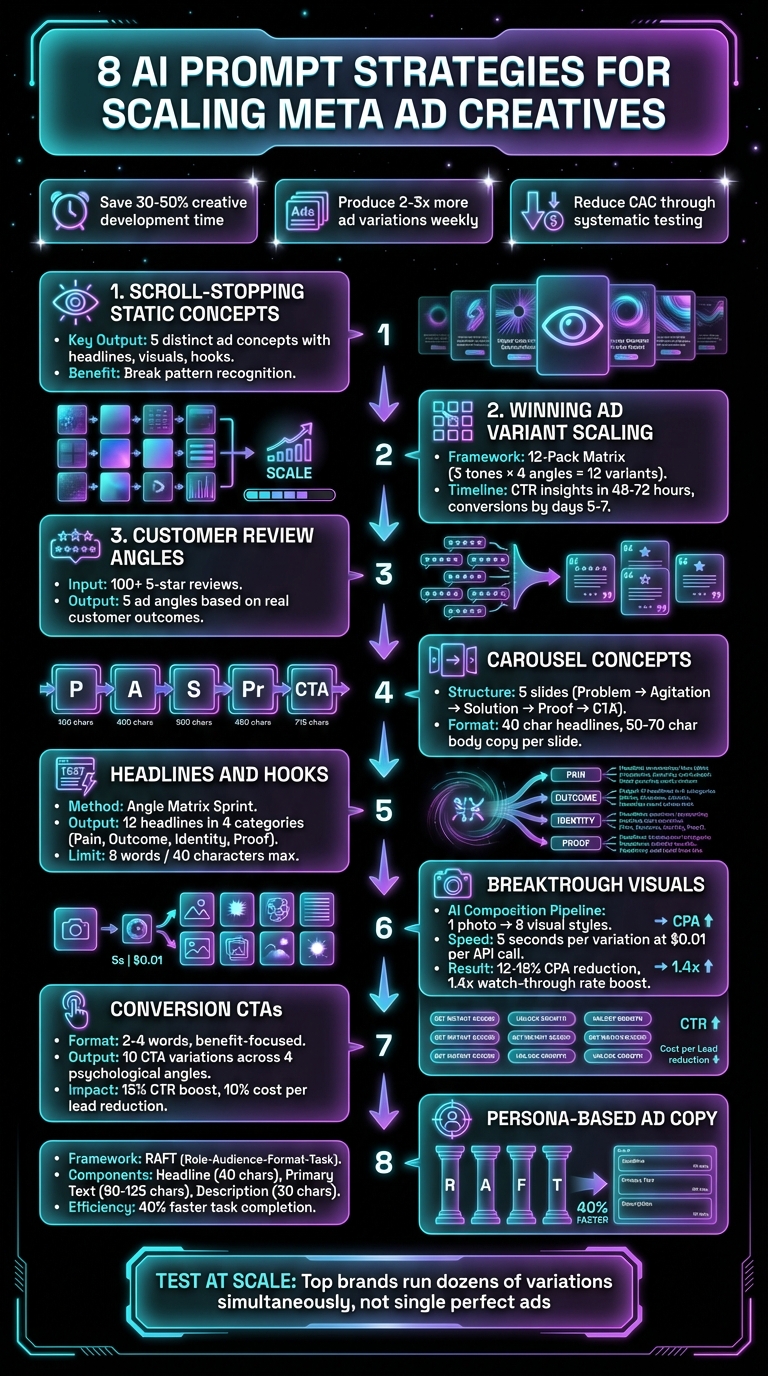
8-Step AI Prompt Framework for Scaling Meta Ad Creatives
How to Scale Your Meta Ads with AI Like a PRO
Put the playbook to work
Apply this playbook to your page
Paste your website and the Lab will turn the strategy you are reading into a ready-to-test ads.
Free to try No prompt writing
1. Scroll-Stopping Static Concepts
"The Strategist Prompt" – Create High-Impact Static Ad Ideas in Seconds
Static ads often get sidelined, with many brands defaulting to user-generated content (UGC) or basic product shots. But Jake Cronin, a Paid-Ads Specialist, highlights their untapped potential:
"Brands Overlook Static. It Often Outperforms UGC When Done Right."
The secret? Disrupting the endless scroll. To achieve this, your AI prompt should take on a high-level, strategic tone and focus on psychological triggers that grab attention. Here's a framework that works:
Copy-Paste Prompt:
"You're A Senior Static Ad Strategist. Generate 5 Distinct, High-Performing Static Ad Concepts For [Product] With Unique Headlines, Visual Formats, And Hooks. Focus On Thumb-Stopping Contrast, Tension, Or Curiosity."
This approach ensures the AI delivers three key elements for each concept: a compelling headline, a description of the visual format, and a hook designed to stop users mid-scroll. The result? Ideas that stand out in a crowded feed.
Copy-Paste Prompt (Visual Innovation):
"Act Like A Creative Director At An Agency Known For Viral DTC Ads. Propose 5 Bold Visual Concepts For [Product] That Interrupt Scrolling, Using Unexpected Comparisons, Metaphors, Or Pop Culture References."
This alternative prompt encourages even bolder creativity, breaking away from tired, generic visuals. Cronin explains why this strategy is effective:
"Everyone's Using The Same Formats. These [visual concepts] break pattern recognition."
Instead of yet another product-on-a-white-background ad, you get ideas that leverage surprising elements to grab attention and hold it.
2. Winning Ad Variant Scaling
"The 12-Pack Matrix" – A System for Generating Ad Variants
Once you’ve identified a winning ad, it’s time to scale ad testing to find more winners. Enter the "12-Pack Matrix", a framework designed to create 12 distinct ad variants based on one successful concept. This method combines three tones - Confident, Friendly, and Urgent - with four angles - Outcome, Problem Relief, Social Proof, and Offer. The result? A structured approach to testing multiple variations effectively.
This matrix helps streamline the creative process, offering a repeatable system for testing and refining ad performance.
When working with this framework, instruct your AI to generate specific ad components: Headline (max 40 characters), Primary Text (90–125 characters), Description (30–40 characters), CTA, Visual Direction, and Overlay Text. As Jeff Bullas aptly notes:
"Your job becomes picking angles, not wordsmithing from scratch".
Ready-to-Use Prompt for AI:
"You're a Meta Ads Specialist. Take this Winning Ad Concept: [Insert Concept]. Generate 12 variants using a matrix of 3 tones (Confident, Friendly, Urgent) and 4 angles (Outcome, Problem Relief, Social Proof, Offer). For each variant, provide: Headline (Max 40 chars), Primary Text (90–125 chars), Description (30–40 chars), CTA, and Visual Direction. Include a policy check to avoid Meta red flags."
Key Tips for Effective Scaling
To ensure meaningful results, fix certain elements - like visuals and CTAs - while varying only the headlines and primary text. This approach ensures that any performance differences are tied directly to changes in messaging, not other factors.
After launching these variants, you can expect click-through rate (CTR) insights within 48–72 hours. Conversion rates typically stabilize by days 5–7. Once a winning angle emerges, take it a step further with a "Headline Sprint" prompt. This generates 10+ alternative hooks to refine CTR even further, all while keeping visuals consistent.
3. Customer Review Angles
"The Review-to-Angle Engine" – Using Real Customer Feedback for Effective Ads
Customer reviews are a goldmine for understanding how people talk about your product. They reveal the benefits that resonate most and the objections your product has successfully addressed. By analyzing these reviews, you can uncover ad angles that immediately connect with new audiences.
Here’s the key: specificity matters. Generic praise like “great product” won’t grab attention. Instead, detailed stories about transformations, solved problems, or those “aha” moments when customers realized the product’s value are what drive conversions. AI can sift through hundreds of reviews in seconds, spotting patterns and pulling out fresh, relatable messaging that feels authentic rather than overly polished. This is how we produce hundreds of ads on autopilot without losing that human touch.
Jake Cronin, a Paid-Ads Specialist, sums it up perfectly:
"Instantly turns social proof into fresh messaging. No guesswork".
To make the most of this, use the following AI prompt:
Ready-to-Use Prompt for AI:
"You're a Creative Strategist for Scaling E-commerce Brands. Analyze 100+ 5-star reviews for [Product Name] and pull out 5 ad angles based on real customer outcomes, unexpected benefits, or objections that were overcome. For each angle, write: Headline (max 40 chars), Primary Text (90–125 chars), Description (30–40 chars), and Visual Direction. Base all claims strictly on review evidence."
This approach ensures that your Meta ad copy stays grounded in what real customers are saying. Instead of relying on assumptions or marketing jargon, the messaging mirrors the language and sentiments of your audience. That’s why it feels so credible - it’s built on the words of the people who already love your product.
4. Carousel Concepts
"The Problem-to-Proof Carousel Builder" – Structuring Multi-Slide Stories That Convert
Carousel ads often fail because their slides feel disconnected. To make carousels work, every slide needs to flow like a story, guiding viewers from recognizing a problem to taking action.
A proven structure to follow is the Problem → Agitation → Solution → Proof → CTA framework. Here’s how it breaks down across five slides:
- Slide 1: Highlight the pain point.
- Slide 2: Emphasize the urgency or consequences of the problem.
- Slide 3: Present your solution.
- Slide 4: Show proof, like testimonials or results.
- Slide 5: End with a clear and compelling call-to-action.
Jake Cronin, a Paid-Ads Specialist at HOC Digital Solutions, puts it perfectly:
"Carousels Are Underused Goldmines When Executed With Strategy."
To simplify the process, here’s a ready-to-use AI prompt: (which works best when paired with the right AI tools for Meta ads)
Ready-to-Use Prompt for AI:
"Assume the role of a Meta Ad Designer. Create A Carousel Ad Concept For [Product] With 5 Slides. Each Slide Should Progress A Single Story Or Benefit, Ending In A Strong CTA. Think: Problem → Agitation → Solution → Proof → CTA. For each slide, provide: Visual Direction (what to show), Headline (max 40 chars), and Body Copy (50–70 chars). Make slide 4 focus specifically on customer proof or results."
This method transforms static images into a dynamic, story-driven experience. By leading viewers through a clear narrative in just five swipes, you can help them move seamlessly from curiosity to conversion.
5. Headlines and Hooks
"The Angle Matrix Sprint" – Creating 12 Headlines in Under 60 Seconds
Headlines are your first impression, and the best ones grab attention in under 8 words. Yet, many marketers only test one or two headline options before launching, leaving untapped opportunities for better results.
The Angle Matrix method, or using a high-CTR ad headline generator, offers a quick, structured way to fix this. It uses four psychological angles - Pain, Outcome, Identity, and Proof - to generate 12 headline variations. Each angle taps into a different emotional trigger, ensuring your message resonates with diverse audience segments.
Great headlines need to be clear, evocative, and intriguing. Here's a ready-to-use AI prompt to get started:
Ready-to-Use Prompt for AI:
"Act as a senior performance copywriter specializing in Meta Ads. Generate 12 headline variations for [Product/Service] targeting [Persona]. Keep each headline within 8 words (40 characters) for mobile clarity. Organize the headlines into four categories: Pain (highlight the problem), Outcome (focus on the benefit), Identity (speak to who they want to become), and Proof (incorporate social proof or data). For each headline, score it from 1 to 10 on clarity, emotion, and curiosity. Exclude generic adjectives such as 'innovative' and 'seamless.' Ensure brevity and impact."
Once you’ve picked a winning headline, take it further. Create 10+ micro-variations of the headline while keeping the visuals and body copy consistent. This lets you measure performance gains and fine-tune your approach for the best results. For a deeper dive into this process, follow our A/B testing Meta ads guide.
6. Breakthrough Visuals
"The AI Composition Pipeline" – Transforming One Product Photo Into 12 Styles That Fit Your Brand
Photoshoots can be slow and expensive, but Meta's algorithm thrives on fresh, creative content to keep ad performance strong. This is where the AI Composition Pipeline comes in, turning a single product photo into multiple, brand-aligned visuals in just seconds.
Imagine this: instead of booking a studio, hiring models, and waiting weeks for results, you can create Hero Shots for sleek e-commerce ads, Lifestyle images for social media engagement, and Flat Lays perfect for Instagram - all from one source image. Each variation costs roughly $0.01 per API call and is ready in just 5 seconds. This process eliminates traditional production delays, letting you refresh your creatives at lightning speed.
Meta also offers native tools to streamline this further. Features like Image Expansion (for adjusting aspect ratios) and Background Generation (for adding dynamic colors and patterns) make testing new ad creatives even easier.
This approach isn’t just fast - it’s effective.
"Creative production is the bottleneck in Meta ads performance. Testing requires multiple variations, but traditional production means photographers, models, and weeks of turnaround." – Benjamin Falkeborg, Rabbitmetrics
A Ready-to-Use AI Prompt for Meta Ads
"Act as a Meta Ads creative director. Using the product image [Insert Product URL or Description], generate 8 optimized visual compositions for Meta placements: (1) Hero Shot – clean white background, centered product, studio lighting; (2) Lifestyle Context – model or person using product in realistic setting; (3) Flat Lay – overhead shot with complementary props; (4) Before/After Split – show transformation or results; (5) Close-Up Detail – highlight key product feature or texture; (6) In-Hand Shot – product being held or demonstrated; (7) Contextual Environment – product in target use location (kitchen, office, gym); (8) Minimal Color Pop – solid color background that contrasts with product. For each, specify the camera angle, lighting, and background. Optimize all outputs for 1:1 (Feed) and 9:16 (Reels/Stories) aspect ratios. Ensure brand safety and visual consistency across all variations."
Once you’ve got your visuals, use the Visual Matrix approach to test combinations of headlines, visuals, and CTAs. This strategy helps identify which combinations perform best instead of relying on a single asset. For example, testing product-focused thumbnails against lifestyle images has been shown to reduce CPA by 12–18%, while UGC-style demos can boost watch-through rates by 1.4x compared to polished branded content. Pair these visuals with your text variations to build a high-performing, comprehensive ad campaign.
7. Conversion CTAs
"The Benefit-First CTA Generator" – Turning Generic Buttons Into Revenue-Driving Actions
Just like a great ad creative, a strong call-to-action (CTA) ties your campaign together by pushing people to act. A short, benefit-focused CTA - typically just 2–4 words - can make a noticeable difference in performance, especially when your audience starts to lose interest after about 23 days. The most effective CTAs mix a sense of urgency with clear benefits and are tailored to how your target audience makes decisions. For example, instead of something basic like "Shop Now", try "Get My Free Guide."
To take it a step further, pair your CTAs with psychological triggers or automate your ad production to save time. Here are some examples:
- Scarcity: "Limited time" or "Offer ends soon" to create FOMO (fear of missing out).
- Social Proof: Highlight popularity, like "Join 1,000 happy customers."
- Authority: Lean on your brand's expertise or leadership position.
- Logical Benefits: Focus on practical reasons, like savings or ROI.
These strategies help craft CTAs that truly connect with your audience and drive conversions.
A Ready-to-Use AI Prompt for Meta Ads
"Act as a senior performance copywriter specializing in Meta Ads. Generate 10 benefit-focused, urgency-infused CTAs (2–4 words) using these button options: Shop Now, Learn More, Book Now, Sign Up, Download, Get Offer. The audience is [Insert Target Persona] and the offer is [Insert Specific Offer]. Generate variations using four distinct psychological angles: (1) Scarcity – emphasize limited availability or time-sensitive offers; (2) Social Proof – reference high user ratings or customer volume; (3) Authority – position the brand as a leading expert; (4) Logic – focus on practical benefits and ROI. Ensure outputs comply with Meta policies and avoid personal attributes or misleading guarantees. End each CTA with an emoji that signals the appropriate emotion (e.g., urgency or calm confidence)."
Deploy these 10 CTA variations in Advantage+ for automatic optimization. Studies show this method can boost click-through rates by 15% and reduce cost per lead by 10% compared to using generic CTAs.
8. Persona-Based Ad Copy
"The Persona Simulator" – Crafting Messages That Truly Connect
Generic ads? They’re easy to ignore. But when your copy feels like it’s speaking directly to someone, it grabs attention. That’s where persona-based ad copy comes in. By using AI to simulate your ideal customer, you can create messages tailored to their specific traits, challenges, and desires. This approach ensures your ads resonate on a deeper level.
A great way to structure persona-based prompts is by using the RAFT framework (Role-Audience-Format-Task). To get the most out of AI, provide detailed context about your audience - things like their age, pain points, level of awareness, and demographics. For instance, instead of targeting a vague group like "parents", narrow it down: "busy parents, aged 30–45, who feel guilty about feeding their kids processed food and struggle with meal prep."
And don’t stop there. Once you’ve written your ad copy, have the AI evaluate it. Ask it to score your work for clarity, relevance, and emotional impact on a 1–10 scale. You can even instruct the AI to act as a "Target Persona Reviewer" to ensure your message connects before you hit publish. For those looking to skip the manual drafting process, you can generate Meta ads automatically using AI-powered tools. This feedback loop has proven to save time too - teams report a 40% increase in task completion speed, which means you can iterate Meta ads at scale faster.
Ready-Made AI Prompt for Meta Ads
Here’s a practical example of how you can use AI to refine your ad copy:
"Act as a Target Persona Reviewer. You are a [Insert Specific Persona: e.g., 35-year-old working mom, lives in suburban Dallas, earns $75,000/year, struggles with meal planning, values convenience and health, currently solution-aware]. Review the following Meta ad copy and score it on a scale of 1–10 for: (1) Clarity – Is the message immediately understandable? (2) Relevance – Does it address specific pain points and desires? (3) Emotional Resonance – Does it make the persona feel understood and motivated to act? Provide your scores with brief explanations. Then, rewrite the copy using the Problem-Agitate-Solution (PAS) formula and conversational language. Format the output as: Headline (under 40 characters), Primary Text (90–125 characters), Description (under 30 characters), and CTA."
This prompt helps you shift your focus from dry product features to the emotional transformation your audience seeks. After all, as David Ogilvy famously said:
"If it doesn't sell, it isn't creative".
The key takeaway? Emotional connection drives results, and persona-based ad copy ensures your message hits home.
Conclusion
From static ideas to persona-focused copy, these prompts lay the groundwork for a streamlined, data-focused creative strategy. Scaling Meta ad creatives doesn’t have to mean spending more or relying on tedious manual work. With these tools, you can quickly produce dozens of ad variations, helping to reduce CPA and improve ROAS.
Whether you're working on static ads, leveraging customer reviews, or tailoring messages to specific personas, these prompts simplify the creative process. Marketers using AI-assisted workflows can complete tasks faster, enabling quicker iterations and optimizations. By systematically testing different hooks, visuals, CTAs, and persona-driven messaging, you let the data guide you toward what resonates most. This approach has already helped brands cut CAC while maintaining - or even enhancing - campaign performance by increasing creative variety.
Testing at scale is the key to success. The top-performing brands on Meta aren’t relying on a single perfect ad - they’re running dozens of variations, constantly testing and scaling what works. Start using these AI prompts today by focusing on the area that challenges you most - whether it’s finding fresh angles through customer reviews, scaling proven ideas, or developing persona-specific messaging. The sooner you start testing, the closer you’ll be to discovering your next high-performing creative.
Dive in now to test, iterate, and scale faster than your competition.
FAQs
How can AI-generated prompts help speed up the creation of Meta ad creatives?
AI-generated prompts make crafting Meta ad creatives faster and easier by offering marketers pre-made ideas designed to align with their specific objectives. This means less time spent brainstorming and designing, and more time producing engaging ad variations - often in just minutes.
By automating much of the creative process, these prompts do more than just save time. They allow businesses to scale campaigns effortlessly, test a variety of ad concepts, and refine performance. The result? Marketers can focus on strategies that cut costs and drive better outcomes.
What is the '12-Pack Matrix,' and how does it help scale Meta ad creatives?
The '12-Pack Matrix' is a method designed to scale Meta ad creatives by producing multiple variations of a winning ad. Essentially, it involves creating 12 or more versions of an ad, each featuring different hooks, visuals, or messaging styles. This allows marketers to test a variety of combinations to see what resonates most with their audience.
By applying this framework, you can pinpoint the elements that drive better performance - think higher click-through rates (CTR) or improved return on ad spend (ROAS). Plus, it simplifies the creative process, cutting down on both time and expenses, while making it easier to adjust based on audience feedback.
How can customer reviews help create better ad ideas?
Customer reviews are a treasure trove for generating impactful ad ideas. They offer a direct window into what customers genuinely care about, the challenges they face, and the benefits they’ve experienced. By utilizing AI tools to analyze these reviews on a larger scale, marketers can identify common themes, recurring positive feedback, and frequently mentioned concerns. This information can then shape ad messaging that aligns with customer priorities or emphasizes social proof.
For instance, reviews can uncover emotional triggers or highlight specific product features that resonate most with your audience. By weaving this language into your ads, you can make them feel more relatable and engaging, which can lead to higher conversions and stronger customer trust. Using customer feedback in this way doesn’t just make your ads more effective - it also helps you create campaigns that address real customer needs and priorities.
Your next ad batch starts here
Finish with a ready-to-test ad batch
Paste your website to generate static creatives. Drop the link → get ads in about 90 seconds → upload them to Meta → scale.
Free to try No prompt writing