Best Meta Ad Prompts for Ecommerce Brands
Use the prompts on your real offer
Generate these ad angles for your product
Skip the blank prompt box. Paste your product page and ADEN'S LAB applies the angles to your offer, images, headlines, and copy.
Free to try No prompt writing

Creating Meta ads that drive results is challenging, but AI prompts can help you save time and reduce costs. By using precise prompts, ecommerce brands can quickly generate and test ad creatives that resonate with their audience. For example, Shein increased their click-through rate by 45% and reduced cost-per-acquisition by 28% using AI-generated ads, leading to $15M in additional revenue. This guide breaks down seven key ad prompt strategies to improve performance:
- Problem-Solution Hooks: Address audience pain points upfront to grab attention.
- Ad Variants: Optimize top-performing ads by testing small tweaks in headlines, visuals, or CTAs.
- Customer Reviews: Turn real buyer feedback into persuasive ad copy.
- Carousel Ads: Use multi-card storytelling to engage users and boost conversions.
- Aspirational Messaging: Focus on the lifestyle benefits your product delivers.
- Visual Angles: Test diverse visuals to match audience preferences and fight ad fatigue.
- High-Impact Hooks: Use customer-inspired language to create attention-grabbing headlines.
AI tools like ADEN's LAB simplify this process, letting you test dozens of ad variations weekly. Success comes from speed, testing, and focusing on what connects with your audience.
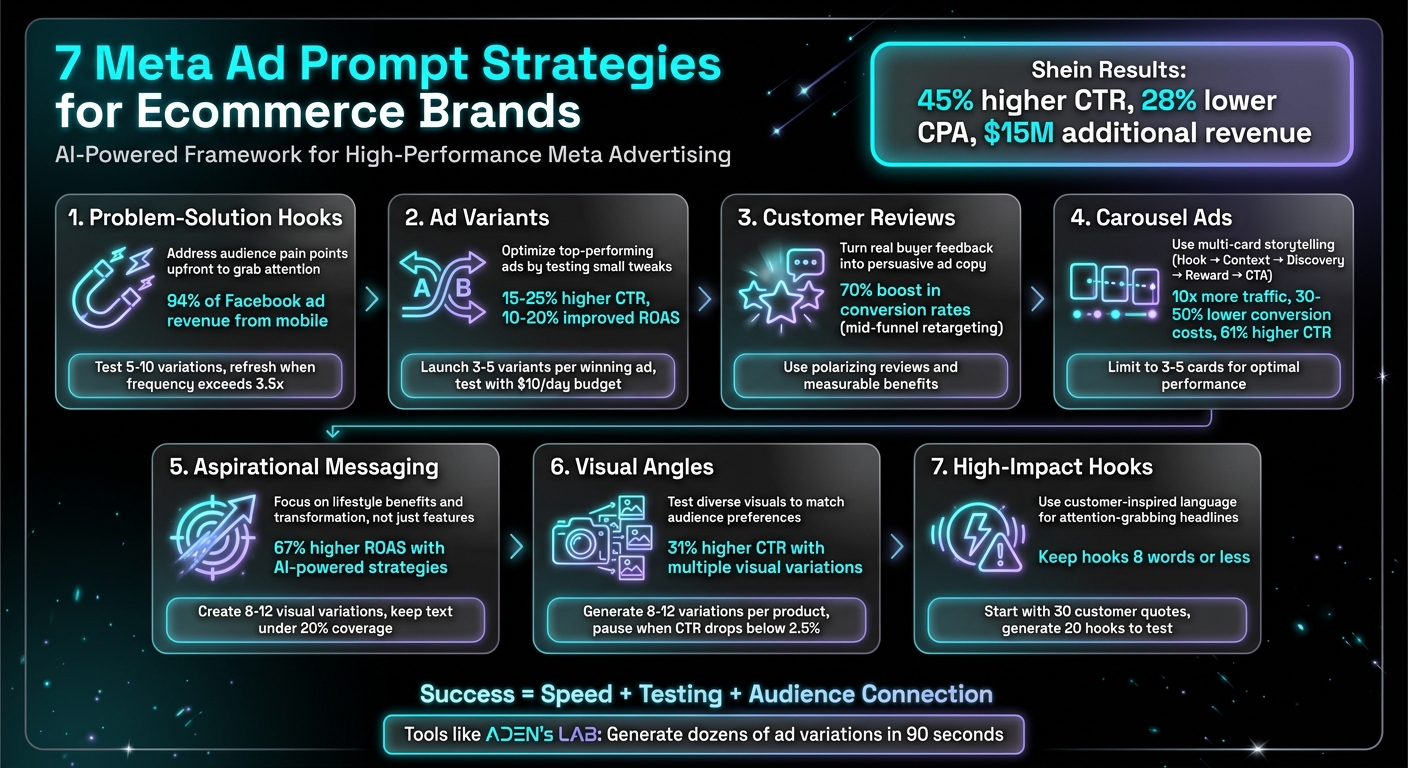
7 Meta Ad Prompt Strategies for Ecommerce Brands
AI Static Ads for eCom Meta Ads AT SCALE (100 Ads in 25 Min)
Put the playbook to work
Apply this playbook to your page
Paste your website and the Lab will turn the strategy you are reading into a ready-to-test ads.
Free to try No prompt writing
1. Scroll-Stopping Ad Concepts
"Problem-Solution Hook" Prompt
This ad strategy focuses on grabbing attention by addressing a pain point and offering your product as the solution, all within the first few seconds. The key is to structure your ad with a relatable frustration, a direct consequence, and a clear solution. For example, a skincare ad might open with: "Tired of products that promise results but deliver nothing?" Then, follow it up with a quick product visual and a clear benefit. This approach resonates because it aligns with how users scroll - they want content that speaks to their needs, not generic branding.
To make an impact, ensure your value proposition is front-loaded. Mobile feeds often cut off text, so the most important message should appear early. Pair this with mobile-friendly visuals that feel natural in a user's feed. Since 94% of Facebook's ad revenue comes from mobile ads, using authentic, mobile-shot visuals can help your ad blend seamlessly into the platform.
When creating ads, test 5–10 variations that target different pain points. Following a structured A/B testing guide can help you identify which hooks perform best. Keep an eye out for creative fatigue - if your click-through rates drop or your ad frequency exceeds 3.5x, it's time to refresh your concepts. Tools like ADEN's LAB can help you automate Meta ad production to quickly generate and test these variations.
The focus here isn't on crafting the perfect ad but on speed and volume. Launch quickly, let the data guide you, and keep feeding the algorithm with fresh, scroll-stopping ideas. Rapid iteration ensures your ads stay relevant and engaging.
2. Ad Variants from Winning Concepts
"Generate 5 Variants from Your Top-Performing Ad" Prompt
Once you’ve nailed down a winning ad, the next step is refining it with carefully crafted variations. This process not only extends the lifespan of your top performer but also helps uncover fresh ways to engage your audience. Using AI tools can make this process faster and more precise, giving you the ability to test multiple angles efficiently.
Start by identifying what makes your winning ad work - whether it’s the headline, visual, or call-to-action (CTA). Then, create variations by tweaking one key element at a time. For instance, if your headline “Get glowing skin in 7 days” is the standout feature, you could test alternatives like:
- Urgency: "Last chance for glowing skin"
- Social proof: "Join 10,000+ happy customers"
- Problem-solving: "Say goodbye to dull skin forever"
Keep the visuals and CTA consistent across all variants. This approach allows you to zero in on what drives performance without introducing too many variables at once.
Why does this matter? Data shows that ad variants can boost click-through rates by 15–25% and improve return on ad spend (ROAS) by 10–20%. Gymshark, for example, has reportedly scaled its campaigns by up to 3× using similar methods.
With tools like ADEN'S LAB, you can speed up this process significantly - generating multiple ad variations in under 90 seconds. This means you can produce dozens of variants weekly, allowing Meta's algorithm to identify the best performers. A simple testing strategy involves launching 3–5 variants per winning ad, monitoring their performance over 48–72 hours, and scaling the ones with the best cost per acquisition. Testing each variant with a modest $10/day budget ensures you can identify winners without overspending.
3. Customer Review Insights
"Turn Customer Reviews into Scroll-Stopping Ad Copy" Prompt
Customer reviews pack a punch when it comes to driving conversions. When potential customers see honest feedback from real buyers, it builds trust and encourages action. The trick is to pull the most engaging parts of these reviews and craft Meta ad copy that grabs attention instantly. By using actual customer voices, you can make your ads resonate on a deeper level.
Focus on reviews that highlight measurable benefits. For example, lines like "My skin cleared up in 5 days" or "Finally found jeans that actually fit" give potential buyers a clear picture of the results they might achieve. These specifics make your ads not only relatable but also persuasive.
Combine your brand's tone with the authentic language of your customers. A headline like "The Skincare Routine That Actually Works" paired with a real review quote and a simple, smartphone-style visual can feel approachable and credible. This method has proven effective for brands like MiamiFruit, which use visuals that appear naturally captured on a smartphone to create a trustworthy vibe.
Want to stand out even more? Use polarizing reviews - like those starting with "I was skeptical, but…" - to spark curiosity. These types of reviews can intrigue users and drive them to click, especially in crowded social feeds.
For maximum impact, place these review-based ads in the middle of your sales funnel. Use them to retarget people who’ve already interacted with your brand, such as watching your videos. GlobeIn's 2025 strategy highlights that this mid-funnel retargeting approach can boost conversion rates by as much as 70%.
4. Carousel Ad Concepts
"Build a Five-Card Story That Converts" Prompt
Carousel ads are a fantastic way to tell a story while keeping users engaged. This ad format lets you showcase 2–10 swipable cards, with each card acting as its own mini-ad, complete with a headline, description, and link. To maximize conversions, use a five-step narrative structure: Hook, Context, Discovery, Reward, and CTA.
Start strong with the first card by featuring a bold benefit, an intriguing question, or a surprising statistic. Use visual elements like arrows or overlapping images to encourage users to swipe through .
"Each card carries its own link, headline, and creative, making carousels function as a mini landing-page sequence."
To keep the experience seamless, link each card to a relevant product page. Consistency is key - stick to a uniform color palette, lighting, and photography style. Also, keep your carousel concise. Limiting it to 3–5 cards is ideal to maintain performance, especially on Instagram Stories.
The results can be impressive. Carousel ads have been shown to drive up to 10× more traffic while cutting conversion costs by 30–50%. A great example is Lacoste’s Instagram Stories carousel, which increased their click-through rate by 61% and reduced cost-per-click by 32%.
Using AI tools for Meta ads like ADEN's LAB makes creating carousel sequences easier. By quickly generating and testing different creative arrangements, it allows marketers to optimize ad performance efficiently using AI.
5. Aspirational Product Messaging
"Sell the Transformation, Not Just the Product" Prompt
Aspirational messaging takes your ad strategy to the next level by turning product features into lifestyle goals. It’s not just about what your product is; it’s about showing what life looks like after someone owns it.
The most effective Meta ads don’t focus solely on the product itself. Instead, they connect to your audience’s dreams - whether that’s reclaiming their mornings, boosting confidence, or making everyday tasks simpler. By highlighting benefit-driven angles like convenience, quality, or social proof, you can make your product feel like the answer to their needs. For example, instead of saying "stainless steel water bottle with double-wall insulation", try "Stay hydrated all day, no refills needed." This emotional shift makes your message feel more like a solution and less like a sales pitch.
Ecommerce brands often create 8–12 different visual variations per product, using a mix of lifestyle shots, studio photography, and user-generated content. This variety gives Meta’s AI the flexibility to tailor ads for different audience segments based on their preferences and behaviors. Brands that embrace AI-powered strategies on Meta report a 67% higher return on ad spend compared to traditional manual approaches.
When designing visuals, keep them clean and simple. Meta research shows that ads with less than 20% text coverage perform better because they blend seamlessly into the newsfeed, avoiding the overly promotional look. Position text around or below the image rather than directly on it to maintain a genuine and relatable vibe.
With tools like ADEN's LAB, you can quickly produce multiple aspirational ad variations, enabling you to test different emotional angles and visual styles without relying heavily on designers or agencies. This allows you to generate dozens of static lifestyle ads each week, helping you identify and scale the messaging that resonates most with your audience.
This focus on transformation sets the stage for even greater ad performance as we explore upcoming strategies.
6. Breakthrough Visuals
"Generate Multiple Visual Angles Per Product" Prompt
When it comes to Meta ad visuals, the secret isn't about landing on one perfect image. Instead, it's about building a collection - 8 to 12 variations per product. These should include a mix of lifestyle shots, studio photography, close-ups, and even comparison charts. Why? Because having this range of visuals allows AI to better match ads to audience behavior.
Meta's AI leverages over 200 user signals to adjust visuals in real time, ensuring that each viewer sees an ad tailored to their preferences. This personalization can make a big impact on performance.
Here’s the proof: Ads featuring multiple visual variations achieve a 31% higher click-through rate compared to standard Meta catalog ads. Plus, dynamic creative refreshes mean you can update visuals faster, keeping your ads fresh and engagement rates high.
To maximize this strategy, combine diverse visuals with automated fatigue monitoring. For instance, pause ads and introduce new variations when the click-through rate dips below 2.5% or when ad frequency exceeds 3.5x. Tools like ADEN's LAB make this process seamless by generating fresh visual options weekly, ensuring your campaigns stay relevant and feed Meta's algorithm the variety it needs to maintain strong performance as you scale.
7. High-ROAS Hooks
"Mine Customer Language for Authentic Hooks" Prompt
Once you’ve nailed the visuals, the next step is crafting hooks that immediately grab your audience’s attention.
The best hooks don’t sound like marketing - they sound like your customers. By analyzing customer reviews, messages, and support tickets, AI can uncover real phrases that resonate on an emotional level. These snippets of genuine language can then be transformed into short, attention-grabbing hooks that connect in just two seconds.
The golden rule? Keep it eight words or less. Start with at least 30 customer quotes, and let AI identify five key angles. From there, it generates five concise hooks per angle - giving you 20 hooks to test. Focus on emotional triggers like relief, pride, or status. For example, instead of generic lines like "Premium Quality Skincare", you might use a customer-inspired hook like, "Finally stopped waking up with breakouts."
This method can dramatically improve ROAS. Tools like GPT-4 can churn out multiple headline variations - emphasizing price, quality, social proof, or urgency - for Dynamic Creative Optimization testing.
Tina Donati, Head of Marketing at Simple Bundles, emphasizes the importance of clear direction:
"AI is only as good as the direction you give it. Vague prompts like 'Write me a high-converting email' won't get you anywhere".
The same principle applies to hooks. Be specific about the angle, pain point, and emotional outcome you want to target. ADEN's LAB, for example, delivers fresh hook variations weekly, helping Meta’s algorithms identify the best-performing micro-segments.
Conclusion
The seven prompt categories outlined here form a complete framework for improving Meta ad performance. By blending eye-catching concepts with customer-focused hooks, carousel approaches with inspiring messages, and dynamic visuals with quick variant testing, you can create a diverse ad portfolio that appeals to multiple audience segments while keeping your campaigns adaptable.
AI-driven prompts don’t eliminate the need for strategic thinking - they speed up testing and help minimize wasted ad spend through better timing. Instead of waiting days for design updates, you can generate dozens of ad variations in minutes and let Meta’s algorithm identify what connects best with your audience.
Once your strategy is refined, an integrated pre-launch ad testing checklist can make testing more efficient. Start with the prompt that addresses your immediate challenge - whether it’s high-ROAS hooks for underperforming ads or scroll-stopping ideas to combat creative fatigue. Monitor which prompt types perform best for your product and scale those approaches.
To make experimenting with prompts easier and track results more effectively, tools like ADEN's LAB can help. This platform simplifies the process of generating fresh static Meta ad variations at scale, allowing you to test multiple concepts weekly without overspending.
Ultimately, success on Meta isn’t about having the largest budget - it’s about producing better, faster, and smarter creative tests than your competitors. These prompts lay the groundwork for an agile, results-driven advertising strategy, combining attention-grabbing ideas, variant testing, and aspirational messaging to build campaigns that deliver results.
FAQs
How do I write better Meta ad prompts?
To craft better Meta ad prompts, focus on creating clear, specific, and action-oriented instructions that guide AI in generating high-performing ad creatives. Here’s how:
- Be specific about the product: Clearly describe what you're advertising, including its unique features or benefits.
- Define the target audience: Mention key demographic details like age, interests, or location to ensure the ad speaks directly to the right people.
- Set the tone: Specify whether the tone should be professional, casual, playful, or something else to match your brand voice.
- Highlight key benefits: Focus on what makes the product appealing and why the audience should care.
- Include a call-to-action (CTA): Guide the AI by specifying the action you want users to take, such as "Shop Now" or "Sign Up Today."
By tailoring your prompts with these elements, the AI can deliver ads that are more engaging and aligned with your campaign goals.
How many ad variations should I test per product?
Testing 3 to 5 ad variations per product is a smart way to boost performance. It allows you to pinpoint which creative elements resonate most with your audience, leading to better campaign outcomes.
When should I refresh creatives for ad fatigue?
When engagement starts to dip or your audience seems less interested, it’s time to refresh your creatives. Waiting too long could lead to higher customer acquisition costs and less effective campaigns. Updating your content early keeps things running smoothly and ensures your message stays impactful.
Your next ad batch starts here
Finish with a ready-to-test ad batch
Paste your website to generate static creatives. Drop the link → get ads in about 90 seconds → upload them to Meta → scale.
Free to try No prompt writing