Copy-Paste AI Prompts for Rapid Meta Iterations
Use the prompts on your real offer
Generate these ad angles for your product
Skip the blank prompt box. Paste your product page and ADEN'S LAB applies the angles to your offer, images, headlines, and copy.
Free to try No prompt writing

Want to improve your Meta ad performance without wasting time? The secret isn’t perfecting a single ad - it’s testing multiple variations quickly. Meta’s algorithm thrives on data diversity, and brands that test dozens of ad angles outperform those stuck fine-tuning a single idea.
Here’s what matters most:
- Speed beats perfection: Testing 10–20 ad variations at once helps Meta’s algorithm find winners faster.
- Manual prompting slows you down: Crafting prompts by hand limits testing capacity and wastes time.
- Automation is the solution: Tools like Aden's Lab can generate hundreds of ad variations in seconds, saving time and boosting results.
The key is to focus on rapid iteration at scale. Stop chasing a "perfect" ad and start testing more angles to scale your campaigns effectively.
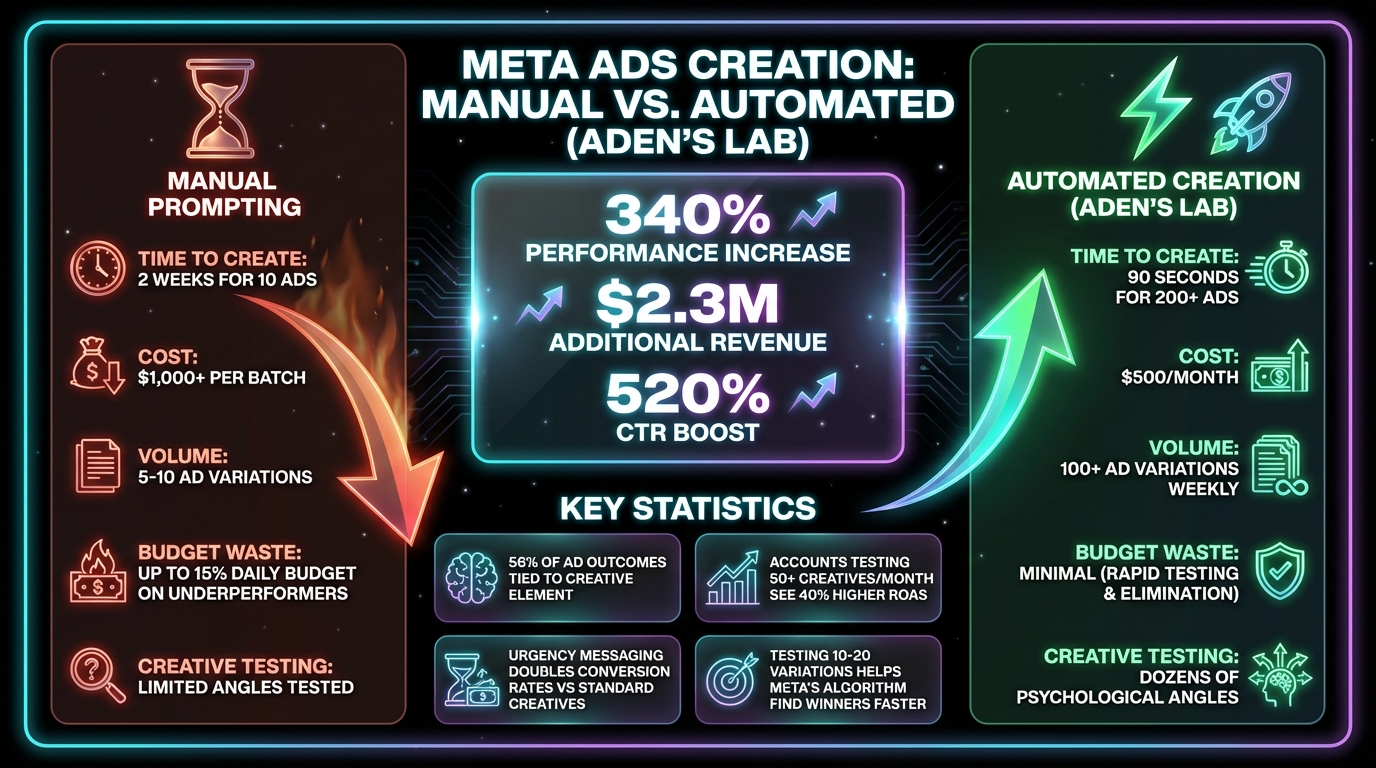
Manual vs Automated Meta Ad Creation: Performance Comparison
The ULTIMATE Guide to using AI to make Facebook Ads (Full Step-by-Step Walkthrough)
Put the playbook to work
Apply this playbook to your page
Paste your website and the Lab will turn the strategy you are reading into a ready-to-test ads.
Free to try No prompt writing
Why Manual Prompting Slows Down Meta Ad Performance
Relying on manual prompting for ad creation can seriously hinder your results. When you're crafting prompts by hand, you're typically limited to producing just 5–10 ad variations. But here's the problem: finding a winning ad often requires testing dozens - or even hundreds - of variations. With such a narrow output, your chances of landing on that breakout creative are slim.
This process gets even more frustrating when you factor in the time it takes. A two-week cycle to produce just 10 ads means you're stuck with infrequent, batch optimizations. During this time, underperforming ads can eat up as much as 15% of your daily budget before you even have the chance to pause them. That’s money wasted and opportunities missed.
The costs don’t stop there. Traditional agency workflows often charge upwards of $1,000 for just 10 ads, with a turnaround time of two weeks. Even if you’re using AI tools for Meta ads, you’re likely spending hours tweaking outputs to align them with your brand - time that could be better spent testing and iterating. And what if the winning creative is buried in the 37th variation you never had the chance to test? That’s a missed opportunity.
"ADEN'S LAB created 200+ ad variations in one day. Our previous agency took 3 weeks for 10 ads. The AI-created ads outperformed our human-created ones by 340%." - Sarah Chen, CMO, Fashion Forward Co.
The real danger lies in how these inefficiencies limit your ability to adapt. When you're only producing a handful of ads every two weeks, the algorithm lacks the variety it needs to optimize effectively. By the time you’ve analyzed results and are ready to iterate, market conditions may have shifted, competitors might have launched fresh campaigns, and your initial creative could already feel outdated. In fast-moving markets, the ability to quickly test and refine isn’t just helpful - it’s essential to staying competitive and keeping costs in check.
The Framework for Writing Effective AI Prompts
When you're dealing with slow, manual ad creation, having a solid framework for designing prompts can make all the difference.
A well-crafted prompt is more than just a request - it's a detailed instruction that tells the AI exactly what to create. The difference between a vague command like "write me an ad" and a prompt that delivers actionable results boils down to five key elements: Role, Context, Task, Constraints, and Objective.
Start by assigning the AI a specific role. Instead of treating it like a AI tools for ad creation, give it a persona. For instance, asking it to act as a seasoned Meta ad copywriter with years of experience in ad spend creates a much more focused tone than simply requesting "ad copy." This role helps guide the AI to emphasize critical elements like conversion strategies, brand storytelling, or direct response techniques.
Next, provide detailed context. Share specifics about your product, audience, and brand. This could include your brand's unique positioning, target demographics, or standout features. Supplying details like product URLs, customer reviews, or existing brand messaging ensures the AI has real-world information to draw from, rather than defaulting to generic outputs.
The task itself should be crystal clear. Spell out exactly what you need. For example, you might say, "Create 10 ad variations, each focusing on different psychological angles such as benefit-driven messaging, objection-handling, social proof, FOMO, and targeted use cases." Also, define the format - whether it’s headline length, body copy word count, or the inclusion of image suggestions and calls-to-action. This level of clarity ensures you get outputs that are ready for testing on platforms like Meta.
Finally, use constraints and objectives to refine the output. Constraints ensure the content stays true to your brand voice. Instructions like "keep it conversational, not overly salesy" or "use a professional yet approachable tone" help maintain consistency. The objective should align with your campaign goals. For example, if you're aiming to drive trial signups, specify, "Focus on low-friction CTAs that encourage first-time users to try the product." For retargeting campaigns, direct the AI to address objections from users who browsed but didn’t buy. This level of precision ensures the AI generates content that’s not only engaging but also tailored to your specific goals.
1. Manual Prompting Challenges
The Time-Sink Problem That Kills Testing Velocity
Manual prompting eats up valuable time. Hours are spent fine-tuning instructions, reworking tone guidelines, and inputting product details one piece at a time. What should be a quick process drags on, leaving you with outputs that still need heavy editing. Meanwhile, competitors using automation are scaling ad testing at scale, leaving you behind.
But the real issue isn't just the time lost. Manual workflows limit your ability to produce the volume of content Meta's algorithm needs to learn and optimize. On top of that, manual prompts often rely on guesswork instead of data-backed strategies. The result? Outputs that miss the mark by failing to highlight key product benefits, address customer objections, or include the social proof that drives engagement.
Even worse, manual prompting often creates an illusion of variety. Minor tweaks - like changing a few words or adjusting a design - might look like new iterations but don’t provide Meta's algorithm with the distinct creative angles it needs to test effectively. This leads to wasted resources, faster creative burnout, and higher costs per acquisition.
The brands thriving on Meta have moved past these inefficiencies. They’ve replaced manual prompting with systems that can turn a simple product URL into dozens of ready-to-go ads in just 90 seconds. No complicated setup, no steep learning curve, and no delays. This shift from manual effort to automated, data-driven iterations is what separates the leaders from the laggards.
2. Framework for Effective Prompts
The 4-Part Formula That Turns Vague AI Into Ready-to-Test Ads
Many prompts fall short because they’re too vague. If you simply ask for "ad copy", you'll likely end up with generic, uninspired content that blends into the sea of AI-generated posts. Instead of overcomplicating things with traditional multi-element frameworks, this four-part formula - role, inputs, format, and criteria - offers a straightforward way to craft prompts that result in ready-to-test ads.
Start by defining the AI’s role. For example, instruct it to act as a senior Meta ad strategist or a performance creative lead. This sets the tone for strategic, high-level outputs rather than surface-level writing. Then, provide specific inputs, such as product details, customer pain points, or competitor insights. The more data-driven your inputs, the more precise and relevant the ad copy will be.
Next, clarify the output format. For instance, you could ask for five headline variations along with body copy, calls to action (CTAs), and visual suggestions. You can also use an ad copy idea generator to streamline this. Don’t forget to include success criteria, like creating scroll-stopping hooks, addressing objections, or evoking urgency. Explaining why these elements are important ensures the AI focuses on delivering results, not just filling in blanks.
Here’s an example of how this works: “Act as a senior Meta ad strategist. Analyze these customer reviews [insert data]. Generate five ad variations with headline, body copy, CTA, and visual suggestions. Focus on hooks that address pain points and boost CTR.” This kind of prompt reduces the need for extensive manual edits because the output aligns with Meta’s best practices right from the start.
That said, even the best prompts often require manual adjustments - like reformatting for Meta specs, fine-tuning phrasing, or adding missing details. While this method is far more effective than starting from scratch, it still can’t match the efficiency of systems that can take a product link and churn out dozens of feed-ready ads in seconds.
This streamlined formula lays the foundation for crafting even more targeted, role-based prompts, which we’ll explore in the next section.
3. Role-Based Prompts
Assign Expert Roles to Unlock Pro-Level Ad Variants
Taking your ad strategy to the next level starts with assigning the AI a specific role - one rooted in expertise. Instead of requesting generic ad copy, guide the AI to work as if it's a seasoned professional, like a Senior Static Ad Strategist or a Performance Creative Lead. This approach shifts the focus from basic ideas to well-thought-out, campaign-driven ads.
For example, try this prompt: "You're a Senior Static Ad Strategist. Create 5 High-Performing Static Ad Concepts for [Product], Each With a Distinct Headline, Visual Format, and Scroll-Stopping Idea." This isn't just a request for ads - it’s a call for strategic creativity. The AI prioritizes proven techniques like contrast, curiosity, and attention-grabbing formats that stand out in a crowded feed, rather than producing generic designs that fade into the background.
This method becomes even more powerful when you're working to refresh a winning concept. Instead of starting over every time engagement slows, use a prompt like: "Assume the role of a Performance Creative Lead. Take This Winning Concept: [Insert Summary] and Build 10 New Ad Variants. Include New Hooks, Visuals, CTAs, and Emotional Angles While Keeping the Core Structure Intact." This way, you're maximizing the potential of what already works, rather than reinventing the wheel.
By assigning expert roles, the AI mirrors the thought process of experienced advertisers. However, even the smartest prompts need the right inputs to deliver strong results. Providing detailed information - like summaries of successful ads, customer reviews, and product specifics - is critical. Without this, the output risks being generic, leading to poor click-through rates and wasted ad spend. Manual processes can’t match this efficiency at scale, making automated systems that instantly process product data indispensable.
Up next, discover how to weave psychological triggers into your strategy to drive even more engagement.
4. Psychological Triggers
Embed Proven Buyer Psychology Into Your Prompts
The success of any ad often comes down to psychological triggers - those subtle mental cues that make people stop scrolling, click, and ultimately buy. When crafting prompts for AI, you're not just asking for random copy or visuals. You're designing prompts to tap into emotional and cognitive responses that have consistently driven results in advertising.
To maximize effectiveness, start your prompts with these triggers in mind. For example: "Generate 8 Static Ad Variations for [Product] Using These Psychological Frameworks: Social Proof (Customer Reviews), Scarcity (Limited Stock), Loss Aversion (What They'll Miss), and Curiosity Gap (Incomplete Information That Demands a Click)." This ensures the AI builds ads around proven mental triggers instead of churning out generic messaging that fails to engage.
Research backs this up: ads with emotional content can increase sales by 23% compared to purely rational ads, and a staggering 95% of purchase decisions happen subconsciously. By incorporating psychological cues into your prompts, you’re leveraging the decision-making shortcuts that drive consumer behavior. For instance, urgency-focused messaging has been shown to double conversion rates compared to standard creatives.
However, even the smartest psychological frameworks won’t work without feeding the AI real-world insights. Incorporate customer objections, product benefits, and pain points pulled directly from reviews or landing pages. Without this context, the output risks being shallow and unconvincing. Testing multiple psychological angles manually can be overwhelming, which is why automated systems that analyze product data and buyer behavior can be game-changers. These tools ensure every detail is captured accurately and consistently, saving time while improving results.
Once you’ve established a strong psychological foundation, the next step is crafting prompts that highlight what makes your product stand out. This is where the real impact begins.
5. Competitive Positioning
Stand Out by Framing Your Product Against the Market
One common mistake advertisers make with competitive positioning is focusing too much on what their product is rather than why it matters in a sea of similar options. Headlines like "The Perfect Solution for Your Business" might sound appealing, but they often blend into the noise of competitors' equally generic claims.
Here’s a better approach: "Generate 6 Static Ad Variations for [Product] that emphasize our unique market position. Use customer reviews to reveal market gaps and highlight one angle each for social proof, speed/convenience, and a common competitor weakness." This forces the creative process to dig into real customer feedback, pulling out specific, relatable angles instead of falling back on a bland feature list.
Why does this matter? Because 56% of ad outcomes are directly tied to the creative element. In a crowded market, success comes from clearly showing why your product is different. Take Glossier, for example. By combining user-generated content with professional visuals, they highlighted real customer experiences instead of polished but impersonal ads. The result? A 2.6x boost in click-through rates and a 40% drop in cost per acquisition. This proves that differentiation rooted in authenticity works far better than just listing features.
Testing multiple competitive angles manually can be time-consuming and expensive. Automating Meta ad production changes the game, allowing you to create and test various positioning strategies in minutes. Meta's algorithm can then identify which message resonates most with your audience. This automated process not only saves time but ensures your campaign stays dynamic and adapts to real-time performance data.
Once you've nailed your market positioning, keeping your messaging fresh is crucial. A higher volume of creative variations helps uncover the winning angle faster and keeps your ads relevant as your campaign evolves.
6. Variation Generation
Generate Volume to Let the Algorithm Find Winners
When most advertisers think about creating variations, they imagine minor tweaks - like changing a button color or trying a new font. But let’s be honest, that’s not true variation. Real variation is about testing entirely different psychological approaches. For example, one ad might focus on a key benefit, another could address a common objection, a third might showcase social proof, and a fourth highlights a specific use case. Each of these gives Meta’s algorithm unique data to work with.
Here’s the deal: testing just three ads limits your chances of finding a winner. But if you test 100 variations, you’re dramatically increasing the odds of discovering what works. This method doesn’t just expand your testing capacity - it aligns perfectly with Aden’s Lab’s promise: drop a link, get ads, and launch directly on Meta.
High-volume testing isn’t just about throwing ideas at the wall; it’s about giving the algorithm more to learn from. The combination of speed, volume, and strategic diversity allows you to identify winning patterns faster. The secret isn’t just creativity - it’s the ability to test a wide range of ideas quickly and effectively.
To make this work, every variation needs to test a distinct concept, not just a recycled template. Use AI to dig deep: pull objections straight from your product page, gather diverse social proof from customer reviews, and frame your offer in multiple ways. Launch all these variations at once, quickly eliminate the underperformers, and generate a fresh batch based on what’s working. This approach helps you stay ahead of creative fatigue and keeps your cost per acquisition under control.
With Aden’s Lab, all it takes is a product link to unlock hundreds of ready-to-launch creative variations for Meta campaigns.
7. Pain-Point & Retargeting Prompts
Prompt for Cart Abandoners: Address Their Key Frustrations, Promise Relief
When it comes to retargeting, generic reminders like "You left something in your cart" or "Finish your order now" often fall flat. Why? They fail to address the real reasons someone abandoned their cart in the first place. Maybe they weren’t convinced the product could solve their problem. Maybe they thought it was too expensive. Or maybe they just lost sight of why they needed it.
To recover those lost sales, you need to dig deeper. Start by identifying the specific frustrations your product solves and craft retargeting ads that speak directly to those pain points. Instead of vague messages, try something like: "Frustrated by slow loading times?" or "Feeling overwhelmed by endless to-do lists?" These ads reignite the original problem that brought them to your site and immediately position your product as the solution.
Here’s a simple formula: analyze your cart data and pinpoint 3–5 common frustrations (e.g., "wasted time on ineffective tools" or "complicated setups"). Then, create ad variations that highlight these issues in the headline, explain your solution in the body, and include a clear, urgent call-to-action (CTA). For example: "You added our app but didn’t finish - get to inbox zero in just 10 minutes today. Complete your setup now."
This approach isn’t just theory - it works. In my own campaigns, I saw a 2.5x lift in ROAS using these targeted ads. Why? Meta’s ad auction system rewards relevance. Ads that directly address user intent lower CPC by 20-30% and boost CTR by 1.5-2x. On the other hand, generic retargeting often feels like spam, quickly leading to ad fatigue. But when your message feels personal, it’s like you’re speaking directly to their needs.
This strategy is especially effective for warm audiences - people who already know your brand. Once you've mastered these retargeting fundamentals, you can scale winning creatives across your entire account to maintain high performance at higher spends. The biggest mistake marketers make here is treating warm audiences like cold traffic. They don’t need an introduction; they need you to resolve the hesitation that stopped them from buying. By tapping into emotional cues and addressing the exact frustrations that caused them to pause, you can turn abandoned carts into completed purchases.
And if identifying pain points feels overwhelming, tools like Aden's Lab can help. Just drop in a link, and it pulls real feedback from your site and reviews, making it easy to create retargeting ads that feel personalized and relevant to each user.
8. Scaling Beyond Prompts
When Manual Prompting Hits Its Ceiling: The Shift from Text to Action
Let’s talk about what happens when manual prompting isn’t enough anymore. Here’s the truth: prompts fall short when speed, not just ideas, becomes the priority. Sure, you might nail a headline prompt, but then you’re spending 30 minutes crafting just three ad variations. That might work for a small test run. But what if you’re managing a $50,000/month Meta budget and need over 100 new creatives weekly to keep up with audience fatigue? Suddenly, the problem isn’t the AI - it’s the slow, repetitive process that stalls your momentum.
The issue lies in the back-and-forth nature of prompting. You describe what you want, wait for the output, review it, refine it, and repeat. It’s manageable for slower-paced projects, but when Meta burns through your top-performing creative in 72 hours, you can’t afford to lose time. As Vahe Sahakyan aptly said:
"At some point, prompting stops helping, not because the model is weak, but because the task requires action, not language".
So, how do you move past this bottleneck? The answer isn’t crafting better prompts - it’s eliminating the need for prompts altogether. Imagine skipping the tedious back-and-forth and having a system that does the heavy lifting for you. Instead of typing out instructions, the AI automatically pulls data from your product page, customer reviews, and other sources, then generates ready-to-launch creatives in seconds. It’s the difference between spending hours on prompts versus dropping a link and getting 50 ads in 90 seconds. Speed isn’t just helpful - it’s your edge.
This is where Aden's Lab comes in. For fast-paced campaigns, every second matters. Their system uses Meta ads automation to streamline the entire creative production process: extracting data, leveraging buyer psychology, and generating diverse ad variations with proven hooks and angles - all backed by billions in ad spend insights. Just paste your product URL, and the system delivers performance-ready ads instantly. While competitors are still tweaking their prompts, you’re already testing, refining, and scaling ahead of the curve.
When Prompts Aren't Enough: Scaling Creative Production
Even the most well-crafted manual prompts hit a wall when it comes to scaling. Sure, you might create a great prompt that churns out effective headlines or engaging copy. But if you're managing over $100,000 in monthly Meta ad spend and need 50–100 new creatives every week, manual prompts simply can't keep up. Each prompt demands time - inputting customer details, product info, audience data, and brand guidelines. Then comes the waiting: reviewing the output, tweaking it, regenerating, and repeating. For a single ad set, this can take 20–30 minutes. Multiply that across dozens of campaigns, and suddenly you’re spending entire days just setting up creatives instead of focusing on testing and scaling. This often requires leveraging Meta Advantage+ to optimize placements and reach.
The real hurdle isn’t the quality of the content - it’s the speed and consistency required to operate at scale. When your ad frequency climbs past 3.0 in just a few days, click-through rates drop, CPMs can jump by 30–50%, and your return on ad spend (ROAS) can dip below 2×. In high-spend campaigns, generating 75+ fresh creative variations weekly becomes a necessity. Unfortunately, even the best manual prompt systems can’t meet Meta's demanding pace. This is where automation becomes essential - a fully automated creative engine can bridge this gap.
Imagine dropping a product URL into a system that instantly extracts images, analyzes customer reviews to highlight key pain points and benefits, and delivers performance-ready Meta ads in just 90 seconds. This kind of automation enables rapid iteration, allowing you to maintain strong ad performance without the bottleneck of manual processes.
That’s exactly where ADEN'S LAB comes in. This solution doesn’t just speed up production; it ensures consistent, high-quality results across campaigns. For instance, Sarah Chen, CMO of Fashion Forward Co., used ADEN'S LAB to create over 200 ad variations in a single day - something that previously took their agency three weeks to produce just 10 ads. The automated creatives outperformed human-made ones by 340%, leading to an additional $2.3 million in revenue. Similarly, Mike Rodriguez, Growth Director at TechGadget Pro, slashed their creative spend from $50,000 per month to just $500 while boosting click-through rates by 520% and generating an extra $1.8 million in revenue.
These aren’t hypothetical scenarios - they’re real outcomes achieved by removing the manual bottlenecks. By letting automation handle the heavy lifting, you free up time to focus on what truly matters: testing, analyzing, and scaling the ads that drive results.
Conclusion
When it comes to Meta advertising, chasing perfection often means missing out on profits. After managing over $100 million in ad spend, one thing has become crystal clear: advertisers who focus on testing a wide range of creative variations consistently outperform those fixated on crafting a single "perfect" ad. Meta's algorithm thrives on speed and volume, not polish. Testing 10–20 different hooks, angles, and layouts at the same time provides the algorithm with the diverse data it needs to quickly identify winners. Spending days perfecting one headline? That’s time and opportunity wasted.
In fact, accounts that test 50+ creatives each month can see up to 40% higher ROAS. I’ve seen this firsthand - taking a winning ad and creating 10 variations helped scale spend by 5× while slashing customer acquisition costs by 25%. The lesson? Waiting for perfection costs you dearly. Rapid testing uncovers trends and patterns that manual tweaks simply can’t match.
The numbers speak for themselves: manual adjustments, while sometimes effective, can’t keep up with the fast pace of today’s digital market. This is especially true for real-time bid adjustments that require constant monitoring. Even the best manual setups take time to input details and review results. When creative fatigue sets in every few days, and you’re managing significant budgets, delays become your biggest enemy. That’s why AI-driven automation is no longer optional - it’s essential. Tools like ADEN'S LAB eliminate these bottlenecks entirely. Just drop in a product link, and within 90 seconds, you’ll have performance-ready Meta ads, freeing you to focus on what truly matters: testing, analyzing results, and quickly cutting underperformers.
The takeaway is simple: ditch the bottlenecks and prioritize launching multiple creative variations quickly. The advertisers dominating Meta aren’t the ones with the most polished ads - they’re the ones testing more angles, faster, and letting the data guide them. Speed and iteration drive growth, not perfection.
FAQs
How many Meta ad variations should I launch at once?
When running ads, it's smart to launch 3 to 5 variations. Why? It allows you to test different creative angles, copy styles, and formats. This approach helps you figure out what clicks with your audience while minimizing the chances of ad fatigue. By trying out multiple versions, you're not putting all your eggs in one basket, and you'll gain clearer insights into which strategies deliver the best results for your campaigns.
What counts as a “real” creative variation vs a tiny tweak?
A “real” creative variation involves making major changes to key elements like the headline, image, or offer. These adjustments result in a noticeably different ad, designed to test how audiences respond to entirely new concepts. In contrast, a tiny tweak focuses on minor details - like altering colors, fonts, or slightly rephrasing text - without shifting the core message or overall concept.
When should I switch from prompting to full automation?
When your prompts consistently deliver high-performing ads, but manual adjustments start to slow you down, it’s time to consider full automation. Automation allows you to scale your creative output faster, cut down on time spent tweaking, and avoid burnout from repetitive tasks. If your prompts are already hitting your KPIs and you're ready to expand without compromising results, automation can help you stay ahead and maintain efficiency.
Your next ad batch starts here
Finish with a ready-to-test ad batch
Paste your website to generate static creatives. Drop the link → get ads in about 90 seconds → upload them to Meta → scale.
Free to try No prompt writing