Best Direct-Response Prompts to Generate High-Converting Meta Ad Text (Copy + Paste)
Use the prompts on your real offer
Generate these ad angles for your product
Skip the blank prompt box. Paste your product page and ADEN'S LAB applies the angles to your offer, images, headlines, and copy.
Free to try No prompt writing
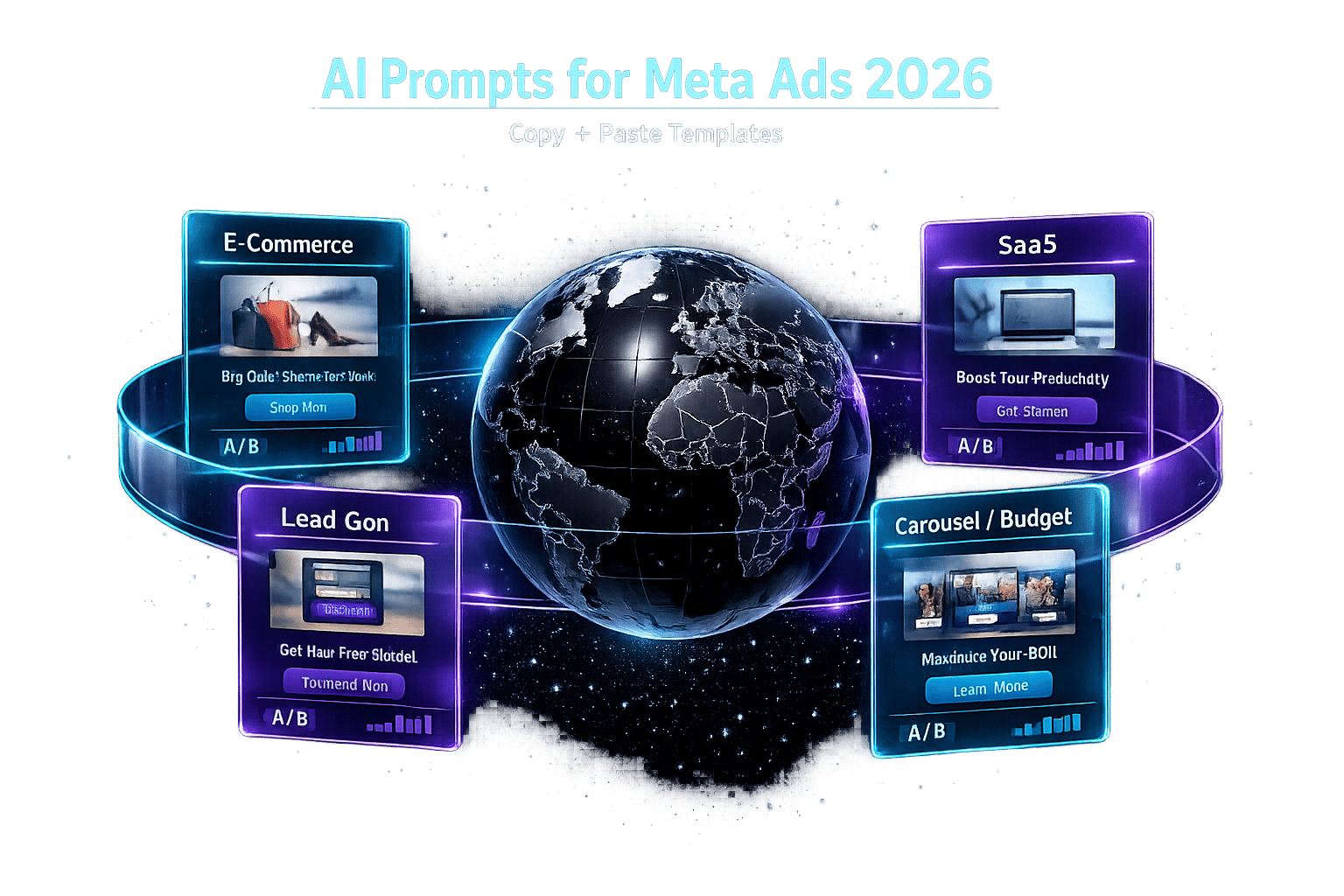
AI prompts are the secret to high-performing Meta ads in 2026. Meta's automation tools like Advantage+ and Lattice architecture handle testing and scaling, but success hinges on the quality of your inputs. Structured prompts can:
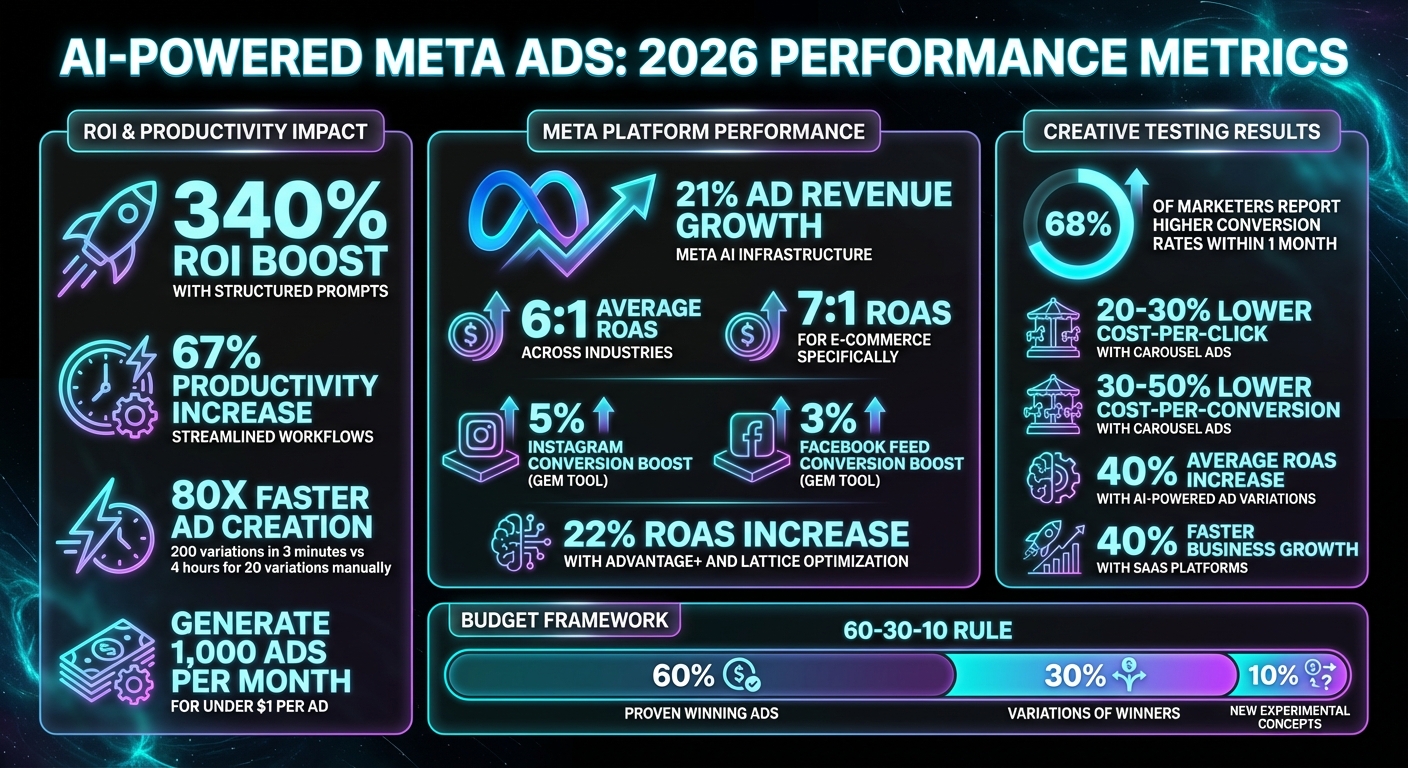
- Boost ROI by 340% and productivity by 67%.
- Generate up to 1,000 ads per month for under $1 per ad.
- Cut ad creation time by 80x, producing 200 variations in 3 minutes.
Key Prompt Frameworks:
- E-commerce: Use direct-response styles like PAS (Problem-Agitate-Solve).
- SaaS: Highlight benefits over features, focusing on outcomes like time saved or costs reduced.
- Lead Generation: Create urgency by exposing hidden problems and offering measurable solutions.
- Creative Testing: Test 12 variations with the "Smart-Stack" method.
- Carousel Ads: Use a 7-card story arc to engage users and lower costs by up to 50%.
Budget Strategy:
Follow the 60-30-10 Rule:
- 60% for proven ads, 30% for variations, and 10% for new ideas.
Scaling Tip:
Leverage AI for budget reallocation and refresh creatives when ad fatigue sets in.
AI-powered tools like ADEN's LAB make it easy to generate Meta ads in seconds, helping you lower costs and scale faster.
AI-Powered Meta Ads Performance Statistics and ROI Metrics 2026
1. E-commerce Ads
The Performance Copywriter Prompt
Generic ad copy often misses the mark when it comes to engaging potential buyers. That’s why structured prompts are the game changers - they give AI a clear framework to create ads that drive conversions.
Here’s a template you can use:
"You are a performance copywriter. Product: {product_name}. Audience: {target_audience}. Goal: {objective}. Constraints: Headline ≤ 40 characters, Primary text ≤ 125 characters. Output: 3 ad variants, each with a headline, primary text, CTA, image idea, and 1 A/B test hypothesis per variant".
This prompt ensures the AI adopts a direct-response marketing style, focusing on crafting ads that reduce customer acquisition costs and boost ROI. Why is this important? Vague prompts often result in repetitive, uninspired copy that ignores key details like character limits or buyer psychology. Structured prompts, on the other hand, deliver targeted ad variations based on proven frameworks like PAS (Problem-Agitate-Solve) and AIDA (Attention-Interest-Desire-Action). These frameworks help create empathy, grab attention, and guide users from the initial hook to making a purchase.
The results speak for themselves: 68% of marketers report higher conversion rates within just one month of using structured ad copy frameworks. Plus, AI-assisted workflows can produce 200 ad variations in just 3 minutes, compared to the 4 hours it takes to manually create 20 variations. That’s an 80x speed increase. With this kind of efficiency, it’s easier to test, identify, and scale winning ads quickly.
For campaigns aimed at high-intent users, you can refine the prompt even further. For example:
"You are a retargeting strategist. Product: {product_name}. Audience: users who added items to cart in the last 14 days. Generate 3 variants with urgency-based messaging and dynamic offers".
This tailored approach focuses on converting abandoned carts into revenue by using urgency-driven messaging and personalized offers. By following these principles, you can adapt prompts to fit a variety of campaign goals, ensuring every ad is optimized for success.
Put the playbook to work
Apply this playbook to your page
Paste your website and the Lab will turn the strategy you are reading into a ready-to-test ads.
Free to try No prompt writing
2. SaaS Ads
The Feature-to-Benefit Translator Prompt
SaaS ads aren't like e-commerce ads. While e-commerce focuses on direct consumer appeals, SaaS demands a different approach - shifting from technical details to benefits that genuinely matter to businesses.
Instead of highlighting features like "OAuth integration" or "multi-tenant architecture", SaaS ads need to showcase how these features solve real problems: saving time, reducing costs, and simplifying workflows.
Here’s a prompt to make this happen:
"Act as a conversion copywriter. Convert the following SaaS features [Insert Features] into three outcome-driven headlines that focus on time saved or revenue gained. Use the Problem-Agitate-Solve framework: Problem is [Pain Point, e.g., scheduling chaos]. Agitate by mentioning [Loss, e.g., 15 hours wasted weekly]. Solve it by introducing our [Feature]."
This method ensures that every headline connects with the audience by focusing on outcomes rather than technical specs. The key is to align with your buyer’s mindset: they’re overwhelmed by manual tasks and want clear, actionable solutions.
For bottom-of-funnel campaigns, comparisons work wonders:
"Contrast my SaaS product [Product Name] against the manual process of [Manual Task]. Emphasize that your tool is [X times] faster, eliminates [Specific Error], and saves over 40 hours of weekly manual management - a solution that reclaims valuable time."
This strategy positions your product as the clear alternative to outdated methods. And the data supports this approach: businesses using growth-oriented SaaS platforms grow 40% faster, while AI-powered ad variation tools deliver an average 40% increase in ROAS.
3. Lead Generation Ads
The Problem-Agitate-Solve (PAS) Framework Prompt
Lead generation ads thrive on urgency, and a great way to achieve that is by exposing hidden, costly problems your audience might not even realize they're facing.
Just like SaaS ads, lead generation campaigns need to hit the mark right away. The PAS framework works by identifying an existing frustration, amplifying its impact, and positioning your service as the ultimate fix. This isn't about manipulation - it's about shedding light on inefficiencies or expenses that are flying under the radar.
Here’s a prompt you can use to craft your message:
"Act as a direct-response copywriter. Identify the top pain point for [Target Audience, e.g., marketing agencies managing Meta campaigns]. Agitate by quantifying the cost (for example, 40+ hours wasted weekly on manual campaign management). Solve it by presenting [Your Service] as the solution that cuts setup time from 4 hours to 3 minutes. Include a low-friction call-to-action such as 'See it in Action' or 'Get a Free Demo.'”
This formula works because it injects urgency and highlights measurable benefits, making it easier for potential leads to see the value. Instead of vague promises like "save time", focus on specifics like "reclaim 15+ hours weekly" or "boost ROAS by 40%." These details not only grab attention but also help lower your cost-per-acquisition (CAC) while improving your return on ad spend (ROAS).
To take it a step further, back up your claims with proof. For high-consideration B2B leads, incorporate social proof directly into your messaging. For example:
"Mention that [Your Platform] is trusted by 100+ agencies managing $500M+ in ad spend."
4. Creative Variations
The "Smart-Stack" 12-Pack Prompt
Creative variation testing takes targeted ad copy to the next level by refining messages to uncover the most effective elements. Testing multiple ad variations helps pinpoint what resonates best. A structured approach, like the "Smart-Stack" method, speeds up the process by generating 12 distinct variations using a blend of tones and strategic angles.
Here’s how the "Smart-Stack" method works:
"Generate 12 Meta ad variations by combining these 3 tones (Confident, Friendly, Urgent) with these 4 angles (Outcome, Problem Relief, Social Proof, Offer/Value). For each variation, provide: Headline (max 40 characters), Primary Text (90–125 characters), Description (30–40 characters), Overlay Text (3–5 words), and Visual Direction. Include a Policy Check field for prohibited content such as personal attributes or before/after claims. Use community phrasing (e.g., 'busy professionals') instead of direct second-person language (e.g., 'you have back pain'). Add an Ad Name field using this format: Angle_Tone_Format_Stage."
This method systematically tests psychological triggers, making it easier to identify what works. Once you find a winning angle, you can refine further with a "Headline Sprint" prompt, which generates 10+ alternative headlines (25–40 characters) while keeping the image and primary text unchanged. This isolates the headline's impact on click-through rates without altering the overall creative.
As Jeff Bullas explains:
"Lock image and CTA in round one; rotate copy only. That small discipline turns noisy results into clear decisions."
5. Carousel Ads
The "Sequential Story Arc" Carousel Generator
Carousel ads are like mini-stories that unfold with each swipe. They turn what could be a passive scroll into an active engagement, thanks to their swipeable cards. These ads can include up to 10 cards, but research suggests that 5–7 cards hold attention the best.
Here’s how you can craft a 7-card carousel ad using the Problem-Agitate-Solve (PAS) framework:
- Card 1: Grab attention with a curiosity-driven hook (keep it under 40 characters).
- Card 2: Highlight the specific pain point your audience faces.
- Card 3: Emphasize the cost of ignoring the problem.
- Card 4: Present your solution and its key benefit.
- Card 5: Show a measurable result (e.g., "Save 15 hours weekly").
- Card 6: Add social proof or a trust signal (e.g., "Trusted by 500+ agencies").
- Card 7: End with an easy call-to-action (e.g., "See it in Action").
For each card, include these elements: Headline, Body Copy (under 125 characters), Visual Direction, and Destination URL. Here’s a sample layout in table format:
| Card Number | Headline | Body Copy | Visual Direction | URL |
|---|---|---|---|---|
| 1 | "Struggling to Save Time?" | "Discover a smarter way to manage tasks" | Image of a frustrated worker | example.com/card1 |
| 2 | "Wasting Hours Daily?" | "Manual processes slowing you down?" | Clock ticking down with stressed worker | example.com/card2 |
| 3 | "The Cost of Inaction" | "Lost time = lost opportunities" | Visual of missed deadlines | example.com/card3 |
| 4 | "Here’s Your Solution" | "Streamline tasks with ease" | Product screenshot in action | example.com/card4 |
| 5 | "Save 15 Hours Weekly" | "Reclaim your time for what matters" | Graph showing time savings | example.com/card5 |
| 6 | "500+ Agencies Trust Us" | "Join the growing list of happy users" | Testimonials or user logos | example.com/card6 |
| 7 | "See It in Action" | "Try it today - no risk, no hassle" | Clear CTA button with product image | example.com/card7 |
Carousel ads don’t just tell stories - they deliver results. Compared to single-image ads, they lower cost-per-click by 20–30% and reduce cost-per-conversion by 30–50%. Plus, the swipe action signals engagement to Meta’s algorithm, often leading to better ad placement and wider reach. Always lead with your most eye-catching visual on Card 1 to secure that first swipe.
Pro Tip: Use Meta's "Business AI" tools, specifically the "Advantage+ creative enhancements" in Ads Manager, to take your carousel ads to the next level. These AI-driven features can answer customer questions and even suggest alternative product URLs directly within the ad. This turns your carousel into an interactive experience that not only engages but also addresses potential objections in real time.
As Jordan Bucknell from Upbeat Agency puts it:
"DCO allows us to upload multiple versions of headlines, images, and calls to action. Facebook then dynamically tests these combinations to determine which performs best."
6. Testing Frameworks
The "60-30-10 Budget Allocation" Framework
One common challenge advertisers face on Meta is mismanaging their testing budgets. Often, too much money is spent on unproven ideas, leaving fresh concepts underutilized. The 60-30-10 Rule offers a clear solution by dividing your budget into three categories: 60% for proven winners (ads that are already delivering strong results), 30% for variations of those winners (slight tweaks like new hooks or thumbnails), and 10% for brand-new ideas (completely different creative approaches).
This method strikes a balance between maintaining consistent results and experimenting with innovative concepts. During the first 24–48 hours, focus on metrics like CTR and CPC; after 48–72 hours and 10–15 conversions, shift your attention to CPA and ROAS. It’s crucial to give Meta’s algorithm enough time to optimize your audience targeting. However, keep in mind that ads with high engagement but low conversions could result in a 58% higher CPA.
When a new concept from the 10% tier shows promise, move it to the 30% tier for further testing. If it delivers profitable results over 7 days, promote it to the 60% tier. Use Ad Set Budget Optimization (ABO) within a single campaign to allocate spending accurately across these tiers. This ensures your ads don’t compete with each other in Meta’s auction system.
| Testing Tier | Budget Allocation | Purpose |
|---|---|---|
| Winners | 60% | Ads that consistently perform well, driving stable ROAS for the account. |
| Winner Variations | 30% | Small adjustments to top-performing ads to capture incremental gains. |
| Fresh Concepts | 10% | Testing entirely new creative ideas with higher risk but potential high reward. |
This structured framework helps you optimize your creative strategy while maintaining stability, paving the way for scalable ad success.
7. Scaling and Optimization
The "AI-Powered Reallocation" Prompt
Scaling successful campaigns while maintaining a solid ROAS requires careful budget adjustments. The 60-30-10 testing framework is a great foundation, but scaling demands precision. Avoid sudden budget increases or launching too many new tests, as these can disrupt Meta's learning phase.
Leverage AI tools to streamline budget reallocation. Instead of manually tweaking budgets every day, try this prompt for your AI:
"Analyze current ad sets and reallocate budget using the 60-30-10 rule. Move budget to ads with at least 25 conversions and a ROAS above [Your Target], while capping fresh concept spend at 10%."
This approach ensures your scaling efforts are grounded in data, directing funds toward top-performing ads while keeping experimental spending under control.
When increasing budgets, stick to a 20% cap per adjustment and wait 48–72 hours to allow results to stabilize. After 10+ conversions, review CPA and ROAS to gauge performance. Keep in mind that Meta's "Andromeda" algorithm, as of 2026, requires a 2–4 week learning phase, so patience is key.
Once scaling is underway, keep an eye on creative fatigue to maintain performance. If ad frequency climbs above 4.0, refresh your creatives with this AI prompt:
"Generate 3 variations of the current winning hook to refresh the creative while maintaining the core message."
Refreshing creatives helps avoid performance dips while keeping the core elements of your best-performing ads intact.
"Meta ads creative testing in 2026 isn't about testing more - it's about testing smarter. Use the 60-30-10 budget allocation framework, judge tests correctly, and protect your proven winners while innovating."
AI Meta Ads That Actually Convert in 2026
Conclusion
AI prompts are proving to be the game-changer that separates successful ad campaigns from wasted budgets. Meta's AI infrastructure is a prime example, driving 21% ad revenue growth. Tools like GEM enhance Instagram conversions by 5% and Facebook Feed conversions by 3%, while combining the right prompts with Meta's Advantage+ features and Lattice optimization can boost ROAS by an impressive 22%. These numbers highlight the measurable impact of fine-tuned prompts.
Meta ads consistently deliver strong results, averaging a 6:1 ROAS across industries, with e-commerce achieving an even better 7:1. Additionally, Meta's $0.68 CPC is significantly more cost-effective compared to Google Ads' $1.15. The prompts discussed in this article are tailored to help you create high-performing ad copy at scale, addressing creative fatigue before it undermines your campaign performance.
Looking ahead, adapting to evolving strategies is crucial. With full automation expected by 2026, mastering prompt engineering now is a smart move. Begin testing these prompts with 10-15% of your ad spend, track key metrics like CTR and conversion rates, and adjust based on actual performance data. The brands excelling on Meta today aren't necessarily the ones with the largest budgets - they're the ones consistently creating data-driven, relevant creatives.
ADEN's LAB offers a solution to streamline this process. Their custom-trained AI agents can generate high-performing Meta ads in under 90 seconds. These aren't generic templates - they're designed to work seamlessly with Meta's algorithm, helping reduce CAC and scale ROAS. Plans start at just $0.90 per ad for higher tiers, making creative bottlenecks a thing of the past and enabling predictable scaling.
Take these prompts, test them in your campaigns, and let the results guide your strategy. As the Meta ad landscape evolves toward 2026, success will hinge on speed, volume, and precision - all of which AI prompts can deliver when used effectively.
FAQs
How can AI prompts help boost Meta ad conversion rates?
AI prompts can boost Meta ad conversion rates by helping create precise, engaging, and attention-grabbing content that speaks directly to your target audience. They simplify the process of crafting ad copy, visuals, and hooks, ensuring your ads connect with users and inspire action.
Using AI, you can quickly produce ads that perform well, stay aligned with current trends, and help lower customer acquisition costs (CAC). This means businesses can focus on scaling up while keeping their ad campaigns efficient and effective.
What does the 60-30-10 budget rule mean for Meta ads?
The 60-30-10 budget rule is a practical way to divide your Meta ad spend to get the most out of your campaigns. Here’s the breakdown:
- 60% of your budget should focus on your top-performing ads - the ones already driving excellent results.
- 30% goes toward ads with potential that are still in the optimization phase.
- 10% is set aside for testing new creative ideas, helping you identify future high-performing ads.
This method strikes a balance between scaling what works, fine-tuning promising ads, and exploring fresh concepts to keep improving your campaign performance.
How can I use AI to keep my Meta ads fresh and engaging?
AI can give your Meta ads a fresh spin by quickly creating variations that grab attention and combat ad fatigue. With AI prompts, you can develop new hooks, visuals, and ad copy specifically tailored to your audience, keeping your ads engaging and on point.
By automating the creative process, you'll be able to test numerous ideas more efficiently, stay aligned with trends, and maintain strong engagement - all while cutting down on customer acquisition costs.
Your next ad batch starts here
Finish with a ready-to-test ad batch
Paste your website to generate static creatives. Drop the link → get ads in about 90 seconds → upload them to Meta → scale.
Free to try No prompt writing