How to Turn AI Prompts Into a Repeatable Meta Ad Creative System
Use the prompts on your real offer
Generate these ad angles for your product
Skip the blank prompt box. Paste your product page and ADEN'S LAB applies the angles to your offer, images, headlines, and copy.
Free to try No prompt writing

Creating effective Meta ads isn't just about generating a single great idea - it’s about building a system that consistently delivers results. Without a structured approach, you risk wasting time, money, and resources. Here’s what you need to know:
- Meta rewards consistency and variety: High-performing campaigns run 8–12 variations per campaign and refresh 25–30% of their ads monthly.
- Creative fatigue is costly: When ad performance drops, your cost-per-action (CPA) spikes. A steady flow of new ads is essential to maintain performance.
- Manual processes slow you down: Writing prompts, reviewing outputs, and making revisions take time. This limits scalability and delays results.
- Automation is the solution: Tools like Aden's Lab generate Meta-ready ads in seconds, eliminating manual bottlenecks and cutting costs.
In short, scaling Meta ads requires a system that produces high-quality ads quickly and efficiently. Automation ensures you stay ahead of creative fatigue, reduce costs, and maximize ad performance.
The ULTIMATE Guide to using AI to make Facebook Ads (Full Step-by-Step Walkthrough)
Put the playbook to work
Apply this playbook to your page
Paste your website and the Lab will turn the strategy you are reading into a ready-to-test ads.
Free to try No prompt writing
Why AI Prompts Alone Don't Scale
Relying only on AI prompts might seem like a shortcut, but it often falls short when you need consistency and speed to scale Meta campaigns effectively.
Inconsistent Prompts Lead to Unreliable Results
Starting from scratch with new prompts every time can lead to wildly different outcomes. One day, the AI might generate a decent ad; the next, it churns out bland content that misses the mark on targeting, tone, or a clear call to action. This isn't a flaw - it's just how AI models operate. Without structured methods like few-shot prompting, the quality fluctuates, forcing you to constantly rework prompts just to maintain a baseline.
Even worse, vague or unclear instructions can lead to inaccurate outputs - sometimes even made-up information. This not only damages your brand's credibility but also wastes money on ads with incorrect messaging. Ads that lack a clear voice or fail to align with your brand's tone get lost in the noise, blending into the feed. This inconsistency demands manual oversight, which only adds to delays.
The Hidden Costs of Manual Prompting
AI promises speed, but manual prompting often slows everything down. Sure, the AI can generate hundreds of outputs in seconds, but someone still has to sift through them to find the winners.
"A single prompt can yield 200 output options, but someone must filter, judge, and refine them."
This process eats up hours every week. Add in delays from approvals, endless revisions, and switching between tools, and team productivity can drop by as much as 40%. On top of that, testing premium AI models without clear processes can quietly inflate costs. For example, one major brand campaign required 70,000 individual prompts. Treating AI like a freelancer - feeding it vague instructions and hoping for good results - isn't efficient. It just shifts the burden to a different expensive workflow, wasting both time and money.
How Slow Production Stalls Scaling
Manual prompting doesn't just create delays; it also limits your ability to scale. Meta's platform, powered by its retrieval engine Andromeda, processes tens of millions of active ads in milliseconds. If you're only uploading a few creatives every couple of weeks, your chances of being retrieved for a user drop significantly.
"If retrieval doesn't pick your ad, the ranking system never even sees it. And this is exactly where most advertisers fall behind. It's not because their ads are 'bad,' but because they're not giving the system enough options."
Slow production also accelerates ad fatigue. By the time you've gone through the cycle of writing prompts, reviewing outputs, revising, and getting approvals, your best-performing ad has already run its course. Meta's algorithm optimizes continuously, meaning even your top "hero" ads have shorter lifespans than before. Without a steady stream of new creatives, your cost-per-action rises, and scaling grinds to a halt. The brands thriving on Meta today aren't necessarily writing better prompts - they're simply producing hundreds of ads on autopilot on a consistent basis.
How to Build a Repeatable Meta Ad Creative System
Creating a system that consistently delivers effective Meta ads isn't about nailing the perfect idea every time. Instead, it’s about putting a reliable structure in place - one that ensures every ad you produce is aligned with your goals and brand identity. When real money is on the line, having a repeatable process is a must.
Standardize Your Inputs
One of the biggest pitfalls is treating each ad as a blank slate. Take DV8 Offroad, for example - they implemented Meta's Conversion API to standardize their visitor data. The result? They added 23,000 new prospects and cut their CPA by 30%.
Start by creating templates that lock in your brand voice, messaging, visuals, and calls-to-action. This doesn’t mean every ad has to look the same; it simply ensures that whether you’re making 10 or 100 ads, they all feel like they belong to your brand. Use a structured naming system (e.g., "Prospecting_Interests_Fitness_Q4_2025") to track performance and understand what resonates.
Segmenting your inputs is also crucial. First-time visitors need a different approach than someone who abandoned their cart. Additionally, set clear performance benchmarks - like aiming for a 3x ROAS or hitting a target CPA. Many advertisers stick to a 70/30 budget split: 70% for proven winners and 30% for testing fresh ideas.
Once your inputs are consistent, it’s time to break down what makes your top-performing ads so effective.
Reverse-Engineer Your Winners
While the Meta Ad Library doesn’t show direct metrics like ROAS or CTR, it does reveal how long an ad has been running. Ads that stay active for months are often a sign of success.
"If an ad has been active for several months, that longevity often signals a successful campaign." - Neil Patel, Co-Founder, NP Digital
Dissect your best ads into their core components - such as the hook, visuals, copy style, and key messages. Then, align these elements with different stages of the customer journey (awareness, consideration, conversion) to uncover what’s working at each step. For instance, if you notice multiple versions of an ad concept with varying headlines, it’s a clue about which elements are driving engagement.
Tag these insights - like hook type, tone, or even audio features - so you can build a creative blueprint based on recurring patterns. This way, you’re not starting from scratch every time; you’re building on proven success.
Create Variations at Scale
Scaling Meta ads effectively means producing a high volume of variations. Meta’s algorithm thrives when you give it plenty of options to work with. Bulk launching ads not only speeds up the process but also allows you to test more variations quickly, which is essential for scaling.
Use your standardized inputs and winning templates to generate multiple versions of your ads. Customize them for different placements - like Instagram Stories, Reels, or the Facebook News Feed - because audience behavior varies across formats. As you scale, increase budgets gradually (by 10-20% every few days) to avoid disrupting Meta’s learning phase. You can also scale Meta ads faster by using AI-driven budget allocation to manage spend across variations.
Ultimately, success on Meta isn’t always about having the most creative ads. Often, it’s about producing a higher volume of ads, testing them quickly, and letting the data guide your decisions. The brands that thrive are the ones that move fast and stay flexible.
Where Prompting Hits Its Limit
You've built up a solid library of prompts, documented your best-performing ones, and even trained your team to use AI tools effectively. But even with all that groundwork, there’s a point where the process just can’t keep up. The earlier strategy might have been fine for producing consistent ads, but scaling up reveals some real bottlenecks.
Manual Execution Still Slows You Down
Even the best prompts still require manual steps to bring them to life. Think about it: generating the image, tweaking the copy, checking dimensions, exporting the file, and finally uploading it to Meta. Now multiply that by 200 ads per month, and you’ve got a serious time sink. Creative teams can lose about 23% of their time just on validating and verifying specs instead of focusing on more strategic tasks.
Here’s the kicker - manual validation takes a whopping 45 minutes per ad, compared to just 8 seconds with automation. That’s a massive gap, especially when you’re launching ads daily. Switching between tools only adds to the inefficiency. And let’s not forget those dreaded platform updates from Meta, which happen 3 to 6 times a year. Often, you only discover the changes after an ad gets rejected. On top of that, manual spec-checking has an error rate of 12% to 15%, meaning even one mistake can lead to wasted ad spend and delays. These inefficiencies make it clear that no matter how good your prompts are, they can’t eliminate these production hurdles.
When Good Prompts Stop Working
Then there’s the issue of scale. After Meta’s Andromeda update, the platform evaluates tens of millions of ad candidates in milliseconds, rewarding advertisers who can deliver a wide variety of creative options.
"In 2025, your ad's biggest performance lever isn't targeting. It's variety." – Pencil
The problem? Manual prompting just can’t keep up with the demand for variety. To stay ahead of creative fatigue, you now need to produce around 200 ads per month. At a traditional designer rate of $50 per ad, that’s about $10,000 a month just for creative production. Whether you’re paying designers or spending countless hours refining prompts, the cost and effort quickly become unsustainable.
Why Fully Automated Creative Generation Works Better
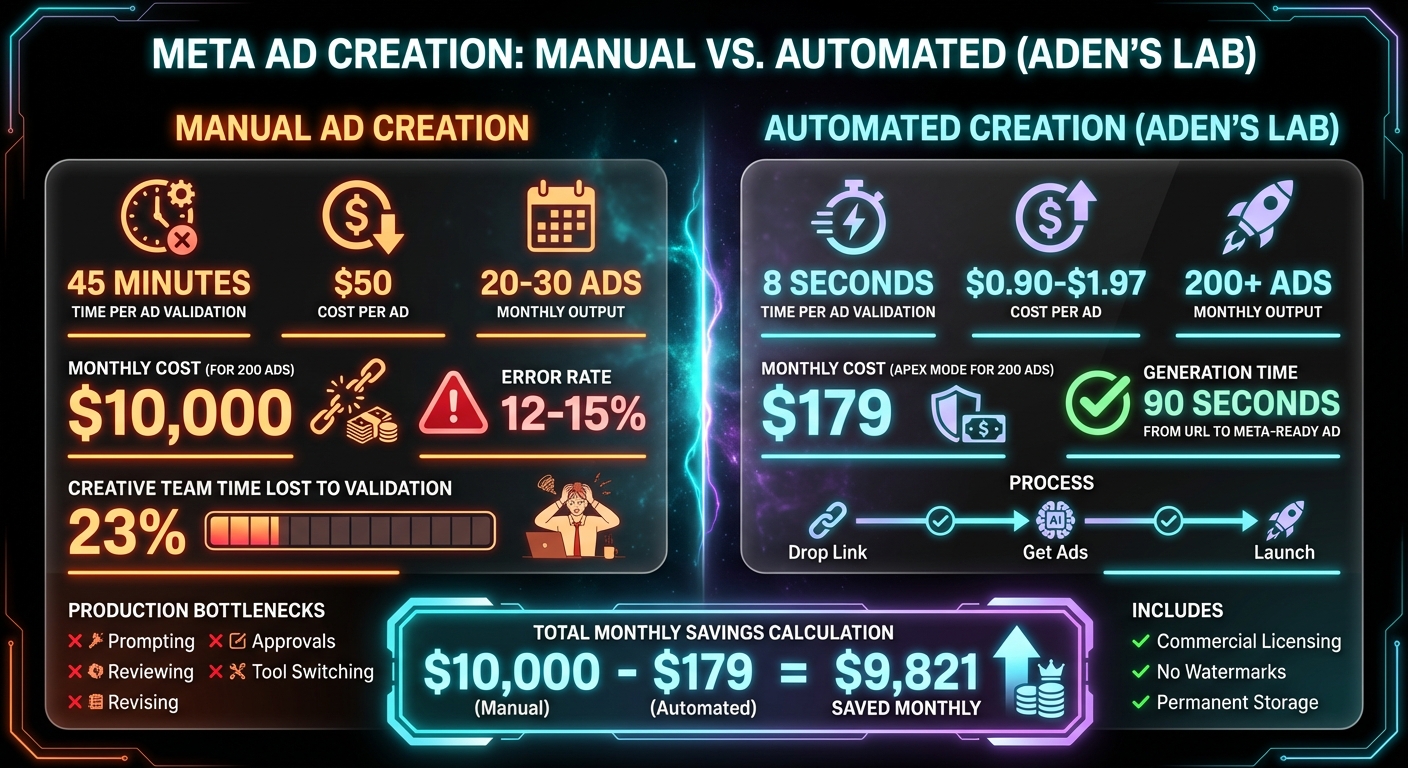
Manual vs Automated Meta Ad Creation: Cost and Time Comparison
Manual processes for ad creation often slow down production and limit output, especially when you're spending six figures monthly on platforms like Meta. The real solution isn't improving prompts - it's eliminating them entirely. A fully automated system removes these bottlenecks, delivering the speed and volume required to keep up with demand.
Drop a Link → Get Ads → Launch
Aden's Lab simplifies the entire process. Just paste your product or landing page URL, and the platform generates Meta-ready ads in just 90 seconds. There’s no need for prompts, creative briefs, or endless revisions. The system analyzes your page, identifies what you're selling, and produces ads optimized for Meta’s algorithm.
The process is seamless: you provide a link, and the system delivers ads ready to launch on Facebook and Instagram. Everything in between is handled automatically, freeing up your time for tasks that matter more.
Why Automation Beats Manual Systems
Hiring a manual designer typically costs about $50 per ad. In contrast, Aden's Lab offers ads for $0.90 to $1.97 each, depending on your plan. But the real advantage is in speed and scalability. A manual workflow might yield 20-30 ads a month - if you're lucky. Automation allows you to generate 200+ ads monthly without needing extra staff.
Meta's algorithm evaluates millions of ad variations in milliseconds, so success now hinges on creative volume and automation. The more high-quality ads you can provide, the better your chances of winning. Manual systems, even those with great prompts, simply can't keep up with this pace. Automation ensures you can scale your ad production to meet the demands of rapid testing and optimization.
How to Scale Without Creative Fatigue
Creative fatigue is a campaign killer. Ads stop performing not because your offer changes but because your audience gets tired of seeing the same thing. The solution? Constantly refreshing your creatives. This requires a system capable of producing new ads daily without overloading your team or draining your budget.
With Aden's Lab's Apex Mode, you can generate 200 ads per month for $179, which breaks down to just $0.90 per ad. This allows you to launch fresh creatives every day while staying within budget. Compare that to the time and cost of hiring designers or managing manual workflows for 20+ hours a week. Plus, every ad comes with commercial licensing, no watermarks, and permanent storage, so they're ready to use right away.
This approach keeps your campaigns fresh and effective without increasing your workload. By automating the most time-consuming part of the process, you can focus on scaling your efforts without burning out your resources or team.
Conclusion
Success with Meta ads hinges on one crucial element: consistently delivering fresh creatives to avoid ad fatigue. While tweaking prompts manually might work occasionally, it simply can't keep up with the speed and consistency Meta's algorithm demands.
The brands that dominate on Facebook and Instagram aren't just good at writing prompts - they excel because they rely on systems that churn out a high volume of quality ads without the delays of manual workflows. When you're spending tens of thousands of dollars every month, waiting days for a designer to deliver ads can slow you down and disrupt your momentum.
That's where automation becomes a game-changer. Aden's Lab eliminates creative bottlenecks entirely. The process is simple: drop a link, get your ads, and launch. With the Apex Mode plan - priced at just $0.90 per ad - you can produce up to 200 ads each month. Compare that to traditional workflows that cost $50 per ad, and it's clear how much time and money this saves. This approach keeps your campaigns fresh, prevents ad fatigue, and lets you test aggressively without blowing your budget. This is essential for brands looking to scale ad testing efficiently.
Moving from manual processes to full automation isn't just about convenience - it's the only way to scale effectively. By matching production speed with testing and iteration, you can avoid fatigue and achieve consistent wins. This rapid pace ensures your campaigns stay dynamic and your scaling efforts remain on track.
FAQs
How can automation reduce creative fatigue in Meta ads?
Automation takes the stress out of ad creation by streamlining and accelerating the process. Instead of spending hours brainstorming and designing ads from scratch, automated tools can produce multiple high-quality variations in no time. This keeps your campaigns fresh and engaging without overwhelming your team with constant creative demands.
It also makes testing and refining ad variations much faster. You can quickly identify which versions resonate most with your audience, ensuring your campaigns remain effective without burning through resources. By automating these repetitive tasks, your team can focus on the bigger picture - like crafting winning strategies - while your ads continue to perform consistently.
What are the advantages of using consistent inputs when creating Meta ads?
Using consistent inputs in ad creation not only simplifies the process but also leads to better performance outcomes. Here's why it makes such a difference:
First, it ensures uniformity in your creatives, which makes tracking performance much easier. When your variables are consistent, you can clearly identify what’s working and what’s not - without the confusion caused by inconsistent elements. This means you’ll get cleaner data and can make smarter, more informed optimizations.
Second, it speeds up the creative production process. Standardized inputs allow automated tools to produce high-quality ads more quickly. This frees up your time to focus on testing and scaling, rather than getting bogged down in repetitive tweaks. For campaigns that need to scale fast, this streamlined approach is essential.
Finally, consistency reduces errors and prevents creative fatigue. A stable, consistent strategy reinforces your brand message, making it easier for your audience to recognize and engage with your ads. Plus, it keeps your costs in check while delivering stronger results. It’s a practical and efficient way to create ads that truly perform.
Why is creating multiple ad variations crucial for Meta campaigns?
Creating multiple ad variations is crucial for testing different creative ideas to discover what clicks with your audience. This approach not only boosts performance but also helps combat creative fatigue - that drop in effectiveness when people see the same ad too many times.
When you pinpoint the ads that perform best, you can allocate your budget smarter, leading to higher engagement and improving your ROAS (Return on Ad Spend). Keeping a consistent stream of fresh ad variations ensures your campaigns remain competitive and responsive to changing audience preferences.
Your next ad batch starts here
Finish with a ready-to-test ad batch
Paste your website to generate static creatives. Drop the link → get ads in about 90 seconds → upload them to Meta → scale.
Free to try No prompt writing