CBO vs ABO in 2026: What Actually Works for Scaling Meta Ads
Turn the strategy into creatives
Create Meta ads for your product
Paste your product page. ADEN'S LAB turns the offer, audience, and positioning into complete ready-to-use Meta static ads.
Free to try No prompt writing

When scaling Meta ads in 2026, the choice between Ad Set Budget Optimization (ABO) and Campaign Budget Optimization (CBO) depends on your goals:
- ABO: Best for testing new creatives or audiences. You manually control budgets for each ad set, ensuring fair testing and balanced insights. Ideal for smaller budgets or campaigns with less than 50 conversions per week.
- CBO: Ideal for scaling proven winners. Meta’s AI dynamically allocates your campaign-level budget to high-performing ad sets, reducing manual effort and improving efficiency. Works best with sufficient conversion data (50+ per week).
Key takeaway: Use ABO to test and identify top-performing ads, then shift to CBO for scaling. Combining both strategies ensures better results while balancing control and automation.
Quick Comparison
| Factor | ABO (Ad Set Budget Optimization) | CBO (Campaign Budget Optimization) |
|---|---|---|
| Budget Control | Manual (per ad set) | Automated (campaign level) |
| Best For | Testing new ideas | Scaling proven winners |
| Management Effort | High (manual adjustments) | Low (AI-driven) |
| Scaling Efficiency | Limited | High |
| Conversion Volume | Works with fewer conversions | Needs 50+ conversions per week |
ABO and CBO are not rivals - they’re tools for different stages of your campaign. Start with ABO to find what works, then let CBO scale the winners while saving time and reducing costs.
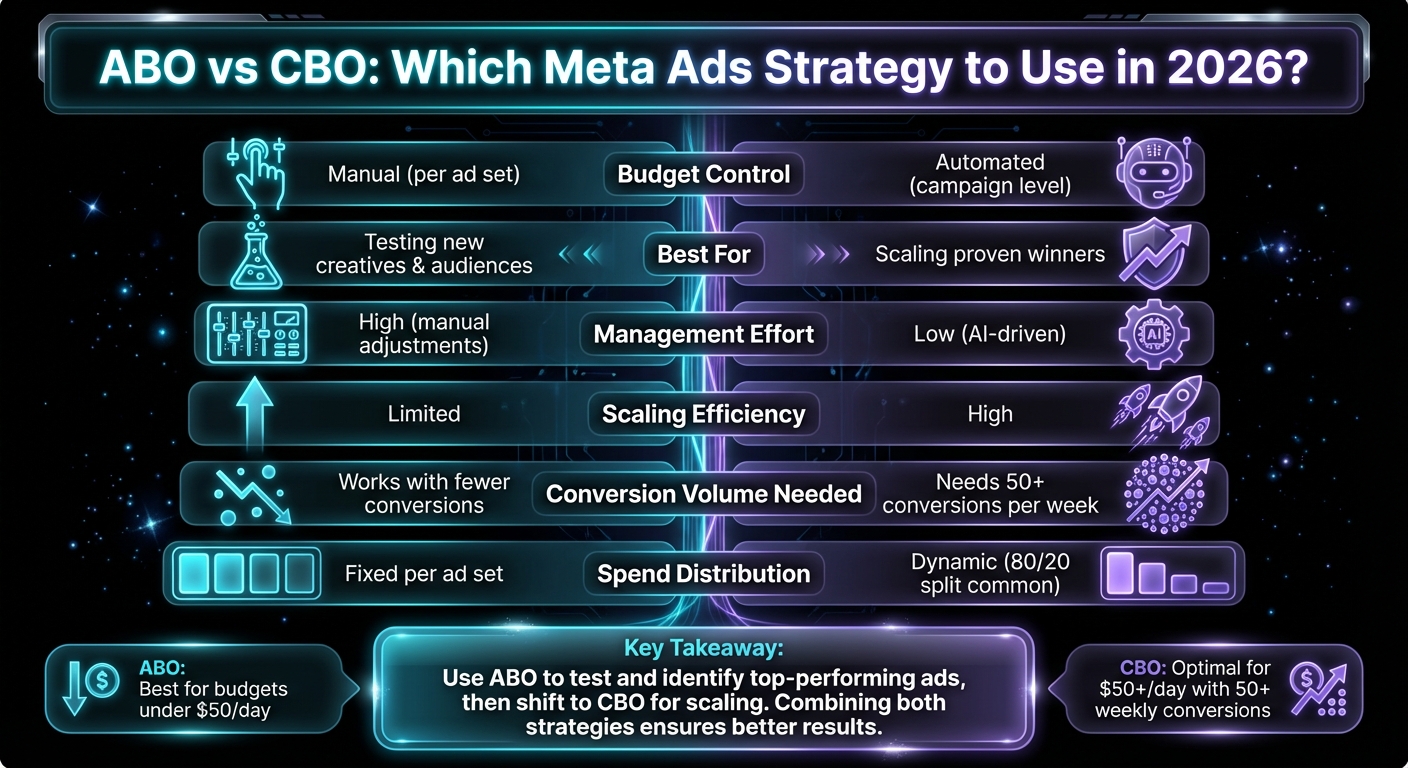
ABO vs CBO Meta Ads Comparison: Budget Control, Use Cases, and Scaling Efficiency
Facebook Ads ABO vs CBO - Which Should You Use in 2026?
Put the playbook to work
Apply this playbook to your page
Paste your website and the Lab will turn the strategy you are reading into a ready-to-test ads.
Free to try No prompt writing
What is ABO (Ad Set Budget Optimization)?
Ad Set Budget Optimization (ABO) is a Meta Ads setup where you control the budget for each ad set individually. For example, you might assign $40 per day to one ad set, and Meta will spend exactly that amount - no more, no less - regardless of how other ad sets in the campaign are performing.
This approach puts you in the driver’s seat, but it also demands ongoing adjustments. As Facebook Ads strategist Barry Hott explains:
"The reason I like to control the budget is to achieve balanced performance insights. I'm consciously choosing to perform a little worse [overall] but to have a better understanding of what is working."
ABO is like a testing ground for new ideas, where each ad set operates independently. This makes it especially useful for new accounts with limited data. For effective testing, aim to set your daily budget at around 2x your target Cost Per Acquisition (CPA). For instance, if your target CPA is $20, allocate $40 per day per ad set.
Meta’s algorithm typically needs about 50 conversions per week per ad set to optimize effectively. ABO is often favored for campaigns with smaller budgets - under $50 per day - where there isn’t enough data for campaign-level optimization.
Let’s break down the advantages and challenges of using ABO.
Benefits of ABO
ABO gives you precise control over how much you spend on each audience or creative. Unlike Campaign Budget Optimization (CBO), which might funnel most of the budget into one ad set at the expense of others, ABO ensures every ad set gets its full share. This makes it the go-to method for fair, unbiased testing, preventing Meta’s algorithm from prematurely favoring one ad set based on early results.
Another advantage? You can allocate spending based on business priorities rather than relying solely on Meta’s algorithm. For example, you might choose to invest more in audiences with high lifetime value, even if they don’t convert as quickly. When testing creatives with ABO, it’s crucial to keep everything else - like audience, placements, and schedule - consistent. This way, any performance differences can be attributed to the creative itself.
As Depesh Mandalia puts it:
"ABOs work well because you can control them far better... If your ABO is performing well, it means you've put the right inputs in - good product, good targeting, good funnel."
Limitations of ABO
While ABO is great for testing, it’s not the easiest to scale. The biggest challenge? Manual management. Scaling with ABO requires constant tweaking of budgets across multiple ad sets, which can quickly become overwhelming. As Rokas Steponavičius, CEO of TryCrush.ai, bluntly puts it:
"If you try to scale to $10k/day with ABO, you will go insane."
Another downside is that ABO lacks flexibility. Unlike CBO, which can automatically redirect budget from underperforming ad sets to better-performing ones, ABO sticks to the assigned budget - even if an ad set is struggling. This rigidity can lead to wasted spend if you’re not actively monitoring performance. Running too many small-budget ad sets can also fragment your data, making it harder for any single ad set to gather enough conversions to optimize effectively.
Lastly, because each ad set operates in isolation, ABO can’t find the "cheapest conversions" across the campaign. This often results in a higher overall CPA compared to CBO. If your ad success rate is below 50%, ABO becomes costly, as it continues spending on underperforming ads that an automated system might cut.
ABO has its strengths, but it requires a hands-on approach and is best suited for certain scenarios, like testing or campaigns with smaller budgets.
What is CBO (Campaign Budget Optimization)?
Campaign Budget Optimization (CBO), now known as "Advantage+ campaign budget" by Meta, shifts how advertisers manage budgets. Instead of assigning specific dollar amounts to each ad set (as with Meta Advantage+ vs manual budget allocation), CBO lets you set a single budget at the campaign level. From there, Meta’s algorithm takes over, distributing the budget across ad sets based on real-time data like conversion likelihood, auction trends, audience saturation, and time-of-day performance. Essentially, the system prioritizes efficiency over fairness, often concentrating most of the budget on one or two high-performing ad sets.
CBO is designed to streamline campaigns and maximize results. To achieve optimal performance, Meta recommends campaigns using CBO hit at least 50 conversions per week. Unlike ABO, which requires constant adjustments to individual ad set budgets, CBO simplifies the process by centralizing budget control.
Chris Pollard, Founder of Ads Uploader, encapsulates this trade-off:
"ABO gives you control at the cost of efficiency. CBO gives you efficiency at the cost of control."
With this understanding, let’s dive into CBO’s advantages and challenges.
Benefits of CBO
The standout benefit of CBO is automation. Instead of manually tweaking budgets for multiple ad sets, you set a single campaign budget and let Meta’s algorithm handle the heavy lifting. This not only saves time but also allows you to focus on more strategic aspects like creative development and audience analysis.
CBO also excels at rapid optimization. Thanks to Meta’s "Real-Time Liquidity", the algorithm adjusts budgets dynamically, pulling funds from underperforming audiences and reallocating them to those delivering better results. Campaigns using CBO often see a 17% lower cost per result when running three or more ad sets, making it particularly effective for scaling. Plus, scaling becomes easier - simply increase the campaign budget without disrupting individual ad set learning phases.
Another key strength of CBO is its ability to focus on what works. As Chris Pollard explains:
"CBO optimizes for efficiency by finding what works and doubling down. It's not trying to test everything equally."
That said, while the benefits are clear, there are also some notable challenges.
Limitations of CBO
One of the main drawbacks of CBO is its reliance on Meta’s algorithm. By handing over control, you lose the ability to evenly distribute budgets across all ad sets. If one ad set achieves a lower cost per action (CPA), the algorithm will funnel most of the budget there, even if other ad sets are important for long-term growth.
Another challenge is the learning phase. CBO typically needs 7–14 days of consistent spending to fully optimize. During this time, performance can be unpredictable, and any significant changes will reset the learning phase, requiring another 7–14 days to stabilize. This makes CBO less ideal for campaigns needing quick results.
CBO also struggles with campaigns that include ad sets with widely varying CPAs. For example, if you combine prospecting (cold audiences) and retargeting (warm audiences) in the same campaign, the algorithm will prioritize retargeting since it usually has a lower CPA. This can leave prospecting efforts underfunded, which is problematic for building long-term growth. To avoid this, group ad sets with similar CPAs and create separate campaigns for different stages of the sales funnel.
Lastly, CBO requires a certain level of conversion volume to function effectively. If your campaign generates fewer than 50 conversions per week, the algorithm won’t have enough data to optimize, leading to poor performance. This makes CBO less suitable for new accounts or campaigns with very small budgets (under $50 per day).
Understanding and working with these limitations is essential for leveraging CBO effectively, especially as Meta ads continue to evolve.
ABO vs CBO: Direct Comparison
Let’s break down the differences between ABO (Ad Set Budget Optimization) and CBO (Campaign Budget Optimization) to help you decide which approach aligns best with your Meta ads strategy.
The choice boils down to control versus automation. As Chris Pollard puts it, ABO offers precise control, while CBO leans on automated efficiency.
Think of ABO as a manual transmission - you’re in charge of every dollar and decide exactly where it goes. On the other hand, CBO is like driving an automatic: you set a total budget, and Meta’s algorithm takes over, distributing funds based on real-time performance signals. Many advertisers now use AI tools to further optimize these automated distributions. This fundamental difference influences everything from how much time you spend managing campaigns to which method works better for testing or scaling.
Here’s a side-by-side comparison to make these distinctions clear:
Comparison Table
| Factor | ABO (Ad Set Budget Optimization) | CBO (Campaign Budget Optimization) |
|---|---|---|
| Budget Control | Manual (ad set level) | Automated (campaign level) |
| Management Effort | High (daily manual adjustments) | Low (algorithm handles most adjustments) |
| Spend Distribution | Fixed per ad set | Dynamic, based on performance (e.g., 80/20 split) |
| Primary Use Case | Testing new creatives and audiences | scaling proven winners |
| Learning Phase | Each ad set learns independently | Campaign-wide learning and data sharing |
| Scaling Efficiency | Lower (budget changes can reset learning) | Higher (handles budget increases of 10-20% smoothly) |
| Risk Profile | Risk of overspending on underperformers until manually adjusted | May underfund promising ad sets early on |
| Best For | Fair testing and precise budget allocation | Automation, scaling, and maximizing efficiency |
Key takeaway? ABO is perfect for testing because it ensures every creative or audience gets a fair share of the budget. This makes it ideal for identifying top performers. Once you’ve found what works, CBO takes the wheel, optimizing spend to scale your campaign efficiently while minimizing cost per action.
Using ABO for scaling or CBO for testing often leads to poor results - it’s like using the wrong tool for the job. By understanding these differences, you can better align your strategy with your campaign objectives and avoid common pitfalls.
When to Use ABO for Meta Ads

ABO (Ad Set Budget Optimization) is your go-to strategy when you need precise control over budget allocation, especially during the testing phase for creatives and audiences. It ensures that each ad set gets an equal share of the budget, avoiding early bias from Meta's algorithm, which might otherwise favor one ad set based on unreliable initial performance signals.
Meta Ads Strategist Barry Hott highlights the advantage of this approach:
"The reason I like to control the budget is to get an even read on everything. I'm consciously choosing to perform a little worse [overall] but to have a better understanding of what is working".
This method prioritizes reliable data collection, setting the foundation for scaling later with automation.
ABO works particularly well for campaigns generating fewer than 50 conversions per week. In such cases, the limited data can make CBO (Campaign Budget Optimization) misallocate funds, while ABO allows for manual adjustments to optimize performance. For example, a D2C clothing brand tested four audiences using CBO with a $2,000/day budget, where 70% of the spend went to one audience. They switched to ABO with $500/day per audience, uncovering two high-performing audiences and reducing their CPA by 32%. This demonstrates how ABO can fine-tune campaigns before transitioning to automated scaling.
ABO is also ideal when you have specific budget allocations in mind - like a 40/60 split between retargeting and prospecting - or for short-term campaigns where immediate results are critical.
ABO Best Practices
To make the most of ABO during testing, follow these guidelines:
- Set the right budget: Allocate 2× your target CPA per ad set to gather data quickly. For example, if your target CPA is $20, assign $40/day for each ad set.
- Keep it focused: Limit campaigns to 3–5 ad sets to avoid spreading your budget too thin and to keep the learning process efficient. When testing creatives, ensure all other factors - like targeting, placements, and schedule - are consistent so that the creative is the only variable being evaluated.
- Define clear kill rules: Before launching, establish thresholds for pausing underperforming ad sets. For instance, stop an ad set that spends 1× CPA without generating a sale in 48 hours. If spending exceeds 3× CPA with ROAS below target, pause it immediately. Unlike CBO, ABO doesn't automatically halt poor performers, so daily monitoring is critical.
- Run tests long enough: Allow tests to run for at least 3–7 days to gather sufficient data and separate actual trends from daily fluctuations. Once you identify winning ads - those showing 3–5 days of consistent profitability - move them to a CBO scaling campaign using Post ID duplication to retain social proof.
When to Use CBO for Scaling Meta Ads
Once you've identified 2–3 winning audiences or creatives through ABO testing, it’s time to switch to CBO (Campaign Budget Optimization) to scale effectively. CBO uses Meta's real-time data optimization to dynamically allocate budgets toward the best-performing ad sets, helping you scale without constant manual adjustments.
CBO works particularly well for broad targeting and full-funnel campaigns. The algorithm identifies conversion opportunities across a wide audience, removing the need to manually predict which segments will perform. Instead of adjusting budgets between ad sets daily, CBO automatically reduces spending on underperforming ads while increasing investment in the winners.
It’s also a great tool when there’s uncertainty about which creative will hit. If no clear frontrunner emerges, CBO focuses on ads showing potential while minimizing spending on weaker ones. Meta even reported a 70% year-over-year growth in adoption of Advantage+ Shopping campaigns, which leverage this CBO logic.
For CBO to deliver results, sufficient data is key. Meta recommends at least 50 conversions per week per campaign for stable optimization. Without this volume, CBO may struggle to exit its learning phase, leading to inefficient budget allocation. To calculate the minimum daily budget required for your campaign, use this formula:
(Target CPA × 50) ÷ 7 days.
As Rokas Steponavičius, founder of TryCrush.ai, explains:
"CBO allows Facebook's machine learning to do what it does best: Real-Time Liquidity".
To make the most of CBO, follow these scaling strategies:
CBO Scaling Strategies
Scaling CBO campaigns successfully requires careful planning to avoid disrupting the algorithm's learning phase. Here’s how to do it:
- Gradual Budget Increases: Increase your budget by 10–20% every 2–3 days. Sudden, large increases - like doubling your budget overnight - can destabilize the campaign, forcing the algorithm to relearn and potentially driving up CPAs.
- Set Initial Spend Limits: During the first 7 days of a new CBO campaign, assign each ad set a minimum daily spend of 10–20% of the total campaign budget. This ensures that every creative gets enough exposure. After the first week, remove these limits to let the algorithm fully optimize.
- Preserve Social Proof: When moving a winning ad from ABO testing to a CBO campaign, use Post ID duplication to retain social proof (likes, comments, shares). This can increase click-through rates by up to 15%. Simply copy the Post ID from the original ad and apply it to the new CBO ad set using the "Use Existing Post" option.
- Follow the 72-Hour Rule: After launching or making significant changes to a CBO campaign, avoid additional adjustments for at least 72 hours. This gives the algorithm time to stabilize. You can also set automated rules to pause any ad set exceeding your target CPA by 20% after hitting a certain spend threshold.
How to Combine ABO and CBO for Better Results
Blending ABO for testing with CBO for scaling creates a powerful strategy that avoids the pitfalls of relying on just one approach. Use ABO to test new creatives and pinpoint top performers, then shift those winners into CBO campaigns to scale effectively. This method optimizes your ad spend while improving conversion rates and lowering CAC.
To maintain a balance, allocate 5–10% of your total ad budget to ABO testing and the remaining 90–95% to CBO campaigns. This ensures ongoing testing without disrupting the efficiency of scaling efforts. By combining precise testing with automated scaling, you can achieve better overall performance.
Hybrid Workflow Steps
-
Test Creatives with ABO
Begin by testing new creatives in an ABO setup, assigning each ad set a budget of 1x to 2x your target CPA. For example, if your target CPA is $30, allocate $30–$60 per ad set daily. This ensures equal spending across all variants, preventing Meta from favoring one creative too early based on initial engagement. -
Run Tests for Statistically Significant Data
Let your ABO tests run for 48 hours to 7 days to gather meaningful data. Identify winners by checking if they meet or beat your target CPA. Those that perform well are ready to move to the next phase. -
Move Winners to CBO Using Post ID Duplication
When transferring top-performing ads to CBO, use Post ID duplication to retain social proof. Simply copy the Post ID from the original ad and select "Use Existing Post" when setting up the CBO ad set. -
Launch and Manage CBO Campaigns
Start your CBO campaign with 3–5 winning ad sets to avoid spreading the budget too thin. During the initial week, set minimum daily spend limits at 10–20% of the total campaign budget for each ad set to ensure all creatives get exposure. After this period, remove the limits and let Meta's algorithm optimize for the best results. -
Scale Gradually
As your CBO campaign progresses, increase the budget by 10–20% every 2–3 days. This avoids triggering the learning phase reset. Meanwhile, keep running ABO campaigns to identify new winners. If a creative fails in the CBO phase, it’s likely an anomaly from testing - discard it and move on.
This hybrid approach ensures you’re constantly testing and scaling, making the most of both ABO and CBO. Up next, we’ll dive into how AI tools can enhance these strategies further. For instance, certain AI tools can cut Meta CPA by automating the creative testing process even further.
AI Tools to Improve ABO and CBO Performance
AI tools address the challenge of quickly creating high-performing ad creatives, ensuring a consistent stream of fresh content to meet algorithm requirements. These tools monitor performance continuously, allowing for quick budget increases on successful ads and timely pauses on those underperforming. In ABO testing, AI automates the creation of isolated ad sets, ensuring each creative gets a fair chance to shine. In CBO scaling, AI identifies successful patterns - like specific hooks or audience segments - and generates hundreds of optimized variations to maintain strong results.
Another big advantage is transparency. Instead of leaving you guessing about budget changes, AI platforms provide detailed activity logs. For instance, you might see a record of a 25% budget increase triggered by a 35% drop in CPA over a six-hour period. This clarity helps you understand what’s driving success, so you can replicate winning strategies faster. This real-time responsiveness enhances both ABO testing and CBO scaling.
ADEN's LAB is a prime example of how AI simplifies testing and scaling, making these processes faster and more efficient.
Using ADEN's LAB for ABO Testing
ADEN's LAB leverages AI to speed up ABO testing by generating dozens of static ad variations in just minutes - work that would otherwise take hours and cost significantly more in design resources. When testing new creatives, speed and volume are critical. The faster you can test a variety of ads, the quicker you can identify winners and move to scaling.
The platform’s bulk launch feature streamlines this process by setting up multiple ad sets at once, removing the need to manually create individual campaigns. This means you can test a new creative approach across several audience segments simultaneously, collecting meaningful data faster. For instance, if you’re testing 10 new static ads daily, ADEN's LAB can produce all the variations in under 90 seconds, keeping your testing pipeline running smoothly without creative delays.
Using ADEN's LAB for CBO Scaling
Once you’ve identified winning creatives, scaling with CBO requires a constant supply of new content to avoid ad fatigue and sustain performance at higher spending levels. ADEN's LAB delivers by producing hundreds of algorithm-optimized static ads each month - up to 1,000 on higher-tier plans. With costs as low as $0.90 per ad on the Apex Mode plan, you can continuously refresh your CBO campaigns without the expense of traditional design workflows.
The platform also includes real-time performance monitoring, allowing you to act quickly on spikes in success. If a creative starts delivering conversions at a lower CPA, the system detects this within minutes and reallocates budget accordingly. For brands spending $10,000 or more monthly on Meta ads, generating 200 fresh static ads every month ensures you’re always providing the algorithm with new material. This steady stream of creatives helps maintain balanced budget distribution while scaling performance.
Conclusion: Choosing the Right Approach for 2026
ABO is your testing ground for creative ideas, while CBO is the engine that scales proven successes. Think of ABO as a way to give each creative a fair shot, and CBO as the tool that uses Meta's AI to automatically allocate budgets to the top performers. As Levi Steede, Consultant, explains:
"Most advertisers treat ABO vs CBO like picking a favorite sports team. It's not about which one is 'better.' It's about using the right tool for the right situation".
A hybrid strategy combines the strengths of both approaches. Use ABO to test creatives at 1–2× your target CPA, then scale the winners with CBO by leveraging Post IDs to retain social proof. This workflow balances the precision of testing with the efficiency of scaling.
Your choice depends on creative performance, campaign goals, and how much management bandwidth you have. ABO is ideal for testing new audiences or creatives - it ensures the algorithm doesn’t prematurely cut off ads with potential. On the other hand, CBO excels at scaling and can reduce costs by up to 27% by focusing spend on top-performing ads. AI tools can also help fine-tune these strategies.
For retargeting or smaller, high-value audiences, ABO ensures precise budget allocation. For broad cold traffic or established creatives, CBO can take over and optimize spend effectively. If you’re unsure, try the "minimum spend trick": set CBO with 10–20% minimum budgets per ad set for the first week, then lift the limits to let the algorithm optimize freely. This method helps you balance control with algorithmic efficiency.
Looking ahead to 2026, success will depend on consistently producing a high volume of winning creatives. Brands capable of generating hundreds of fresh static ads each month will leave competitors struggling to keep up.
FAQs
How do I know my account has enough data to switch from ABO to CBO?
When your account shows stable performance and consistent data, it’s a good sign you’re ready to move from ABO to CBO. This usually happens after you’ve tested various audiences and creatives using ABO, identified the top performers, and achieved steady metrics. At this stage, you can rely on Meta’s algorithm to handle budget allocation efficiently, making CBO the smarter option for scaling.
What budget should I start with if I want 50 conversions per week?
To figure out your starting budget, use your average cost per acquisition (CPA) as a guide. For instance, if your CPA is $10, you’d need a weekly budget of around $500 ($10 x 50), which breaks down to about $72 per day. Begin with this amount, keep a close eye on your results, and tweak as necessary. Start by using Ad Set Budget Optimization (ABO) to test and fine-tune your CPA before moving on to Campaign Budget Optimization (CBO) for scaling.
How can I stop CBO from spending everything on just one ad set?
To avoid overspending on a single ad set when using CBO, it's smart to set caps or limits for each ad set in the campaign. Keep a close eye on performance and tweak bids or budgets for ad sets that aren't performing well. You can also use automated rules to pause or adjust ad sets that spend too much without delivering results. These steps help maintain a balanced budget and improve the overall performance of your campaign.
Your next ad batch starts here
Finish with a ready-to-test ad batch
Paste your website to generate static creatives. Drop the link → get ads in about 90 seconds → upload them to Meta → scale.
Free to try No prompt writing