CBO vs ABO: When to Use Each
Turn the strategy into creatives
Create Meta ads for your product
Paste your product page. ADEN'S LAB turns the offer, audience, and positioning into complete ready-to-use Meta static ads.
Free to try No prompt writing

When running Meta ad campaigns, your budget strategy plays a huge role in performance. The two main options are CBO (Campaign Budget Optimization) - now called Advantage Campaign Budget - and ABO (Ad Set Budget Optimization). Here's the key difference:
- CBO: Meta's algorithm distributes your budget dynamically across ad sets, prioritizing the best performers.
- ABO: You manually control the budget for each ad set, ensuring equal distribution regardless of performance.
Quick Takeaway: Use ABO for testing new audiences or creatives when you need control. Switch to CBO for scaling campaigns with proven winners to let Meta optimize for efficiency.
Quick Comparison
| Factor | ABO (Ad Set Budget Optimization) | CBO (Campaign Budget Optimization) |
|---|---|---|
| Budget Control | Manual | Automated |
| Best For | Testing | Scaling |
| Management Effort | High | Low |
| Spend Distribution | Fixed | Performance-based |
| Learning Phase | Independent per ad set | Shared across campaign |
Start with ABO to test, then move to CBO for scaling. Choose the right tool based on your campaign's goals and stage.
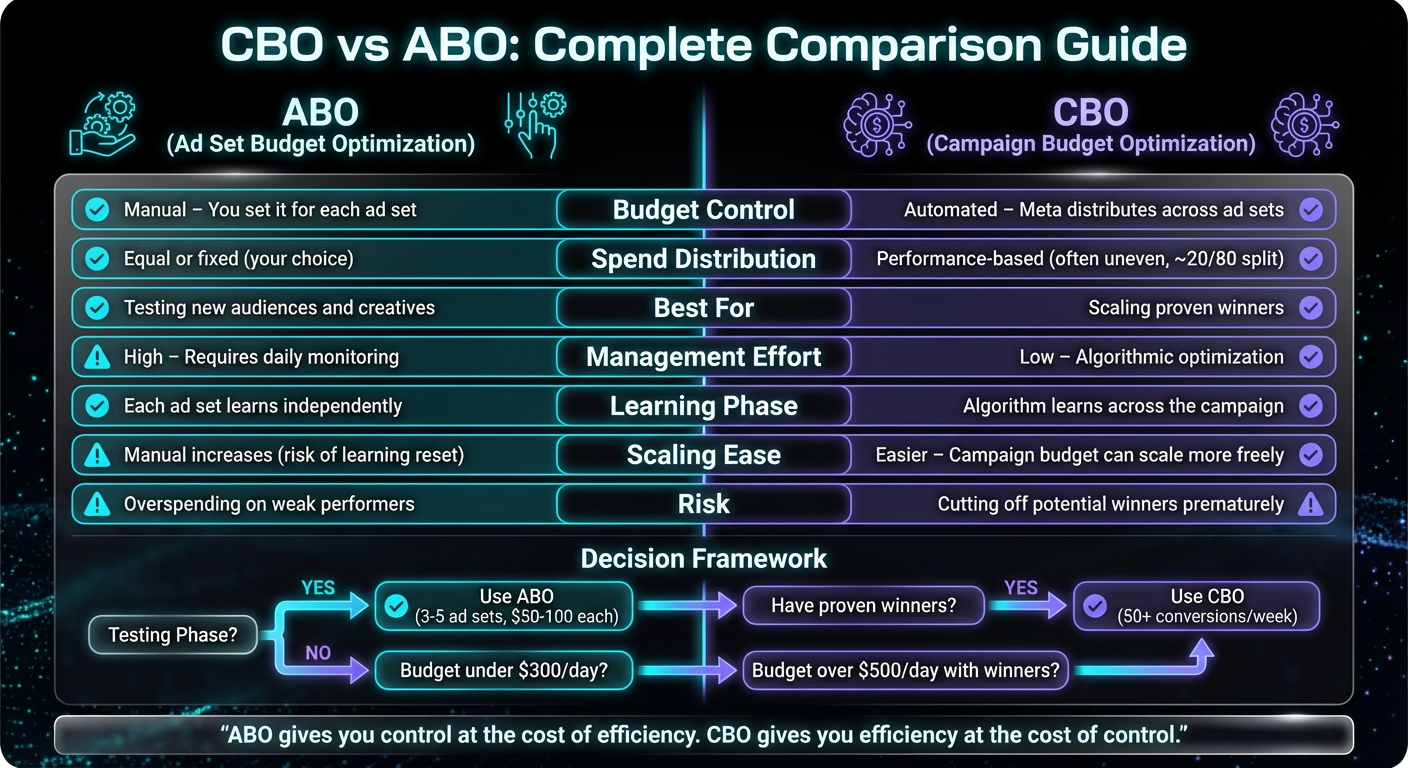
CBO vs ABO Meta Ads Budget Optimization Comparison Chart
Should You Test Your Meta Ads with CBO or ABO and Why?

Put the playbook to work
Apply this playbook to your page
Paste your website and the Lab will turn the strategy you are reading into a ready-to-test ads.
Free to try No prompt writing
How CBO and ABO Differ
When it comes to CBO (Campaign Budget Optimization) and ABO (Ad Set Budget Optimization), the main difference lies in who controls the budget. With ABO, you decide how much budget each ad set gets, and Meta sticks to your allocation. In contrast, CBO hands over that decision-making to Meta's algorithm, which adjusts the budget dynamically based on performance predictions.
Think of ABO as driving a manual car - you're in control, but it requires effort. On the other hand, CBO is like an automatic transmission, where the system optimizes spending in real time. As Chris Pollard from Ads Uploader explains:
"ABO gives you control at the cost of efficiency. CBO gives you efficiency at the cost of control".
Another key distinction lies in how the learning phase operates. With ABO, each ad set learns independently, essentially running its own experiment. CBO, however, consolidates data across the entire campaign, allowing the algorithm to reallocate budget to the best-performing ad sets. This can speed up the learning process for successful ads but may also cut off underperformers too soon. These differences in control and data usage form the foundation for the comparison table below.
CBO vs ABO: Side-by-Side Comparison
Here's a quick breakdown of how these two methods stack up:
| Factor | ABO (Ad Set Budget Optimization) | CBO (Advantage Campaign Budget) |
|---|---|---|
| Budget Control | Manual - you set it for each ad set | Automated - Meta distributes it across ad sets |
| Spend Distribution | Equal or fixed (your choice) | Performance-based (often uneven, ~20/80 split) |
| Best For | Testing new audiences and creatives | Scaling proven winners |
| Management Level | High - requires daily monitoring | Low - algorithmic optimization |
| Learning Phase | Each ad set learns independently | Algorithm learns across the campaign |
| Scaling Ease | Manual increases (risk of learning reset) | Easier - campaign budget can scale more freely |
| Risk | Overspending on weak performers | Cutting off potential winners prematurely |
ABO ensures every ad set gets its assigned budget, making it ideal for testing when unbiased data is critical. On the flip side, CBO focuses on efficiency, redistributing funds to chase the best cost per result - even if that means uneven spending.
When CBO Works Best
CBO shines when you’ve already identified audiences and creatives that deliver strong results. Once you know what works, CBO takes over, reallocating your budget in real time. This eliminates the need for constant manual tweaks.
The algorithm keeps an eye on subtle performance changes - like shifts in auction competition, early signs of creative fatigue, or short bursts of efficiency. It adjusts the budget automatically, sometimes multiple times a day, to keep costs per result as low as possible. That’s why some advertisers compare CBO to an "automatic transmission" - it handles the fine-tuning for you.
Scaling Without Manual Budget Shifts
One of CBO’s standout strengths is its ability to scale without requiring constant adjustments. With ABO, increasing your spend means manually raising the budget for each ad set. And if you raise an ad set’s budget by more than 20%, you risk resetting the learning phase. This can hurt performance for days while the system recalibrates.
With CBO, scaling is far simpler. You just increase the overall campaign budget, and the system redistributes funds across ad sets based on their performance. For example, I once scaled a CBO campaign from $500/day to $2,000/day in just a week - without any major spikes in costs.
If an ad set starts underperforming, CBO doesn’t wait for your input. It quickly shifts the budget to other ad sets that are still delivering results, helping protect your return on ad spend (ROAS). This makes it an ideal solution for campaigns built around proven, high-performing elements.
Campaigns with Proven Ad Sets
CBO works best when you’re working with solid, reliable data. If you’ve tested 3–5 creatives using ABO and identified one or two clear winners, it’s time to move those into a CBO campaign. Meta’s system thrives on mature data - about 50 conversions per ad set per week are recommended for optimal performance.
Many experienced media buyers stick to a straightforward process: test with ABO first, then scale with CBO. To get the most out of CBO, keep your campaigns focused. Limit the number of ad sets to around 3–7. This ensures the algorithm has enough data for each ad set to exit the learning phase and optimize effectively.
When ABO Works Best
ABO puts you in the driver’s seat, giving you complete control over how every dollar is spent. You decide exactly where the budget goes, which makes it especially handy when testing different creatives or audience segments. This approach avoids a common issue with CBO, where the algorithm might prematurely favor one variant based on early, unreliable data.
Testing New Audiences and Creatives
If you're experimenting with multiple creative ideas or comparing distinct audience groups, ABO ensures every option gets a fair chance. By assigning a fixed daily budget to each ad set, you prevent the scenario where CBO over-invests in one ad set and leaves the others underfunded. This is particularly important for smaller-scale campaigns, like those in B2B or niche industries, where limited conversion data can make it harder for algorithms to optimize effectively.
This level of control doesn’t just benefit testing - it’s also invaluable when managing larger budgets.
Controlling Spend in Large Budgets
For campaigns with significant budgets, ABO is ideal for maintaining strict control over how funds are distributed across different stages of the funnel. Imagine running a $10,000-per-day campaign: if $4,000 is allocated for retargeting and $6,000 for prospecting, ABO ensures those numbers stay locked in. In contrast, CBO might override your plan, funneling most of the budget into one area and potentially derailing your strategy.
Take the example of Solutions 8, an agency that scaled a client’s campaign in January 2025 using ABO. They cloned a successful ad set five times, assigning each a $100 daily budget. This "scaling sideways" tactic led to impressive results: a 10% cost reduction, a 118% boost in new customer acquisition, and an 11.4% drop in acquisition costs.
"ABO is manual transmission, CBO is automatic. With ABO, you're deciding exactly where the budget goes." - Cedric Yarish, Co-Founder, AdManage.ai
However, this level of control requires careful monitoring. Daily oversight and strict "kill rules" are essential - for instance, pausing an ad set if its cost per conversion exceeds double your target after a set spend threshold. Without these safeguards, you could end up wasting money on underperforming ads. But if precision and control are what you’re after, ABO delivers what CBO simply can’t.
Mistakes That Waste Money with CBO and ABO
Both budget strategies can drain your wallet fast if you're not careful. The errors might not be obvious, but they’re entirely avoidable.
CBO Mistake: Letting the Algorithm Run Blind
One of the biggest missteps with CBO (Campaign Budget Optimization) is throwing an untested campaign at Meta and expecting it to work miracles. What usually happens? The algorithm locks onto one ad set early - often driven by initial engagement metrics that don’t translate into conversions - and dumps the majority of your budget there. The other ad sets? They barely get any exposure, let alone a fair chance to perform.
Here’s how it plays out: On Day 1, one ad set might soak up $450 out of a $500 budget, leaving the others with scraps. By Day 3, those underfunded ad sets haven’t collected enough data to prove their value, and the algorithm essentially abandons them.
"Don't hand Meta a large CBO budget without tested creatives. It will optimize but it might optimize the wrong way." - Rowads
The solution is straightforward: use ad set spend limits during the first week. Allocate at least $50–$100 per ad set so every creative gets a fair shot at proving itself. Once you’ve gathered a week’s worth of data, remove those limits and let the algorithm optimize based on actual performance - not Day 1 anomalies.
Another common mistake? Mixing audiences of vastly different sizes. For example, combining a 2 million-person cold audience with a 5,000-person retargeting list in the same campaign is a recipe for disaster. The algorithm will naturally favor the larger audience because it generates more data signals, leaving the smaller audience underfunded. To avoid this, keep audience sizes similar or split them into separate campaigns.
While CBO has its quirks, ABO (Ad Set Budget Optimization) comes with its own set of challenges.
ABO Mistake: Managing Too Many Ad Sets
ABO’s main drawback is its rigidity. Unlike CBO, which can shift budgets away from poor performers, ABO spends your budget evenly across all ad sets - whether they’re working or not - until you step in and manually shut them down.
For instance, if you’re running 10 ad sets and only 2 are performing well, you’re wasting 80% of your budget. CBO would automatically reallocate funds to the winners, but ABO doesn’t have that flexibility. The financial impact adds up quickly, especially if your creative success rate is low.
The manual effort required can also be overwhelming. Monitoring 15 ad sets daily, tweaking budgets, and keeping track of which ones you paused can turn into a logistical nightmare. Scaling winners is another headache. Increasing the budget on a successful ad set risks resetting the learning phase, which often leads to higher costs per acquisition.
"ABO spends even when performance is bad. The budget will still be spent daily unless you manually intervene." - Friday Marketing Agency
To manage ABO effectively, you need discipline and clear rules. Limit yourself to 3–5 ad sets per campaign to ensure each one gets enough budget to generate meaningful data. Establish strict "kill rules" before launching - like pausing any ad set that spends $100 without hitting half your target CPA. Once you’ve identified winners, move them to CBO for scaling. Trying to scale within ABO is a recipe for endless manual adjustments.
Both CBO and ABO mistakes stem from the same issue: using the wrong tool for the job. CBO without tested creatives is a gamble. ABO with too many ad sets is a management nightmare. Choosing the right strategy for your campaign phase can save you time, money, and frustration.
Picking the Right Approach for Your Campaign
Choosing between CBO (Campaign Budget Optimization) and ABO (Ad Set Budget Optimization) isn't about finding a universal winner - it’s about aligning the method with your campaign's goals. If you’re in the testing phase, ABO gives you more control. You can allocate a specific budget to each ad set, ensuring every creative or audience gets a fair shot. This level of precision is especially important when your daily budget is under $300–$500 or when you’re still figuring out what resonates with your audience.
Once you’ve identified the top-performing creatives or audiences, CBO becomes the smarter option for scaling. Meta’s algorithm takes over, redistributing your budget to the best-performing ad sets in real time. This reduces manual effort while helping maintain consistent results. However, for CBO to work effectively, each ad set needs to generate about 50 conversions per week. Without that data volume, the algorithm is essentially making educated guesses.
Your budget also plays a big role in deciding which approach to use. Smaller budgets benefit from ABO’s precision since you can’t afford to let the algorithm misallocate funds. On the other hand, if you’re scaling beyond $500 per day, CBO’s automation becomes invaluable. Managing multiple ad sets manually at this level can become overwhelming, and CBO helps streamline the process while maximizing efficiency.
The best strategy often involves using both approaches in sequence. Start with ABO to test 3–5 creatives, allocating equal budgets to each. After about a week of data collection, transition the top performers into a CBO campaign. This way, you leverage ABO’s precision during the testing phase and CBO’s automation during scaling.
What to Do Next
To apply these strategies, begin by reviewing your current campaigns. If your daily spend is under $300 or you’re testing new creatives, stick with ABO and limit your ad sets to 3–5. Once you’ve identified what works and are ready to scale, switch to CBO. Remove any spend limits after the first week to let Meta’s algorithm optimize effectively. Your decision should depend on your campaign’s current stage, rather than simply favoring one method over the other.
FAQs
When is the right time to switch from ABO to CBO in my ad campaigns?
Switch to CBO (Campaign Budget Optimization) after testing your campaigns with ABO (Ad Set Budget Optimization) and identifying which audiences and creatives deliver the best results. CBO is ideal for scaling because Meta’s algorithm automatically adjusts the budget, allocating it to the highest-performing ad sets.
During the testing phase, stick with ABO to keep full control over how your budget is distributed. Once you’ve nailed down what works, CBO can streamline the process, minimize wasted spend, and maintain steadier performance as you grow.
What’s the difference between CBO and ABO for managing ad budgets?
CBO (Campaign Budget Optimization) takes the wheel when it comes to managing your campaign budget. Facebook’s system automatically shifts spending between ad sets based on performance. This means more budget goes to the ad sets that are driving the best results, making it easier to scale campaigns quickly without constant tweaking.
ABO (Ad Set Budget Optimization), on the other hand, puts you in the driver’s seat. You decide exactly how much budget each ad set gets. While this approach is ideal for testing specific strategies or focusing spend in certain areas, it requires more active management. Without close monitoring, it can lead to inefficiencies.
To sum it up: CBO is ideal for scaling and saving time, while ABO offers greater control and flexibility for testing. Your choice depends on your goals and how much time you can dedicate to managing budgets.
What are the biggest mistakes to avoid with CBO and ABO on Meta Ads?
When working with CBO (Campaign Budget Optimization) and ABO (Ad Set Budget Optimization), there are a few common pitfalls that can lead to wasted ad spend or underwhelming results.
With ABO, one frequent misstep is being too controlling when setting budgets at the ad set level. Manually allocating budgets can restrict the algorithm's ability to pinpoint the best-performing audiences or creatives. This issue often arises when budgets aren’t monitored or adjusted regularly. Another problem is not testing enough variations. Without sufficient testing, you might end up funneling money into underperforming ad sets, missing out on better opportunities.
For CBO, a typical mistake is over-relying on automation without proper testing. This can lead the algorithm to favor certain ad sets too early, potentially sidelining others that could perform well with more data. Another common error is starting with a campaign budget that’s too high. During the testing phase, this can result in inefficient spending and unpredictable outcomes. It’s smarter to begin with a smaller budget, allowing the system to gather data and optimize before scaling up.
Both approaches call for a thoughtful balance of testing, regular fine-tuning, and a mix of manual oversight with algorithm-driven optimization to achieve the best results.
Your next ad batch starts here
Finish with a ready-to-test ad batch
Paste your website to generate static creatives. Drop the link → get ads in about 90 seconds → upload them to Meta → scale.
Free to try No prompt writing