Why Your Meta Ads Get Impressions but No Clicks
Turn the strategy into creatives
Create Meta ads for your product
Paste your product page. ADEN'S LAB turns the offer, audience, and positioning into complete ready-to-use Meta static ads.
Free to try No prompt writing

Your Meta ads might be getting impressions but no clicks because of three common issues:
- Poor visuals or ineffective design: Ads have just 1.7 seconds to grab attention. Weak visuals, cluttered layouts, or unengaging openings can cause users to scroll past.
- Wrong audience targeting: If your audience is too broad or too narrow, your ads may miss the mark. Meta also needs around 50 conversions per ad set weekly to optimize performance.
- Unclear messaging or weak CTAs: If your ad doesn't clearly show value or has a generic call-to-action, users won't feel motivated to click.
Key fixes include:
- Use bold visuals and concise hooks that highlight benefits immediately.
- Refine targeting based on demographics and campaign goals.
- Test action-driven CTAs like "Shop Now" or "Claim 40% Off."
Pro tip: Monitor metrics like CTR (aim for 1.0%+), hook rate (30–40%), and ad frequency (keep under 3.5 for cold audiences). Regularly test and refresh your ads to avoid fatigue and improve results. For more insights, see these Meta ad optimization answers regarding creative fatigue and budget management.
Facebook Ads CTR Secrets Revealed by Meta Ads Expert
Put the playbook to work
Apply this playbook to your page
Paste your website and the Lab will turn the strategy you are reading into a ready-to-test ads.
Free to try No prompt writing
Why Your Meta Ads Get Impressions but No Clicks
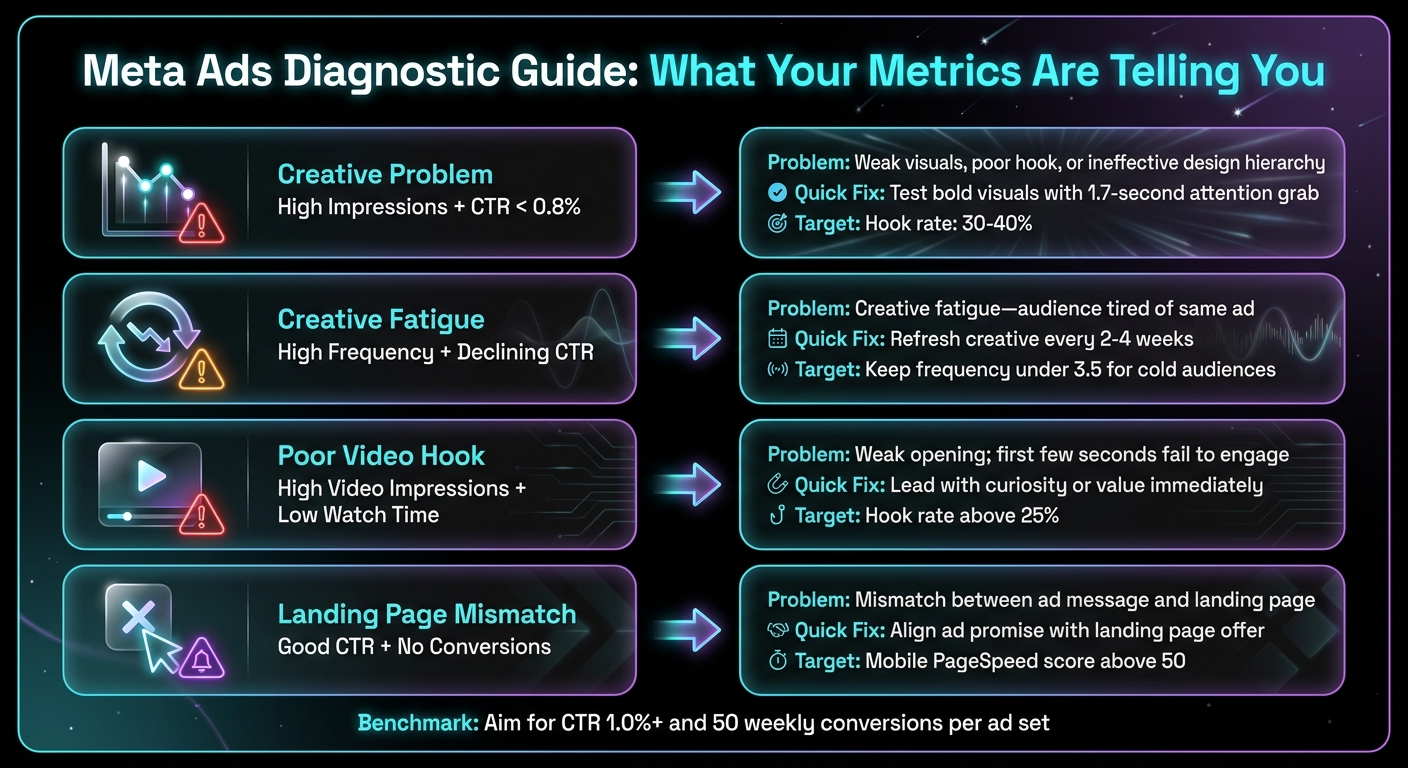
Meta Ads Diagnostic Guide: Symptoms and Solutions for Low CTR
If your Meta ads are racking up impressions but struggling to get clicks, there are likely three main culprits: weak creative, misaligned targeting, or unclear messaging. Let’s break these down to see how they might be holding your campaigns back.
Poor Ad Creative That Fails to Grab Attention
You have just 1.7 seconds to capture someone’s attention before they scroll past your ad. If your visuals are cluttered or lack contrast, they’ll blend into the feed and fail to stop the scroll.
Overly polished content can also backfire. Users tend to respond better to authentic, user-generated content (UGC) —which you can now produce at scale using AI— - think casual, phone-shot videos or real customer testimonials. These feel more native to platforms like Facebook and Instagram compared to studio-quality images or videos.
When it comes to video ads, the first few seconds are critical. If your ad’s hook rate is below 25%, the opening isn’t doing its job. Avoid wasting time on logos or slow intros; instead, spark curiosity or deliver value immediately.
Another common issue? Focusing too much on product features. Ads that address customer pain points perform much better. Your creative should pass the 5-second test - viewers should instantly understand your product, its price, and the action you want them to take.
Here’s a quick guide to diagnosing creative problems:
| Symptom | Likely Creative Issue |
|---|---|
| High Impressions + CTR < 0.8% | Weak visuals, poor hook, or ineffective design hierarchy |
| High Frequency + Declining CTR | Creative fatigue - your audience is tired of seeing the same ad |
| High Video Impressions + Low Watch Time | Weak opening; the first few seconds fail to engage |
| Good CTR + No Conversions | Mismatch between ad message and landing page |
If your creative isn’t connecting, even the best targeting won’t save your campaign.
Incorrect Audience Targeting
Targeting the wrong audience wastes your budget and drives low engagement. If your audience is too broad, your ad will reach people who have no interest in your product. On the other hand, overly narrow targeting can limit the algorithm’s ability to optimize, as Meta needs about 50 weekly conversions per ad set to work effectively.
Another issue is using the same creative for both cold and warm audiences. Different stages of the funnel require tailored messaging - ads that adjust for these stages can improve engagement rates by up to 50%.
Check your breakdown reports by variables like age, gender, placement, and device, or analyze your Meta CPA to see which segments are underperforming. If most impressions are going to demographics that don’t convert, it’s a sign your targeting needs adjustment.
Vague or Generic Messaging
Even with great visuals and precise targeting, unclear messaging can sink your ad performance. If users can’t quickly answer “What’s in it for me?”, they won’t click. Generic headlines, buzzwords, or overly technical language don’t communicate a clear benefit.
Instead, focus on benefit-driven headlines - they can deliver 2–3x higher CTR compared to generic ones. Your call-to-action (CTA) also plays a huge role. A vague “Learn More” won’t inspire clicks, but specific, action-oriented CTAs like “Get Your Free Report Today” or “Shop Now” can boost CTR by 15–25%.
Keep your copy short and to the point, especially for mobile users. If your messaging feels like it could apply to any competitor, it’s too generic to stand out. Make sure your value proposition is clear and immediately visible.
How Your Call-to-Action Affects Click Rates
Once you've fine-tuned your creative and targeting, the next critical step is ensuring your call-to-action (CTA) compels users to click. This is the moment of truth - where someone decides whether to engage or scroll past. A vague or mismatched CTA can cost you clicks, while a clear, action-driven one can make all the difference. In fact, a well-crafted CTA can lead to a 15–25% increase in click-through rates (CTR) compared to a poorly executed one.
What Makes a CTA Work
The best CTAs use strong, action-oriented verbs that leave no doubt about what the user should do. Phrases like "Shop Now", "Sign Up Today", or "Get Your Free Report" work because they are specific and set clear expectations. On the other hand, generic phrases like "Learn More" often fall flat unless paired with compelling ad copy.
"CTR is determined by how well you understand your target, and how valuable your ad text feels to the consumer." - Elias Michael Davis, Founder, Affilicademy
Effective CTAs also create an "information gap" - a sense of curiosity or urgency that can only be resolved by clicking. This approach works especially well when paired with your campaign's goals. For instance, if you're running a sales campaign but use a soft CTA like "Learn More", it can confuse both Meta's algorithm and your audience.
Consistency is key. Your CTA must align with your ad's promise and the landing page. If your ad promotes "40% Off Today" but the landing page doesn't immediately reflect that offer, you've broken the scent - and users are likely to leave. For mobile users, it's even more important to ensure that key offers are visible above the fold, eliminating the need to scroll.
| CTA Type | Example | Best For |
|---|---|---|
| Direct Action | "Shop Now", "Sign Up" | Product-aware audiences ready to convert |
| Incentive-Based | "Get Your Free Report", "Claim 40% Off" | Problem-aware audiences needing a "hook" |
| Curiosity-Based | "See How It Works", "Find Out Why" | Unaware audiences at the top of the funnel |
| Outcome-Focused | "Start Saving Today", "Get Results" | Solution-aware audiences comparing options |
Once you've crafted your CTA, the next step is testing it to see what drives the best results.
Testing Different CTAs
Instead of guessing which CTA will perform best, test multiple variations. Keep other elements of your ad consistent so you can isolate the impact of the CTA itself. Many marketers now test over 50 creative and CTA combinations at once, relying on Meta's algorithm to identify top performers through large-scale testing.
Monitor metrics like CTR and conversion rates to evaluate your CTA's effectiveness. If your outbound CTR is below 1.0%, it’s a sign that your CTA isn’t compelling enough. Also, keep an eye on your ad frequency - if it exceeds 3.5 and CTR begins to drop, it might be time to refresh your CTA or creative. Testing should be an ongoing process to combat creative fatigue and maintain engagement.
How to Fix Low Click-Through Rates: A Testing Framework
Struggling with low click-through rates (CTR) on your ads? A structured testing approach can help you identify and resolve the problem. Random experimentation often wastes your budget and disrupts Meta's algorithm. By following a clear framework, you can pinpoint issues and amplify what works.
Which Ad Elements to Test First
Once you've identified performance gaps, focus on testing the most impactful elements of your ads. Research shows that creative quality drives 47% of ad performance variability. Start with the following elements in this order:
- Concept/Angle: This is the core of your message. Are you highlighting a pain point, showcasing social proof, or emphasizing a unique benefit? A strong concept can boost ROAS by 3–8x.
- Hook: The opening moments of your ad (like the first three seconds of a video or the headline of an image) are critical. Aim for a hook rate of 30–40%. Anything below 20% suggests your opening isn't grabbing attention.
- Format: Test different formats - video, static images, and carousels - to see what resonates most with your audience.
- Refinements: After addressing major elements, fine-tune details like copy length, color schemes, and CTA button styles.
When running A/B tests, change only one variable at a time while keeping everything else constant. Evaluate results after 48 hours using CTR and CPC as early indicators. For decisions based on CPA or ROAS, wait until you've gathered at least 10–15 conversions. To balance risk and reward, apply the 60-30-10 budget rule: allocate 60% of your budget to proven winners, 30% to variations (like new hooks or thumbnails), and 10% to entirely new concepts.
Metrics That Matter Beyond CTR
A high CTR doesn't always translate into conversions. Meta's algorithm may promote ads that get clicks but fail to generate sales, leading to wasted ad spend. To get a complete picture, use Meta's Relevance Diagnostics and other key metrics:
- Quality Ranking: Assesses the creative quality and post-click experience.
- Engagement Rate Ranking: Measures how engaging your ad is.
- Conversion Rate Ranking: Evaluates how well your offer and landing page perform.
For video ads, track additional metrics like:
- Hook Rate: The percentage of 3-second views compared to impressions.
- ThruPlay Rate: The percentage of viewers who watch the video to the end.
- Hold Rate: How long viewers stay engaged.
Monitor ad frequency carefully. For cold audiences, keep frequency under 3–4; for retargeting, stay below 5–6 to avoid audience fatigue. If you're seeing high impressions but low clicks, the issue likely lies in your creative or hook. On the other hand, high clicks but low conversions often point to problems with your landing page - like slow load times, broken tracking, or mismatched messaging. A mobile PageSpeed score below 50 can also lead to high bounce rates.
| Metric | Kill Threshold | Winner Signal |
|---|---|---|
| Hook Rate | Below 15–20% | Above 30–40% |
| CTR | Below 0.5% | Above 1.5% |
| Frequency | Above 4.0 (Cold) | Below 3.0 |
| ROAS | Below 1.5x | Above 3.0x |
| ThruPlay Rate | Below 10% | Above 25% |
Once you've identified winning ads, focus on scaling them while avoiding overexposure.
Scaling Ads and Preventing Creative Fatigue
Scaling your ads effectively requires careful management to avoid creative fatigue. Fatigue usually sets in after 2–4 weeks. Look for warning signs like a 30%+ increase in CPA over two weeks, a frequency above 3.0 for cold audiences, or a 40%+ drop in CTR from its peak. When these issues arise, it's time to refresh your creatives.
To maintain a steady flow of new ideas, use the 10-5-2 creative pipeline: keep 10 concepts in ideation, 5 in production, and 2 ready to launch at all times. In today's landscape, authentic user-generated content often performs better than polished brand creatives because it blends seamlessly into organic feeds.
For scaling, use Ad Set Budget Optimization (ABO) to consolidate data within a single campaign. This prevents auction overlaps and ensures Meta's algorithm can stabilize performance. Keep in mind that Meta's algorithm needs around 50 conversions per week per ad set to exit the learning phase.
If new ads significantly lower ROAS, pause them for 24 hours and relaunch proven winners. Let these winners run uninterrupted for at least seven days.
Finally, leverage AI tools to streamline creative production. For example, ADEN'S LAB can generate dozens - or even hundreds - of static Meta ads each month. By keeping production costs under $1 per creative, you can test aggressively without breaking the bank, allowing you to scale efficiently and keep your campaigns fresh.
Conclusion
If your Meta ads are racking up impressions but struggling to get clicks, the problem likely lies in how well your creative, targeting, messaging, and call-to-actions align. Maybe the creative isn’t grabbing attention in that crucial 1.7-second window, the audience targeting is off, the messaging feels unclear, or the CTAs just aren’t compelling enough. When one of these elements misses the mark, the whole campaign can falter.
The key to turning things around? Testing. Start by focusing on your core concept and visual hook, then experiment with different formats and messaging variations. Don’t just rely on CTR to measure success - metrics like the thumb-stop rate can give you a better picture of how well your creative is capturing attention. Also, remember that Meta’s algorithm often needs about 50 conversions per week to move out of the learning phase and deliver more consistent results. Testing like this not only helps you identify weak points but also provides direction for improving your creative.
To keep your campaigns fresh and engaging, avoid creative fatigue by regularly refreshing your ads. Tools like ADEN'S LAB make it easy to produce hundreds of affordable static Meta ads every month - each costing less than $1. This allows you to test rapidly and keep your audience engaged without breaking the bank.
FAQs
How can I tell if my issue is creative or targeting?
If your ads are receiving impressions but not generating clicks, despite targeting the right audience, the issue might be with your ad visuals or messaging. This could mean your content isn’t connecting with viewers in a way that drives action.
To address this, experiment with different ad creatives and adjust your targeting strategies. Testing variations can help you figure out what resonates and improve your campaign's overall performance.
What should I do if I can’t hit 50 conversions per week?
If your campaign isn’t hitting 50 conversions per week, it’s time to dig into the details and figure out what’s going wrong. Start by checking for potential issues, such as mismatched targeting, outdated ad creatives, or technical glitches.
Make sure your audience, budget, and campaign settings align with your goals. Experiment with fresh creatives and adjust your targeting to better connect with your audience. Keep an eye on key metrics like a click-through rate (CTR) of over 1% and ensure ad frequency stays below 2.5 for cold audiences. These tweaks can help improve engagement and drive more conversions.
Which metrics matter most besides CTR?
When evaluating ad performance, Click-Through Rate (CTR) is just the beginning. Other key metrics to monitor include:
- Outbound CTR: This measures the percentage of users clicking through to your website. A good benchmark is aiming for over 1%.
- Hook Rate: This tracks how many viewers engage with the first three seconds of your ad. It’s a critical indicator of how well your content grabs attention.
- Frequency: For cold audiences, try to keep this number below 2.5 to avoid overexposure.
Additionally, metrics like conversion rate, cost per click (CPC), and return on ad spend (ROAS) offer valuable insights into how effectively your ads are driving results. Together, these metrics provide a clearer picture of your campaign's overall performance.
Your next ad batch starts here
Finish with a ready-to-test ad batch
Paste your website to generate static creatives. Drop the link → get ads in about 90 seconds → upload them to Meta → scale.
Free to try No prompt writing