Why Your Meta Ads CTR Is Low and How to Fix It
Turn the idea into a testing batch
Generate new hooks and angles from your product page
Paste your URL to create multiple ready-to-test concepts instead of adapting generic examples by hand.
Free to try No prompt writing

If your Meta ads aren’t getting enough clicks, it’s likely due to one of these five common issues:
- Poor Audience Targeting: Your ads might be reaching the wrong people or showing irrelevant messages.
- Weak Visuals: Bland or unappealing images fail to grab attention in just 1–3 seconds.
- Ineffective Ad Copy: Vague or mismatched messaging and CTAs can confuse or repel users.
- Ad Fatigue: Repeatedly showing the same ad to the same audience lowers engagement.
- Landing Page Mismatch: If your landing page doesn’t match your ad’s promise, users bounce.
Quick Fixes:
- Use Meta’s Advantage+ Audience and refine targeting with interest-based, Custom, and Lookalike Audiences.
- Test high-contrast visuals with clear product focus and minimal text.
- Tailor CTAs to your audience’s intent and simplify your ad copy.
- Refresh ads every 7–14 days to combat fatigue.
- Align your landing page with your ad’s offer and ensure fast load times.
Ad Fatigue in Meta Ads - How to Fix Falling CTR & Rising Costs
Put the playbook to work
Apply this playbook to your page
Paste your website and the Lab will turn the strategy you are reading into a ready-to-test ads.
Free to try No prompt writing
Why Your Meta Ads Have Low CTR
Low click-through rates (CTR) often stem from issues in how your ads are designed, targeted, or delivered. Figuring out the root of the problem is the first step toward improving performance. Let’s break down the main reasons your Meta ads might be struggling and how to address them.
Poor Audience Targeting
Even the most eye-catching ad will fail if it’s reaching the wrong people. Broad targeting might get you plenty of impressions, but it often results in minimal clicks because your message doesn’t resonate.
"When your audience is too broad, your message can't be strong enough because you're trying to resonate with too many people." - Stefana Zaric, Freelance Writer & Content Marketer
Another common issue is showing the wrong message at the wrong stage of the buyer journey. For example, pushing a "Buy Now" call-to-action to someone unfamiliar with your brand can backfire. Similarly, showing ads to users who have already converted or relying on poorly built lookalike audiences can waste impressions.
"Reaching 'everyone' often means reaching no one." - Joe Domaleski, CEO of Country Fried Creative
To fix this, refine your targeting and ensure your ad copy speaks directly to your intended audience. Precision is key.
Weak Visual Creatives
You’ve got just a few seconds - 1 to 3, to be exact - to grab attention before users scroll past. If your visuals don’t immediately stand out, you’ve already lost the click. Poor-quality images, bad lighting, or overused stock photos can make your ad feel unappealing or untrustworthy.
Ads that scream "commercial" can also fall victim to banner blindness, where users instinctively tune out anything that looks like a traditional ad. On the other hand, content that mimics organic posts - like user-generated videos or influencer-style creatives - often performs better because it feels more authentic.
If your visuals aren’t working, test fresh, engaging designs that feel native to the platform.
Ineffective Ad Copy and CTAs
Your ad copy needs to do more than just fill space - it should spark action. If your messaging is vague, overly complicated, or doesn’t align with the audience’s stage in the buyer journey, it creates friction. For example, a generic "Learn More" button might not drive clicks from warm leads, while a "Buy Now" CTA could feel too pushy for first-time viewers.
"Give your body copy a single goal, and stick to it." - Joanna Wiebe, Copyhackers
The solution? Simplify your copy and tailor your call-to-action (CTA) to match your audience’s intent.
Ad Fatigue from Repetition
Even the best-performing ads lose their edge over time. When the same audience sees the same creative repeatedly, they stop engaging. Ad fatigue typically sets in when frequency hits 2.5 or higher, and once users have seen your ad five or more times, CTR often drops significantly.
"Ad fatigue occurs when the same creative keeps showing to the same audience, even if the ad initially performed well." - Sara Alimehmeti, Bïrch
To keep your ads fresh, regularly update your creatives and rotate new designs into your campaigns.
Landing Page Mismatch
Sometimes, the problem isn’t the ad - it’s the landing page. If your ad promises one thing (like a 20% discount) but the landing page doesn’t deliver, users may feel misled and leave without converting. Even small inconsistencies in tone, imagery, or offers can create friction, wasting clicks and lowering your CTR.
This mismatch also impacts your Quality Score, driving up costs and reducing your ad’s visibility. Aligning your landing page with your ad’s messaging is critical to converting clicks into actions.
How to Fix Low CTR in Meta Ads
Now that you’ve identified what’s dragging your CTR down, let’s dive into actionable ways to turn things around and boost those clicks.
Improve Audience Targeting with Custom and Lookalike Audiences
Forget manual targeting - it’s yesterday’s news. Meta’s AI-driven tools, like Advantage+ Audience, take the guesswork out of segmentation. Powered by the "Andromeda" AI engine, this system processes billions of signals in real time, aligning your ads with user behaviors. Campaigns using Advantage+ have reported up to 11% higher CTR and 15% lower costs compared to manual setups.
Start by creating Custom Audiences based on your most engaged users - think website visitors, email subscribers, or those who interacted with your Facebook or Instagram content in the past 90 days. Then, build Lookalike Audiences with a 1% similarity to find people who resemble your best customers. As your campaigns gain traction, test broader Lookalike percentages (3% or 5%) to expand your reach without diluting quality. Don’t forget to exclude recent buyers or leads from prospecting campaigns to avoid wasting ad spend.
If you’re running Advantage+ campaigns, give the AI a strong foundation by supplying audience suggestions, such as your top engagers. Also, implement Meta’s Conversions API (CAPI) alongside the pixel. Advertisers using CAPI see an average 13% improvement in cost per action, thanks to cleaner, server-side data that helps the AI optimize performance and increase CTR.
Next, let’s make your visuals work harder for you.
Create Better Static Creatives with AI
Visuals are your first impression, so they need to grab attention immediately. High-contrast colors and bright backgrounds can make your products pop. Studies show that 62–90% of initial product impressions stem from color alone. Forget generic stock photos - use custom images that showcase your product in real-world settings or feature happy customers to build trust and encourage clicks.
If you’re using models, have them focus on the product instead of staring into the camera. This subtle trick guides viewers’ attention to what matters. Also, include your strongest value proposition directly in the image, as users often process visuals before reading headlines. Keep text overlays minimal - ads with less than 20% text tend to perform better.
The challenge? Producing enough fresh, engaging creatives to avoid ad fatigue. That’s where ADEN’s LAB comes in. This AI-powered platform generates conversion-ready Meta ads in just 90 seconds. Plans start at $59 per month for 30 ads (about $1.97 per ad), with premium options dropping costs to as low as $0.90 per ad. It’s a fast, cost-effective way to scale your creative output without relying on a design team.
Now, let’s refine your ad copy for maximum impact.
Write Better Ad Copy with Clear CTAs
Your copy has one job: drive the click. Keep it simple, focused on benefits, and tailored to your audience’s position in the buyer journey. For example, a CTA like "Learn More" works well for cold audiences, while "Shop Now" or "Get Started" resonates more with warm leads.
Shorter copy often performs better. Posts between 120 and 139 characters are 13.3% more engaging than slightly longer ones. When appropriate, use urgency or scarcity - one A/B test showed that adding a countdown timer increased conversion rates by 332% compared to plain text. Regularly test new hooks and CTAs to keep your messaging fresh and relevant.
Fight Ad Fatigue with Regular Creative Testing
Ad fatigue is real. CTRs can drop by up to 15% within the first week of a campaign, and 61% of consumers are less likely to purchase from brands that bombard them with the same ad repeatedly.
Refresh your creatives every 7–14 days. You don’t always need to overhaul the entire ad; sometimes tweaking the hook - like the opening line of your copy or the first few seconds of a video - can re-engage your audience. Mixing up formats, such as static images, carousel ads, and user-generated content–style videos, can also help. Meta’s delivery system will prioritize the format most likely to resonate with each user.
AI tools like ADEN’s LAB make it easy to produce fresh creatives. Instead of waiting on designers, you can generate dozens of new ads weekly and test them immediately. Additionally, use automated rules in Meta Ads Manager to pause underperforming creatives when CTR drops or when ad frequency exceeds five. This protects your budget and keeps performance steady.
Match Ad Messaging to Landing Page Experience
Consistency between your ad and landing page is non-negotiable. If your ad promises a 20% discount, your landing page should highlight that offer clearly and immediately. Any mismatch in messaging, tone, or visuals creates friction, which can hurt both conversions and your Quality Score.
Make sure your landing page loads fast - ideally in under 3 seconds - especially since over 90% of Facebook users access the platform on mobile devices. Use the same language, imagery, and offers from your ad to create a seamless experience. This not only enhances trust but also improves CTR and conversion rates, reinforcing the importance of alignment across your campaign elements.
CTR Benchmarks: How Your Ads Compare
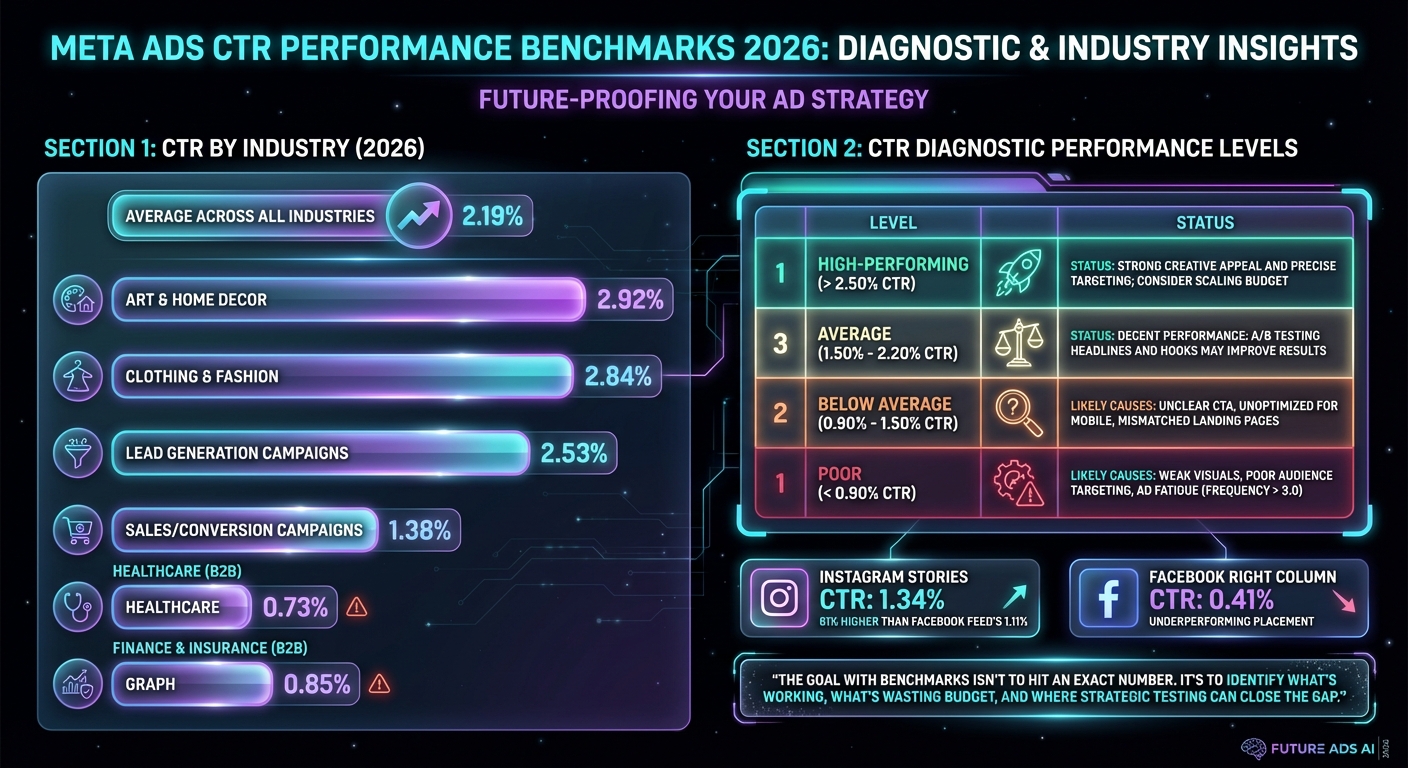
Meta Ads CTR Benchmarks by Industry and Performance Level 2026
Knowing where your CTR (Click-Through Rate) stands can help you spot areas for improvement. In 2026, the average Facebook CTR across industries reached 2.19%, a rise from 1.93% the previous year. However, what qualifies as a "good" CTR depends on factors like your industry, campaign goals, and ad placement.
For instance, visually-driven industries like Art & Home Decor (2.92%) and Clothing & Fashion (2.84%) tend to see stronger engagement. On the other hand, B2B sectors such as Healthcare (0.73%) and Finance & Insurance (0.85%) often experience lower CTRs, reflecting the longer decision-making processes typical of these fields. Campaign objectives also matter - Lead Generation campaigns average around 2.53%, while Sales/Conversion campaigns hover at 1.38%.
Ad placement plays a big role, too. For example, Instagram Stories achieve a 1.34% CTR, which is 61% higher than the Facebook Feed's 1.11%. If your ads are stuck in underperforming placements like the Right Column (CTR of 0.41%), this could be dragging down your results. The table below can help you evaluate your campaign's performance against these benchmarks.
CTR Diagnostic Table
This table breaks down performance levels and points to potential issues:
| CTR Range | Performance Level | Likely Causes of Low Performance |
|---|---|---|
| < 0.90% | Poor | Weak visuals, poor audience targeting, or ad fatigue (Frequency > 3.0). |
| 0.90% - 1.50% | Below Average | Unclear CTA, unoptimized for mobile, or mismatched landing pages. |
| 1.50% - 2.20% | Average | Decent performance; A/B testing headlines and hooks may improve results. |
| > 2.50% | High-performing | Strong creative appeal and precise targeting; consider scaling your budget. |
"The goal with benchmarks isn't to hit an exact number. It's to identify what's working, what's wasting budget, and where strategic testing can close the gap." - Lornah Ngugi, Marketing Writer, WebFX
If your CTR falls below 0.72%, issues like poor targeting, stale creative, or weak visuals are likely culprits. When ad frequency exceeds 3.0, your cost per acquisition can rise by 10–25%, signaling it's time to refresh your ads and re-engage your audience.
These benchmarks can guide you in fine-tuning your Meta ad campaigns. Use them to identify weaknesses and tailor your targeting and creative strategies for better results.
Conclusion
Low click-through rates (CTR) on Meta ads often result from issues like poor targeting, outdated visuals, and ad fatigue. The good news? These problems are entirely fixable. By refining your audience targeting, experimenting with new visuals and messaging, and consistently refreshing your ads, you can grab attention and drive more clicks.
Addressing these challenges can lead to quick improvements. In 2026, rapid creative testing is critical. CTRs can drop by as much as 15% within the first week if ads aren’t updated regularly. Success in this environment comes down to iterating Meta ads at scale, and relying on data - not guesswork - to guide decisions. This means rolling out 10–20 (or more) new concepts each month and letting Meta’s algorithm identify the top performers.
Enter ADEN’s LAB - a tool designed to simplify and accelerate this process. Instead of waiting days for designers or spending $30–$50 per ad, you can create high-performing static Meta ads in less than 90 seconds. With plans starting at $59/month for 30 ads (and scaling to as little as $0.90 per ad with higher-tier plans), you can dramatically increase your creative output. AI-powered automation does the heavy lifting, generating dozens - or even hundreds - of variations, so you can focus on scaling what works.
Improving your ad strategy doesn’t just boost CTR; it enhances the overall efficiency of your campaigns. CTR isn’t just a number - it’s a reflection of your creative’s effectiveness and a key factor in lowering cost-per-click (CPC). By combining sharp targeting, compelling hooks, and a steady stream of fresh creatives, you’re building a system that delivers consistent, scalable results over time.
Think of your Meta ads as a constantly evolving creative engine rather than a one-and-done effort. Brands that adopt this mindset - and leverage tools designed for speed and scale - will be the ones leading the pack in 2026 and beyond.
FAQs
What’s a good Meta ads CTR for my industry?
A strong Meta ads CTR generally ranges between 0.9% and 1.5% across most industries in the United States. If your CTR dips below 0.5%, it could indicate problems with your targeting, ad creatives, or how well your audience aligns with your messaging. Addressing these aspects can help boost engagement and overall performance.
How do I find out what’s causing my CTR to drop?
To figure out why your CTR might be declining, start by examining a few critical areas: audience targeting, creative elements, and campaign setup. Make sure your targeting aligns with the right audience - are you still reaching the people most likely to engage with your content? Look for signs of audience fatigue or creative fatigue, which can happen when the same ads are shown repeatedly without updates.
Also, double-check that your landing page matches the promises or messaging in your ad. A mismatch here can confuse users and hurt your CTR. Lastly, dig into your campaign metrics and any recent changes - this includes checking for algorithm updates that might be influencing performance. These insights can help you uncover the reason behind the drop.
How many new creatives should I test each month?
Testing 3–5 new ad creatives each month is a smart way to keep your content fresh and engaging. This approach helps you avoid creative fatigue while boosting click-through rates. By sticking to this range, you strike a balance between keeping your audience interested and staying within your budget.
Your next ad batch starts here
Finish with a ready-to-test ad batch
Paste your website to generate static creatives. Drop the link → get ads in about 90 seconds → upload them to Meta → scale.
Free to try No prompt writing