Why Most Brands Fail on Meta Ads (And the AI Tools That Fix It)
Try the workflow instead of comparing it
See what an AI ad generator makes from your product
Paste your product page and get a complete Meta ad batch—creative concepts, images, headlines, and copy—without another tool stack.
Free to try No prompt writing

Most brands fail on Meta ads because they can't keep up with the platform's demands for constant, high-quality ad variations. Rising ad costs and faster creative fatigue make delays in producing new ads a costly mistake. Here's why this happens and how to fix it:
- Meta Ads Are Expensive: CPMs doubled from $9 to $19 between 2020 and 2024, meaning mistakes now cost more.
- Creative Fatigue: Ads stop performing after 4+ exposures, causing engagement and ROAS to drop.
- Slow Ad Production: Traditional workflows take weeks, leaving brands stuck with underperforming ads.
- Key to Success: Winning brands produce high volumes of fresh ad concepts regularly and test them quickly.
Solution: Tools like ADEN's Lab generate ad variations instantly from your website, reducing costs and speeding up testing cycles. For $179/month, you get 200 ad variations - just $0.90 each - eliminating the delays and expense of traditional production methods.
To succeed on Meta, focus on producing diverse, engaging ads at a fast pace, and let data - not opinions - guide your decisions.
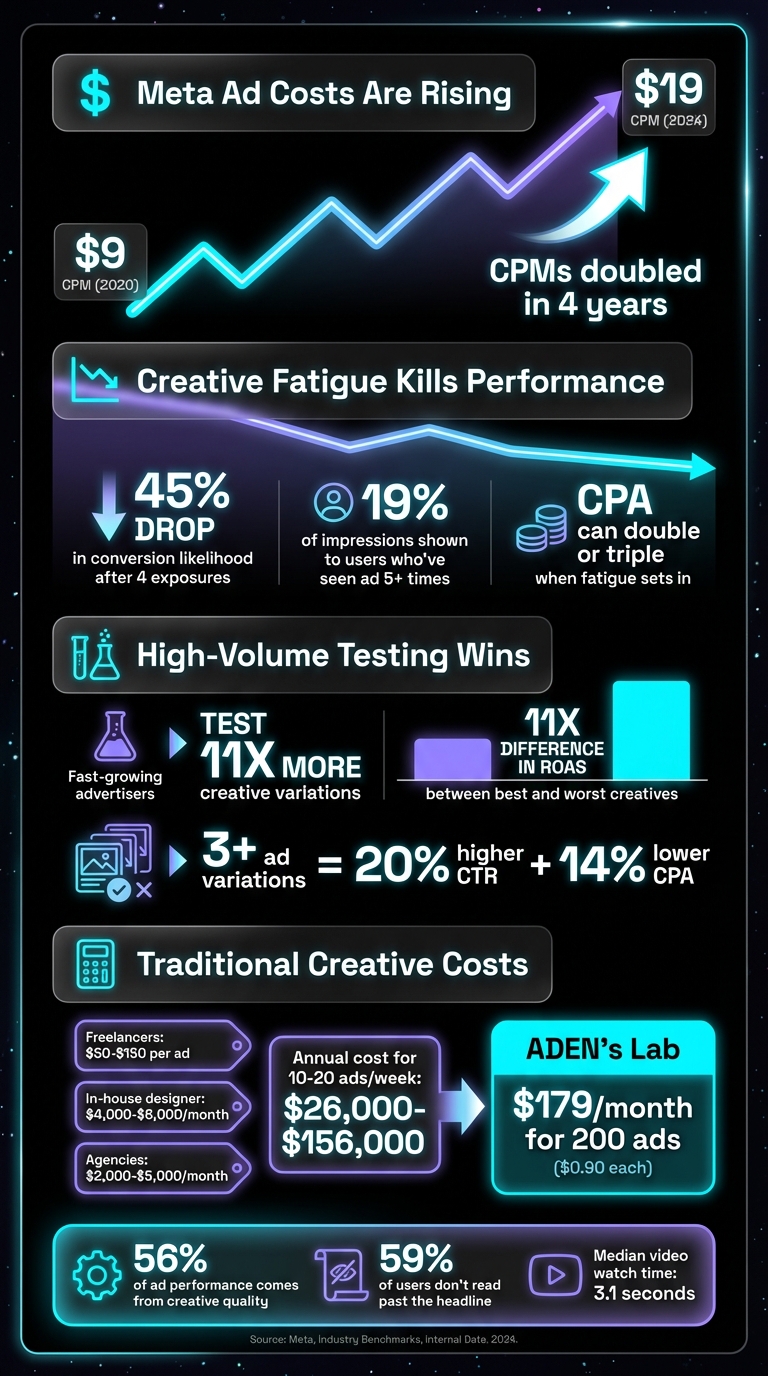
Meta Ads Performance Statistics: CPM Costs, Creative Fatigue Impact, and Testing Results
How to Create the Best Facebook Ads with AI
Put the playbook to work
Apply this playbook to your page
Paste your website and the Lab will turn the strategy you are reading into a ready-to-test ads.
Free to try No prompt writing
The Creative Bottleneck: How Slow Ad Production Kills Performance
Advertisers know they need fresh creatives, but the challenge is producing them fast enough. If your creative production can’t keep up with Meta’s algorithm, you’re essentially throwing money away.
Here’s a common scenario: You launch a campaign with three or four ads, and they perform well for a couple of weeks. But as your ad frequency climbs past 4.0, performance starts to dip. Click-through rates drop, CPM creeps up, and suddenly your campaign isn’t delivering the same results. By the time you notice the issue, brief your designer, and receive new concepts, another week - or even two - has passed. Add in revisions, and you’re looking at a two- to three-week delay before fresh ads are live. During this time, you’re stuck running fatigued creatives that cost far more per conversion than they did initially. The result? Wasted ad spend and accelerated creative fatigue.
This isn’t an issue of creative quality - it’s about speed. Brands spending $100,000 per month need far more creatives than those spending $10,000 because higher reach means faster fatigue. If your production process can’t meet that demand, you’ll hit a scaling wall that no amount of budget tweaks can fix.
Creative Fatigue: What It Is and Why It’s Costly
Delays in producing new creatives directly lead to creative fatigue. This happens when your audience sees the same ad so many times that they stop engaging. Research shows that after four exposures, the likelihood of conversion drops by about 45%. In fact, over 19% of Meta ad impressions are shown to users who’ve already seen the ad five or more times.
Meta’s algorithm picks up on this drop in engagement instantly. When users scroll past your ad without interacting, it flags your creative as less relevant. This causes your CPM to rise because Meta charges more for ads it deems “unpopular”. Meanwhile, as engagement plummets, your CPA can double or even triple, crushing your ROAS.
"If Meta performance was a car, creative would be the engine. When the engine is healthy, everything runs smoothly. When it breaks, nothing else matters."
- Ivan Teh, CEO, Advisible
Meta even calls this out in your account. If your cost per result is higher than previous ads but still under 2x, you’ll see “Creative Limited.” Once it hits 2x or more, it’s labeled “Creative Fatigue”. By the time these warnings show up, you’ve already burned through a chunk of your budget on underperforming ads.
The solution seems straightforward: refresh your creatives every two to four weeks, depending on your audience size and spend. But for most brands, this is easier said than done. Slow production processes make it nearly impossible to maintain this cadence.
Why Traditional Creative Production Slows You Down
The traditional creative workflow - briefing a designer, waiting for drafts, giving feedback, and waiting again for revisions - was built for a time when ads could run for months without changes. In today’s fast-paced environment, this process is a liability.
Imagine this: You notice performance slipping on a Thursday. You set up a meeting with your creative team or agency for Monday. After brainstorming, you agree on a direction, and they promise drafts by Wednesday. But when the drafts arrive, they miss the mark. You send feedback, wait for revisions, and by the time final assets are ready, two weeks have passed. Meanwhile, you’ve continued spending thousands on ads that are already underperforming.
Scaling only makes this problem worse. Meta’s Andromeda system processes 10,000x more data per impression than its predecessor. It evaluates every aspect of your creatives - visuals, copy, and overall concept - to determine who should see your ads. This advanced system demands a constant stream of diverse creatives. If you’re only producing one or two new concepts a month, you’re giving the algorithm very little to work with. You end up competing in the same auction slots with the same creative angles, over and over again.
"The larger the budget, the further the reach; the further the reach, the quicker everyone has seen your ads, and the fatigue sets in."
- Ema Moljevic, Hunch
To make matters worse, many advertisers think they’re producing high volumes of creatives when they’re not. For instance, they might create 50 variations of the same ad with minor tweaks to the headline, colors, or fonts. Meta’s Andromeda system clusters these similar ads under a single “Entity ID,” meaning they’re treated as one ad in the auction. So despite all that extra work, you’re only getting one “ticket” in the auction.
The real solution isn’t about hiring more designers or spending more money. It’s about building a system that produces genuinely diverse creatives at a speed that matches Meta’s demands. Without addressing this bottleneck, keeping up with Meta’s evolving landscape becomes nearly impossible.
3 Mistakes That Waste Ad Spend on Meta
When running ads on Meta, avoiding common pitfalls can save you significant budget. Here are three frequent mistakes that can drain your ad spend unnecessarily.
Spending Big on Untested Creatives
Imagine launching a campaign with just a handful of ad variations and a hefty budget - it’s a gamble. If your creative doesn’t resonate with your audience, you could blow through your budget before realizing it’s underperforming. Research shows that advertisers growing the fastest test 11 times more creative variations than their slower-growing competitors. A better strategy? Allocate 10% to 20% of your budget for testing multiple creative concepts at lower spend levels. Once you identify the winners, scale those based on actual performance data.
Another issue tied to creative performance is relying on subjective opinions instead of data.
Making Creative Decisions Based on Opinions, Not Data
How often have you heard someone say, “I like this ad better,” or “This feels more on-brand”? While these statements may come from a good place, they can lead to costly mistakes. Creative is responsible for 56% of all Meta ad outcomes, so relying on personal taste instead of hard data can hurt results and delay necessary updates.
"Guessing may be the easier way to find the correct audience, ad creative, and budget, but it's also much more expensive to choose this route."
- Jesse McNamar, Best Version Media
Here’s a reality check: 59% of users don’t read past the headline, and the median video watch time is just 3.1 seconds. Even within a single brand’s ads, there’s often an 11x difference in ROAS between the best and worst-performing creatives. For example, in 2025, a client insisted on prioritizing Instagram Feed ads due to personal preference. When they allowed Meta’s automatic placements to guide delivery, Facebook Marketplace unexpectedly became the top performer, reducing cost per lead by 41% and boosting conversions by 37%. Use Meta’s breakdown tools to analyze performance by metrics like age, gender, device, and placement. If a large chunk of your budget is going to a poorly converting segment, it’s a data insight - not a targeting mistake.
Creating Ads That Don't Match How Meta's Algorithm Works
Meta’s algorithm prioritizes keeping users engaged. If your ad doesn’t grab attention within the first few seconds, the system flags it as low quality and limits its reach. This can leave your ad stuck in a "non-delivery graveyard" with unspent budget.
"Meta doesn't care if your ad performs. It cares if users stay on its platform."
- Courtney Fritts, Creative Strategist
Small tweaks, like changing a background color or adding an emoji, usually won’t trick the algorithm into thinking your ad is new - it often identifies these as the same asset. To reset the algorithm’s signal, you need a fresh approach: a new hook, visual style, or delivery format that re-engages users. The first few seconds of your ad are critical - they act as "algorithmic oxygen", encouraging Meta to expand your ad’s reach. High-performing ads deliver their core message upfront, aligning with the fast-paced scrolling behavior on feeds and Reels.
How ADEN's Lab Solves the Creative Production Problem
Keeping up with Meta’s constantly evolving algorithm is a nightmare for most brands. They struggle to produce creative assets fast enough, often stuck in a cycle of waiting on designers, shelling out thousands to agencies, or spending hours trying to piece together campaigns on tools like Canva.
ADEN's Lab changes the game. With just your website link, it generates ready-to-launch Meta ads - no prompts, no back-and-forth. The platform scans your site, pulls key messaging, and creates static ads tailored for Facebook and Instagram. This streamlined process helps brands combat creative fatigue and stay ahead in the competitive ad landscape.
How ADEN's Lab Actually Works
The process couldn’t be simpler. Drop your website link, and the platform does the rest. It analyzes your page content, extracts relevant messaging, matches your brand’s style, and churns out fully formatted Meta ads. These ads are ready to upload directly to Ads Manager - no extra steps required.
This rapid production is a game-changer for fighting creative fatigue. Instead of waiting days or weeks for a single designer to deliver, you can generate 10 ad variations instantly. This means you’re always testing fresh creatives before your current ads lose their effectiveness. Each ad is crafted with a strong hook, benefit-driven messaging, and visuals designed to grab attention while signaling quality to Meta’s algorithm.
Built for Meta's Algorithm and Fast Testing
ADEN's Lab doesn’t just create ads - it creates ads that work with Meta’s delivery system. It’s not about flashy visuals but about crafting creatives that consistently drive impressions, clicks, and conversions.
By enabling the production of dozens - or even hundreds - of ad variations each month, you’re no longer guessing which creative will perform best. Instead, you can test continuously, cut underperformers, and scale up the winners. All of this happens without the need for costly external creative teams, keeping your campaigns both efficient and effective.
High Volume Without High Costs
Traditional creative production can quickly burn through your budget. Freelance designers charge anywhere from $50 to $150 per ad, while in-house designers can cost $4,000–$6,000 a month, and agencies typically bill $2,000–$5,000 monthly for ongoing support. For brands testing 10–20 new ads weekly, this adds up to an annual cost of $26,000–$156,000 just to maintain a steady creative pipeline.
ADEN's Lab offers a fixed subscription model that’s far more affordable. The Apex Mode plan delivers 200 ads per month for $179 - breaking down to just $0.90 per ad. By dramatically reducing both time and costs, ADEN's Lab solves the resource drain that often comes with high-volume creative production. For brands spending $10,000 or more monthly on Meta ads, this service typically pays for itself in the first month by eliminating designer fees and speeding up testing cycles.
Conclusion: Fix Your Creative Process, Fix Your Results
When ad campaigns fall flat, many brands point fingers at targeting issues or budget constraints. But the reality is more straightforward: 56% of ad performance comes down to the creative itself. If your ads aren't spending or your ROAS is plummeting, the culprit likely isn't the algorithm - it’s your creative. It might not be engaging enough, produced quickly enough, or varied enough to make an impact.
Here’s the deal: Meta’s algorithm doesn’t care about your ad’s success - it cares about keeping users engaged on its platform. If your ad doesn’t grab attention immediately, Meta’s system will throttle its reach. No amount of budget adjustments or audience fine-tuning can save an ad that fails to captivate.
The brands succeeding on Meta aren’t necessarily the ones with the deepest pockets. They’re the ones producing dozens of fresh creatives weekly, testing relentlessly, and cutting poor performers before they drain resources. Data backs this up: advertisers who test at least three ad variations see a 20% higher click-through rate and a 14% lower cost per acquisition. This shows that producing a steady stream of diverse creatives isn’t just helpful - it’s the key to staying ahead of the algorithm.
Your creative process can either drive your success or hold you back. Waiting days to churn out new creatives puts you at a disadvantage. Speed up your production, test more frequently, and let the data guide your decisions. Tools like ADEN's Lab make this easier than ever - just drop your link, receive ready-to-launch ads instantly, and get your campaigns moving on Meta.
FAQs
What is creative fatigue, and how does it affect Meta ad performance?
Creative fatigue occurs when your audience gets tired of seeing the same ad repeatedly. As a result, they lose interest, which leads to lower engagement, fewer clicks, and rising costs per result. Over time, your ad's performance drops simply because people stop noticing it.
The solution? Regularly updating your ads with new, engaging creative content. Keeping things fresh ensures your audience stays interested. Without consistent updates, even the best campaigns can fizzle out, draining your budget without delivering results.
What are the advantages of using AI tools like Aden’s Lab for creating Meta ads?
AI tools such as Aden’s Lab make ad creation a breeze by automatically generating high-performing, ready-to-launch Meta ads - all from a single website link. No more manual design, endless revisions, or guesswork. This streamlined process saves time and helps reduce the creative burnout that often comes with traditional ad production.
By automating the creative workflow, Aden’s Lab delivers consistent quality, allowing you to scale campaigns quickly without sacrificing results. It’s a smart, budget-friendly solution for producing attention-grabbing ads that drive conversions, minus the usual hassle.
Why should you test different ad variations on Meta?
Testing various ad variations on Meta is crucial for understanding what truly connects with your audience. Not every ad will strike the right chord, but by experimenting with multiple versions, you can pinpoint the ones that generate the most engagement and conversions.
This strategy also helps you avoid wasting your ad budget. Rather than betting everything on one concept, you let performance data steer you toward the ads that deliver the best results. In the long run, this leads to improved outcomes, smarter spending, and deeper insights into what appeals to your customers.
Your next ad batch starts here
Finish with a ready-to-test ad batch
Paste your website to generate static creatives. Drop the link → get ads in about 90 seconds → upload them to Meta → scale.
Free to try No prompt writing