Why D2C Brands With Great Products Still Lose on Meta Ads
Turn the strategy into creatives
Create Meta ads for your product
Paste your product page. ADEN'S LAB turns the offer, audience, and positioning into complete ready-to-use Meta static ads.
Free to try No prompt writing

Even the best products can fail on Meta ads if your ad content isn't strong. Meta's algorithm prioritizes ad performance - not product quality. Here's what matters most:
- Ad Performance Over Product Quality: Meta's algorithm ranks ads based on user engagement, not the product's value.
- Weak Ads Cost More: Poor engagement leads to higher CPMs, lower-quality audiences, and wasted budget.
- Creative Output is Key: Ads need to stand out and refresh frequently. Brands testing 5–10 new ads weekly often see better results. This requires a creative scaling system to maintain momentum.
- Manual Production Slows You Down: Traditional workflows can't keep up with the volume and speed needed for Meta's algorithm.
- Automated Systems Are Cheaper and Faster: Platforms like ADEN’s Lab produce high-quality static ads for under $2 each, compared to $30–$50 for manually created ads.
To win on Meta, focus on producing a steady stream of engaging, varied ads. Success isn't about the product - it's about feeding Meta's system with the right content.
How To Build a Meta Ad Creative Machine (Step-by-Step)
Put the playbook to work
Apply this playbook to your page
Paste your website and the Lab will turn the strategy you are reading into a ready-to-test ads.
Free to try No prompt writing
How Meta's Algorithm Works
Meta's ad system doesn’t care how amazing your product might be - it’s all about how users interact with your ad creative. The platform uses a two-step process to decide which ads get shown. First, an AI system called Andromeda narrows down millions of ads to around 1,000 candidates. Then, a traditional auction selects a winner from that shortlist. If your creative doesn’t make it past the first stage, your ad won’t even enter the competition, no matter how much you’re willing to spend.
Meta’s algorithm assigns every ad a "semantic fingerprint", analyzing its images, text, and video using AI. This fingerprint helps the system figure out who might be interested in your ad. As Jon Loomer explains:
Targeting largely happens in the ad now. Instead of obsessing over age, gender, or interest levers, focus on ads that speak to the people you want.
In other words, the creative itself handles much of the targeting that advertisers used to manage manually. This shift means even a fantastic product can fail if the ad doesn’t send the right signals.
Meta also groups visually similar ads under a single "Entity ID." For example, if you upload 50 versions of an ad with only minor tweaks (like a different headline color), the system treats them as one concept. Chris Pollard, founder of Ads Uploader, explains:
If you have 50 ads but they are all clustered into 1 Entity ID, you only have one ticket to the Stage 2 auction. You aren't overloading the system. You are bottlenecking yourself.
This means small tweaks don’t give you more chances - they just waste time.
The system also uses "branch-cutting" to organize ads into a tree of user intent. For instance, if a user is categorized as having "Yoga" intent, the algorithm might automatically rule out ads in the "Nutrition" category before the auction even begins. If your creative doesn’t immediately signal the right intent, your ad won’t even be seen by the audience you’re after.
What Weak Creatives Actually Cost You
Underperforming creatives don’t just get shown less - they come with a double penalty. Not only do they require more clicks to make a sale, but they also increase your CPMs by signaling low conversion potential. Courtney Fritts from Foxwell Digital explains this downward spiral:
Meta's algorithm learns that people who click your ads don't convert well. Your Estimated Action Rate drops... Your CPMs increase, you enter worse auctions, and you're shown to lower-intent users.
This creates a vicious cycle. If your ad gets clicks but no conversions, Meta assumes your audience is low-value. As a result, it charges you more to reach anyone, and the users it does show your ad to are less likely to buy. You’re not just losing money on ineffective clicks - you’re training the system to make every future click costlier.
Creative fatigue makes things worse. What looks like audience burnout is often the algorithm deprioritizing your ad. Joshua Uebergang from Digital Darts puts it simply:
Good ads get fed, bad ads get starved.
In Campaign Budget Optimization (CBO) setups, high-performing ads typically grab 80% to 90% of the budget within the first 24 hours. Weak creatives, on the other hand, get minimal delivery or sky-high costs because the system has already decided they’re not worth showing.
Even the format of your creative matters. Polished, professional videos often lead to higher CPMs and lower engagement compared to lo-fi, user-generated content that feels more natural in the feed. If your ad screams "advertisement", users scroll past, and Meta takes that as a signal to stop showing it.
Addressing creative fatigue isn’t just about improving performance - it’s essential for staying competitive in the auction.
Why Meta Needs Volume and Variety
Given the steep costs of weak creatives, Meta rewards ads that are fresh and diverse. A large pool of different creatives gives the algorithm more opportunities to find what works. But it’s not just about volume - it’s about variety. Uploading similar ads won’t increase your chances of winning the auction.
To improve your odds, your creatives need to stand out visually and conceptually. Chris Pollard suggests using the "4-Dimension Scattershot" approach: diversify your ads across at least two dimensions, like format, target persona, environment, or benefit. This ensures each creative gets its own Entity ID and a fair shot in the auction.
A great example comes from Sand Cloud, a lifestyle brand that revamped its ad strategy in late 2024. Instead of relying on one concept, they expanded their creative assets to appeal to a broader range of personas. The result? A 24% lower cost per purchase without changing their budget or targeting. The product stayed the same - the key difference was the variety in their creative.
To combat fatigue, brands need to consistently introduce fresh material. Many successful direct-to-consumer (DTC) brands now treat creative testing as a weekly routine, launching 5 to 10 new assets each week by automating Meta ad production. This isn’t about chasing trends - it’s about giving Meta enough variety to keep finding high-intent users.
Why Manual Creative Production Can't Keep Up
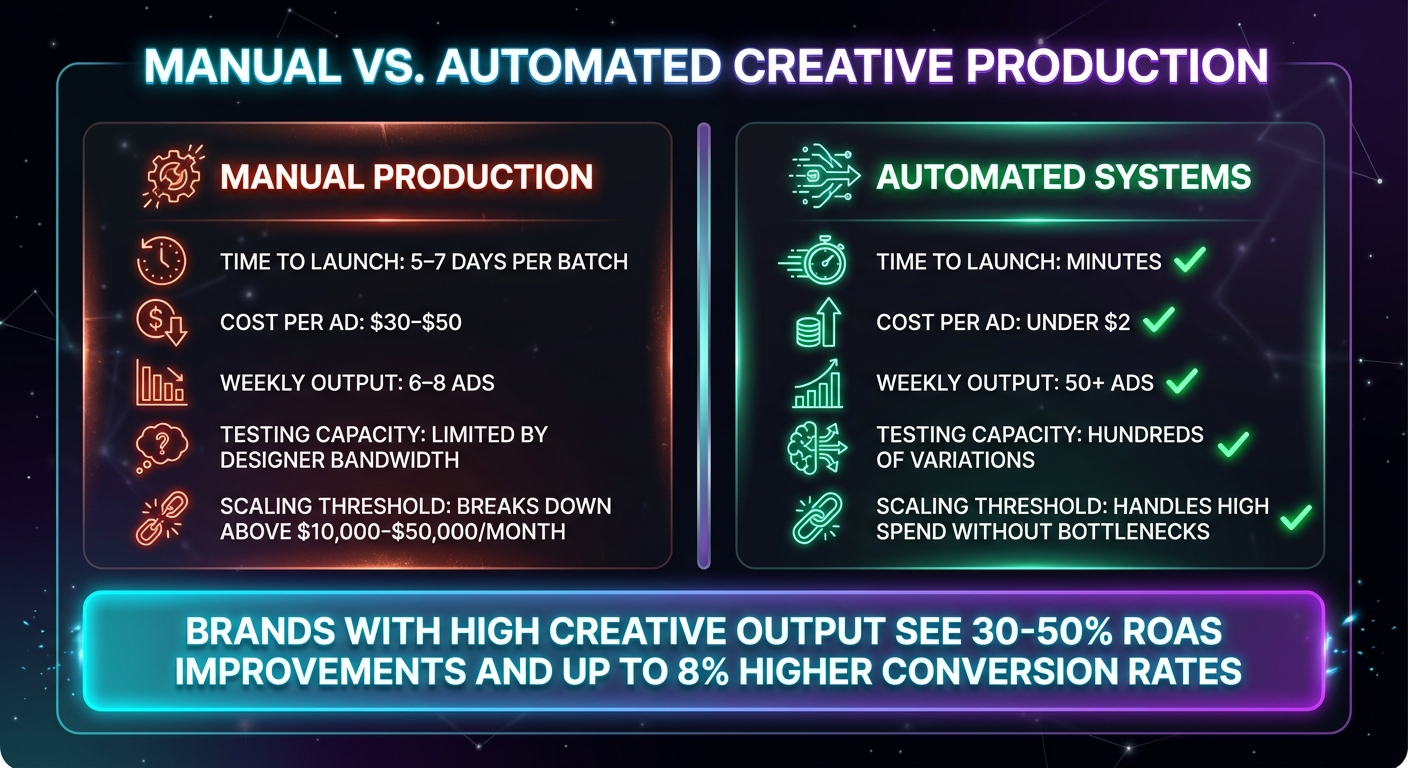
Manual vs Automated Meta Ad Production: Cost and Performance Comparison
The math behind traditional creative production just doesn’t add up. Freelance designers often take 5 to 7 days to deliver a single batch of ads. By the time those ads are live, they’re already losing their edge, and your cost-per-acquisition (CPA) is climbing. Meta’s algorithm thrives on fresh content - waiting a week simply won’t cut it.
The costs make scaling even harder. A single batch of ads typically costs $500 to $1,500, breaking down to about $30 to $50 per ad. For brands aiming to test 5 to 10 new creatives every week to stay competitive, the expenses pile up quickly. Adding more designers to the team only increases overhead - sometimes by as much as $15,000 per month.
But the biggest issue isn’t just the cost - it’s the missed opportunities. With manual workflows producing only 6–8 ads weekly, brands are forced to limit their creative testing.
Take performance marketer James Williams, for example. In late 2025, he worked with an e-commerce fashion brand stuck in a manual design process, generating only a few ads every two weeks. After switching to a system capable of producing 12 to 15 fresh creatives weekly, the brand saw its CPA drop from $23 to $12 and its return on ad spend (ROAS) leap from 2.1x to 3.8x. The product and targeting didn’t change - just the creative output. That kind of delay doesn’t just slow you down; it creates a ripple effect of missed testing opportunities.
Low Output Kills Testing and Scaling
Without the ability to produce new creatives quickly, testing grinds to a halt. When you’re only launching a few ads each week, you’re not testing effectively - you’re guessing. Real testing requires volume and variety. Meta’s algorithm needs a broad range of creatives to identify patterns that resonate with different audiences, formats, and messages. Manual production often limits brands to testing one idea at a time, forcing them to wait days for results before starting the cycle again.
This slow pace compounds the problem. While you wait for your next batch of ads, your live campaigns are burning through budget with fatigued creatives. Joshua Uebergang from Digital Darts highlights that outdated testing methods often lead brands to waste 80 to 90 percent of their test campaign budget on ads that fail. The result? You’re not just moving slowly - you’re actively losing money.
On top of that, manual production limits your ability to respond to real-time changes. If a winning ad starts to fatigue on a Friday, you can’t whip up fresh variations over the weekend. Instead, you’re stuck waiting until Monday to brief your designer, then another week for delivery. By the time new ads are ready, the opportunity to capitalize on demand has already disappeared.
High Costs and Slow Turnaround Hurt Returns
The financial impact of manual production goes beyond the upfront costs. Creative fatigue drives performance down and costs up. For instance, in November 2025, James Williams managed a B2B SaaS campaign where the CPA soared from $32 to $87 in just 29 days as ad frequency hit 4.7 impressions per person. The manual creative team simply couldn’t keep up with the refresh rate needed to combat fatigue.
Even when new creatives finally arrive, the lag between concept and launch often means you’ve missed the moment. Spot a trend or competitor strategy worth testing? By the time your designer delivers the next batch, the window to act has closed. In fast-paced markets, these delays can mean the difference between capturing demand and watching it slip away.
Manual workflows also slow down the algorithm’s ability to perform optimally. Traditional approval processes add friction, as creative directors and stakeholders debate aesthetics - like font choices and color palettes - instead of focusing on rapid iterations based on performance data. This delay leaves profitable campaigns stalled, waiting for fresh material.
Manual vs. Automated: The Numbers
The inefficiencies of manual production become glaringly obvious when compared to Meta ads automation systems. Here’s how they stack up:
| Metric | Manual Production | Automated Systems |
|---|---|---|
| Time to Launch | 5–7 days per batch | Minutes |
| Cost Per Ad | $30–$50 | Under $2 |
| Weekly Output | 6–8 ads | 50+ ads |
| Testing Capacity | Limited by designer bandwidth | Hundreds of variations |
| Scaling Threshold | Breaks down above $10,000–$50,000/month | Handles high spend without bottlenecks |
Brands that achieve high creative output often see 30 to 50 percent ROAS improvements and up to 8 percent higher conversion rates. This isn’t about spending more or targeting better - it’s about consistently feeding Meta’s algorithm with enough fresh creatives to find and scale winning ads.
If your creative pipeline isn’t generating at least 10 to 15 new ads weekly, you’re falling behind. Competitors who’ve solved this production bottleneck are testing faster, scaling more aggressively, and paying less per conversion. Meta rewards brands that deliver volume and variety - and manual workflows simply can’t keep up with the pace required.
How Automated Creative Systems Fix This
Automated creative systems transform the way Meta ads are produced by generating dozens - or even hundreds - of ads in the time it typically takes to complete a single kickoff call. This level of efficiency doesn’t just save time; it allows advertisers to meet Meta’s demand for constant variety, high volume, and quick iterations. Together, these elements create the foundation for consistently strong ad performance.
Tackling Fatigue with High Volume
Creative fatigue happens when ad performance drops sharply. According to a 2022 Meta study, ad performance can decline by as much as 45% after just four exposures to the same audience. For campaigns with large daily budgets and limited creative options, this fatigue can set in within just three or four days.
Automated systems solve this by delivering a steady stream of fresh creatives. Top-performing DTC brands now aim to test 5 to 10 new creatives every week as part of their routine. This constant production not only combats fatigue but actively prevents it. The formula is straightforward: the bigger your budget, the broader your reach, and the faster your audience will tire of your ads. For example, a brand spending $100,000 a month on ads would need roughly ten times more creatives than a brand spending $10,000 to maintain performance and avoid fatigue.
Cutting Costs While Scaling
The cost difference between manual and automated ad production is staggering. While manual designers typically charge $30 to $50 per ad, automated platforms can generate high-performing creatives for as little as $0.90 to $1.97 per ad. For a brand spending $50,000 a month on Meta ads, manual production might cost between $600 and $1,500 per week, whereas an automated system could produce the same volume for just $18 to $59 weekly. This isn’t just about saving money - it’s about enabling brands to scale their creative testing without blowing through their ad budgets.
In fact, brands using AI-powered templates have reported a 30% higher Click-Through Rate and twice the purchases and impressions compared to standard ads. When each creative costs less than $2, brands can afford to test multiple variations aggressively using a Meta ads A/B testing guide without worrying about wasted resources. ADEN’s Lab takes these efficiencies even further.
How ADEN's Lab Streamlines Creative Production
ADEN’s Lab is designed to eliminate the bottlenecks in creative production. All it takes is a product or landing page link, and within 90 seconds, the platform generates static ads (image-based ads with no animation) optimized for both Facebook and Instagram. No prompts, no back-and-forth communication - just a streamlined process that delivers ready-to-launch ads.
This platform is built for speed and scale. Depending on your subscription plan, you can create dozens of ads each week, hundreds each month, or even thousands if needed. By transforming the creative workflow, ADEN’s Lab produces ads faster, at a fraction of the usual cost, while ensuring the variety Meta’s algorithm thrives on.
Static ads remain one of the most reliable and cost-effective formats on Meta. While many advertisers are drawn to video formats like Reels, static ads consistently perform well, test efficiently, and scale predictably. ADEN’s Lab focuses exclusively on static ads because they deliver results - and because most brands simply can’t meet the demand for these ads manually. At around $0.90 per ad on the highest-volume plan, you’re not just cutting costs - you’re outproducing competitors and continuously feeding Meta’s algorithm with fresh creatives. When creative production is no longer a bottleneck, everything else - from testing to scaling to maximizing return on ad spend - gets a whole lot easier.
What Actually Matters for Meta Ad Success
Years of running Meta ads and spending millions have taught one clear lesson: success isn’t about having the most impressive product or the biggest budget. It’s about feeding Meta’s algorithm what it thrives on - a steady stream of diverse, high-volume, and fast-updating creatives - while avoiding costly mistakes that drain resources.
Here’s the core strategy broken down:
- Grab attention immediately. With consumers deciding within 0.5 seconds and 85% of video views happening with the sound off, your ads need a strong visual hook right out of the gate. Use bold contrasts, eye-catching imagery, or even familiar faces to stop the scroll.
- Keep your creatives fresh. Meta’s algorithm favors novelty over repetition, so testing new ideas is non-negotiable. Top-performing direct-to-consumer (D2C) brands typically test 5 to 10 new creatives every week.
- Measure performance smartly. Early metrics like CTR (click-through rate) and CPC (cost per click) are crucial during the first 24 to 48 hours. But don’t rush to judge CPA (cost per acquisition) or ROAS (return on ad spend) until the ad has at least 10 to 15 conversions under its belt.
To make this actionable, the 60-30-10 budget rule is a game-changer. Allocate 60% of your budget to proven winners, 30% to variations of those winners, and 10% to completely new creative ideas. Combine this with a unified campaign setup, where ad sets are separated into "winners" and "tests", to avoid auction overlap and algorithm resets. One supplement brand saw their ROAS jump from 0.75 to 2.50 in just five days by following this framework.
But what about when budgets are tight? Manual creative production often falls short. Each ad can cost $30–$50, meaning testing 10 creatives a week adds up to $300–$500 - not to mention delays caused by revisions. Enter AI tools for Meta ads like ADEN's LAB, which flips the script by delivering high-performing static ads for just $0.90 each. Simply input your product link, and within 90 seconds, you’ll have ready-to-launch, scroll-stopping ads.
This isn’t just theory - it’s a proven approach. Brands that succeed on Meta aren’t relying on flashy visuals or massive followings. They’re the ones churning out creatives at scale, testing smarter, and letting data - not gut feelings - drive decisions. For instance, producing 200 ads per month with ADEN's LAB costs just $179, compared to roughly $6,000 for manual production. That’s not just a cost-saving; it’s a way to test more ideas, find winners faster, and scale with confidence. That’s how you stay ahead.
FAQs
How do I know if my creative is the problem (not my product)?
If your ads aren't delivering the results you expect - whether that's high bounce rates, strong engagement without conversions, or consistently poor performance - it’s probably a problem with your creative. A sudden drop in performance, even when your product is solid, often suggests creative fatigue. This happens when your ads lose their appeal and fail to connect with your audience, signaling it’s time for a refresh. The issue here isn’t your product - it’s the messaging.
What counts as 'real' creative variety to Meta (different Entity IDs)?
When Meta talks about "real" creative variety, they’re referring to ad assets that are fundamentally different and registered under separate Entity IDs. This isn’t about making small adjustments to an existing ad - it’s about crafting entirely distinct formats. Think UGC-style videos, carousel ads, or hook-driven reels.
Why does this matter? Genuine variety helps combat creative fatigue and minimizes audience overlap. Plus, it shows Meta that you’re experimenting with multiple strategies, which can lead to better ad delivery and performance.
How many new ads should I launch each week at my budget level?
Aim to roll out 6 to 10 new ads each week, striking a balance between testing fresh ideas and managing your budget wisely. Experiment with a mix of visuals, messaging styles, and audience segments to pinpoint what resonates best. However, be cautious not to flood the platform with too many ads at once, as untested options can quickly drain your budget. This strategy allows you to discover top-performing creatives while minimizing unnecessary spending.
Your next ad batch starts here
Finish with a ready-to-test ad batch
Paste your website to generate static creatives. Drop the link → get ads in about 90 seconds → upload them to Meta → scale.
Free to try No prompt writing