Meta Ads Aren’t Broken - Your Creative System Is
Turn the strategy into creatives
Create Meta ads for your product
Paste your product page. ADEN'S LAB turns the offer, audience, and positioning into complete ready-to-use Meta static ads.
Free to try No prompt writing

Struggling with Meta ads? It’s not the algorithm - it’s your ad production process. Meta’s Andromeda update (2024) shifted ad success from targeting settings to how engaging your ads are. To get results, you need a steady flow of fresh ads, not just a few recycled ones. Here’s why your campaigns might be underperforming and how to fix it:
- The Problem: Ads go stale fast, causing engagement to drop and costs to spike. Running the same ads for weeks leaves the algorithm with nothing new to optimize.
- The Solution: Launch 10–15 new ad concepts weekly. Static ads are faster and cheaper to test than videos, making them ideal for high-volume production.
- Why It Matters: Creative fatigue is inevitable. If you don’t refresh ads every 7–14 days, performance will crash.
- Tools to Help: Platforms like ADEN'S LAB can produce ads in seconds, cutting costs to $0.90 per ad and eliminating delays.
Takeaway: Outperform competitors by producing more ads, faster. Focus on testing static ads first, then scale winners into video formats. The faster you adapt, the better your results.
The ULTIMATE Meta Ad Testing Program (Guaranteed to Scale)
Put the playbook to work
Apply this playbook to your page
Paste your website and the Lab will turn the strategy you are reading into a ready-to-test ads.
Free to try No prompt writing
Creative Fatigue Kills Your ROAS Faster Than Anything Else
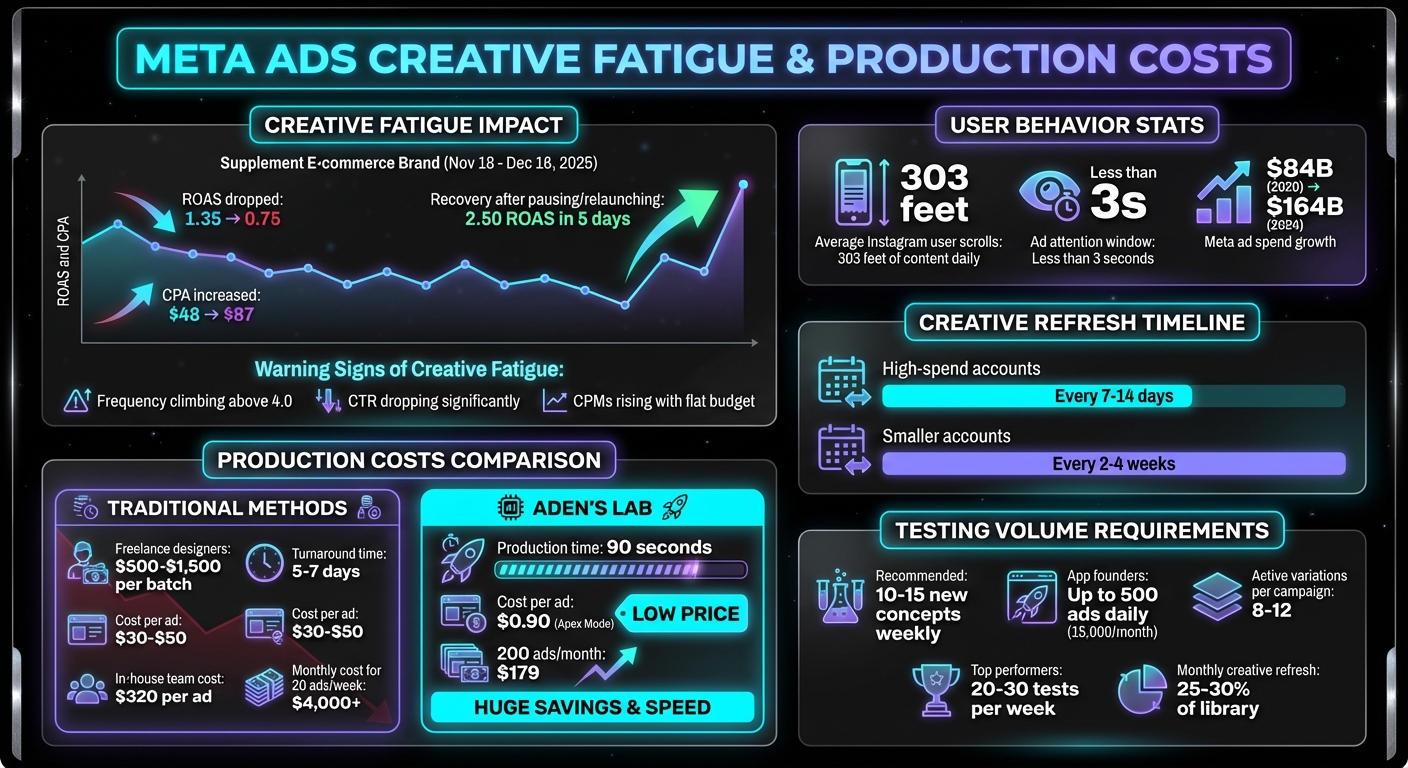
Meta Ads Creative Fatigue Statistics and Production Costs Comparison
What Happens When Ads Get Stale
Creative fatigue happens when repeated exposure to the same ad causes engagement and performance to drop sharply.
Here’s how it works: Meta’s algorithm prioritizes ads based on engagement signals like clicks, watch time, and interactions. When engagement slows down, Meta raises your CPM to maintain its revenue, which drives up your Cost Per Acquisition (CPA). The result? Your ROAS takes a hit.
Take this example: Between November 18 and December 16, 2025, a supplement e-commerce brand saw their ROAS plummet from 1.35 to 0.75, while their CPA shot up from $48 to $87. What caused it? They launched six new ads that fell into the "high-engagement trap" - ads that got clicks but didn’t convert. The algorithm funneled budget into these underperforming ads, starving their proven winners. By pausing all ads for 24 hours and relaunching only their best-performing concepts, they rebounded to a 2.50 ROAS within just five days.
"If Meta performance was a car, creative would be the engine. When the engine is healthy, everything runs smoothly. When it breaks, nothing else matters." - Ivan Teh, Advisible
Watch for early warning signs of fatigue: frequency climbing above 4.0, CTR dropping significantly, and rising CPMs even when your budget stays flat. These indicators mean it’s time to refresh your creative before performance spirals.
This rapid drop in engagement makes updating your ads an absolute must.
Why You Need New Ads Every 7-14 Days
Creative fatigue doesn’t just hurt performance - it does so fast. That’s why refreshing your ads regularly is critical.
Consider this: the average Instagram user scrolls through about 303 feet of content daily. Your ad has less than three seconds to grab their attention before it’s ignored - by both the user and Meta’s algorithm. The only way to stay competitive is by consistently introducing fresh creative.
Meta’s system now groups similar ad variants under a single "Entity ID" through its Andromeda update. This means small tweaks - like changing a button color or headline - won’t reset fatigue. Instead, all variations share one "auction ticket", so launching dozens of minor updates only compounds the problem.
For high-spend accounts, new creatives are a must every 7 to 14 days. Smaller accounts might stretch this to 2 to 4 weeks, but the rule remains the same: fresh, distinct ads keep your costs low. The goal isn’t to churn out endless ads but to introduce visuals, messaging, and calls-to-action that Meta recognizes as entirely new assets. To maintain this velocity, many brands now use AI to produce hundreds of Meta ads on autopilot.
"Creative fatigue is not a maybe. It is a guarantee. The only question is whether you see it early and refresh your ads or ignore the signs and let your results crash." - Ivan Teh, Advisible
Between 2020 and 2024, Meta ad spend doubled from $84 billion to $164 billion. This surge in spending has intensified competition and sped up creative burnout. Brands that stay ahead of fatigue are the ones launching fresh, distinct ads faster than their competitors.
Why Hiring Designers Can't Solve the Volume Problem
The $30-50 Per Ad Problem
Creative fatigue is a persistent challenge, and many advertisers turn to freelance designers or agencies hoping to fix it. But instead of solving the problem, this approach often creates a new bottleneck.
Let’s break it down: Freelance designers typically charge anywhere from $500 to $1,500 for a batch of ads, with a typical turnaround time of 5 to 7 days. If you're aiming for 20 fresh creatives each week, you're looking at $1,000 - or about $4,000 per month - just for production. And that doesn’t even account for the time lost in feedback and revisions.
The real struggle isn’t just about cost; it’s about revisions. A low First Pass Approval Rate (FPAR) means designers spend more time revising old ads than creating new ones. For instance, one creative team managed to boost their FPAR from 17% to 71%, significantly cutting down wasted time on rework. But for many, this cycle of endless revisions continues to drain both time and resources.
And then there’s the creative risk factor. Under pressure, designers often play it safe, focusing on small tweaks - like changing a button color or swapping out headlines - rather than bold new ideas. Here’s the kicker: Meta’s Andromeda system groups similar ad variations into a single Entity ID. That means 50 slightly adjusted ads may count as just one in the auction. Essentially, you’re paying for quantity that the algorithm doesn’t even recognize as distinct.
"Every revision costs you time... When your FPAR is low, you're burning resources on rework instead of volume." - Adacted
This combination of high costs, slow turnaround, and repetitive revisions creates a bottleneck that stifles your ability to scale.
Scaling Means Testing 20+ Ads Per Week
The reality is, scaling in today’s ad landscape requires speed and volume. Winning on Meta in 2026 means producing 10 to 15 completely new creative concepts every week. Some app founders push this even further, testing up to 500 new ads daily - that’s around 15,000 ads a month. Traditional design workflows simply can’t keep up.
The most successful teams have moved to a sprint-based approach, where they review performance data on Monday and launch 20 to 30 strategic tests by Friday. Waiting 5 to 7 days for freelancers? That’s too slow - by the time your new ads go live, your current ones are already fatigued.
Even well-organized in-house teams face challenges. When you factor in the costs of creators, editors, and strategists, production expenses can hit $320 per ad. Testing just 20 ads a week at that rate adds up to $6,400 - a cost that quickly eats into your budget.
The gap between what’s needed and what traditional workflows can deliver is growing. The speed of algorithms outpaces human production, making it crucial to eliminate the bottleneck caused by manual processes altogether.
sbb-itb-628c49f
Static Ads Are Easier to Scale Than Video
Why Static Ads Win for Testing Speed
When it comes to addressing the creative bottleneck, speed is everything - and static ads deliver that in spades.
There’s a common misconception that video is always the secret to creating compelling ads. But when you're testing 10–15 new ideas every week, video slows you down. Static ads, on the other hand, allow you to test and validate messaging in just a day or two. For example, you can try out a new hook, analyze the results, and decide if it’s worth further investment in video. This kind of quick, targeted testing is critical to sidestep the creative fatigue we touched on earlier. Plus, AI-powered tools for generating static ads can slash testing costs by up to 60% and churn out concepts in minutes.
Interestingly, raw, unpolished visuals - like post-it notes, customer snapshots, or even handwritten text - often perform better in social feeds than polished, high-budget videos. These types of visuals feel more authentic and blend seamlessly into the scrolling experience, grabbing attention more effectively.
How Meta's System Favors Static Formats
Meta’s Andromeda algorithm is designed to prioritize clarity and immediate creative signals over flashy production. A static image with a sharp hook and a clear benefit statement gives the algorithm exactly what it needs to quickly align your ad with the right audience. Unlike video ads, which require users to watch for a few seconds before engagement metrics can be collected, static ads deliver their message instantly.
Here’s another advantage: when you tweak video variations, Meta’s system groups them under the same Entity ID, limiting the impact of your tests. But when you switch to a completely different static format - say, from a product shot to a customer testimonial - it triggers a new auction ticket, giving the algorithm fresh data to work with. Considering the average Instagram user scrolls about 303 feet daily, with your ad having less than two seconds to catch their attention, the ability to quickly test different headlines, visuals, and layouts becomes a game-changer. This rapid testing cycle is exactly what you need to stay competitive in Meta’s ad environment.
How ADEN'S LAB Solves the Creative Bottleneck
ADEN'S LAB tackles the challenges of slow, manual creative production with an effortless and automated process.
Drop a Link, Get Ads in 90 Seconds
Gone are the days of lengthy back-and-forths and complex briefings. With ADEN'S LAB, all you need to do is paste your website link, and within 90 seconds, you’ll receive ready-to-launch static ads. There’s no steep learning curve - this system leverages Meta ads automation and designed to deliver high-performing ads instantly. Unlike traditional methods that treat creative production as a one-off task, ADEN'S LAB transforms it into a seamless, continuous process from start to finish.
How It Fixes Creative Fatigue
ADEN'S LAB also addresses one of the biggest challenges in advertising: creative fatigue.
Creative fatigue happens when your ads lose their effectiveness because you’re unable to produce fresh content fast enough. With traditional production methods, a designer may take 5–7 days to deliver new ads. By the time those ads go live, they might already feel outdated, leading to higher costs and reduced performance. ADEN'S LAB changes the game by enabling you to create dozens - or even hundreds - of ads every month without delays.
Consider this: successful Meta accounts often run 8–12 active creative variations per campaign, and top-performing brands refresh about 25–30% of their creative library monthly. With ADEN'S LAB, you can generate ads in seconds, ensuring your campaigns stay fresh and effective.
Pricing That Makes High-Volume Production Possible
Traditional creative production is not only slow but also expensive. ADEN'S LAB makes it affordable to test and produce ads at scale.
For context, designers typically charge $30–$50 per ad, while agencies may bill $500–$1,500 for a batch of ads. If you’re testing 20+ ads weekly, those costs can spiral quickly. ADEN'S LAB offers a smarter alternative: on the Apex Mode plan, you can produce ads for as little as $0.90 each. For example, creating 200 ads a month would only cost $179, making high-volume testing both efficient and budget-friendly.
"Every revision costs you time... When your FPAR (First Pass Approval Rate) is low, you're burning resources on rework instead of volume." - Adacted
Conclusion: Win by Producing More Ads Than Your Competitors
Meta's algorithm rewards brands that produce a higher volume of quality ads at a faster pace. Think about it: when you're scrolling through 303 feet of content daily - the length of a football field - ads have less than two seconds to grab your attention. To win in that fleeting moment, you need to constantly test fresh ideas, update your campaigns, and ensure your account never feels stagnant.
This is where creative velocity becomes the game-changer. As Sam Tomlinson explains: "Creative velocity is the primary driver of creative value, and creative value is the single-most-impactful lever you have to move the needle on Meta". Brands that consistently launch 10–15 diverse ad concepts each week are the ones capturing new audiences, generating more Entity IDs, and increasing their chances in Meta’s auction system.
To keep up this pace, scalable and efficient ad formats are essential. Static ads are a perfect solution - they’re quicker to create, cheaper to test, and easier to adapt than videos. Once a static ad proves successful, you can scale it into higher-production formats if necessary. This speed advantage helps you stay ahead of creative fatigue and maintain a competitive edge.
What to Do Next
To overcome creative bottlenecks and boost performance, implement the 60-30-10 rule: allocate 60% of your budget to proven winners using AI budget allocation, 30% to variations of those winners, and 10% to brand-new concepts. Use static ads for testing - they allow you to validate ideas in days instead of weeks and cost significantly less than video production. Tools like ADEN'S LAB make this process even faster, letting you create ads in just 90 seconds. With the ability to produce 200+ ads per month for under $180, you’ll be testing your next batch of concepts while competitors are still waiting for their designers to deliver a few options. Outproducing your competition is how you win on Meta.
FAQs
How often should I update my Meta ads to maintain performance?
To keep your Meta ads effective and engaging, aim to refresh them every 7 to 14 days. This regular update helps maintain audience interest and prevents performance dips over time.
If you spot a decline in key metrics like click-through rate (CTR) or conversions earlier than expected, it’s a signal to switch up your creative sooner. By consistently testing new visuals and messaging, you can ensure your campaigns remain appealing and relevant to your audience.
Why are static ads better for testing than video ads?
Static ads are an excellent starting point for testing because they’re quicker and less expensive to produce than video ads. They let you experiment with various visuals, headlines, and messages to figure out what catches attention and drives clicks - all without the complexities of video production.
Starting with static ads helps you quickly pinpoint which creative ideas connect with your audience. This approach allows you to allocate your budget toward scaling the concepts that work best, saving both time and money while minimizing the risk of spending on ideas that haven’t been tested.
How has Meta's Andromeda update affected ad performance?
Meta's Andromeda update has completely shifted the way ads perform by moving away from traditional audience targeting. Instead of sticking to fixed interests or demographics, Meta now relies on an AI-powered system that evaluates user behavior and context in real time. While this approach aims to fine-tune ad relevance, it also introduces a level of unpredictability.
Since the update, many advertisers have faced hurdles like lower ROAS (Return on Ad Spend) and higher CPAs (Cost Per Acquisition). Why? The new system focuses on relevance and engagement signals, meaning ad performance now depends heavily on the quality and freshness of your creative. To navigate this new landscape, it's essential to rethink your creative strategy and develop ads that can thrive in this ever-changing environment.
Your next ad batch starts here
Finish with a ready-to-test ad batch
Paste your website to generate static creatives. Drop the link → get ads in about 90 seconds → upload them to Meta → scale.
Free to try No prompt writing