Why Meta Ad Budgets Bleed When Creatives Become the Bottleneck
Turn the strategy into creatives
Create Meta ads for your product
Paste your product page. ADEN'S LAB turns the offer, audience, and positioning into complete ready-to-use Meta static ads.
Free to try No prompt writing

When running Meta ad campaigns, the biggest issue isn’t targeting or budget - it’s using the same ads for too long. Ads that perform well initially can quickly lose effectiveness due to audience fatigue. This happens when people see the same ad repeatedly and stop engaging, leading to higher costs (CPMs, CPCs, CPAs) and lower returns (CTR, ROAS). Meta’s algorithm penalizes outdated ads by deprioritizing them, making it harder to scale campaigns.
Key takeaways:
- Creative fatigue occurs when ads are overexposed, causing engagement to drop and costs to rise.
- Manual production delays make it hard to test and refresh ads fast enough, stalling performance.
- Automation tools like Aden’s Lab can reduce production time from days to seconds, allowing for faster testing and better results.
Without fresh ads, budgets are wasted on underperforming campaigns. Automating production helps overcome this bottleneck, keeping campaigns efficient and competitive.
Ad Fatigue in Meta Ads - How to Fix Falling CTR & Rising Costs
Put the playbook to work
Apply this playbook to your page
Paste your website and the Lab will turn the strategy you are reading into a ready-to-test ads.
Free to try No prompt writing
How Manual Creative Production Kills Testing Speed
The biggest issue with manual creative production isn’t just how slow it is - it’s how much it costs you every single day it drags on. Traditional workflows treat creative production like a one-time project instead of an ongoing process, creating a bottleneck that slows down testing and burns through your budget.
Many advertisers don’t realize just how much time they lose until they break down the entire process. It’s not just about waiting for the designer to finish. You’re also stuck in a cycle of briefing calls, revision requests, file transfers, feedback loops, and approval processes. Each step adds unnecessary delays.
The Real Timeline of Designer-Made Ads
Here’s what typically happens when you need new creatives: you brief the designer, wait three to five days for the first draft, and then send it back with feedback. On average, it takes five to seven days from the initial brief to launch.
But here’s the kicker: the first draft is rarely perfect. Maybe the messaging misses the mark, the design doesn’t align with your brand, or the call-to-action lacks punch. Every revision eats into valuable time - time that could’ve been spent creating new ads.
"Every revision costs you time. It requires downloads, uploads, and pulling your editor away from making new ads. When your FPAR is low, you're burning resources on rework instead of volume." - Adacted Growth Academy
If you’re testing multiple angles or need a variety of ad formats, this process can stretch into weeks. And during that time, your current ads start losing steam. Frequency rates creep above 4.0, click-through rates plummet, and Meta begins charging you more for impressions as engagement drops. All the while, you’re stuck waiting for fresh creatives to arrive.
Why Fewer Ads Mean Slower Algorithm Learning
The delays caused by slow creative production don’t just hurt your current campaigns - they also cripple your ability to scale. Meta’s algorithm thrives on data. It needs a constant stream of information to figure out which users are most likely to convert and which placements deliver the best results. Launching just a handful of ads every few weeks starves the algorithm of the data it needs to optimize.
Your creatives are the key to targeting effectively. Different formats, hooks, and visuals appeal to different audience segments. For example, a carousel ad might resonate with one group, while a bold single-image ad works better for another. Without a steady flow of fresh creatives, you’re left reacting to performance dips instead of staying ahead of them.
This reactive approach is costly. While you scramble to produce new ads, your live campaigns deteriorate. Testing 50 ads under this traditional model can cost between $10,000 and $25,000 in media spend alone - and much of that budget is wasted while you wait for the next batch.
Fewer ads mean fewer data points, slower algorithm optimization, and higher costs. If your production pipeline can’t keep up with Meta’s demand for fresh creative, your campaigns stall. Meanwhile, competitors with faster production pipelines swoop in and capture the audience you’re trying to reach.
What Creative Bottlenecks Actually Cost You
Delays in creative production don’t just slow things down - they hit your wallet hard. When you rely on outdated ads, the financial impact becomes unavoidable. As we’ve seen with sluggish manual production processes, every day spent running fatigued ads not only hurts performance but also eats into your profits. It’s not just an operational hiccup; it’s a direct hit to your bottom line that snowballs over time.
How Fatigued Ads Drive Up Costs and Kill ROAS
When your ads start to fatigue, Meta's algorithm doesn’t just look the other way - it actively works against you. How? By raising your CPMs to compensate for the drop in relevance. Research shows that purchase intent drops by about 16% once someone has seen the same ad six or more times. And by the time Meta slaps your ad with a "Creative Fatigue" label, your Cost Per Result has already doubled compared to your usual benchmarks.
Here’s what that looks like in real terms: your click-through rate (CTR) might plummet from 1.5% to 0.7%, while your cost per acquisition (CPA) steadily climbs. Meta can even fall into the "high-engagement trap", where it prioritizes a new ad with an attention-grabbing hook - even if that ad converts poorly. For instance, in November 2025, a supplement brand saw its ROAS nosedive from 1.35 to 0.75 after Meta shifted budget to an ad with a 44% hook rate. The problem? That ad delivered a $68 CPA, compared to $43 for a proven winner. Over four weeks, this misstep cost the brand $18,000.
"If Meta performance was a car, creative would be the engine. When the engine is healthy, everything runs smoothly. When it breaks, nothing else matters." - Ivan Teh, Advisible
Another overlooked factor? Meta reduces ad delivery once fatigue sets in. Even if your budget stays the same, the platform cuts impressions because it assumes the returns won’t justify the spend.
The Scaling Wall: When Budgets Hit Their Limit
As costs rise and performance drops, scaling becomes nearly impossible. Creative bottlenecks limit how far you can stretch your budget. You can’t just throw more money at fatigued ads and expect results. Instead, higher budgets only speed up frequency spikes, driving CPAs even higher.
Eventually, the algorithm runs out of fresh audience segments to target with your limited creative pool. This leaves you spending money on people who’ve already tuned out. And here’s the kicker: strong Meta creatives often burn out in just one to three weeks due to rapid audience saturation. If your production pipeline can’t keep up, you’re stuck reacting to performance dips instead of staying ahead of them.
| Metric | Healthy Ad | Fatigued Ad |
|---|---|---|
| CTR | 1.5% (stable or rising) | 0.7% (sharp drop) |
| CPA | At or below target | 2x+ higher than benchmark |
| Frequency | 1–3 (prospecting) | 8–9+ (overexposure) |
| Reach | Expanding | Plateauing as frequency rises |
Running underperforming ads doesn’t just waste money - it blocks you from capitalizing on potential revenue. Every day your creatives are delayed, you're not just losing money - you’re giving competitors the chance to pull ahead.
How Aden's Lab Fixes the Creative Bottleneck
The issue isn't about needing better creatives - it's about not being able to produce them fast enough. When your production slows down, your CPAs spike, and faster competitors take the lead. Aden's Lab addresses this challenge by cutting down creative production time from several days to just 90 seconds.
Forget about lengthy designer briefs, endless revisions, and back-and-forth edits. With Aden's Lab, you simply drop a product link, and the platform delivers dozens of optimized static Meta ads instantly. It scans your page, applies proven conversion techniques, and generates ads tailored specifically for Meta's delivery system. This isn't about replacing thoughtful creative strategy - it's about removing the roadblocks that stop you from scaling effectively. By speeding up production, you feed Meta’s algorithm with fresh data, enabling smoother campaign scaling. Faster output doesn’t just save money; it also opens the door for broader testing opportunities.
Drop a Link, Get Ads in 90 Seconds
Traditional workflows treat each ad as a custom project. That might have worked when you only needed a handful of ads each month. But when Meta’s algorithm demands 8–12 active variations per campaign and a 25–30% monthly refresh rate to maintain performance, this old approach falls apart. Aden's Lab changes the game by treating creative production like a supply chain - offering consistent output, predictable quality, and the speed Meta’s algorithm thrives on.
All it takes is pasting your landing page URL. Within 90 seconds, you’ll have a batch of static ads ready to go. These assets are optimized for conversions, tailored for Meta, and test different angles - without waiting on a designer's schedule. One creative team saw their First Pass Approval Rate jump from 17% to 71%, cutting down rework time and allowing them to focus on strategy rather than execution.
Compare this to traditional ad production, which costs $500–$1,500 per batch and takes 5–7 days to complete. Aden's Lab delivers ads for under $1 per asset on higher-volume plans - sometimes as low as $0.90 - and does it in minutes, not days.
Why Static Ads Still Win on Meta
Once production delays are out of the way, your ads can work more effectively with Meta’s algorithm. While videos may grab attention, static ads often outperform them in terms of results. Static ads provide creative liquidity - the ability to participate in more auctions across Meta's 26+ placements without being penalized by the "monotony tax" caused by limited format options. Meta’s algorithm rewards advertisers with diverse formats by lowering CPMs and expanding reach, and static ads play a key role in meeting these demands.
Since over 90% of Facebook users access the platform on mobile devices, static ads using the 4:5 aspect ratio take up more vertical screen space compared to square or landscape formats. This maximizes engagement by minimizing distractions, especially in moments when users are scrolling without sound - like during work breaks or in quieter environments.
"Often we see simple, ugly creatives that took minutes to produce outperform Spielberg-esque creatives." - Nathan Hudson, Growth Lead
Static ads are also perfect for testing "proof elements" such as testimonials, statistics, and authority cues, which often drive conversions more effectively than flashy, high-production videos. They’re quicker to iterate, cheaper to produce at scale, and easier for Meta’s algorithm to test across various audience segments. When applying the 60-30-10 budget allocation (60% to proven winners, 30% to variations, and 10% to fresh ideas), static ads let you execute this strategy without draining your production budget.
As the concept of "creative as targeting" takes hold, your ads essentially become your audience strategy. Meta's algorithm relies on engagement signals from a variety of creatives to determine who should see your products. By delivering hundreds of static ad variations quickly, you eliminate bottlenecks, keep Meta’s algorithm engaged, and see direct benefits like lower CPMs and improved ROAS.
What Changes When You Automate Creative Production
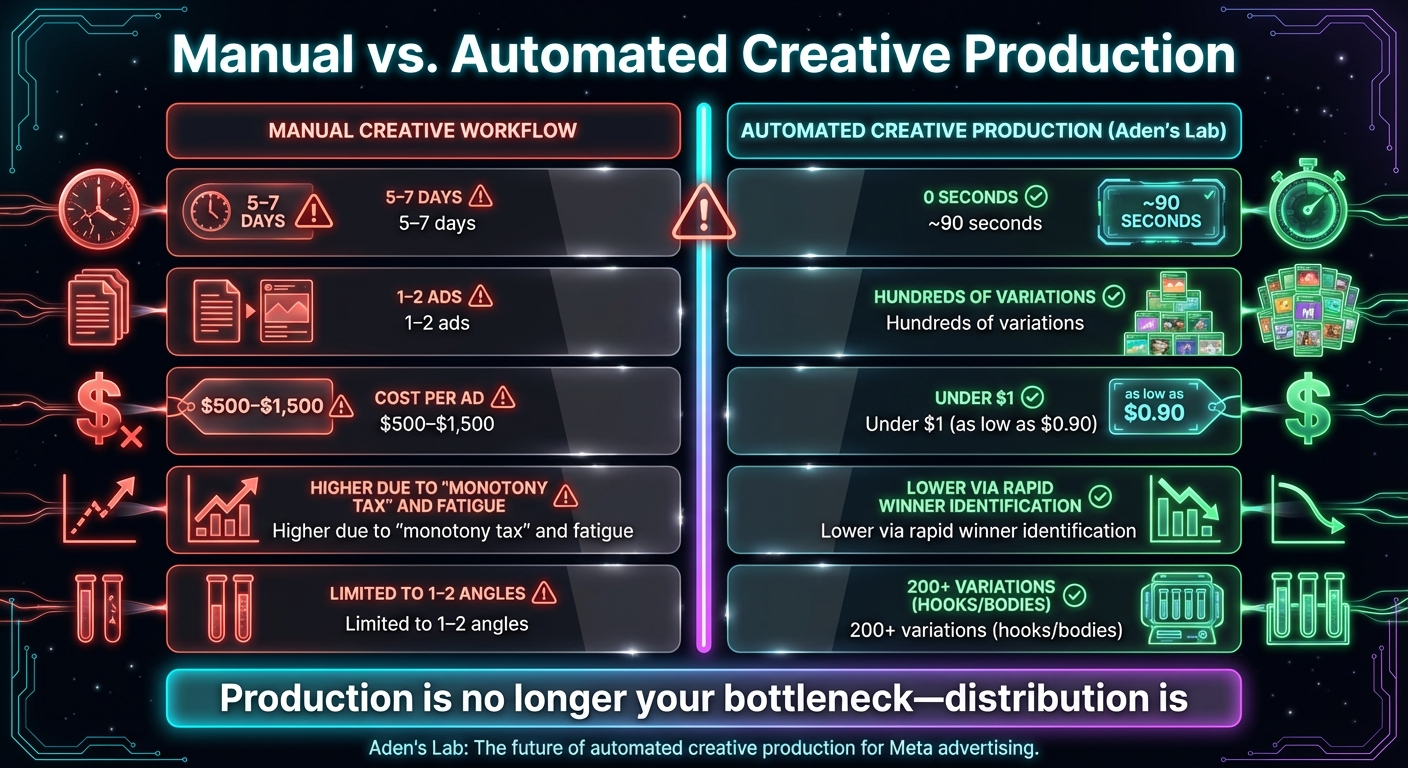
Manual vs Automated Meta Ad Creative Production: Cost, Speed & Performance Comparison
Switching from manual to automated creative production can completely reshape your campaign's performance. By automating, you eliminate delays caused by design bottlenecks, enabling faster testing, quicker refreshes, and giving Meta’s algorithm the tools it needs to pair the right ads with the right audience. This change directly impacts key metrics like CPAs, ROAS, and how much you can scale your daily budget before hitting a plateau.
More Testing, Lower CPAs, Better ROAS
Manually creating ads can be painfully slow and expensive. With costs ranging from $500–$1,500 per ad and a turnaround time of 5–7 days, you’re often stuck launching just one or two concepts and hoping they perform well until the inevitable decline. Automation flips this on its head. Using Aden’s Lab, for example, you can launch 8–12 active variations per campaign and refresh 25–30% of your creative library every month - a cadence proven to keep high-performing accounts ahead of the "monotony tax" that leads to higher CPMs.
The more variations you test, the more data Meta’s algorithm has to work with, resulting in better audience targeting and lower costs. One creative team saw their First Pass Approval Rate jump from 17% to 71% simply by streamlining production, which freed up their time to focus on strategy instead of endless revisions.
This approach also directly impacts your CPA. Producing hundreds of ads a month means you’re no longer guessing which creative angle might work - you’re letting the data guide you. According to Meta, ad performance drops by 45% after just four exposures to the same audience. Brands that refresh their creatives faster have a clear advantage, and automation allows you to keep your library fresh without exhausting your budget or waiting on designers.
The Numbers: Manual vs. Automated Production
| Metric | Manual Creative Workflow | Automated (Aden's Lab) |
|---|---|---|
| Time per Ad/Batch | 5–7 days | ~90 seconds |
| Monthly Ad Volume | 1–2 ads | Hundreds of variations |
| Cost per Ad | $500–$1,500 | Under $1 (as low as $0.90) |
| CPA Impact | Higher due to "monotony tax" and fatigue | Lower via rapid winner identification |
| Testing Capacity | Limited to 1–2 angles | 200+ variations (hooks/bodies) |
By automating creative production, you slash testing costs while identifying winning ads faster. The algorithm works best when it has more data to analyze, so feeding it a steady stream of variations accelerates the process of finding what resonates. This shift lets you break through the creative barriers that often limit campaign scaling.
"Production is no longer your bottleneck - distribution is. That means you should be launching more ads, more often, with less emotional attachment to individual creatives." - Social Nucleus
When production speed is no longer a constraint, you can scale campaigns without running into the creative roadblocks that derail most strategies.
Stop Letting Creatives Limit Your Ad Spend
Creative delays and rising costs aren't just frustrating - they're holding your ad campaigns back. Many advertisers hit a scaling wall not because their targeting is off or their product isn’t good enough, but because they can’t produce new creatives quickly enough to keep up with Meta’s algorithm. When designers take days to deliver new ads, your testing slows to a crawl, costs climb, and your budget gets drained by stale ads. Meta penalizes this stagnation by hiking your CPMs and dragging down your ROAS.
Here’s the deal: Meta’s algorithm thrives on variety. Without a steady flow of fresh ads, your account gets flagged as "Creative Limited", triggering what’s essentially a penalty for lack of variety - a "monotony tax" that stifles your reach and inflates your costs. Campaigns stall, and while you're stuck, competitors who roll out 8–12 active variations per campaign and refresh 25–30% of their creative library monthly consistently outmaneuver you. They’re not necessarily spending more - they’ve just eliminated the creative bottleneck.
That’s where Aden’s Lab steps in. Drop your product link, and within 90 seconds, you’ll have Meta-ready static ads ready to launch. No waiting, no bottlenecks - just a constant stream of fresh creatives that let you test faster, scale further, and stop wasting money on ads that have already peaked.
As mentioned earlier, Meta’s algorithm rewards brands that prioritize variety. The most successful advertisers treat creative production as an ongoing system, not a one-time task. When you eliminate delays in creative production, you unlock the ability to scale without hitting that all-too-common creative wall. It’s the difference between hoping your next ad performs and reliably finding winning ads week after week.
FAQs
What is creative fatigue, and how does it affect Meta ad performance and costs?
Creative fatigue occurs when your audience is exposed to the same ad repeatedly, leading to a loss of interest or engagement. When this happens, Meta’s algorithm interprets the dip in engagement as a sign that your ad is less relevant. The result? Higher costs and poorer performance.
Put simply, outdated creatives drain your budget. They fail to grab attention, reduce click-through rates, and make it harder to scale your campaigns effectively. To keep your results strong and your spending efficient, it’s essential to keep your ads fresh and engaging.
What are the advantages of automating creative production for Meta ads?
Automating creative production for Meta ads can completely change how your campaigns perform by addressing common hurdles like slow production, high costs, and inconsistent designs. Instead of relying on time-consuming manual processes, automation lets you create ready-to-use, high-quality ad creatives quickly - using just a single website link. This means you can launch and test ads faster, respond to audience feedback in real-time, and scale campaigns without unnecessary delays.
Automation also tackles creative fatigue, a common issue where ads lose their impact after repeated exposure. Automated tools ensure a constant stream of fresh, varied creatives to keep your audience engaged and improve performance over time. By regularly updating content, you can avoid rising costs and maintain a healthy return on ad spend (ROAS).
On top of that, automation saves you time and resources. Instead of getting bogged down with endless creative revisions, you can focus on strategy, optimizing campaigns, and scaling your efforts. This streamlined approach not only cuts costs but also makes your campaigns more adaptable and better aligned with performance data.
Why do Meta ads stop performing well if you don’t update creatives regularly?
Meta ads often lose their effectiveness over time due to something called creative fatigue. This occurs when your audience is exposed to the same ad repeatedly, causing them to lose interest or simply tune it out. The result? Lower engagement, a declining click-through rate (CTR), and rising costs.
To combat this, regularly updating your ad creatives is key. Fresh visuals and messaging can recapture attention, keep your audience engaged, and prevent you from spending money on ads that no longer connect with viewers. It's a crucial step to ensure your campaigns perform well and continue to scale efficiently.
Your next ad batch starts here
Finish with a ready-to-test ad batch
Paste your website to generate static creatives. Drop the link → get ads in about 90 seconds → upload them to Meta → scale.
Free to try No prompt writing