Meta Ad Prompts for Candles, Fragrance, and Self-Care Products
Use the prompts on your real offer
Generate these ad angles for your product
Skip the blank prompt box. Paste your product page and ADEN'S LAB applies the angles to your offer, images, headlines, and copy.
Free to try No signup No prompt writing

Static Meta ads for candles, fragrance, and self-care fail when they lean on pretty product shots and vague mood copy. Buyers need a fast read on what it is, why it matters, and why to click now - all from one image. This page gives a tighter way to build those ads: use page-stated facts, visible sensory cues, and one clear angle per static. It also shows how that work fits the current ADEN'S LAB flow: paste a supported product or collection URL, let the system pull available visuals and copy, generate multiple static ads, review them, download the right ones, and test selected variants using a structured A/B testing guide in Meta.
Static ads in this category work best when they replace missing scent and texture with visible stand-ins.
A candle photo cannot show smell.
A serum image cannot show texture on skin.
A fragrance bottle on a plain backdrop does not explain notes, gift fit, or set value in the first 1–2 seconds of feed attention.
So the ad has to do more than look polished. It needs one job.
One image. One angle. One supported claim.
That is the core rule running through the article. The strongest prompts are not the most poetic ones. They are the ones tied to what the landing page can prove.
If the page shows an 8 oz candle, a cotton wick, a listed price of $34, and a gift box add-on, those inputs are enough to build several static ads without making anything up. If the page does not list burn time, sourcing, skin claims, or scent notes, those do not belong in the ad.
That constraint matters because the category is easy to overstate.
For candles and fragrance, scent language should frame the product, not promise a result. For self-care, ritual and texture can be shown, but before-and-after stories, skin outcomes, or regulated claims need proof on-page. The article keeps that line clear, and that is the right call.
The most useful part is the shift from “nice product image” to visual proxy.
For this category, the proxy does most of the selling work:
- ingredients for scent cues
- wax, balm, or vessel texture for product feel
- ritual setting for use case
- gift packaging for buyer intent
- bundle layout for value and scope
- scale cues for size and practical context
Those inputs turn a static into something legible.
A cedar bark split image next to a candle jar gives a buyer more to process than another dark jar-on-stone brand shot. A flat lay with 45–50 hours on-image gives a cleaner reason to click than abstract lifestyle copy. A boxed set shown in full is easier to understand than a single bottle with “perfect gift” written on top.
That is where the article is strongest: it treats static ads as decision tools, not design exercises.
The four-angle structure is also solid because each angle solves a different problem.
Sensory proxy works when the page has ingredient, vessel, or texture proof.
Ritual/mood works when the page already implies a repeat use moment.
Craft/product truth works when named materials or specs are visible.
Gift/collection/offer works when buyer logic matters more than sensory language.
That separation is useful in testing because it keeps the read clean. If one ad leans on texture, another on gift fit, and another on price, a team can learn which buying trigger pulls interest without changing the product or landing page.
That testing logic is a stronger point than the prompts themselves.
Too many ad lists collapse into filler because they treat every concept like a new campaign idea. This article keeps the frame tighter: same item, same audience, same offer, then swap only the angle. That is a controlled setup.
The six-concept test batch is a good example.
It asks practical questions:
- Do ingredient or texture cues beat a standard product shot?
- Does a habit-based scene pull more attention than a neutral layout?
- Does gift framing shift who clicks?
- Does a spec-led static build more trust than a mood-led one?
- Does a range view beat a single-SKU image?
- Does the offer itself deserve the headline?
Those are the right early questions for static Meta work in this category.
Only one table is needed here, and the article’s own logic can be cut into a shorter operator matrix:
| Angle | Best input from page | What the ad should say | What to avoid |
|---|---|---|---|
| Sensory proxy | Ingredients, wax, vessel, outer box | One visible cue plus plain product facts | Extra scent claims, sourcing claims |
| Ritual/mood | Existing scene, props, routine wording | The moment around the product | Sleep, stress, wellness outcomes |
| Craft/product truth | Size, wick type, listed materials, process | Specs and stated details | “Clean,” “premium,” or quality language not on-page |
| Gift/offer | Box, set contents, promo, listed price | What buyer gets and why now | Made-up value math or missing add-on pricing |
The worked examples are useful because they stay disciplined.
The fictional candle example includes facts that can support ads: 8 oz, hand-poured, cotton wick, cedarwood and smoked amber, 45–50 hour burn, $34, and gift box available. From that, the article maps five ad routes.
That matters because most prompt lists skip the hard part: not “what could be said,” but “what can be said safely from the page.”
The examples also avoid one of the biggest issues in candle and self-care ad copy: claiming outcomes the image cannot support.
Lines around calm, stress relief, sleep, aromatherapy, non-toxic, and skin benefits are common in this market, but they are weak if the product page does not state them and back them up. The article draws that boundary clearly.
That is a good fit for Meta static ads because static images have less room to explain context. A claim either lands fast or it creates friction.
The piece also stays close to the current ADEN'S LAB product instead of drifting into extra features. That matters.
The workflow is framed simply:
- Paste a supported product or collection URL
- Let the system pull available visuals and page copy
- Generate multiple static ad routes
- Review and download the ones that fit the angle
- Test selected ads in Meta
That is specific enough to be useful, and it does not oversell the tool.
For teams working from live PDPs and collection pages, that workflow fits the actual bottleneck. The issue is rarely “coming up with one more prompt.” It is turning a product page into several ready-to-test static ads without adding unsupported details.
The article’s promise is narrow, and that helps. It is not trying to teach brand strategy, full-funnel planning, or media buying theory. It stays on static ad construction for a category that depends on indirect visual cues.
A few parts could be tighter.
The piece says 25 concrete static ad briefs, but the body leans more on frameworks, five worked examples, and the six-concept test order than on a clean list of 25 distinct prompts. For a reader expecting a direct prompt bank, that may feel looser than the headline suggests.
The repeated mentions of ADEN'S LAB also do the job, but some are more frequent than needed. The workflow is clear after the first few references. Past that point, the product tie-in could be lighter.
Still, the main value holds up because the article stays commercial and skeptical.
It does not pretend that a static candle ad can prove scent.
It does not treat lifestyle styling as a substitute for a hook.
It does not tell the reader to pile mood, craft, gifting, and offer language into one image.
Instead, it pushes a better rule set:
- stay inside page facts
- use visible stand-ins for sensory products
- give each static one clear role
- test angle against angle before changing the offer
That makes this article most useful for:
- candle brands with strong PDP visuals but weak ad variation
- fragrance brands that need to sell sets, notes, and gift logic without overselling smell
- self-care brands with texture, ritual, or packaging proof on-page
- operators who want a clean first batch of statics from one URL
The practical takeaway is simple.
If the product page already has the proof, the next step is not more abstract prompting. It is to turn that page into a small batch of controlled static tests built around one angle at a time. In ADEN'S LAB, that means pasting the product or collection URL, generating several static routes from the page inputs, reviewing the claims and layouts, then testing the selected ads in Meta against the same offer and landing page.
Building a Candle and Fragrance Company on Meta Ads & Email
sbb-itb-628c49f
Put the playbook to work
Apply this playbook to your page
Paste your website and the Lab will turn the strategy you are reading into a ready-to-test ads.
Free to try No signup No prompt writing
Why Candle and Fragrance Static Ads Need More Than Pretty Product Photos
A clean candle photo is not enough for Meta. If the ad has no visual hierarchy, no hook, no proof, and no clear offer, it often gets skipped. The common failure is easy to spot: dark product-on-stone imagery, soft lifestyle styling, and vague mood copy that could belong to any brand. In-feed, that blends in. It doesn’t answer the two things a buyer needs right away: what is this and why should care now?
Static candle and fragrance ads need a job to do. One image should push one idea. That usually means one focal point, one plain-language hook, one overlay that adds useful context, and body copy that matches the image instead of drifting into brand poetry.
For this category, angle matters more than most teams think. Different angles do different work:
- Gift angle for occasion and recipient fit
- Texture angle for wax, vessel, label, and finish
- Ingredient flat lay for scent cues and product framing
- Ritual scene for use case and setting
Those are the core inputs the anchor product will use next.
Scent copy needs discipline. Treat scent language as positioning, not a promise. A static ad cannot prove how something smells. It can only suggest a lane. That’s why the best candle and fragrance ads lean on visual proxies instead of trying to oversell the scent itself.
Useful proxies include:
- ingredients
- setting
- ritual
- scale
- texture
- gifting context
That keeps the claim grounded in what the image can support.
This matters inside the current ADEN'S LAB workflow too. Start with a supported product or collection URL. The tool pulls the available visuals and on-page messaging, then turns them into hundreds of static creative routes. For candle and fragrance brands, that makes it easier to split one PDP into several ad directions instead of forcing one polished product shot to do everything. Review the outputs, download the few that fit the testing plan, verify them against an e-commerce ad checklist, and put those into Meta with separate angles by concept.
Self-care examples only belong here when the same static treatment applies. Texture, ritual, gifting, and ingredient callouts all transfer cleanly. Anything that depends on motion, smell reaction, or a before/after story does not.
The next anchor product example is where these rules become a usable ad prompt.
Anchor Product Example and Creative Guardrails
There’s no verified product page attached to this section, so the anchor example must stay tight: use only facts shown on a real candle, fragrance, or self-care product URL.
Anchor example: real product page facts only - product photos, packaging, listed ingredients or materials, collection name, price, bundle details, and any shipping or offer language stated on the page.
That matters for one reason: Meta static ads fall apart fast when the brief starts adding details the page never said. If the product page shows an amber jar, a $28 price, and a “buy 2, get 1 free” offer, that’s fair game. If it does not list scent notes, burn time, sourcing, or skin claims, those details should not appear in the prompt.
This is also where the workflow needs to stay disciplined inside ADEN'S LAB. Paste the product URL, let the tool pull the visuals and on-page messaging that are actually available, generate several static concepts using AI tools for Meta ads, then review and test only the versions that stay inside the page facts. No guesswork, no made-up product story.
The guardrails below keep the prompts usable for static Meta ads and stop the usual drift into unsupported copy.
| Off-limits claim | Why it's off-limits |
|---|---|
| Unlisted scent notes or fragrance accords | A still image cannot prove scent, and the page did not state them |
| Burn time or performance claims | Requires published testing data |
| Origin or sourcing claims | Must be stated by the brand |
| Sustainability or "clean" credentials | Requires verification |
| "Non-toxic", "natural", or skin-benefit claims | Regulated language that needs substantiation |
| Star ratings or review counts | Must match real, current page data |
The five examples below follow the same rule set: start with page facts, build static concepts from what is visible, and keep every line of ad copy tied to what the product URL actually shows.
How to Read the Prompt Format Before You Build
Each idea below follows the same five-field structure. Read the fields first. The point is simple: build from what’s on the page, not from guesswork.
| Field | What it means | How to use it |
|---|---|---|
| Hook Direction | The main angle or trigger meant to stop the scroll | Pick one per concept. Don’t mix two hooks into one static. |
| Composition | The layout of the static image, including subject, framing, and placement | Match it to visuals the page actually gives you. |
| Text Overlay | The short copy placed on the image | Use claims you can support and wording pulled from the product page. |
| Proof / Input Required | The asset or proof point needed to make the ad believable | Treat this as a build filter. If the input is missing, skip the concept. |
| Copy Direction | The tone and narrative path for the primary text and headline | Stay inside the page’s stated position and the context you can verify. |
Once the fields are clear, pick the lens that fits the assets on the page you’re using. Not the assets you wish you had. The assets you actually have.
Use one lens per concept:
- Sensory proxy - best for ingredient-led visuals or texture-heavy product pages
- Ritual / mood - best for use-case scenes or pages selling a feeling
- Craft / product truth - best for founder story, process, or product-detail pages
- Gift / collection / offer - best for seasonal pushes, bundles, sets, or promo-led pages
Keep it to one lens per ad. That constraint matters. A static usually gets weaker when it tries to sell texture, founder story, and gifting all at once.
This is also where the ADEN'S LAB workflow starts to make sense in practice. Paste in a supported product or collection URL, let the system pull the visuals and page language that are already there, then generate multiple static routes from that source. From there, review what holds up, download the ads that match the proof on-page, and test the ones that make a clean, single-point claim.
Next, map those fields to a real anchor page and turn them into concepts you can actually run.
1. Sensory proxies
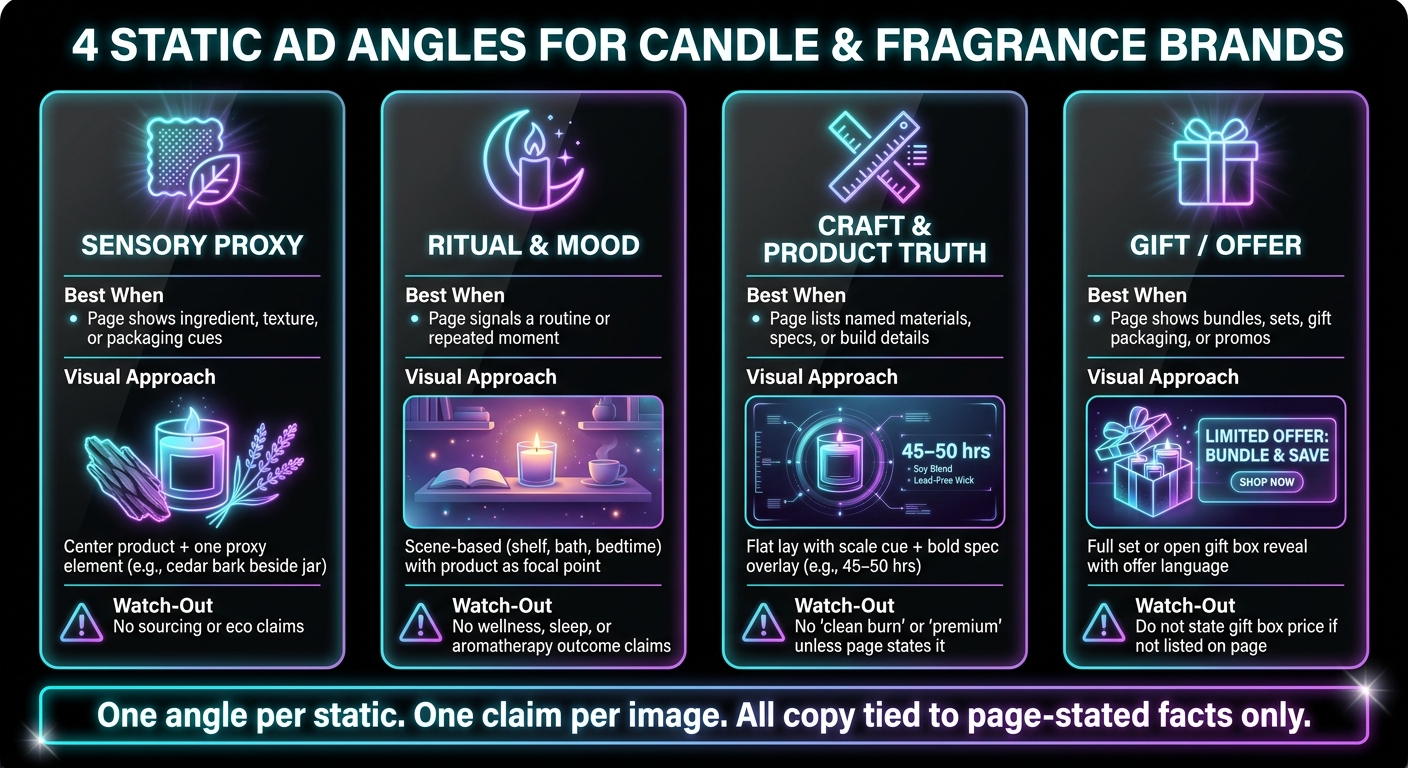
4 Static Ad Angles for Candle & Fragrance Brands: What to Use & When
Use sensory proxies when the page shows ingredient, texture, or packaging cues. For candles and fragrance, that usually means the wax surface, vessel, label, botanicals, outer box, or a simple set layout.
The job here is simple: pick one visible cue and let it do the work. If the page shows a matte ceramic vessel, a textured wax pour, dried botanicals, or a branded carton, that’s enough to guide the ad. No need to stretch into scent promises or wellness angles the page doesn’t support.
| Field | Direction |
|---|---|
| Hook Direction | Lead with one ingredient, texture, or packaging cue. |
| Composition | Center the product and support it with one proxy element. |
| Text Overlay | Use one page-verified phrase or product cue; no scent claims. |
| Proof / Input Required | Ingredient, texture, packaging, or collection details shown on the page. |
| Copy Direction | Short primary text tied to page facts; no scent-result or wellness claims. |
This works best when the landing page gives clear visual proof. In ADEN'S LAB, that usually means pasting the product or collection URL, letting the tool pull the available visuals and on-page messaging, then turning those cues into several static routes built around the same product. One route might lean on the vessel. Another might use the box. A third might focus on the ingredient shown on-page. Review the set, download the ones that stay closest to the page, and test them against a more use-case-led concept.
Use this lens when the page gives ingredient, texture, or packaging proof. If the page is built more around occasion, bundle logic, or buyer intent, shift to ritual or gifting instead.
2. Ritual and mood
Use this angle only when the product page already signals a routine moment. The ad should come straight from that signal, not from invented lifestyle fluff. Build around what’s already there: the scene, the light, the props, and a short line of copy lifted from the page language.
This works best when the page already frames the product as part of a habit or a repeated moment in the day. If that cue isn’t there, forcing a “ritual” story usually turns into generic brand dressing.
| Field | Direction |
|---|---|
| Hook Direction | Use the page's existing routine cue. |
| Composition | Match the page's scene, lighting, and props. |
| Text Overlay | Use the page's wording. |
| Proof / Input Required | Use only page-visible cues. |
| Copy Direction | Do not imply an outcome the page does not support. |
In ADEN'S LAB, this means starting with a supported product URL, letting the tool pull the available visuals and messaging, and then generating static ad options that stay close to those routine cues while optimizing Meta ad performance. Review the outputs, cut anything that drifts beyond the page, and test only the variants that keep the mood tied to visible proof.
If the page gives more material detail, process, or build-quality signals than mood, switch to craft and product truth instead.
3. Craft and product truth
Once sensory and mood angles are covered, move to craft when the product page gives hard proof. That means named materials, build details, ingredients, or packaging facts that are clearly stated on the page.
This angle works best when the ad opens with one verified product detail. Not a soft promise. Not a mood-heavy line. A plain fact the page already says. If the candle page says soy wax or wood wick, that becomes the hook. If the balm page names an ingredient or texture detail, use that. The point is simple: turn product facts people can see into the reason to stop.
For fragrance, stay tight on the brand’s note structure: top, heart, and base notes. Don’t drift into claims about how someone will feel. Show the scent makeup, not the result.
Example: if the page lists bergamot, cedar, and amber, use that system as the ad input. Don’t turn it into “smells like confidence” unless the page itself says that.
Ingredient close-up
| Field | Direction |
|---|---|
| Hook Direction | Lead with one named, page-verified material or process detail. |
| Composition | Macro crop on the material itself - wood wick, wax pour, or balm texture - with grain or surface visible. |
| Text Overlay | One page-verified material line. |
| Proof / Input Required | Details explicitly stated on the product page. |
| Copy Direction | Write like a product fact, not a mood line. |
This is a clean fit for ADEN'S LAB. Paste the product URL, let the tool pull the page visuals and product language, then generate static craft-led options from what is already there. Review the outputs, download the ones that stay tight to the page facts, and test those in Meta.
If the page is built around bundles or discounts instead of product detail, don’t force the craft angle. Switch to gift or offer framing next.
4. Gift, collection, and offer
When a product page moves past the item itself and starts selling the reason to buy now, switch to gift, collection, and offer framing. That means bundles, discovery sets, seasonal packs, and gift-ready collections that are clearly shown on the page.
This angle only works when the buying context is verified on-page. If the site shows a set, a promo, gift packaging, or a clear occasion tie-in, build the static around that. If it doesn't, skip it.
For fragrance in particular, this matters. A static image can't communicate scent in any reliable way. So don't make the ad try to sell the smell. Sell the purchase logic instead: what's in the set, what the shopper gets for the price, and why it makes sense as a gift.
| Field | Direction |
|---|---|
| Hook Direction | Lead with the offer or gift context - bundle contents, discount, or occasion fit. |
| Composition | Show the full set, packaging, or bundle together; let the scope of the offer do the visual work. |
| Text Overlay | Use page-stated offer language: bundle name, price, discount, or occasion callout. |
| Proof / Input Required | Bundle contents, pricing, gift packaging, or promotional details explicitly stated on the page. |
| Copy Direction | Write around the buying reason - value, occasion, or recipient fit - not the sensory experience. |
In practice, the ad should make the set feel clear at a glance. Show the full bundle. Show the packaging if that's part of the gift case. Put the offer language right on the image if the page states it. The shopper should understand the deal without needing to decode it.
Copy should stay tight to the page. That means bundle name, listed price, stated discount, included items, or a holiday or gifting callout if it's there. No invented value claims. No leaning on vague lines about how it smells or feels. The page already gave the sales angle - use that.
In ADEN'S LAB, paste a product or collection URL that includes bundle, set, or offer details. The tool pulls the available visuals and page messaging, then generates static options built around that buying context. From there, review the outputs, download the versions that stay close to the actual page offer, and test those in Meta.
Use this lens only when the page shows a real bundle, set, or promotion. The examples that follow take those page-level facts and turn them into static concepts.
Five Worked Examples Mapped From the Anchor Product Page
Below are five ready-to-test static ad mappings pulled from page-stated facts only. There is no live ADEN'S LAB output for this anchor product, so treat these as controlled examples built from the product page, not reported winners.
Anchor product (fictional, clearly labeled): Hearthwick No. 4 Soy Candle - 8 oz, hand-poured, cotton wick, listed scent description: cedarwood and smoked amber, burn time stated as 45–50 hours, price $34, gift box available as an add-on at checkout.
That same structure also works for fragrance pages with note pyramids and self-care pages where texture, use case, or ritual cues are visible on-page.
These examples are direct translations of the four lenses above into static Meta ads.
Example 1 - Ingredient as visual proof (Sensory Proxies)
The page lists cedarwood and smoked amber, but it does not include sourcing or eco claims. So the ad should stay tight. A split composition works well here: raw cedar bark on the left, the candle jar on the right. The main job of the image is texture contrast - rough bark against a smooth matte jar.
Use overlay copy like Cedarwood. Smoked amber. Keep the headline simple: What's inside the jar. Primary text: Hearthwick No. 4. Hand-poured, 8 oz, 45–50 hr burn. $34.
The point is to sell ingredient cues, not to drift into mood language or scent performance claims that the page does not support.
Example 2 - Ritual setting (Ritual and Mood)
The product page shows the candle. The ritual context has to come from a scene the brand already owns or can shoot. A bathroom shelf setup is enough: lit candle, folded towel, book spine. Nothing fancy. The focal point should still be the flame and the jar label, not props fighting for attention.
Overlay: The part of the evening that's yours.
Headline: 45–50 hours of it.
Primary text: Hearthwick No. 4 - cedarwood and smoked amber. $34.
This angle sells the moment around the product. It should not slip into wellness, stress relief, sleep, or aromatherapy language unless the page gives that proof.
Example 3 - Scale and burn time (Craft and Product Truth)
This one stays closest to the product page. The page states 8 oz, 45–50 hour burn time, hand-poured, and cotton wick. So the static ad can work like a visual spec sheet. A flat lay is the cleanest route: candle jar centered, coin beside it for scale, and a bold text card reading 45–50 hrs.
Overlay: 45–50 hours. Hand-poured. Cotton wick.
Headline: 45–50 hours. Hand-poured. Cotton wick.
Primary text: 8 oz. $34. Hearthwick No. 4.
Every line here should stay page-stated. No detours into “clean burn,” “luxury,” or “premium quality” unless the page says that in plain terms.
Example 4 - Gift packaging (Gift, Collection, and Offer)
The product page says a gift box is available as an add-on at checkout. That gives a clean gift angle, but only within that limit. Show the candle in an open gift box with the lid beside it. The visual job is the reveal: product plus packaging, clearly framed.
Overlay: Gift box available.
Headline: Add the box at checkout.
Primary text: Hearthwick No. 4 - $34. Gift box available at checkout.
One guardrail matters here: do not price the gift box unless the page does. If the add-on cost is missing, the ad should leave it out too.
Example 5 - Price-anchored direct offer (Gift, Collection, and Offer - offer sub-angle)
This is the most direct version. Use it when price and burn time are the fastest hooks available on-page. A white-background packshot works because it strips away mood and puts the offer front and center. The focal point should be the jar label and the price overlay.
Overlay: $34. 45–50 hours.
Headline: 45–50 hours. $34.
Primary text: Hearthwick No. 4 - hand-poured soy candle. Cedarwood and smoked amber. Shop now.
This kind of ad is useful when the goal is fast message clarity, not scene-building.
| Angle | Visual setup | Safe page-stated hooks | Watch-outs |
|---|---|---|---|
| Sensory Proxies | Cedar bark + jar split image | Cedarwood, smoked amber, 8 oz, hand-poured, 45–50 hours, $34 | No sourcing or eco claims |
| Ritual and Mood | Shelf scene with lit candle | 45–50 hours, cedarwood and smoked amber, $34 | No wellness or aromatherapy claims |
| Craft and Product Truth | Flat lay with scale cue | 8 oz, cotton wick, hand-poured, 45–50 hours, $34 | No “clean burn” unless stated |
| Gift angle | Open gift box reveal | Gift box available at checkout, $34 | Do not state gift box price if missing |
| Direct offer | White-background packshot | $34, 45–50 hours, soy candle, cedarwood and smoked amber | Avoid extra quality claims |
Inside ADEN'S LAB, this is where the workflow gets practical. Paste the product URL, let the tool pull the visuals and messaging the page already gives you, generate several static concepts from those inputs, then review and download the few that stay closest to the page truth. From there, test selected ads in Meta by angle - ingredient cue, ritual scene, spec-led proof, gift framing, or direct price hook - instead of mixing all five into one muddled creative.
Next, separate page-stated claims from claims that need proof.
Claims You May Use vs Claims That Require Proof
Before turning a concept into a static ad, run every line against the product page. If the page says it, use it. If it only hints at it, leave it out. Mood words are fine when they set the scene, but they should not promise a result. That rule applies to every sensory, ritual, craft, and offer angle before writing the overlay.
| Claim type | Examples | Status |
|---|---|---|
| Page-verifiable facts | Stated materials, size, bundle contents, price, and offer terms | ✅ Safe to use directly |
| Mood positioning | Cozy, spa-like, evening reset, warm atmosphere | ✅ Safe - describe atmosphere, not outcome |
| Requires proof before use | Non-toxic, sustainable, ethically sourced, reduces anxiety, dermatologist-tested, aromatherapy benefits | ⛔ Off-limits without proof |
Treat terms like non-toxic, sustainable, ethically sourced, stress relief, sleep, calm, and aromatherapy as off-limits unless the product page states them plainly and there is proof behind them.
This is a simple control step, but it matters. It keeps the first six tests tight, compliant, and tied to what the landing page can actually support. That also fits the current ADEN'S LAB workflow: paste the product URL, pull the visuals and copy the page already gives you, generate multiple static concepts from those inputs, then review and test the ads that stay inside the claim boundary.
The First Six Concepts to Test Without Changing Your Offer
Start with one controlled batch: same product, same audience, same landing page, same offer. Change only the creative angle across the six ads below. That keeps the read clean. If one concept pulls ahead, the next step is obvious: build more ads in that direction before touching targeting or the offer.
This is the first test order. It is not a prompt list.
| # | Angle | Visual | Test question |
|---|---|---|---|
| 1 | Sensory proxy | Raw ingredients or a macro shot of wax beside the product | Whether scent proxies outperform a styled product shot |
| 2 | Ritual setup | Product placed inside a specific, time-bound habit or environment, such as a bedtime or evening scene | Whether a recognizable personal habit creates stronger identification than a neutral background |
| 3 | Gifting | Product in or beside its box, with tissue paper or another gift cue visible | Whether gift-occasion framing pulls a different buyer than self-purchase copy |
| 4 | Craft / product truth | One verified product-page detail shown close and labeled | Whether specificity builds trust faster than mood-forward creative |
| 5 | Collection or comparison | Two or three SKUs from the same line arranged by scent family or season | Whether a range view drives more clicks than a single-product focus |
| 6 | Offer-led | Hero image with the active offer as the main overlay | Whether an explicit value statement beats atmosphere-first creative |
Why these six first? They cover the main ways a static ad can frame the same product without drifting into a different offer or a different buyer story. That matters because most early tests get messy fast. One ad changes the image, another changes the message, a third changes the promo, and now the result tells you almost nothing.
This batch avoids that problem.
A few notes on how to run each angle:
- Sensory proxy works when the product benefit is hard to show directly. For candles, wax texture, ingredients, or scent-linked objects can stand in for what the buyer expects to feel.
- Ritual setup puts the product inside a familiar moment. Bedtime, wind-down, bath, reading chair, evening kitchen counter. The point is recognition, not fantasy.
- Gifting can pull a different click than self-buy intent. Same item, same page, different reason to care.
- Craft / product truth should stay tight and factual. Use one page-stated detail only. Don’t pile on claims.
- Collection or comparison helps when choice is part of the appeal. It can show range without forcing the ad to explain every SKU.
- Offer-led is the plainest test in the set. Put the active offer up front and see if direct value framing beats a mood-first image.
The practical rule is simple: do not rewrite the offer inside the test. If the site says one thing, the ad says that same thing. No added claims. No hinted results. No dressed-up promise that the page can’t support.
This is also where ADEN'S LAB fits cleanly into the workflow. Paste the product or collection URL, let the tool pull the available visuals and page copy, generate multiple static routes across these six angles by automating Meta ad production, then review and download the ads that stay closest to the page truth. From there, test the selected set in Meta with the same landing page and offer attached to each concept.
That approach keeps the test controlled and fast to read. One winner doesn’t prove a final answer, but it does tell you what to make next.
Use only page-stated facts. Keep mood language atmospheric, not outcome-based.
From Prompt-Style Ideas to URL-Based Static Ad Generation
Prompt-style ideas can work as briefs. The problem is what happens next.
Most teams can get to a decent angle. Then they hit the same wall: the brief is done, but there’s still no ad asset ready to review, approve, and test. That handoff from idea to asset is where work slows down.
With a URL-based workflow, that step turns into execution instead of more prompting. ADEN'S LAB handles that gap directly. Rather than asking for prompt after prompt, it takes one input: a product page, landing page, offer page, or full website URL.
From that page, it pulls available visuals, copy, and offer details, then generates ready-to-test static Meta ad assets:
- images
- headlines
- primary text
- alternate layouts
No prompt writing is required. For candles and fragrance, that matters. These categories often depend on product feel, scent story, gifting angle, and offer clarity. If the source page already holds those inputs, the workflow is faster and less messy.
This also fits how static testing usually works in practice. A team already has a page live. The next step is not to sit around polishing prompts. It’s to turn the page into multiple static concepts, review the outputs, download the ads that make sense, and push selected variants into testing.
That’s the current ADEN'S LAB flow:
- paste a supported URL
- let the platform extract available visuals and messaging
- generate multiple static creatives
- review or download the outputs
- test the selected ads in Meta
One point matters here: review every asset before launch. If the page overstates a benefit, the ad will repeat it. So the speed comes from the workflow, not from skipping judgment. The source page still sets the ceiling for claim quality, which is why this review step keeps the output in line with the claims rules above.
For volume, the available plans are 9, 30, 50, 200, or 500 ads/month. There’s also a 7-day trial with card activation. The 9-ad tier covers the first six-concept batch, which is enough to get the first set live and see which direction deserves the next round.
If the goal is to move from candle or fragrance page to static Meta concepts without turning every angle into a manual prompt exercise, this is the point where the workflow gets simpler: start with the URL, generate the batch, review the claims, and test the ads worth spending on.
Conclusion
Polished aesthetic shots don’t give enough signal on their own. What tends to matter more is ingredient scale, ritual context, and gift cues. That pattern shows up across all 25 briefs, and it’s the logic behind the matrix, the examples, and the claim guardrails.
The matrix points to the angle. The examples show how to build it. The claims box helps keep each line defensible.
For candle, fragrance, and self-care brands, that turns into a practical workflow inside ADEN'S LAB: paste in a product URL, let the platform pull the visuals and messaging it can use, generate a batch of static concepts from the strongest angles, then review, download, and test the ads that make sense for the account.
If the goal is to move faster without drifting into weak claims or generic lifestyle creative, that’s the next step: drop in the URL and build a static test batch around the angles most likely to give a clear read.
FAQs
How do I choose the best angle for one static ad?
The current answer is off-topic. It talks about cell-phone location data and the Fourth Amendment, which has nothing to do with static Meta ads.
A correct answer should explain how to pick the best static ad angle.
The simplest way to do that is to start with the offer, then map angles to what might move a buyer to click. In practice, that usually means testing a small set of distinct directions instead of guessing at one.
Good static ad angles often fall into a few buckets:
- Problem-aware: lead with the pain, frustration, or cost of doing nothing
- Benefit-led: show the main outcome the buyer wants
- Objection-led: answer a clear point of friction like price, effort, or trust
- Audience-specific: speak to a defined buyer segment
- Offer-led: put the deal, bundle, trial, or promo at the front
- Proof-led: use reviews, ratings, results, or product detail when proof exists
The best angle is usually the one that matches buyer awareness and the job of the ad. A cold prospect may respond to a clear problem or outcome. A warmer audience may need proof, product detail, or a direct offer.
A simple way to choose angles is:
| What to review | What to ask | Example angle |
|---|---|---|
| Offer | Why would someone buy this now? | Limited-time bundle |
| Buyer pain | What problem is most annoying? | Stop wasting time on setup |
| Desired outcome | What does success look like? | Get cleaner skin in less time |
| Objections | What might block the click? | No complicated install |
| Proof | What can be shown credibly? | 4.8-star rating from verified buyers |
For ADEN'S LAB, the workflow is straightforward: paste a supported product or landing page URL, let the system pull available visuals and messaging, generate multiple static concepts based on different angles, then review and download the ones worth testing in Meta. That makes angle selection less about opinion and more about controlled variation.
A tighter replacement for the FAQ would be:
Choose the best ad angle by matching the message to the buyer’s main reason to act. Start with the offer, identify the top pain point, desired outcome, objection, and proof available, then turn each into a separate static concept. In ADEN'S LAB, paste a supported URL, generate multiple static creatives from the page’s visuals and copy, review angle variations, and test the strongest options in Meta. Don’t try to find the perfect angle in one shot - test a few clearly different directions and keep the ones that earn clicks and downstream results.
What if my product page is missing key proof like notes or burn time?
Use only what the product page clearly supports. If key proof like notes or burn time is missing, don’t invent it.
Treat scent descriptions as positioning, not objective outcomes. Build the creative around what’s actually on the page: available visuals, messaging, offer details, and other stated facts.
For ADEN'S LAB, that means a simple workflow: paste the product URL, pull in the page assets that exist, generate static Meta ads from those inputs, review the outputs, then download and test the versions that fit the account. If the page gives weak inputs, the ads should stay tight and honest rather than padding the concept with claims the product page doesn’t back up.
How should I test candle ad prompts without changing too many variables?
Test one prompt angle at a time and keep the rest of the ad the same. That’s how you isolate what changed performance: the hook, the composition, the text overlay, the proof element, or the copy direction.
Use these prompts as creative briefs, then paste your product URL into ADEN'S LAB to pull the available visuals and messaging, generate a static batch, and review variations that stay tight and comparable.
Your next ad batch starts here
Finish with a ready-to-test ad batch
Paste your website to generate static creatives. Drop the link → get ads in about 90 seconds → upload them to Meta → scale.
Free to try No signup No prompt writing