Meta Ad Prompts for Home Decor and Furniture Brands
Use the prompts on your real offer
Generate these ad angles for your product
Skip the blank prompt box. Paste your product page and ADEN'S LAB applies the angles to your offer, images, headlines, and copy.
Free to try No signup No prompt writing

If your Meta ads for furniture don’t answer fit, look, price, and delivery fast, you lose the click.
I’d sum up the article like this: the best prompt depends on where the shopper is in the funnel. For cold traffic, I’d use in-room styling and size-based hooks. For warm traffic, I’d lean on reviews, dimensions, financing, and delivery details. For launches, holiday pushes, and bundles, I’d focus on timing, room context, and add-on items that complete the space.
Here’s the whole playbook in plain English:
-
Prospecting ads should stop the scroll with:
- styled room images
- small-space angles
- material shots
- comfort clips
- life-moment hooks like moving or first apartment
- soft CTAs such as “Explore styles” or “Check sizes”
-
Retargeting ads should remove doubt with:
- room mockups of viewed items
- dimension overlays
- review quotes
- free delivery or installation
- financing mentions
- cross-sells after a main purchase
-
Seasonal and launch ads should give people a reason to act now with:
- spring room swaps
- outdoor summer scenes
- holiday hosting setups
- Black Friday offers tied to service or bundles
- new drops grouped by style
- life-stage hooks tied to furnishing needs
-
Style and bundle ads should help shoppers picture a full room, not a single item:
- Scandinavian dining sets
- farmhouse living room layers
- small-apartment setups
- eco-focused room groupings
- boho mixes
- “complete the look” product sets
I’d also keep testing simple. The article breaks testing into four parts: fit, proof, offer, and friction. That means testing things like in-room photos vs. studio shots, review images vs. material close-ups, bundles vs. financing, and warranty vs. delivery messaging.
A few details matter more here than in many other categories. Furniture is a high-price, slow-decision buy. People want to know if a sofa fits a wall, if a rug suits the room, or if a table arrives without hassle. That’s why a single image with scale cues, clear dimensions, or a lived-in room can do more work than generic product copy.
| Campaign type | Main goal | Best prompt angle |
|---|---|---|
| Prospecting | Get attention | In-room style, small-space problem/solution |
| Retargeting | Remove doubt | Reviews, dimensions, delivery, financing |
| Seasonal/Launch | Add urgency | Timing + room scene + service/value |
| Bundle/Style | Increase order size | Full-room styling and product sets |
My takeaway: use prompts to match the shopper’s question. New shoppers ask, “What is this and will it work in my home?” Warm shoppers ask, “Can I trust this, and is buying easy?” Good Meta ads answer those questions right away.
The rest of the article shows prompt ideas for each campaign type and how to turn them into repeatable ad tests, often using AI tools for Meta ads to speed up the process.
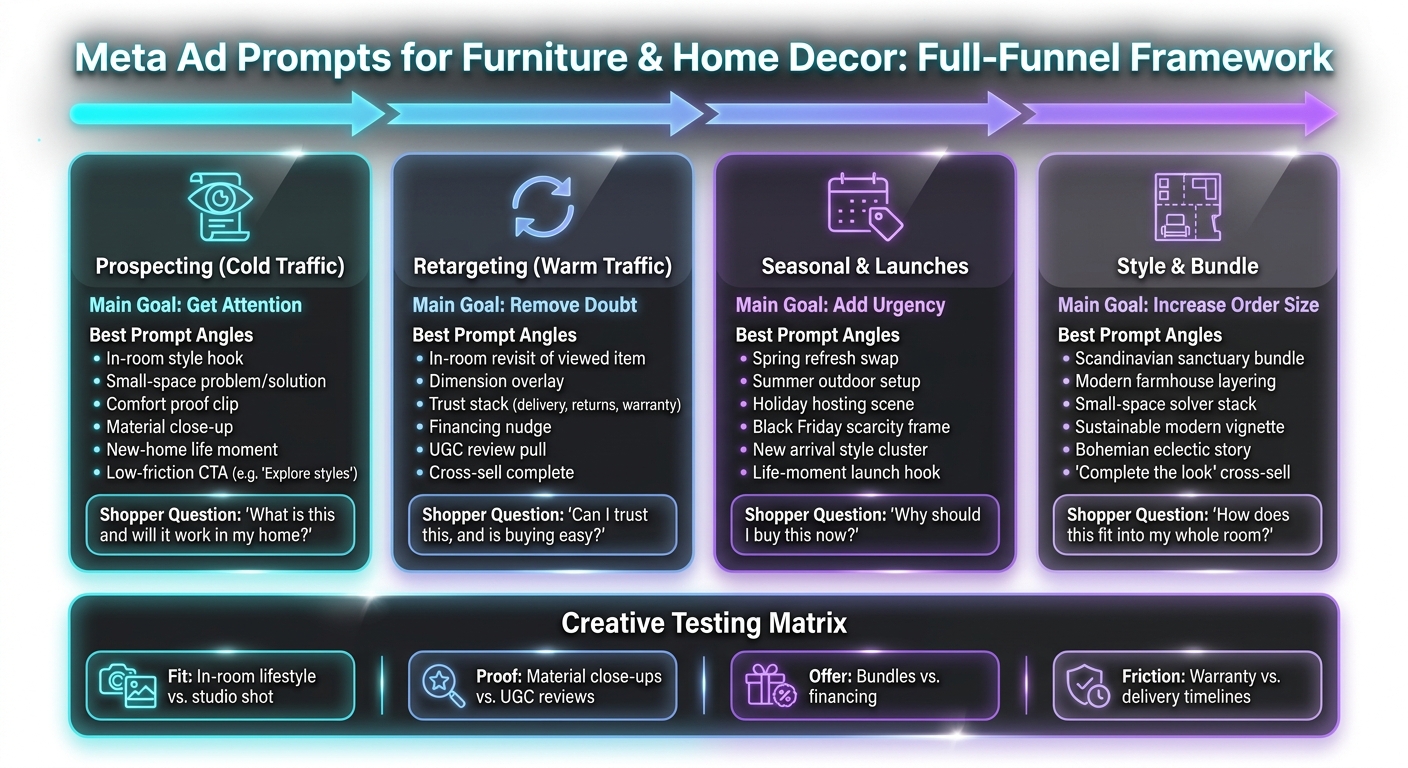
Meta Ad Prompts for Furniture Brands: Full-Funnel Framework
Furniture Ads Not Working? Here Is Your Step-by-Step Fix
sbb-itb-628c49f
Put the playbook to work
Apply this playbook to your page
Paste your website and the Lab will turn the strategy you are reading into a ready-to-test ads.
Free to try No signup No prompt writing
How to Use Meta Ad Prompts for Furniture and Home Decor Campaigns
Room-style inspiration prompts lead with lifestyle visuals, like a sofa styled in a Scandinavian living room or a dining table shown in a styled room. That matters because people don’t just buy furniture. They picture how it’ll look in their space. This type of prompt helps stop the scroll early by putting the product in context.
Problem-solution prompts go after common friction points, such as small-space living or delivery concerns. These work well for both prospecting and retargeting because they deal with the stuff that makes shoppers hesitate.
Social-proof prompts lean on customer reviews, real-home photos, and UGC. Their job is simple: answer the trust question that often stalls mid-funnel buyers.
Benefit-led prompts frame value through service and material details, like stain-resistant fabric, a 5-year warranty, or free installation, instead of leaning only on price cuts.
Use this map to pick the right prompt before building each ad.
| Framework | Best Campaign Goal | Core Job |
|---|---|---|
| Room-Style Inspiration | Prospecting / New Arrivals | Help shoppers visualize the product at home |
| Problem-Solution | Prospecting / Retargeting | Qualify clicks, remove friction |
| Social-Proof | Retargeting / Consideration | Add proof, validate quality |
| Benefit-Led | Seasonal / Room Bundles | Frame value beyond the price tag |
For prospecting, room-style inspiration and problem-solution hooks tend to do the most work. They help new shoppers see the product in use and deal with objections before those objections turn into a bounce.
For retargeting, social-proof and benefit-led copy usually make more sense. At that stage, the shopper already knows the product exists. What they need now is a little more trust and a little less risk.
Seasonal promotions and new arrivals often do well with benefit-led framing paired with new styling. That combo can create urgency without leaning on discounts. And for higher-AOV room bundles, room-style inspiration can carry a lot of weight by showing how a rug, lamp, or side table completes a look the buyer already liked.
When CTR is low, the hook or visual usually isn’t landing. When CTR looks good but purchases lag, the issue is often confidence after the click, like missing dimensions, unclear delivery timelines, or no financing option in sight. Matching the framework to the funnel stage helps fix the right problem at the right time. Next, use these frameworks to write prospecting prompts that convert and stop the scroll fast.
1. Prospecting
Cold traffic needs instant clarity, scale, and trust. The job here is simple: stop the scroll fast and make the product feel easy to understand.
Here are six prompt angles built for cold traffic:
- The In-Room Style Hook: Show the product styled in a finished room that matches a specific aesthetic - Scandinavian, Industrial, or Bohemian. Copy reads: "Your living room, but make it intentional. Shop the [style name] collection." Use a lifestyle photo instead of a studio shot.
- The Small-Space Solve: Lead with a size problem, not the product. "No room for a full sectional? This sofa is designed for studio apartment living without crowding the layout." Add a dimension overlay or a person for scale.
- The Comfort Proof Clip: Run a 10–20 second video showing someone sitting down, leaning back, or pressing into a cushion. A moving visual shows what a static image can't: how the piece actually feels. This works well for sofas, lounge chairs, and other upholstered pieces.
- The Material Close-Up: Zoom in on texture and material quality. Copy: "Stain-resistant velvet for busy family rooms." This gives shoppers a better sense of texture and finish before they click.
- The New-Home Angle: Frame the product around a life moment, not just a room. "Just moved in? Start with the piece that ties the whole space together." Targeting life moments like "new home", "moving", or "first apartment" makes the ad feel more specific, not generic.
- The Low-Friction CTA: Use softer CTAs for cold audiences - "Explore styles", "Check sizes", "Shop best sellers" - instead of hard buy-now language.
Once you earn the click, retargeting can do the next job: answer objections and build trust.
2. Retargeting
Retargeting should deal with the last bit of hesitation: fit, trust, or payment friction.
Here are six prompt angles for warm audiences:
- The In-Room Revisit: If someone viewed a product but didn’t add it to cart, show a lifestyle photo of that exact item styled in a finished room. Copy: "Still thinking about it? See how it looks in a real living room." This helps answer the classic hesitation: Will it fit my space?
- The Dimension Overlay: Show the product with a clear size diagram or next to a person for scale. Copy: "Check the exact size before you buy."
- The Trust Stack: For cart abandoners, lead with service instead of a discount. Highlight "Free delivery + installation", "7-day returns," or "5-year warranty included". That lowers perceived risk and helps protect margin.
- The Financing Nudge: Checkout abandoners often stop at the payment step. An ad that reads "Not ready yet? Financing available." can remove that last barrier without cutting into your margin.
- The UGC Review Pull: Use a real-home photo paired with a short quote from a customer review. This works especially well for sofas, rugs, and dining tables. People want to see these pieces in an actual home, not just a studio shot.
- The Cross-Sell Complete: For past buyers of a big anchor piece like a dining table, retarget them with items that finish the room, like a matching rug, pendant lighting, or a set of side tables. Copy: "You've got the table. Now finish the room." This can lift repeat revenue.
Use these retargeting prompts to win back warm traffic, then apply the same setup to seasonal offers and new launches.
3. Seasonal & Launches
Once trust is there, timing gives shoppers a reason to act now. Seasonal moments and new drops add urgency. But for furniture, urgency alone usually isn’t enough. People still need to see how a piece fits into their room, their layout, and their day-to-day life.
That’s why the prompt matters so much. The right setup can turn casual browsing into buying.
Here are six prompt ideas built for these moments:
- The Spring Refresh Swap: Show a side-by-side before-and-after room visual. Start with a winter setup, then switch to lighter textures, brighter accents, and clear scale cues for small-space shoppers. This helps qualify clicks and makes the room feel ready for a seasonal update.
- The Summer Outdoor Setup: Open with a 10–20 second video of someone using the furniture in a real patio or outdoor setting. A patio scene helps shoppers judge outdoor scale and see how the piece is meant to be used.
- The Holiday Hosting Scene: Build video ads around families and friends gathered in styled rooms to create a cozy holiday-home mood. This works well for dining, seating, and decor that sells through feeling and setting.
- The Black Friday Scarcity Frame: Mix urgency with value. Think free delivery, installation, an extended warranty, or a limited-time bundle.
- The New Arrival Style Cluster: When launching a new collection, split launches by style - Modern, Scandinavian, Traditional, Industrial - and test one look per ad. One style per ad makes performance easier to read.
- The Life-Moment Launch Hook: Tie the new drop to a life moment like moving into a new place, getting married, or setting up a home office. Use copy like "Moving in? Start with the right sofa." to reach shoppers who are furnishing right now.
Use these seasonal angles to build room-bundle and style-led ads next.
4. Style & Bundle Inspiration
Style-led ads need to answer one thing fast: will this fit my home? That’s why the creative should show a full room, not just one product floating on its own.
Here are six prompt ideas for style and bundle campaigns:
- The Scandinavian Sanctuary Bundle: Pair a light wood dining table with linen chairs and a pendant lamp. Show all three pieces together in a real dining room, not a studio-only shot, so shoppers can judge scale and fit right away.
- The Modern Farmhouse Layering Shot: Start with a large sectional, then add a woven rug, a reclaimed wood coffee table, and a floor lamp. Use warm, lived-in rooms to show how layered textures can make the space feel cozy and finished.
- The Small-Space Solver Stack: Prompt for a video set in a studio or small apartment where a compact sofa, nesting side table, and wall-mounted shelving work together in one tight layout. Add a simple dimension overlay or size diagram so shoppers can see how it fits.
- The Sustainable Modern Vignette: Feature ethically sourced or artisan-made pieces together - a solid wood credenza, a recycled-fiber rug, and a hand-thrown ceramic lamp base. Use neatly staged rooms with natural finishes to signal a calm, modern feel.
- The Bohemian Eclectic Story: Prompt for a mix of textures and eras - a rattan chair, a vintage-style floor mirror, and a patterned throw. Show the blend clearly so shoppers can picture a personal, collected look.
- The "Complete the Look" Cross-Sell: Show past buyers the complementary pieces that finish their room. Use Advantage+ Catalog to pull those SKUs automatically, and frame the copy around the full room instead of only the single item.
These prompts work best when you test a few room setups, then put more spend behind the ones that win. That gives you a clear way to test different room stories, bundle combinations, and style groupings at scale.
Using Prompt Ideas to Scale Creative Testing and Output
A prompt is a starting point, not a full test plan. To scale it, run each idea across product clusters, audience stages, and room contexts.
Take a small-space prompt. You can test it across modern, Scandinavian, or industrial style clusters. Then layer in different image types, like in-room lifestyle photos, studio shots, and dimension overlays.
Test each prompt across four levers:
| Testing Layer | Variable to Test | Goal |
|---|---|---|
| Fit | In-room lifestyle vs. studio shot | Answer whether it will fit and look good in the home |
| Proof | Material close-ups vs. UGC reviews | Show that it is high quality |
| Offer | Bundles vs. financing | Make the offer feel worth the price |
| Friction | Warranty vs. delivery timelines | Address what happens if something goes wrong |
For prospecting, use in-room visuals so shoppers can picture the piece in their own space. For retargeting, lean on close-ups, reviews, dimensions, and delivery reassurance to remove the doubt that often slows furniture buyers down. That shift makes it much easier to turn a prompt idea into a testable variation.
ADEN's LAB turns a product or landing-page URL into Meta-ready static ad variants fast, which makes weekly refreshes easier.
The workflow is simple: map prompts to your testing matrix, generate variants, launch by audience stage, and keep the winners in rotation.
Conclusion
Strong Meta ad prompts for home decor and furniture brands work best when they’re specific. They should line up with the product, the shopper’s stage, and the visual setting. When those pieces match, it becomes much easier to make ads people can picture in their own homes, trust at a glance, and click on with intent. Once the prompt is clear, the campaign stage shapes the angle.
Each prompt type has a different role. Prospecting ads help you win attention. Retargeting ads help clear up doubt. Seasonal ads add urgency. Bundle ads can increase order value. When you assign each prompt a clear job, testing gets cleaner and performance is easier to read.
That setup cuts wasted spend and improves ROAS by matching the right message to the right shopper.
In home decor and furniture, better prompts lead to better creative, faster testing, and more qualified clicks. Start with one product, one audience stage, and one visual angle. Then test from there.
FAQs
How many ad prompts should I test at once?
There’s no magic number when it comes to how many ad prompts a home decor brand should test at one time. The main thing is to use a clear set of prompts that helps you try different angles, styles, and hooks without turning the process into a mess.
That’s where ADEN'S LAB comes in. Its prompt packs include 10 to 30 prompts built for different campaign goals, so you can spin up a range of ad ideas from a single product link in under 90 seconds.
Which furniture products work best with room-style ads?
Room-style ads tend to work well across most furniture and decor categories, from sofas and beds to dining sets, storage pieces, and home office furniture.
When people see a product in a space that looks lived-in and believable, it gets easier to judge scale, fit, and style match. That makes the item easier to picture in their own home, which can help cut down on purchase hesitation.
What should I fix if clicks are high but sales are low?
High clicks but low sales usually mean one of two things: shoppers don’t feel sure enough on the product page, or something is getting in their way at checkout.
Start with the product page. Add the details people look for before they buy, such as:
- Dimensions
- Materials
- Delivery timelines
- Warranty info
- In-room proof
That last one matters more than many brands think. A clean product photo is nice. Seeing the item in an actual room helps people picture it in their own home.
If sales still lag after that, shift your attention to checkout. Look for friction points like a clunky flow, surprise shipping costs, or extra fees that show up too late. Even small pricing shocks can push buyers to bail.
Your next ad batch starts here
Finish with a ready-to-test ad batch
Paste your website to generate static creatives. Drop the link → get ads in about 90 seconds → upload them to Meta → scale.
Free to try No signup No prompt writing