How High-Performing Lead Gen Agencies Generate New Ads Every Week Without Designers
Try the workflow instead of comparing it
See what an AI ad generator makes from your product
Paste your product page and get a complete Meta ad batch—creative concepts, images, headlines, and copy—without another tool stack.
Free to try No prompt writing

Tired of ad fatigue driving up your costs? Meta's algorithm penalizes stale ads within 7–14 days, leading to skyrocketing CPAs and wasted budgets. High-performing agencies solve this by manual vs automated ad production, creating 200+ ads monthly for less than $180 - a fraction of traditional costs.
Here’s the key takeaway: Automation slashes production time from days to minutes, reduces costs by 98%, and allows agencies to test 10–20 ad variants weekly. This rapid cycle identifies winners faster, cuts poor performers early, and stabilizes CPAs up to 48 hours sooner.
Quick Overview:
- Problem: Ad fatigue increases CPAs after 7–14 days.
- Solution: Automated tools like Aden's Lab generate ads in 90 seconds for $0.90 each.
- Results: Up to 66% lower cost per lead, 208% more qualified leads, and faster scaling.
Agencies using automation outpace competitors stuck in slow, costly manual workflows. Want faster results and lower costs? Automate your ad creation process now.
How To Build a Meta Ad Creative Machine (Step-by-Step)

Put the playbook to work
Apply this playbook to your page
Paste your website and the Lab will turn the strategy you are reading into a ready-to-test ads.
Free to try No prompt writing
Why Traditional Ad Creation Kills Agency Speed
The problem isn't about how skilled your designers are. It's that designer-reliant workflows can't keep up with the breakneck pace of Meta advertising. When you're managing ad budgets of $10,000, $50,000, or even $100,000+ per month, the biggest obstacle to scaling profitably is how quickly you can produce new creative.
A manual process takes around seven days from briefing to launch. During that time, your existing ads are losing effectiveness, your cost-per-acquisition (CPA) is climbing, and you're burning money on creative that no longer works. This delay feeds directly into creative fatigue - a challenge that can seriously hurt agencies. It's why those adopting automated systems like Aden's Lab are seeing such a dramatic shift in results.
Creative Fatigue Hits After 7-14 Days
Meta's algorithm doesn't wait around. When the same ad gets shown repeatedly to the same audience, engagement drops, click-through rates plummet, and relevance scores take a hit. The algorithm responds by increasing your CPA. On the flip side, fresh creative gets rewarded with lower CPMs and better placements.
For most lead generation campaigns, ads start to fatigue within 7 to 14 days, depending on audience size and spend. If you're running aggressive budgets, the fatigue sets in even faster. Agencies that succeed are the ones replacing stale ads before the algorithm penalizes them. Agencies that struggle are stuck waiting on designers while their CPAs spiral upward.
What Manual Ad Creation Actually Costs
Custom ad production isn't cheap. Each ad costs between $30 and $50. To test 20 variants and find a couple of winners, you're looking at $600 to $1,000 right off the bat. Many agencies can't afford that, so they test just three ads, cross their fingers that one performs, and scale it until fatigue inevitably sets in.
But the real expense isn't the invoice - it's the time lost to slow production. While you're waiting for revisions, competitors with automated workflows are testing dozens of variants, dropping underperformers in 48 hours, and scaling winners before you've even finalized your first round of feedback. They aren't necessarily smarter or better funded - they're just working faster.
Manual workflows also come with an "inefficiency tax." Slower targeting, delayed optimizations, and sluggish creative turnover can add 10% to 15% to your total ad spend. For a $50,000 monthly budget, that's $5,000 to $7,500 wasted simply because your process can't keep up with the algorithm's speed.
Why Volume and Speed Matter More Than Ever
With these costs and delays, speed isn't just helpful - it's critical. Agencies dominating lead generation in 2026 won't necessarily have "better" ads. They'll have more ads, produced faster. Generating 50, 100, or even 200 ads per month means you're no longer guessing what works. You're testing everything, letting the data guide you, and pulling poor performers before they drain your budget.
Manual workflows might get you 10 to 15 ads per month if you're pushing hard. But automated systems can deliver 200+ ads per month for under $180. That’s not just an improvement - it’s a game-changer. You’re testing 10 times more ideas, refreshing fatigued ads twice as fast, and staying ahead of competitors still stuck in endless revision cycles with their designers.
How to Automate Static Ad Creation with One Link
When battling creative fatigue and climbing CPAs, automation takes the hassle out of manual design. This shift isn’t about sidelining creativity - it’s about cutting out the delays that slow down your testing cycle. Waiting a week for new ads? That’s a week of missed opportunities. Automation flips the script, letting you test multiple ad variants almost instantly.
Instead of relying on the traditional back-and-forth between designers and copywriters, automated ad engines simplify the process. All it takes is a single URL, and you can have conversion-ready ads in no time.
Drop a Link, Get Ads in Minutes
Aden's Lab makes static Meta ad creation unbelievably quick. With just a landing page or product link, their system generates ads in about 90 seconds. You paste the URL, and the tool scans your page, pulls key selling points, and produces visually appealing ads tailored for Facebook and Instagram.
The speed here is a game-changer. Immediate testing helps you avoid wasting ad spend by identifying winners within 48 hours and pausing underperformers before they drain your budget. Plus, the system can crank out up to 150 variations optimized for various aspect ratios like 1:1, 4:5, and 9:16. Matching this output manually would require an entire team of designers.
Here’s a real-world example: Between January and May 2025, a local athletic training center used Aden’s Lab to prep for the New Year rush. By generating 150 ad variations with a "Problem-Symptom" hook and integrating Google ratings and testimonials, they saw incredible results. Membership inquiries jumped from 42 to 186 (+343%) in just 14 days. Their cost per lead dropped from $45 to $12.60, and the owner managed to book out the class roster while spending only $15 on credits.
"Our class roster booked out within two weeks. What used to take three freelancers I now do on a lunch break." - T Adil, Owner, Athletic Training Center
Why Automated Ads Outperform Manual Design
Beyond saving time, automated ads often deliver better results. The secret isn’t about creating “prettier” designs - it’s about speed, volume, and leveraging algorithms. Meta’s delivery system thrives on creative diversity. Ad sets with 10+ unique creatives stabilize CPAs 48 hours faster than those with just one or two designs. By testing dozens of ad angles weekly, you give the algorithm more opportunities to pinpoint what works.
Manual design simply can’t keep pace without driving up costs. Automation, on the other hand, slashes production expenses while speeding up testing. For instance, generating 20 ad concepts with an automated tool costs roughly $10.
Another key advantage? Automated systems come with built-in policy checkers. These tools review your ad copy and visuals for compliance with Meta’s guidelines, flagging restricted content like health claims or personal attributes. This feature reduces the risk of ad rejections and keeps your campaigns running smoothly. In fact, businesses using automation have reported cutting their cost per lead by up to 72% within two weeks.
sbb-itb-628c49f
How to Scale Ad Production Without Guessing
Once you've mastered automating Meta ad production, the next challenge is scaling production without relying on blind guesses. Producing more ads without a clear, data-backed strategy is like throwing darts in the dark. Instead, launching 20 ad variants weekly allows performance data to guide your decisions.
Creative fatigue happens often, so testing a high volume of ads ensures your choices are based on real-world results. Agencies that don't refresh their creatives regularly face higher CPAs, while competitors with fresh ads win over audiences. This approach sets the stage for quickly identifying top-performing ads, which we'll dive into next.
Test 10–20 Variants Every Week and Drop Low Performers Fast
Testing multiple ad variants at once speeds up the learning process. Instead of waiting weeks to see if one ad works, testing 10–20 variants can reveal winners in just 3–5 days. Here's how to do it: allocate a $500 budget across 20 variants (about $25 per ad). Pause any ad with a CTR below 1% or a CPA that's 20% higher than your target after 1,000 impressions. By cutting about 70% of underperformers and scaling the remaining 30%, you can significantly reduce wasted spend. Agencies using this strategy have reported lowering CPAs by 25% over time.
Take Thrive Internet Marketing Agency as an example. Between January and May 2025, they applied this method while working with Restoration 1, a U.S.-based property restoration company. By testing multiple ad variants across SEO, PPC, and paid social in 22 service areas, they generated 89,422 leads, including a record 12,884 leads in a single month - a 452% jump in conversions. They also achieved 1,345 phone calls and 2,064 paid ad conversions by continuously testing and cutting underperformers.
Produce Ads for $0.90 Each Instead of $50
One of the biggest hurdles to high-volume ad testing is cost. If you're paying $50 per ad to a freelance designer, producing 20 variants weekly (or 80 ads monthly) adds up to $4,000 - before you even spend a dime on media.
Automation changes the game. With tools like ADEN's LAB, you can slash production costs dramatically. For example, their Apex Mode plan costs $179 per month for 200 ads, bringing the cost per ad down to just $0.90 - a 98% reduction compared to manual design. This massive savings lets you focus your budget on media spend, where it can drive leads.
Here's a cost comparison:
| Approach | Cost per Ad | Monthly Volume | Total Monthly Cost | Extra Budget for Media |
|---|---|---|---|---|
| Manual Designer | $50 | 80 ads | $4,000 | - |
| ADEN's LAB (Apex Mode) | $0.90 | 200 ads | $179 | $3,821 |
By spending $179 instead of $4,000 on ad production, you free up $3,821 to test more ad sets, scale winners faster, or invest in additional lead generation. Agencies using this model have reported 20–30% improvements in ROAS because they're no longer held back by high creative costs.
This approach also eliminates the stress of deciding whether to invest in more designer-made ads. With automation, you can generate multiple variants from a single product link, test them all, and let performance data determine which ads deserve your budget.
What Happens When Agencies Automate Ad Creation
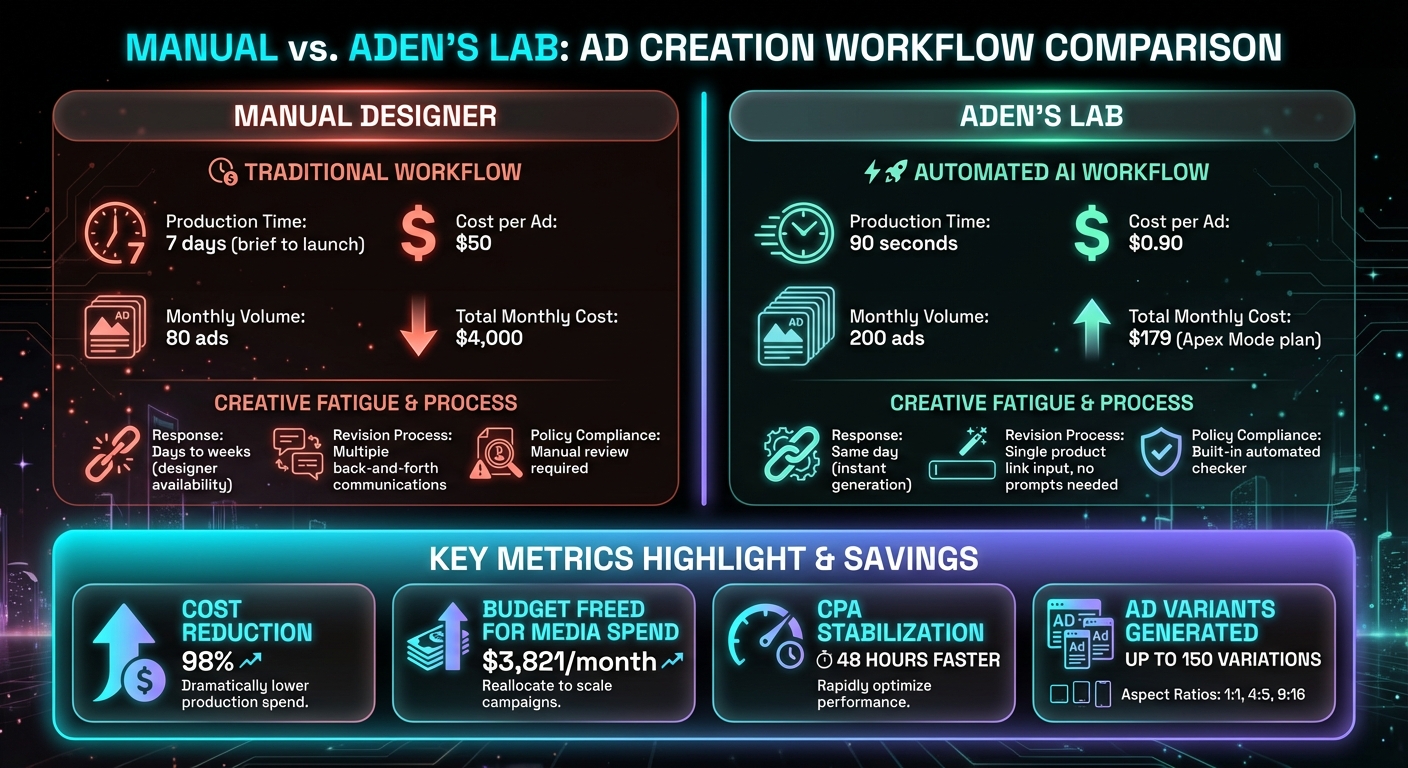
Manual vs Automated Ad Creation: Cost and Speed Comparison for Lead Gen Agencies
Switching from manual design processes to automated ad generation can drastically impact costs, speed, and campaign performance. Agencies using automation report lower costs per lead, faster campaign launches, and improved ROAS because they’re no longer reliant on traditional creative workflows.
The results speak for themselves. For instance, Right Left Agency saw a 45% reduction in Cost per Qualified Lead and a 125% increase in Marketing Qualified Leads within just six months. Similarly, Callbox Inc. helped digital agencies deliver over 40 qualified leads monthly, shorten sales cycles by 30%, and achieve a 4x ROI.
These aren’t just impressive figures - they highlight how automation reshapes daily operations. Instead of waiting weeks for a designer to produce a few concepts, agencies can test 20 ad variants in a single week. This rapid testing cycle allows you to identify top-performing creatives in days and scale them before competitors even start their first test.
Manual Designers vs. ADEN's LAB: Side-by-Side Comparison
The difference between traditional workflows and automation is striking. While manual design work might cost $50 per ad, automated tools like ADEN's LAB reduce that to just $0.90 per ad. Production time also shrinks - from days to just 90 seconds per ad. This efficiency frees up significant budget that can be reallocated to media spend instead of creative production.
Manual processes often involve multiple revisions and back-and-forth communication. In contrast, ADEN's LAB generates ads directly from a single product link - no prompts, no delays. When creative fatigue sets in after 7–14 days, you can quickly launch fresh ads the same day, eliminating the need to scramble for designer availability.
Why Weekly Ad Production Beats Occasional Creativity
With the cost and speed advantages of automation, maintaining a weekly ad production cycle becomes a game-changer. Agencies that consistently refresh their creatives outperform those relying on monthly updates or waiting for performance to decline. Platforms like Meta favor fresh content, and audiences quickly lose interest in seeing the same ad repeatedly, making frequent updates essential.
By generating 10–20 new ad variants every week, you provide algorithms with a steady stream of fresh options, speeding up the learning phase. Testing multiple angles, hooks, and offers simultaneously helps you identify winning strategies faster and continuously optimize campaigns.
Without automation, producing 20 ads weekly could cost around $1,000 in designer fees - adding up to $4,000 per month. But with ADEN's LAB, you can produce 200 ads for just $179 per month. This allows for daily testing and can lead to 20–30% improvements in ROAS, all while avoiding the delays and high costs of traditional creative processes.
Automate Ad Creation to Scale Faster
Meta's algorithm tends to reduce the effectiveness of ads after just 7–14 days. If you're stuck waiting days for new designs, you're already falling behind. The key to staying ahead? Consistently producing fresh creatives. But let's be honest - traditional workflows just can't keep up with that demand.
That's where automation changes the game. It delivers speed and volume at a fraction of the cost. Instead of paying $50 per ad and waiting days for delivery, you can create ads for as little as $0.90 each in under 90 seconds. This isn't just a small improvement - it completely transforms how you work. With ADEN's LAB, you simply drop a link and instantly generate high-performing static Meta ads - no prompts, no delays.
Think about the numbers: producing 200 ads manually could cost you around $10,000 a month. With ADEN's LAB, the same output costs just $179 - a 98% reduction. That means you can redirect those savings into your media spend, scaling your winning campaigns faster and driving better results without draining your budget.
This high-volume approach also gives you a competitive edge with Meta's algorithm. By refreshing creatives quickly, you can stabilize CPAs up to 48 hours faster, which is critical for optimizing campaigns efficiently. When you're A/B testing 10–20 ad variants weekly, you find winners faster, cut underperformers before they waste your budget, and scale the best-performing ads - all while your competitors are still waiting on their next batch of revisions.
The agencies that scale successfully aren't necessarily the ones with the most polished designs - they're the ones producing the most creatives. ADEN's LAB eliminates the bottleneck, making ad creation fast, affordable, and repeatable. This continuous flow of new ads sets your campaigns up for consistent and measurable performance improvements.
FAQs
How does automation help lower the cost of creating ads?
Automation slashes ad production costs by cutting out the need for manual design work and reducing dependence on costly resources like professional designers. What used to take weeks - crafting ad creatives - can now be done in minutes, saving both time and money.
On top of that, automated tools simplify workflows and minimize human errors, making it easier to scale campaigns without adding to overhead. This efficiency means advertisers can allocate more of their budget toward campaign performance instead of production, helping to boost ROI.
What are the main advantages of using automated tools like ADEN's LAB for ad creation?
Automated ad creation platforms like ADEN's LAB are transforming how advertisers approach campaign scaling. These tools bring speed, cost-efficiency, and consistency to the creative process, making them a powerful asset for any marketer.
First, they remove the need for designers or time-consuming back-and-forth revisions. With just a few clicks, you can generate polished, ready-to-launch ads in seconds. This rapid turnaround helps you stay ahead in fast-changing markets and avoids creative fatigue, a common issue that can drag down ad performance over time.
Second, they’re a huge time and money saver. Instead of spending hundreds of dollars per ad or waiting days for production, these tools let you create multiple ad variations instantly. This efficiency not only slashes costs but also allows you to test and identify high-performing creatives much faster. Platforms like Meta reward this kind of agility with better campaign performance.
Lastly, automated tools ensure a steady stream of fresh, relevant ads to keep your campaigns competitive. By simplifying the creative process, you can shift your focus to strategy and scaling, leaving the heavy lifting to the platform. The payoff? Improved ROAS (return on ad spend) and reduced CPA (cost per acquisition) - all without the usual hassle.
Why is frequent ad testing important for improving campaign performance and lowering costs?
Frequent ad testing is key to understanding which creative elements click with your audience. By pinpointing what grabs attention and drives action, you can allocate your budget toward ads that deliver stronger engagement and higher conversions.
This approach doesn’t just boost your campaign’s performance - it also lowers your cost per acquisition (CPA). When your ads truly connect with your audience, you can achieve better results while spending less.
Your next ad batch starts here
Finish with a ready-to-test ad batch
Paste your website to generate static creatives. Drop the link → get ads in about 90 seconds → upload them to Meta → scale.
Free to try No prompt writing