Why Most Lead Gen Ads Stop Working After 14 Days (And How Top Agencies Fix It)
Turn the strategy into creatives
Create Meta ads for your product
Paste your product page. ADEN'S LAB turns the offer, audience, and positioning into complete ready-to-use Meta static ads.
Free to try No prompt writing

When lead generation ads stop performing after two weeks, it’s not bad luck - it’s creative fatigue. This happens when your audience sees the same ad too often, leading to lower engagement, increased costs, and fewer conversions. Meta’s algorithm penalizes ads with poor engagement, reducing delivery and making your campaigns more expensive.
Here’s the key takeaway: ads don’t fail because of targeting or budgets - they fail because they’re overused. The solution? Constantly refresh your ads. Top agencies produce 50+ new ads weekly and launch 10–20 variations daily to stay ahead of fatigue. They monitor metrics like CTR (click-through rate) and frequency to spot fatigue early, pausing underperforming ads and scaling winners with small tweaks.
Key steps to fix this problem:
- Watch for warning signs like a CTR drop of 20% or frequency exceeding 3.0.
- Replace ads every 7–14 days to maintain performance.
- Automate ad creation to eliminate delays and keep campaigns running smoothly.
If your ads are struggling after two weeks, it’s time to rethink your approach. The brands that succeed in 2026 are the ones that treat ad production as a constant process, not a one-time effort.
Why Lead Gen Ads Stop Working After 14 Days
What Creative Fatigue Actually Means
Creative fatigue sets in when ads lose their ability to grab attention, even if the offer or targeting remains solid. Essentially, the ad itself becomes "invisible." Meta keeps track of user engagement, and when people start ignoring your ad, it signals that the creative has run its course. This is a common hurdle when scaling campaigns: ads that perform well initially can't maintain momentum forever. Static image ads face this issue faster than other formats. They typically lose their effectiveness within 5 to 10 days, while video ads tend to hold attention for 10 to 21 days. Since static images rely on a single frame to capture interest, their impact fades quickly after repeated exposure.
How Frequency and CTR Signal Fatigue
Two key metrics - frequency and CTR (click-through rate) - help identify when an ad is wearing out. Frequency shows how often each person in your audience sees the ad, while CTR reflects how many are compelled to click. When an ad's frequency exceeds 2.5 views per person and CTR drops by 10–15% each week, it’s a clear sign of fatigue. Repeated exposure also impacts purchase intent, which can decline by about 16% after a user sees an ad six or more times. As engagement drops, Meta's algorithm flags the ad as less relevant and reduces its delivery, even if you maintain your budget. These declining metrics often result in warnings on your dashboard.
What Fatigued Ads Look Like in Your Dashboard
Recognizing fatigue in your Ads Manager is crucial. While some signs are subtle, others are more obvious. For instance, your CPM (cost per thousand impressions) might stay consistent, but lead volume could plateau after two weeks. If your CTR falls from 1.2% to 0.6%, you may find yourself paying twice as much per lead. Meta helps identify these issues with warnings in the "Delivery" column. Messages like "Creative Limited" suggest your cost per result is higher than usual but not yet double the average, while "Creative Fatigue" indicates costs have doubled or more.
The typical pattern is clear: strong performance in the first week, a slowdown in the second, and a steep decline by the third. In some cases, impressions drop to zero as the algorithm deems the ad uncompetitive. This isn't a glitch - Meta actively reduces delivery for ads that fail to engage, prioritizing user experience.
"Meta wants strong performance signals. If users stop engaging, your delivery automatically drops. Meta does not wait. It shifts your spending elsewhere."
- Ivan Teh, Advisible
Put the playbook to work
Apply this playbook to your page
Paste your website and the Lab will turn the strategy you are reading into a ready-to-test ads.
Free to try No prompt writing
Ad Fatigue in Meta Ads - How to Fix Falling CTR & Rising Costs
How to Spot Creative Fatigue Before It Kills Performance
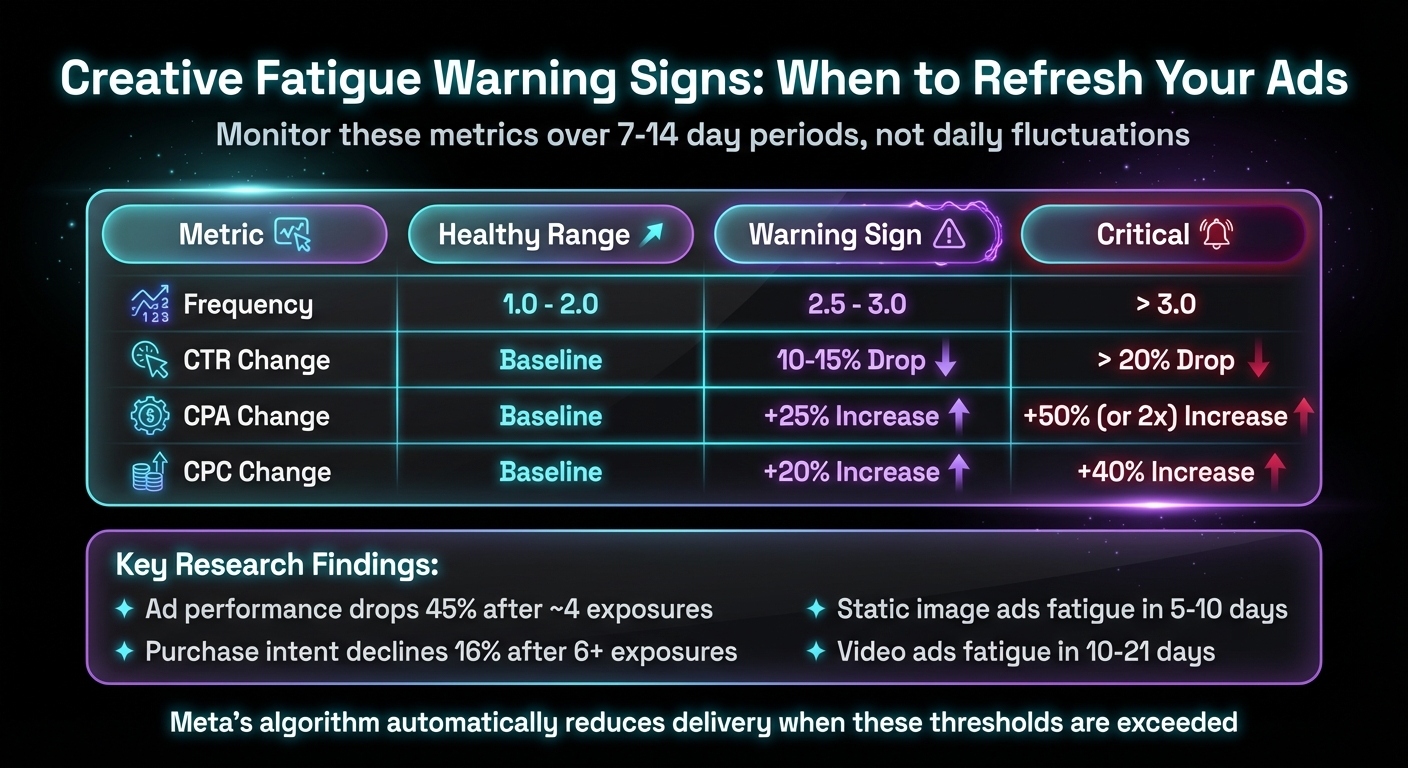
Creative Fatigue Warning Signs: Key Metrics and Thresholds for Meta Ads
Look at 7-14 Day Trends, Not Daily Numbers
Daily numbers can be misleading because fluctuations happen all the time. Instead, focus on trends over 7–14 days. For instance, if your CTR (click-through rate) drops 20% below its seven-day average and stays there, that’s a red flag for creative fatigue. Similarly, a steady increase in CPA (cost per acquisition) over this time suggests your ad is losing its edge.
Weekly reports are your best tool for identifying these patterns. They help you separate normal day-to-day changes from real performance issues.
Once you’ve identified a long-term trend, it’s time to dig into your core metrics.
Watch Frequency and CTR Thresholds
High ad frequency paired with a declining CTR is a classic sign of fatigue. If your ad is being shown to the same audience an average of 2.5 times per person, and its CTR drops by 20% or more from the baseline, it’s likely no longer effective. At this point, you might also notice CPC (cost per click) rising while your reach stagnates - essentially, you’re paying more but getting less in return.
Here’s a quick reference for key metrics and their thresholds:
| Metric | Healthy Range | Warning Sign | Critical |
|---|---|---|---|
| Frequency | 1.0 - 2.0 | 2.5 - 3.0 | > 3.0 |
| CTR Change | Baseline | 10-15% Drop | > 20% Drop |
| CPA Change | Baseline | +25% Increase | +50% (or 2x) Increase |
| CPC Change | Baseline | +20% Increase | +40% Increase |
These thresholds are based on research. Meta’s internal studies show that ad performance drops by 45% after about four exposures to the same creative. By the sixth exposure, purchase intent drops by roughly 16%.
Rule Out Other Problems First
Metrics may point to creative fatigue, but don’t jump to conclusions. Before making changes, rule out other issues. Start by auditing your landing page - ensure it loads quickly, works well on mobile, and has no glitches in forms or navigation. If your frequency is low (around 1.0 to 1.5) but costs are climbing, the issue could be auction dynamics or targeting inefficiencies, not creative fatigue.
Also, consider external factors like seasonal CPM (cost per thousand impressions) spikes, which can mimic the symptoms of fatigue.
"If you've optimized targeting and bids and still see a persistent dip you can't shake, the creative itself is likely worn out." - Cedric Yarish
Common Mistakes That Make Creative Fatigue Worse
Reusing Old Ads Without Enough New Creatives
Relying on past ad successes can backfire, especially when the same creatives are relaunched without fresh updates. Meta's algorithm quickly detects repeated ad exposures across all campaigns tied to a single Page. When you bring back an ad that's already fatigued, the system limits its delivery.
This creates a false sense of security. You might think you’re reviving a "proven winner", but in reality, the algorithm recognizes that your audience has already seen it too many times. In Advantage+ Shopping Campaigns, older ads often dominate the budget, leaving newer creatives underutilized. By the time you relaunch an old ad, your audience may have already encountered it six or more times, which can lead to a 16% drop in purchase intent.
The longer you delay introducing fresh creatives, the worse this problem becomes.
Using Slow Manual Design Processes
When creative fatigue starts to hurt performance, slow design workflows can make things even worse. Waiting days for new creatives allows underperforming ads to keep running, driving up your costs. For instance, freelance designers typically charge $30–$50 per ad and take 5–7 days to deliver a batch. During this time, your click-through rates drop, and your cost per acquisition rises.
This delay is especially damaging because static image ads tend to fatigue quickly - often within just 5–10 days. By the time new creatives are ready, your existing ads may have already drained your top audience segments, and at a higher cost. Meta might even flag these ads as "Creative Fatigue" when the cost per result doubles your historical average. Once that happens, the algorithm starts cutting delivery, even if your budget stays the same.
Meanwhile, competitors using AI tools for Meta ads are running circles around manual processes. They’re able to launch 10–20 new ads daily, grabbing audience attention before fatigue sets in. It’s not that they’re more skilled - they’ve just removed the bottleneck that slows down most campaigns.
How Top Agencies Fix Creative Fatigue
Top agencies don’t sit back and wait for ad performance to nosedive. They treat creative production like managing inventory - constantly replenishing with fresh assets. By swiftly replacing worn-out ads, they keep campaigns engaging and avoid the stagnation that often comes with creative fatigue. This proactive approach ensures campaigns maintain momentum, even as ads naturally age.
Generate 50+ Static Ads Every Week
When ads start to lose their edge - often within just 14 days - top agencies act fast, swapping them out with fresh alternatives to prevent performance dips. Many aim to produce 50 to 100 new static ads weekly, experimenting with different messaging angles around the same offer. For example, one ad might focus on a pain point like, "Tired of wasting money on leads that don’t convert?" while another emphasizes a benefit, such as securing more qualified demos without increasing ad spend.
This method relies on modular variations. Agencies tweak elements like headlines, primary text, or visuals while keeping the core offer consistent. It’s common to launch ad sets with 20+ variations, each tailored to specific customer personas or psychological triggers.
"A core narrative with interchangeable beats allowed us to create 40+ variants from one shoot and keep performance strong for 8-12 weeks." - Andrew Cussens, Founder & Producer at FilmFolk
Meta advertising expert Jon Loomer highlights the importance of this approach:
"Approach your initial ad creation with a diversification mindset... You don't need to refresh ads every few weeks if you plan for lots of variations upfront."
Use Automated Systems to Eliminate Creative Bottlenecks
Producing a high volume of static ads is only half the battle - speed is equally critical. Relying on manual workflows can’t keep up with the fast-paced demands of modern Meta campaigns. Waiting five to seven days for new creatives gives fatigue time to drain your budget. That’s why leading agencies have embraced automated systems to remove these bottlenecks.
Tools like ADEN's LAB are designed to meet this need. By simply dropping in a landing page link, the system generates dozens of conversion-optimized static Meta ads in minutes - no extra steps required. This automation allows campaigns to refresh daily rather than waiting for lengthy manual design cycles. Instead of creating a small batch of ads and hoping for success, agencies can launch multiple variations, pause underperformers, and continuously inject fresh creative into their campaigns. This strategy keeps campaigns ahead of fatigue, ensuring consistent results over time.
A Step-by-Step Workflow for Scaling Lead Gen Campaigns
Successful agencies follow a tried-and-true process: consistently introduce fresh creative and quickly phase out underperforming ads. The idea is to outpace fatigue without prematurely cutting potential winners. Here's a detailed workflow to keep your campaigns flexible and ahead of the curve.
Launch 10-20 New Ads Every Day
Every day, roll out 10-20 static ads to test different angles and keep the momentum going. These ads should revolve around the same offer but highlight various approaches. For instance, one ad might focus on a pain point like, "Tired of leads ghosting after the first call?" while another emphasizes a benefit: "Book 3x more qualified demos without increasing your ad spend."
This doesn’t mean reinventing the wheel for every ad. Use a modular framework where you mix and match hooks, headlines, or visuals while keeping the core message consistent. A great example of this approach comes from Andrew Cussens at FilmFolk. Back in 2025, he used one production shoot to create over 40 ad variations by swapping interchangeable "beats." The result? Performance stayed strong for 8-12 weeks. The lesson here: always have a backlog of ads ready to go. If you wait until your current ads start underperforming, you’re already losing valuable time and budget.
Tools like ADEN's LAB can streamline this process by generating conversion-focused static Meta ads from a single link, helping advertisers hit their daily volume goals without delays.
Pause Low-Performing Ads Within 48 Hours
The first 48 hours are critical for gauging an ad’s potential. Focus on metrics like CTR (click-through rate) and CPC (cost per click). Meta typically needs about 50 optimization events or three full days to fine-tune delivery, so don’t rush to judge based on cost per lead or ROAS just yet.
Here’s a quick guideline: if an ad’s CTR surpasses your baseline by 25–35% and its CPC is 15–20% below average after 48 hours, let it run until it achieves 10+ conversions before making a final decision. On the other hand, if the CTR is stagnant or dropping and CPC is rising, pause the ad immediately and replace it with a fresh creative from your daily batch.
One common pitfall to avoid: don’t equate high engagement with high conversions. An ad might collect plenty of likes and comments but still deliver a poor cost per lead.
"High engagement ≠ high conversions. Meta can't distinguish 'this ad gets clicks' from 'this ad gets profitable sales' until it has conversion data." - Rahul Mondal, Ideon Labs
Set automated rules to pause ads when their frequency exceeds 3.0–4.0 or when the cost per result doubles your historical average. This helps prevent wasted budget on fatigued ads. Once you’ve paused the underperformers, shift your focus to optimizing and scaling the successful ones.
Scale Winners with Small Variations
When you identify a winning ad, don’t just pour more money into it. Instead, duplicate the ad and tweak one element, like the headline or color. Scaling too aggressively can disrupt learning or oversaturate your audience. Treat your winning creative as a template - keep the core idea but refresh one aspect. For example, if an ad with the headline "Get 50% more qualified leads in 30 days" performs well, create variations like "Stop wasting budget on unqualified leads" or "Book more demos without spending more." These slight changes reset the fatigue clock without losing the essence of what works.
"Treat your winning creative like a format. Keep the idea, refresh the pacing, delivery style, or angle so it feels new while still scaling." - Cody Jensen, Searchbloom
To maintain trust and social proof, use the same Post ID when creating variations. This ensures likes, comments, and shares carry over. Allocate your budget strategically using the 60-30-10 rule: dedicate 60% to proven winners, 30% to variations, and 10% to entirely new concepts. This approach keeps your account stable while still allowing room for experimentation. When scaling a winner’s budget, increase it by no more than 20% every two days to avoid disrupting delivery.
| Creative Element | Fatigue Rate | Refresh Interval |
|---|---|---|
| Hooks (First 3s) | Fastest | Weekly |
| Headlines | Fast | Bi-weekly |
| Primary Text | Moderate | Bi-weekly |
| Visuals/Video | Moderate | Monthly |
| CTAs | Slowest | Every 4-6 weeks |
Conclusion: Staying Ahead of Creative Fatigue
Most lead generation ads lose their effectiveness after just 14 days because the target audience has seen them too many times. Click-through rates (CTR) can drop by 60% within two weeks, and Meta's own research shows a 45% performance decline after about four exposures. No matter how much you spend on your "perfect" ad, once people stop clicking, your cost per lead skyrockets, and your budget starts to bleed.
The solution isn’t complicated, but it does require a change in mindset. You need to create more ads - and faster - than your competitors. Top-performing agencies crank out over 50 static ads weekly and launch 10-20 new variations every single day. They keep a close eye on CTR and frequency trends over 7-14 day periods, pausing underperforming ads within 48 hours and tweaking successful ones to extend their lifespan. This isn’t about raw creativity - it’s about having a system that stays ahead of the inevitable drop in ad performance.
For most advertisers, the real hurdle isn’t strategy or budget - it’s the speed of creative production. If you’re stuck waiting on designers, bogged down by revisions, or building every ad manually, you’re already falling behind. Tools like ADEN's LAB solve this problem by automating ad creation. With just a URL, it generates ready-to-launch Meta ads - no prompts, no setup. At $0.90 per ad on the Apex Mode plan, you can produce 200 ads a month for less than the cost of a single custom design from most agencies.
Creative quality now accounts for about 50% of Facebook ad performance. No amount of precise targeting or bidding will save an ad that’s gone stale. The brands that dominate Meta in 2026 will be the ones that treat creative like a renewable resource - constantly testing, refining, and replacing fatigued ads before they drag down results. Build a pipeline, test relentlessly, and stay ahead of the curve. That’s the game plan.
FAQs
How do I know if my lead generation ads are losing effectiveness?
You can identify when your lead generation ads are losing their edge by looking for signs of creative fatigue. These include a clear drop in engagement - fewer likes, comments, and shares - a 10-15% week-over-week decrease in click-through rates (CTR), higher CPMs (cost per thousand impressions), and overall performance slowing down, often after about two weeks of running the same ad.
This happens when your audience has seen the ad too many times, leading to saturation. As engagement drops, platforms like Meta start favoring newer, more engaging content. Monitoring these metrics closely can help you tackle fatigue early and avoid wasting your ad budget.
What metrics should I track to measure my ad performance?
To gauge how well your ads are performing, pay attention to key metrics like click-through rate (CTR), cost-per-acquisition (CPA), and impressions. These numbers provide insight into how effectively your ads are grabbing attention and driving conversions.
It’s also important to track frequency - how many times the same person sees your ad - and engagement metrics like likes, shares, and comments. These indicators can alert you to potential problems, such as audience fatigue or your creative content losing its impact, allowing you to make adjustments before performance takes a hit.
By keeping these metrics in check, you can ensure your ad spend is being used wisely while maintaining solid results over time.
How do top agencies keep their ads performing over time?
Top agencies keep their ads effective by regularly updating their ad creatives to combat ad fatigue. When audiences see the same ad too often, they tend to lose interest, which can lead to fewer clicks and higher costs. To prevent this, agencies introduce fresh creative variations, experiment with new messaging or visuals, and adjust targeting strategies to ensure the content remains engaging and relevant.
They also keep a close eye on key performance metrics like click-through rates (CTR) and cost per result (CPR). These indicators help them identify early signs of fatigue. By refreshing their ads before performance takes a hit, they not only sustain strong results but also make the most of their ad budgets.
Your next ad batch starts here
Finish with a ready-to-test ad batch
Paste your website to generate static creatives. Drop the link → get ads in about 90 seconds → upload them to Meta → scale.
Free to try No prompt writing