Why Meta Ad Budgets Burn Fast (And the AI Tools That Stop It)
Try the workflow instead of comparing it
See what an AI ad generator makes from your product
Paste your product page and get a complete Meta ad batch—creative concepts, images, headlines, and copy—without another tool stack.
Free to try No prompt writing

Meta's ad system is designed to spend your budget quickly, often prioritizing speed over efficiency. This can lead to wasted ad spend, especially when creative fatigue, poor budget pacing, or limited ad variations come into play. For example, campaigns can burn through 75% of daily budgets in hours with little return, as seen on February 14, 2024, when CPMs skyrocketed from $28 to $250. The key issues include:
- Creative fatigue: Ads lose effectiveness after 3–4 impressions per user, driving up costs.
- Poor pacing: Automated tools can exhaust budgets early in the day, missing peak audience times.
- Insufficient ad variations: Scaling requires 8–12 active ads and regular updates to maintain performance.
Solution: ADEN's LAB automates ad production, generating Meta-ready static ads in under 90 seconds for as little as $0.90 per ad. This allows advertisers to test and update ads faster, control costs, and improve ROAS by keeping campaigns fresh and effective.
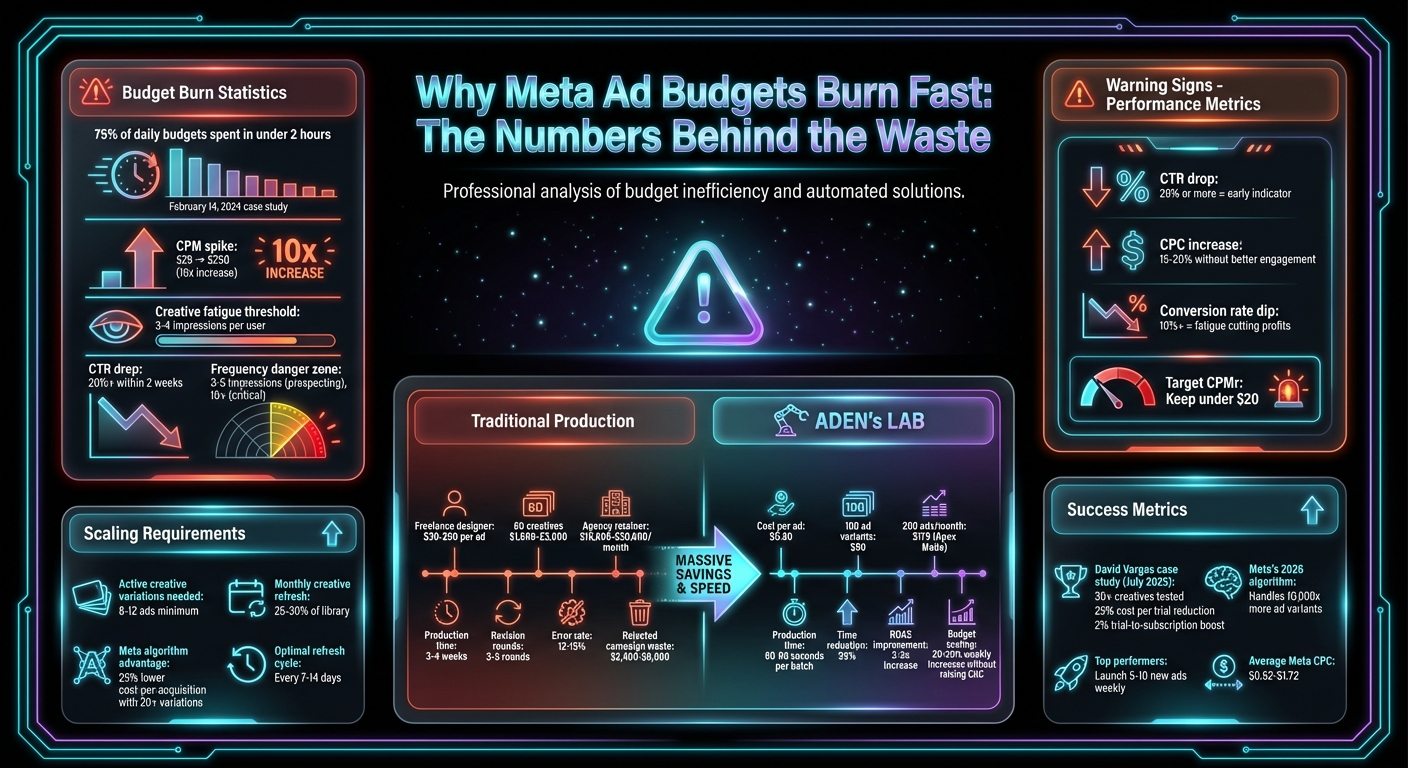
Meta Ad Budget Waste: Key Statistics and Cost Comparisons
Facebook Ad Campaign Setup To “Force Test” All Creatives (2026)
Put the playbook to work
Apply this playbook to your page
Paste your website and the Lab will turn the strategy you are reading into a ready-to-test ads.
Free to try No prompt writing
3 Reasons Meta Ad Budgets Disappear Fast

After managing over $100 million in Meta ad spend, I’ve seen the same mistakes drain budgets over and over again. These aren’t minor missteps - they quickly snowball, turning what could be profitable campaigns into financial disasters. Let’s break down the three main reasons why Meta ad budgets seem to vanish into thin air.
Creative Fatigue Drives Up Costs
Audiences lose interest fast. Once people see the same ad three or four times, engagement drops off a cliff. Click-through rates can plummet by 20% or more in just two weeks, and Meta’s algorithm punishes you for it by charging higher rates for impressions.
Here’s how it works: when engagement declines, Meta interprets your ad as low quality. As a result, your ad becomes less competitive in the auction, and you’re suddenly up against fresher, better-performing creatives. This can send your CPMs (cost per thousand impressions) soaring - from a reasonable $28 to jaw-dropping levels like $250. Essentially, you’re paying more for worse results.
The algorithm doesn’t care if your ad was a hit last month. Once your frequency exceeds 3-4 impressions per person, performance tanks. At that point, you’re spending premium dollars to irritate people who’ve already decided they’re not interested.
And if that wasn’t bad enough, poor pacing can make things even worse.
Poor Budget Pacing Wastes Money
Meta’s system has a knack for burning through your daily budget in record time if left unchecked. On February 14, 2024, RC Williams from 1-800-D2C saw this firsthand when Meta spent 75% of his clients’ daily budgets within just a couple of hours.
"Meta had blown through roughly 75 percent of the daily ad budgets for both clients in under a couple of hours." - RC Williams, Co-founder, 1-800-D2C
This happens when you rely too heavily on automation tools like Campaign Budget Optimization or Advantage Plus. These tools prioritize speed, not precision. Without close monitoring, your budget can get drained on low-quality traffic early in the day, leaving nothing for the prime hours when your target audience is actually online.
Not Enough Creatives to Scale
Scaling isn’t just about increasing your budget - you need a deep pool of creative assets to keep performance steady. Running the same handful of ads at $10,000 per day simply doesn’t work. Top-performing campaigns keep 8-12 creative variations active at all times, and successful advertisers refresh 25-30% of their creative library every month.
Without enough creative options, your ads will quickly exhaust your core audience. The algorithm then starts serving your ads to less relevant users, leading to lower conversion rates and higher costs. Meanwhile, you’re stuck waiting for new creatives while your campaign continues to bleed money.
David Vargas, a growth specialist, demonstrated the importance of creative volume in July 2025. By testing over 30 creatives in one month and separating winners from losers after 10,000 impressions, he reduced cost per trial by 29% and boosted trial-to-subscription conversions by 2%. This approach shows how a robust creative strategy can save your budget and improve results at the same time.
How Creative Fatigue Kills ROAS
Creative fatigue doesn’t just hurt engagement - it wreaks havoc on your Return on Ad Spend (ROAS) by undermining critical performance metrics. When the same ad is shown repeatedly, click-through rates (CTR) drop, prompting Meta’s algorithm to hike up cost-per-thousand impressions (CPMs). This means you’re paying more for fewer clicks. RC Williams from 1-800-D2C experienced this firsthand in February 2024, when CPMs skyrocketed from under $28 to nearly $250 in just two hours. The result? 75% of the daily budget was burned with almost no revenue to show for it.
"CPMs, or cost per impressions, were roughly 10 times higher than normal. A usual CPM of under $28 had inflated to roughly $250, way above the industry average."
– RC Williams, Co-founder, 1-800-D2C
Let’s break down the key metrics that signal fatigue in your campaigns.
What Fatigue Looks Like in Your Campaigns
Certain metrics serve as clear warning signs that your ads are losing their effectiveness. Here’s what to watch for:
- A CTR drop of 20% or more compared to your baseline is an early indicator.
- If your cost-per-click (CPC) increases by 15–20% without better engagement, it’s a red flag that your audience has seen your ad too often.
- A conversion rate dip of over 10% points to fatigue already cutting into your profits.
One overlooked metric is frequency - how many times each person sees your ad. For prospecting campaigns, hitting 3–5 impressions per user puts you in the danger zone. If frequency scores climb to 10 or more, you’re not just losing money - you’re irritating your audience. To avoid this, aim to keep CPMs under $20 and rotate your ads before they wear out.
Why Static Ads Still Perform
When creative fatigue drives costs through the roof, static ads provide a simple yet effective solution. They’re budget-friendly, quick to produce, and easy to refresh at scale. Unlike video content, which requires costly production and longer lead times, static ads can be updated in a matter of minutes. This makes them perfect for the frequent creative rotations needed to fight fatigue.
Here’s an important insight: copy wears out faster than visuals. You don’t need to overhaul your entire ad to keep it fresh. Swapping out the headline or reworking the opening hook can give your ad new life without starting from scratch. By mixing and matching elements like hooks, body text, and calls-to-action, you can stretch the lifespan of your creative assets while keeping production costs low.
Static ads also excel at grabbing attention instantly. In a fast-moving feed, users decide within seconds whether to engage. A well-crafted static ad delivers the value proposition at a glance, without requiring the time commitment of a video. Producing these ads in high volume gives you the creative arsenal to stay ahead of fatigue while keeping ROAS steady.
The Real Cost of Manual Creative Production
Manual creative production eats away at both time and money. The real issue isn't just the cost per ad - it’s how the slow pace of production stifles your ability to test, learn, and scale effectively before your budget runs dry.
What Designers and Agencies Actually Cost
Hiring a freelance designer for a single static ad typically costs $30–$50. To properly test a 20-product collection, you’d need at least 60 creatives. That’s a hefty $1,800 to $3,000 spent before you’ve even launched. If you’re working with an agency, the costs climb even higher. Monthly retainers range from $10,000 to $30,000, yet most agencies specializing in fashion only deliver 10–12 creatives per month.
But here’s the kicker: the bigger problem isn’t the upfront cost - it’s the time lag. Traditional production workflows take 3 to 4 weeks from brief to delivery. By the time your ads are ready, trends may have passed, or your audience may already be saturated by competitors. Need changes? Get ready for 3 to 5 rounds of revisions, each adding days to your timeline while your ad budget bleeds on outdated creatives.
On top of that, designers often spend 4–8 hours resizing assets for different platforms. That’s not creative work - it’s tedious, time-consuming labor that eats into billable hours. And errors aren’t uncommon: asset checks reveal a 12–15% error rate. These mistakes can cost you dearly. A rejected campaign due to spec errors might waste $2,400 to $8,000, with rush fees adding another $500–$2,000 to meet deadlines.
These high costs and slow production cycles make rapid testing nearly impossible. Yet, rapid testing is essential for scaling performance. Delays and errors in manual creative production directly undermine your ability to compete, especially since platforms like Meta reward campaigns with a high volume of diverse creatives.
Why Volume Matters for Scaling
Meta’s algorithm prioritizes creative diversity and volume. Campaigns running 20 or more variations see a 29% lower incremental cost-per-acquisition compared to those with fewer executions. If your designer is only producing 10–12 creatives per month, and you need 60 just for testing, you’re already five months behind before you even begin scaling.
"The collection launches February 1st. Today is January 15th. We have 8 ads ready and need 60."
– James Williams
Falling behind on creative output drives up costs. Without refreshing ads every 7–14 days, fatigue sets in, CPMs rise, and performance plummets. Meanwhile, competitors with higher creative volume are testing faster, identifying winners sooner, and scaling profitably - all while you’re stuck waiting on yet another round of revisions.
The real bottleneck isn’t your budget - it’s your creative production capacity. Every day spent in manual production adds to the risks of creative fatigue and wasted ad spend. Waiting for new ads means your current creatives are burning money instead of delivering results.
How ADEN's LAB Fixes These Problems
ADEN's LAB offers a game-changing solution: it creates Meta-ready static ads directly from any product link in 60 to 90 seconds. There’s no need for briefings, revisions, or waiting. You simply provide a link, and the system generates static ads optimized for Facebook and Instagram. This isn’t another design tool you have to master - it’s a fully automated creative engine that eliminates the traditional back-and-forth process entirely.
Generate Ads in Under 90 Seconds
Traditional ad production can take 4 to 8 hours per ad set. With ADEN's LAB, that same process is completed in under 90 seconds per batch, reducing production time by an impressive 99%. What used to take weeks - like creating 60 unique ad creatives - can now be done in just one afternoon. This speed lets you test new creatives daily, keeping your campaigns fresh and addressing the delays that can hurt performance.
The platform also ensures that every ad is formatted for 9:16 vertical layouts, which dominate Meta’s inventory, accounting for 90% of available ad space in 2026. Each ad is delivered ready to upload and launch, saving even more time.
Stay Ahead of Fatigue With High Volume
ADEN's LAB enables you to produce dozens to hundreds of new ads every month, depending on your subscription plan. For example, with Apex Mode, you can generate 200 ads monthly for $179, which breaks down to just $0.90 per ad. Compare that to the $30–$50 per ad typically charged by designers, and the cost savings are clear.
Meta’s 2026 algorithm handles 10,000 times more ad variants simultaneously, favoring brands that provide a steady stream of creative options. Top-performing advertisers now launch 5 to 10 new ads weekly, running each for seven days before scaling the winners. With ADEN's LAB, you’re no longer held back by designer schedules or agency retainers. Instead, you can maintain a steady flow of fresh creatives without blowing your budget.
Lower Costs, Better ROAS
At just $0.90 per ad, producing 100 ad variants costs only $90 - a fraction of what it would cost to hire a designer or agency. For brands managing a $100,000 monthly ad budget, this approach redirects funds from production costs straight into media spend. That means every dollar saved can go toward generating more clicks and conversions. With Meta’s average CPC ranging between $0.62 and $1.72, these savings directly enhance your campaign performance.
Users have reported 2x to 3x increases in ROAS thanks to the rapid testing enabled by high-volume ad production. Fresh creatives also help keep CPMr (cost per 1,000 reach) under $20, which is a key indicator of successfully reaching new audiences. When CPMr starts to rise - a sign of ad fatigue - ADEN's LAB is already working on the next batch of creatives, ensuring performance doesn’t dip. This constant refresh cycle supports 20 to 30% weekly increases in ad budgets without raising CAC, giving you the ability to scale aggressively while competitors are stuck waiting for their design teams.
Practical Strategies to Stop Wasting Money
Many advertisers lose money simply because they lack systems to catch problems before they escalate. Meta campaigns, for instance, can burn through hundreds - or even thousands - of dollars in just one day if you're not paying attention to the right metrics. Instead of micromanaging every ad, you can use automation rules to act as safeguards, even while you're asleep. Below are practical strategies to help you avoid overspending and ensure timely creative updates.
Automation Rules That Save Money
One straightforward rule to implement is the "1.5x Rule." Here's how it works: if an ad set spends 1.5 times your target cost per acquisition (CPA) without generating a single conversion, pause it immediately. For example, if your target CPA is $50, you would stop any ad set that spends $75 without a conversion. This simple rule has consistently prevented budget blowouts during testing.
Another effective approach is ROAS-based scaling. If an ad set achieves a return on ad spend (ROAS) above 3.0 for three consecutive days, increase its daily budget by 20%. This gradual adjustment avoids sudden changes that could push your campaign back into the learning phase, which typically takes 3 to 4 days to stabilize.
"Automated rules are your secret weapon to save time and optimize campaigns without losing control. These rules handle tasks like pausing underperforming ads, reducing audience overlap, scaling budgets, and adjusting bids."
- Patrick Cumming, Head of Marketing, KlientBoost
Monitoring ad frequency alongside rising CPA can also provide early warnings of creative fatigue. For instance, if an ad's frequency exceeds 3.0 and its CPA starts to climb, set up a rule to either alert you or automatically pause the ad. Additionally, consider using a "recovery trigger." If a paused ad set later registers delayed conversions - thanks to Conversions API signals - that bring it back within your target CPA, unpause it automatically. This ensures you don't prematurely abandon campaigns that are simply experiencing a delay in attribution.
Pairing Automation With Creative Volume
Automation works best when paired with a steady flow of fresh creative assets. This is where ADEN's LAB shines, ensuring you're never stuck waiting for new designs. When automation pauses an ad due to fatigue - say, in the middle of the night - you need replacement creatives ready to go by morning, not weeks later. With ADEN's LAB producing new ad variants in under 90 seconds, you can seamlessly replace paused ads with fresh options.
The key to success lies in combining smart automation with high creative output. Automation signals when action is needed, while a robust creative pipeline ensures you have the tools to act quickly. Top advertisers consistently refresh their creatives to stay ahead of fatigue. With low per-ad production costs, you can keep your campaigns running smoothly, as automation and fresh creatives work hand-in-hand to maintain momentum.
Wrapping It Up
Meta ad budgets can drain quickly due to creative fatigue. When your audience sees the same ads repeatedly, engagement drops, which then drives up CPMs and CPAs - often within just two weeks. The problem isn’t about targeting or budget adjustments; it’s simply overexposing the same creative.
Traditional design processes struggle to keep up with the demand for fresh ad variations. Producing enough creatives takes too much time and money. Hiring additional designers? That could easily add $15,000 or more to your monthly expenses, making it tough to scale effectively. This imbalance between the need for new ads and the resources to create them highlights the need for a faster, more affordable approach.
Automating creative production changes the game. ADEN’s LAB offers an efficient solution, delivering high-quality static ads in under 90 seconds - just by dropping a product link. Starting at $59 per month, you can produce up to 200 ads for as little as $0.90 per ad. This means you can stay ahead of creative fatigue without breaking the bank or waiting weeks for new designs.
FAQs
How does Aden’s Lab help prevent creative fatigue in Meta ads?
Aden’s Lab takes the hassle out of creating Meta ad creatives by fully automating the process. Forget spending endless hours designing, tweaking, or brainstorming. All you need to do is drop in a website link, and Aden’s Lab generates fresh, high-performing static ads for you. This means no more repetitive, time-consuming tasks that can drain your creativity and hurt your ad performance.
By consistently delivering new ads at a fast pace, Aden’s Lab keeps your campaigns engaging without putting extra pressure on your team. There’s no setup or steep learning curve - just an easy way to update your ads whenever necessary. It’s a simple solution to maintain strong results while steering clear of the burnout that often comes with manual ad creation.
How can you tell if your ad creatives are losing effectiveness?
Creative fatigue sets in when your audience grows weary of seeing the same ads repeatedly, and this fatigue becomes evident in your performance metrics. Here are the main signs to watch for:
- Engagement drops: Metrics like click-through rate (CTR) or conversions start to decline.
- Rising costs: You notice an increase in cost-per-click (CPC) or cost-per-result.
- High ad frequency: Your audience is being exposed to the same ad too often.
- Lower reach and impressions: Even with a steady budget, fewer people are seeing your ads.
When you see these trends, it’s a clear indication that your ads are losing their impact. The fix? Regularly update your creatives to maintain your audience’s interest and avoid wasting your ad budget.
How can automation help make Meta ad budgets more efficient?
Automation simplifies managing Meta ad campaigns by leveraging AI to handle critical tasks like budget optimization and spotting top-performing creatives. This ensures your ad spend is directed toward effective ads, avoiding wasted resources on those that don’t perform well.
By automating the creative process, you not only save time but also scale your campaigns more efficiently while maintaining quality and consistency. It eliminates much of the manual trial-and-error, allowing you to focus your budget where it drives the strongest impact.
Your next ad batch starts here
Finish with a ready-to-test ad batch
Paste your website to generate static creatives. Drop the link → get ads in about 90 seconds → upload them to Meta → scale.
Free to try No prompt writing