Why Your Dropshipping Ads Die Fast (And the Only Way to Outrun Creative Fatigue)
Turn the idea into a testing batch
Generate new hooks and angles from your product page
Paste your URL to create multiple ready-to-test concepts instead of adapting generic examples by hand.
Free to try No prompt writing

Dropshipping ads fail quickly because they rely on repetitive exposure to broad audiences. When ad frequency (how often people see your ad) rises above 3.0, performance collapses. Metrics like Cost Per Acquisition (CPA) spike, Click-Through Rate (CTR) drops, and campaigns lose profitability. The main issue? Creative fatigue - your audience gets tired of seeing the same ad.
Key insights:
- Frequency Danger Zone: Ad frequency above 3.0 signals trouble.
- Performance Decline: CTR drops by 10–15%, CPA doubles, and Return on Ad Spend (ROAS) collapses.
- Dropshipping Challenges: Thin profit margins ($12–$16 per sale) make even small performance dips disastrous.
- Manual Production Bottlenecks: Traditional ad creation is too slow (5–7 days) and expensive ($30–$50 per ad).
Solution: High-volume automation tools like Meta ads automation like ADEN's Lab allow you to generate 10–20 new ads weekly, ensuring you stay ahead of fatigue. Plans start at $59/month for 30 ads, cutting costs to under $2 per ad. This approach helps you rotate ads faster, test more variations, and maintain consistent results without breaking the bank.
Why Your Dropshipping Ads Keep Failing and How to Fix It Fast!
Put the playbook to work
Apply this playbook to your page
Paste your website and the Lab will turn the strategy you are reading into a ready-to-test ads.
Free to try No prompt writing
What Creative Fatigue Actually Is and How It Destroys Performance
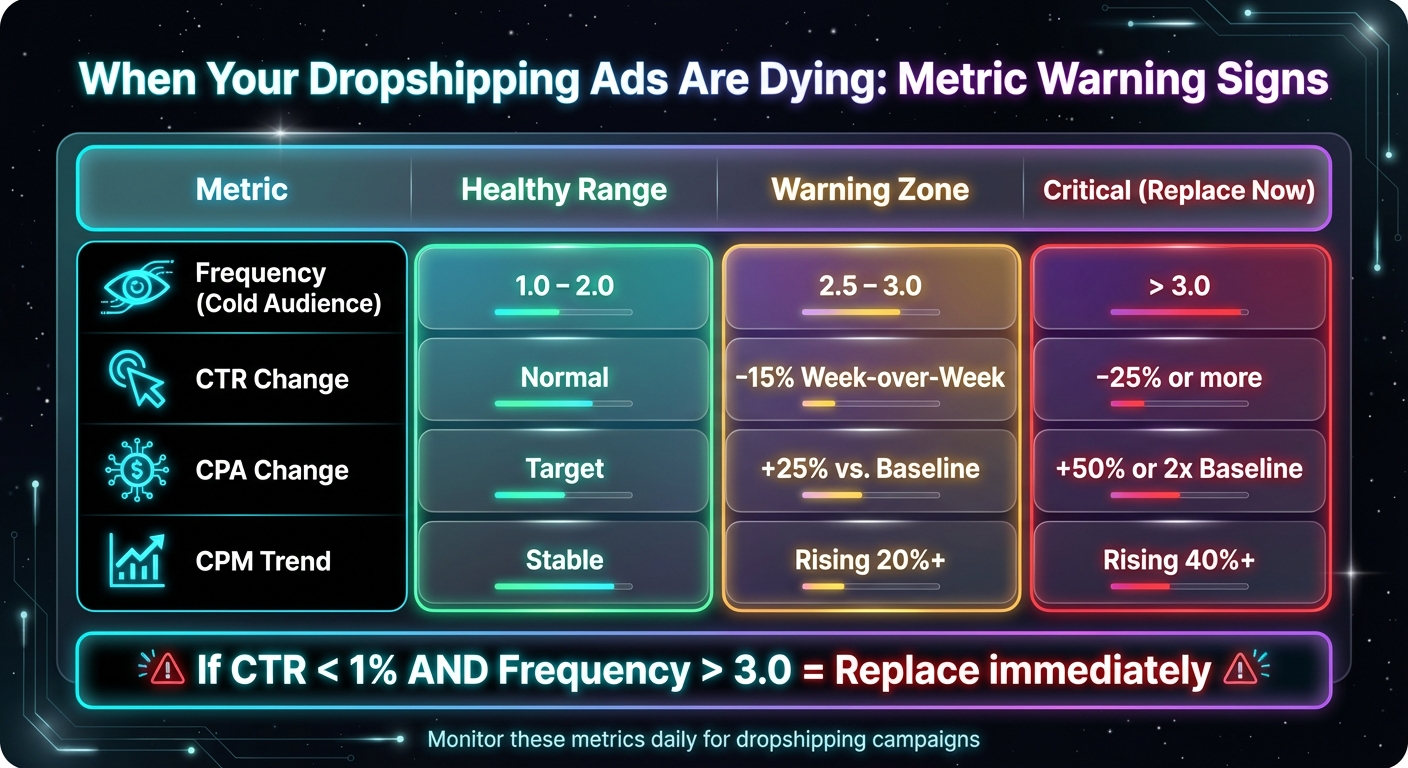
Meta Ad Performance Metrics: Healthy vs Warning vs Critical Zones
Creative fatigue happens when your audience sees the same ad so many times that they simply tune it out. It’s not about your product or targeting being off - it’s just that repeated exposure dulls interest. Once engagement drops, Meta’s system penalizes outdated ads by charging more to deliver them, which drags your results down even further.
Meta provides clear signals when this is happening. In Ads Manager’s "Delivery" column, you might notice labels like Creative Limited, which means your Cost Per Result is climbing but hasn’t yet doubled. If you see Creative Fatigue, it’s a more severe warning - your costs have doubled compared to your historical benchmarks.
"Creative fatigue is not a maybe. It is a guarantee. The only question is whether you see it early and scale winning creatives or ignore the signs and let your results crash."
- Ivan Teh, Founder, Advisible
The signs are clear: first, your CTR (click-through rate) drops. Then, CPC (cost per click) and CPM (cost per thousand impressions) rise until CAC (customer acquisition cost) doubles, and ROAS (return on ad spend) collapses. For dropshipping campaigns, where profit margins are razor-thin, this chain reaction can kill a campaign in just days.
The Numbers That Tell You Your Ads Are Dying
You don’t need to guess when fatigue sets in - your metrics will tell you. If your frequency (the average number of times someone sees your ad) climbs past 3.0 in cold audiences, it’s a warning. A CTR drop of 10–15% week-over-week while frequency rises is another clear signal. And if your CPA spikes by 50% or more from your baseline, you’re losing money fast.
Here’s a quick guide to help you identify when your ads are in trouble:
| Metric | Healthy Range | Warning Zone | Critical (Replace Now) |
|---|---|---|---|
| Frequency (Cold) | 1.0 – 2.0 | 2.5 – 3.0 | > 3.0 |
| CTR Change | Normal | –15% Week-over-Week | –25% or more |
| CPA Change | Target | +25% vs. Baseline | +50% or 2x Baseline |
| CPM Trend | Stable | Rising 20%+ | Rising 40%+ |
Pay attention to these metrics daily. If your CTR dips below 1% and your frequency is above 3.0, your ad has likely lost its appeal. Hoping it will "bounce back" is wishful thinking - it won’t. Especially in dropshipping, where every dollar counts, catching fatigue early can mean the difference between scaling up or shutting down a campaign.
Why Dropshipping Campaigns Burn Out Faster Than Other Models
Dropshipping campaigns are especially prone to creative fatigue. Why? Because they rely on impulse purchases and operate on slim profit margins. With an average order value under $50, even small performance dips can be disastrous. Once an ad loses its novelty, its ability to convert fades quickly.
The way dropshippers scale their campaigns often makes matters worse. When a "winning" ad is found, it’s common to pour thousands of dollars into it to maximize sales. This rapid scaling quickly exhausts the audience. Broad targeting often means the same small group of people sees the ad repeatedly. Research shows that after four exposures, ad performance can drop by 45%, and after six, purchase intent falls by about 16%. With privacy changes shrinking retargeting pools, the same limited group of potential buyers ends up seeing your ad over and over until they’re completely burned out.
Other business models, like SaaS or high-ticket coaching, don’t face this issue as intensely because their higher profit margins allow for higher CPAs. Dropshipping doesn’t have that cushion. If your CPA doubles, every sale starts to cost you money. That’s why top dropshippers refresh their creatives every 1–2 weeks instead of waiting a full month. The moment you stop giving the algorithm fresh ads, your campaign’s performance will nosedive.
Why Manual Creative Production Can't Keep Pace
Manual creative production simply can't keep up with the pace that dropshipping campaigns demand. In this fast-moving space, ads need to be refreshed every 1–2 weeks to remain effective. But the traditional workflow - briefing a designer, waiting for drafts, requesting revisions, and then approving the final version - just takes too long. By the time your new ads are ready, your current ones are already underperforming. Your cost per acquisition (CPA) has skyrocketed, and you've wasted money running fatigued ads that no longer convert.
This isn’t just an inconvenience - it’s a core problem that stifles your ability to scale. Dropshipping campaigns thrive on automating Meta ad production to counter ad fatigue, but manual production creates a bottleneck. Instead of staying ahead, you're stuck reacting to declining performance, always one step behind.
What Manual Creative Production Actually Costs
Freelance designers typically charge $30 to $50 per ad. At first glance, that might seem manageable. But to stay competitive, you need to test 10–20 new ads weekly. That quickly adds up. For example, producing 15 ads per week costs $450–$750, which translates to $1,800–$3,000 per month. For dropshippers working with tight profit margins, this expense can quickly eat into any potential gains.
And here's the kicker: not every ad will succeed. In fact, most fail during testing. If only 2 out of 10 ads perform well, you're effectively spending $150–$250 per winning creative. For businesses with an average order value under $50, this math just doesn’t work. The high costs force you to test fewer ads, reducing your chances of finding winners and leaving you vulnerable to creative fatigue.
The Speed Problem
Cost isn’t the only issue - manual production is also painfully slow. The average freelance production cycle takes 5–7 days from start to finish. During that week, your click-through rate (CTR) drops, your CPA rises, and your budget bleeds into underperforming ads. By the time your new creatives are ready, you’ve already lost momentum - and money.
This delay can be especially damaging during seasonal peaks or when trends emerge. If a product starts trending or a new opportunity aligns perfectly with your offer, you can’t seize it fast enough. While you’re waiting for revisions, faster competitors are already capitalizing on the opportunity. In dropshipping, where timing is everything, this lag can be the difference between a profitable campaign and a missed chance.
The Quality Problem: Inconsistent Ads That Don't Perform
Another challenge with manual production is inconsistency. Working with different designers or freelancers often results in a mixed bag of quality. One designer might perfectly capture your brand’s tone, while another completely misses the mark. The result? A collection of ads that feel disjointed, don’t align with your brand, and fail to give Meta’s algorithm the consistent performance signals it needs to optimize your campaigns.
"If your visuals are stale, your performance will be too."
- Ivan Teh, Founder, Advisible
Inconsistent ads also make it harder to pinpoint what’s working. When every creative looks different - different layouts, fonts, and messaging styles - you can’t identify which elements are driving results. This lack of cohesion wastes both time and money. Meta’s algorithm prioritizes high engagement, and when your ads send mixed signals due to inconsistent quality, it penalizes you with reduced delivery and higher costs. You end up spending more for worse outcomes, all because your production process can’t maintain a steady standard.
These challenges highlight how manual production undermines your profitability. The delays, high costs, and lack of consistency make it nearly impossible to combat creative fatigue effectively. To stay competitive, dropshippers need a faster, more streamlined approach that eliminates these bottlenecks.
The Only Way to Beat Creative Fatigue: High-Volume Automation
Creative fatigue sets in faster than traditional production methods can handle. Ads can lose effectiveness in just 1–3 weeks, but creating new designs manually often takes 5–7 days. This mismatch creates a serious challenge: by the time new ads are ready, the old ones are already past their prime.
The solution? Automation. Not to replace your creative strategy, but to eliminate production delays. With automation, you can generate dozens - or even hundreds - of ads in the time it would take to brief a single freelancer. This shift allows you to stay ahead of creative fatigue instead of constantly playing catch-up. In fact, campaigns with 20 or more ads per ad set tend to perform better because Meta’s algorithm has more options to match the right creative with the right audience. Achieving this manually would require enormous budgets and weeks of effort.
Automation also addresses a common pitfall in Advantage+ Shopping Campaigns. Meta’s algorithm often latches onto an early-performing ad and ignores newer uploads. Fixing this isn’t as simple as adding more ads; it requires launching entirely new campaign structures stocked with fresh creative - a task perfectly suited to high-speed ad generation.
"Creative accounts for roughly 50% of Facebook ad performance. Targeting and bidding matter, but they can't save a stale ad." - AdManage
High-volume automation transforms what’s possible. You can test 10–20 new ads weekly, refresh hooks regularly, and launch campaigns before your current ones hit the fatigue threshold (frequency above 2.5–3.0). Without automation, achieving this pace would require either a massive team or an unsustainable budget. Automation makes it effortless.
How ADEN's Lab Tackles Creative Fatigue
ADEN's Lab offers a streamlined solution to the speed, cost, and consistency challenges of ad production. With this platform, you can generate dozens - or even hundreds - of Meta-optimized static ads from a single product link. Just drop the link, and ADEN's Lab delivers ready-to-use, conversion-focused ads - no back-and-forth or lengthy setup required.
Unlike traditional methods that lead to delays and high costs, ADEN's Lab simplifies the entire process. The focus is on static ads, which are both effective and ideal for dropshippers looking to combat creative fatigue without the unpredictability of video production.
The platform aligns with Meta’s priorities, where creative quality drives 56% of sales lift across digital channels. Clever targeting won’t save a stale ad, but ADEN's Lab ensures your ads are built to perform. Each one features clear hooks, benefit-driven copy, and visuals tailored for Meta’s feed. These aren’t about artistic flair - they’re designed to drive clicks and conversions.
With bulk generation, you can test 20–30 ad variations every week. This gives top advertisers a competitive edge, providing Meta’s algorithm with plenty of options to optimize performance.
"Creative fatigue is the silent ROI killer in Meta Ads... it's not that your creative is 'bad.' It's that your audience has simply seen it too much." - Sachit Sharma, CEO, Deepsolv
Automation also ensures consistency. Every ad follows proven frameworks and adheres to strict brand guidelines, eliminating the variability that often comes with multiple designers. Consistent messaging sends clear performance signals to Meta’s algorithm, resulting in more predictable outcomes.
Producing Ads at Scale Without Delays
ADEN's Lab cuts production time from days to minutes. Just drop your product link, get your ads, and launch them on Meta. There’s no need for lengthy briefing phases, revision rounds, or waiting on designers - the ads are ready to use immediately.
This speed is a game-changer. Automated systems can reduce creative turnaround by up to 68%, allowing you to respond to performance dips in real time. When your CTR drops by 15% week-over-week or your frequency nears 2.5, fresh ads are already prepared to deploy.
The cost savings are just as impressive. Traditional designers may charge $30–$50 per ad, but ADEN's Lab starts at $59 per month for 30 ads (just $1.97 per ad) and goes up to 200 ads for $179 ($0.90 per ad). This makes aggressive testing and frequent ad rotations affordable, even for dropshippers operating on tight margins.
High-volume automation enables strategies that manual workflows simply can’t support. You can build a library of ads in advance, rotate themes weekly (like user-generated content, product benefits, or seasonal promotions), and create entirely new campaign structures to avoid the pitfalls of early-winning ads.
With automation, quality and consistency are built in. ADEN's Lab applies proven frameworks to every ad, ensuring your campaigns deliver clear signals to Meta’s algorithm while producing better results faster - and at a fraction of the cost of manual processes.
ADEN's Lab Pricing vs. Traditional Designer Costs
Let's talk numbers. Hiring traditional designers for ads can quickly add up. They typically charge between $30 and $50 per ad. So, if you’re aiming to test 20 ads, you’re looking at a cost of $600 to $1,000. Need 100 ads? That skyrockets to $3,000–$5,000. For most dropshippers, these costs, combined with slow turnaround times, make large-scale testing almost impossible.
Now, take a look at ADEN's Lab. Their pricing flips the script. With plans like Lift Off at $59/month for 30 ads (just $1.97 per ad), Hyperstream at $89/month for 50 ads (around $1.78 per ad), and Apex Mode at $179/month for 200 ads (only $0.90 per ad), you’re getting top-tier Meta ads for under a dollar each.
| Creative Source | Cost Per Ad | 100 Ads Cost |
|---|---|---|
| Traditional Designer | $30.00–$50.00 | $3,000–$5,000 |
| ADEN's Lab (Lift Off) | $1.97 | $197 |
| ADEN's Lab (Hyperstream) | $1.78 | $178 |
| ADEN's Lab (Apex Mode) | $0.90 | $90 |
Clearly, ADEN's Lab produces Meta ads on autopilot, delivering massive savings compared to manual production. But that’s not the only advantage.
Cost Per Ad: ADEN's Lab vs. Manual Design
Traditional designers come with hidden expenses. Agencies often tack on 15–20% for account management, charge $500–$2,000 for revision rounds, and apply rush fees that can raise costs by 25–50%. And let’s not forget the time factor - manual production takes 4–8 hours per ad, with revision cycles dragging on for 3–5 business days.
ADEN's Lab eliminates all of that. Their AI-powered workflow delivers Meta-optimized ads in just 30–60 minutes, with same-day turnarounds. No briefings. No back-and-forth revisions. Just upload your link, and you’re set. This efficiency is why many are switching to AI tools for Meta ads to maintain a competitive edge. This speed is crucial: Meta’s internal studies reveal ad performance can drop by 45% after around four exposures. With ADEN's Lab, you can refresh your creatives before your audience tunes out.
Why High Creative Volume Wins in Dropshipping
The lower cost per ad isn’t just about saving money - it’s about giving you the ability to outpace competitors. Dropshipping often operates on razor-thin margins, so testing and iterating quickly is your best weapon. When you can afford to test 20–30 ad variations instead of just 3–5, you’re giving Meta’s algorithm more to work with.
Here’s why that matters: different audiences respond to different styles. Some people engage with humor, others with proof points, product shots, or lifestyle imagery. The more variations you provide, the better the chances of connecting with your audience. And in a field where competitors can sell the same products, your creative strategy can be the game-changer.
How to Launch and Scale Dropshipping Ads with ADEN's Lab
Here's how it works: drop your product link into ADEN's Lab, generate 10–20 ads, and launch them into brand-new campaigns. Avoid adding new creatives to existing Advantage+ Shopping Campaigns (ASCs). Why? Meta's algorithm tends to favor "locked-in" winners, leaving your fresh ads with little to no spend. Instead, start a new ASC for each batch of creatives. This approach ensures every ad gets a fair chance to perform. Plus, it prevents outdated creatives from dragging down your overall results.
Organize your campaigns by theme or product angle - think "travel gear" versus "everyday carry." This strategy helps the algorithm avoid sidelining underperforming ads too early. Let your campaigns run for 3–5 days to exit the learning phase before making decisions. Early data can be misleading, so give your ads time to stabilize. Once your themes are set, you can test at scale to quickly identify high-performing creatives.
Testing 10–20 New Ads Daily
Constant testing is key to staying ahead of ad fatigue while uncovering top-performing creatives. Statistically, only 1–3 out of every 10 ads will perform well. The more you test, the faster you'll find those winners. For accounts with ad spend under $1,000 per day, aim to keep 10–20 creatives in active testing. If your daily spend exceeds $10,000, scale up to testing 50–100 ads at once.
Dedicate 10–20% of your total ad budget to testing. Spend at least $100–$150 per creative to gather enough data before deciding whether to cut it or scale it. When you identify a winning ad, carry over its Post ID to your scaling campaigns. This preserves the likes, comments, and social proof that can significantly impact performance.
"The creative is your highest-leverage optimization point. Finding that unicorn ad through systematic testing is worth 10x more than fine-tuning your bid strategy." - Cedric Yarish, AdManage
Rotating Creatives Weekly to Stay Ahead of Fatigue
The first 3 seconds of your ad - the hook - wear out the fastest, often within a week. Use ADEN's Lab to generate fresh hooks weekly while keeping the rest of your winning ad intact. This weekly rotation helps combat the performance dips caused by high ad frequency. When your ad frequency hits 2.5–3.0, performance usually starts to tank. At that point, swap in a new creative immediately.
Set automated rules to pause ads if your click-through rate (CTR) drops by more than 20% week-over-week or if your cost per acquisition (CPA) exceeds 150% of your target. Don’t wait for your return on ad spend (ROAS) to completely collapse before making changes - that's a surefire way to waste budget. The brands that thrive in 2026 will be the ones that refresh their ads before performance metrics start to decline.
Conclusion: How to Stay Profitable in Dropshipping Ads
Ad performance can decline quickly, driving up costs, especially when manual methods can’t keep up with the 1–2 week cycle needed to maintain momentum.
That’s where ADEN's Lab steps in. It streamlines the process by generating Meta ads in bulk from just a single product link - no need for prompts, complex setups, or back-and-forth with designers. Simply drop a link, and you’re ready to launch. With the Apex Mode plan priced at $0.90 per ad, you can keep campaigns running with fresh creatives, avoiding delays and high costs. This speed and efficiency open the door to scalable campaigns that adapt on the fly.
The brands that scale successfully in dropshipping don’t rely on one great ad. Instead, they have systems that consistently produce 10–20 new ads every week, refreshing hooks before audiences grow tired of them. This strategy helps avoid ad fatigue, which can stall growth. With creative quality now making up about 50% of campaign performance, waiting days for revisions can mean losing valuable momentum.
Producing a high volume of ads isn’t optional - it’s essential to staying competitive. If your competitors are testing dozens of creatives weekly while you’re stuck with just a few, the results are predictable. ADEN's Lab eliminates creative roadblocks, allowing you to focus on identifying winning ads, scaling them, and replacing them before they lose their edge. This systematic approach allows you to scale ad testing without blowing your budget.
FAQs
How do I know if my dropshipping ads are experiencing creative fatigue?
Creative fatigue sets in when your audience has seen your ads so often that they start ignoring them. You’ll spot this issue through noticeable dips in performance metrics, such as:
- Engagement dropping off: Fewer likes, comments, or shares on your ads.
- Rising costs: Your CPC or CPM starts climbing, even though your spend remains steady.
- Click-through rates (CTR) taking a hit: A decline of 10–15% week-over-week is a common signal.
- Overall performance weakening: This happens despite keeping your targeting and budget unchanged.
When these red flags appear, it’s a clear sign your ads are losing their impact. A creative refresh can help recapture your audience's attention and boost your results.
What are the advantages of using an automated tool like Aden’s Lab for creating ad creatives?
Using a tool like Aden’s Lab takes the hassle out of ad creation and tackles common issues like creative fatigue and production delays. Instead of pouring hours or even days into manually crafting and testing ads, Aden’s Lab can instantly generate high-performing static creatives using just a single website link. This means you can refresh your campaigns consistently and quickly, keeping your audience interested and your ads delivering results.
Automation also keeps your creative pool varied, which helps prevent issues like declining click-through rates (CTR) or rising costs per thousand impressions (CPM) that often come with repetitive ads. By cutting out the guesswork and manual labor, tools like Aden’s Lab free up your time to focus on strategy and scaling your campaigns - all while making the most of your ad budget.
Why do dropshipping ads burn out faster than ads for other types of businesses?
Dropshipping ads tend to lose their effectiveness quickly because they often target very specific, smaller audiences. When the same group of people keeps seeing the same ad over and over, creative fatigue sets in. This happens when engagement drops simply because the audience is tired of seeing the same content.
Additionally, many dropshipping products depend on impulse purchases, so the ads are crafted to grab attention fast. While this approach can work initially, it also means the ads lose their appeal sooner - especially when competitors are running similar styles of ads. The outcome? Ad performance starts to drop, and costs rise unless new, eye-catching creatives are consistently introduced.
Your next ad batch starts here
Finish with a ready-to-test ad batch
Paste your website to generate static creatives. Drop the link → get ads in about 90 seconds → upload them to Meta → scale.
Free to try No prompt writing