How to Turn 1 Winning Meta Ad Into 10 New Variations (Copy-Paste Prompts)
Use the prompts on your real offer
Generate these ad angles for your product
Skip the blank prompt box. Paste your product page and ADEN'S LAB applies the angles to your offer, images, headlines, and copy.
Free to try No prompt writing

Struggling to keep your Meta ads profitable after a few weeks? Here's the solution: take a winning ad and create 10 variations to combat ad fatigue, reduce costs, and maintain performance. Instead of starting from scratch, tweak key elements like headlines, visuals, body copy, and CTAs to keep your ads fresh and engaging.
Key Takeaways:
- Ad fatigue kills results: ROAS drops when the same ad is shown too often.
- Focus on 4 key elements: Visuals, headlines, body copy, and CTAs.
- Test systematically: Change one element at a time to find what works.
- Use data: CTR, CPA, and ROAS metrics guide decision-making.
- Automation tools: Platforms like Aden's Lab can save time and generate variations in minutes.
By reworking your top-performing ad into multiple versions, you not only extend its lifespan but also give Meta's algorithm the variety it needs to improve results. Stop wasting money on manual processes - follow this approach to scale smarter and faster.
this is the only way to scale meta ads past $3M/mo (profitably.)
Put the playbook to work
Apply this playbook to your page
Paste your website and the Lab will turn the strategy you are reading into a ready-to-test ads.
Free to try No prompt writing
Breaking Down What Makes Your Ad Work
Before jumping into creating ad variations, take a moment to figure out why your current ad is performing well. Many advertisers skip this step and dive straight into tweaking - trying out new headlines, swapping images - without understanding what’s actually driving the results. The outcome? A batch of new ads that don’t perform as expected. To avoid this, break your ad into its key components and identify what’s making it effective.
Every Meta ad is built around four main elements: the visual (image or video), the headline, the body copy, and the CTA (call-to-action). Each piece has a specific job: the visual grabs attention, the headline sparks interest, the body copy communicates value, and the CTA tells people what to do next. If you’re not sure which of these is doing the heavy lifting, you’re essentially guessing. Pinpointing their individual roles is the first step to creating variations that resonate with your audience and keep Meta's algorithm working in your favor.
How to Analyze Performance and Find What's Working
Start by diving into Ads Manager to evaluate your ad’s metrics. CTR (click-through rate) is a great indicator of whether your creative and headline are connecting with your audience. A low CTR could mean your hook isn’t strong enough, or your targeting might need adjustment. On the other hand, conversion rate and CPA (cost per action) show how well your offer and CTA are performing. If your CTR is high but conversions are low, the issue might lie with your landing page or offer rather than the ad itself.
For video ads, focus on watch time metrics like 3-second views, 10-second views, and where viewers are dropping off. If most people leave within the first 3–6 seconds, your opening isn’t grabbing attention. Make sure to deliver value or showcase your brand right at the start. Keep an eye on frequency too - if it climbs above 5 and performance starts to dip, your audience may be experiencing ad fatigue. That’s your cue to refresh your creative rather than optimizing your targeting.
Use the Breakdowns tool in Ads Manager to get more detailed insights. Analyze performance by age, gender, region, and placement (e.g., Instagram Stories vs. Facebook Feed). For example, an ad may perform well in the Feed but struggle in Stories because the format doesn’t align with the content. Let the data guide you - don’t rely on guesswork. Once you’ve identified the winning parts of your ad, you can focus on refining the individual elements.
Why Each Element Matters: Headlines, Visuals, and CTAs
Each component of your ad plays a unique role, and testing them individually helps you uncover what works best. The visual is your primary attention-grabber. Content like original graphics, infographics, and user-generated content (UGC) often performs well because it feels authentic and delivers value instantly. Remember, people scroll through social media in under two seconds, so your visual needs to stand out immediately.
The headline serves as a secondary hook, pulling people in after the visual catches their eye. This is where you can experiment with different approaches - try angles that are benefit-driven, curiosity-driven, problem-focused, or solution-focused. The body copy handles the heavy lifting by explaining how your product solves a problem or makes life better. Keep it short and punchy - under 125 characters works best on Meta. Lastly, the CTA should align with your ad’s goal. For example, "Shop Now" works well for purchases, while "Learn More" or "Get Started" might be better for lead generation.
The golden rule? Test one variable at a time. If you change the headline, visual, and CTA all at once, you won’t know which adjustment made the difference. Start with the headline, then move to the visual, and finally tweak the CTA. This step-by-step approach ensures you’re building a scalable system instead of relying on trial and error that drains your budget.
How to Create 10 Variations From 1 Winning Ad
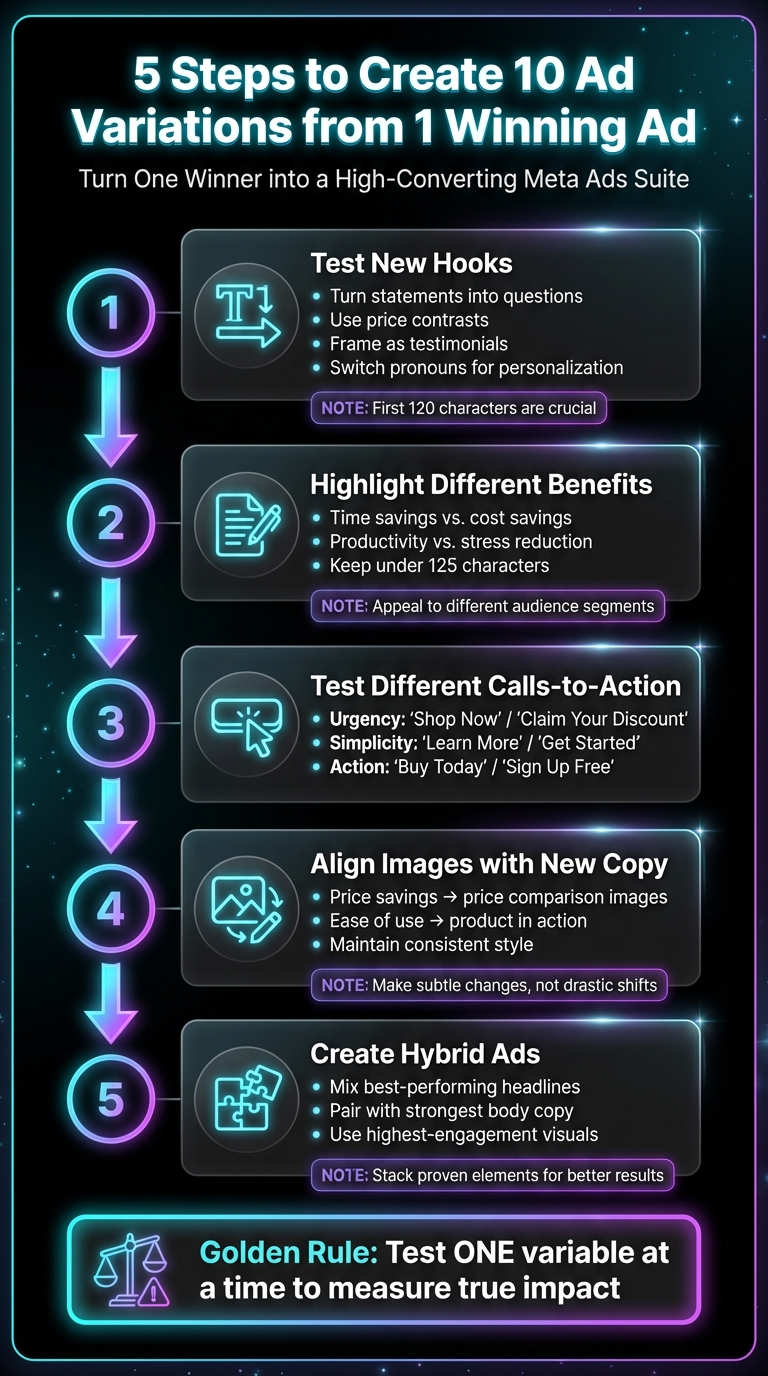
5-Step Process to Create 10 Meta Ad Variations from 1 Winning Ad
Once you've identified a winning ad, the next step is to create new versions that test specific elements while keeping the rest consistent. The idea is simple: tweak one part at a time, test it, and then move on to another. This methodical approach helps you refine and iterate your campaign to scale effectively. Here's how to generate 10 new ads from a single successful one.
Step 1: Rewrite the Headline to Try New Hooks
The headline is what grabs attention right after the visual does its job. It needs to work fast, so keeping the core idea (like saving money) steady while experimenting with the way it's presented can make all the difference.
Here are a few strategies to try:
- Turn a statement into a question to spark curiosity. For example, change "This works better than expensive brands" to "Why spend $200 when this works better?"
- Use price contrasts, like "Designer skincare costs $200… This costs $32."
- Frame it as a testimonial: "I didn’t believe the hype... until I tried it."
- Switch pronouns for a more personal feel, such as changing "I struggled with acne for years" to "Do you struggle with acne?"
"The angle is the strategic idea; the hook is one of many ways to express it." - Billo.app
Keep everything else in the ad unchanged so you can measure the true impact of the headline tweak. On platforms like Meta, the first 120 characters are crucial - they determine whether people even click to see more.
Step 2: Adjust the Body Copy to Highlight New Benefits
The body copy is where you explain how your product solves a problem. Different people care about different benefits, so tweaking this part can help you appeal to various audience segments.
For instance:
- If the original ad focuses on time savings, try a version that highlights cost savings.
- For a productivity tool, one version might emphasize "getting more done", while another focuses on "reducing stress."
Keep the copy concise and only modify this section while leaving the headline and visuals intact. For example, if you're promoting a meal kit service, the original might say, "Healthy dinners in 20 minutes." A variation could be "Stop wasting money on takeout" to attract budget-conscious buyers or "No more meal planning stress" for busy parents.
Step 3: Experiment With Different CTAs
Your call-to-action (CTA) is what nudges people to take the next step, and even small changes can lead to noticeable differences in performance. Test CTAs that create urgency, like "Shop Now" or "Claim Your Discount", versus those that emphasize simplicity, such as "Learn More" or "Get Started."
For example:
- "Stop overpaying" might resonate differently than "Upgrade your routine", even if both aim for the same action.
Choose a CTA that aligns with your campaign’s goal. If you're pushing for purchases, "Buy Today" or "Shop Now" might work best. For lead generation, options like "Get Your Free Guide" or "Sign Up Free" could be more effective. Test the CTA while keeping the headline and body copy constant to measure its impact accurately.
Step 4: Update Visuals to Match New Copy
Once you've tested headlines, body copy, and CTAs, it's time to refresh your visuals to align with the updated messaging. For example:
- If your new headline focuses on price savings, use an image that highlights affordability, like a side-by-side price comparison.
- If ease of use is the focus, show the product in action.
The goal is to make subtle changes that enhance the message, such as tweaking the product angle or adding a text overlay. Avoid drastic shifts like swapping a lifestyle photo for an illustration, as consistency in style is key to maintaining brand recognition.
Step 5: Combine Winning Elements for Hybrid Ads
After identifying the best-performing components from your tests, mix and match them to create hybrid ads. Pair the most effective headline with the strongest body copy and the visual that drove the highest engagement. This approach allows you to stack proven elements for even better results.
For example, if "Why spend $200 when this works better?" is your top headline, "Stop wasting money on takeout" is the most compelling body copy, and a side-by-side price comparison image performed best, combine all three into one ad. Testing these hybrids can sometimes uncover a new ad that surpasses the original in performance.
Testing and Scaling Your New Variations
How to Set Budgets and Track Performance
When testing new ad variations, start with a daily budget of $20–50 per ad set. This range allows you to gather sufficient data without risking too much on unproven creatives. With Meta's typical CPMs (cost per thousand impressions) ranging from $5 to $12, this budget should yield approximately 400–1,000 impressions per ad within 24–48 hours. That’s enough to spot early trends without making hasty decisions.
Run each variation for 3–7 days or until you’ve spent $100–200 per ad set. This ensures you allow Meta’s algorithm to complete its learning phase. Evaluating performance too soon - before reaching around 50 clicks - can lead to premature conclusions since the algorithm needs time to stabilize. A good rule of thumb is to let ads run for at least 72 hours, which also helps smooth out fluctuations caused by day-of-week biases. By day four, most underperformers will start to stand out.
To evaluate performance effectively, focus on three key metrics in Meta Ads Manager:
- CTR (Click-Through Rate): Aim for a CTR above 1–2%.
- CPA (Cost Per Acquisition): Keep this below your target cost, ideally around one-third of your customer's lifetime value.
- ROAS (Return on Ad Spend): Target a ROAS of 3x or higher.
For example, a variation with a 2% CTR and 4x ROAS might outperform another with a 3% CTR but only 1.5x ROAS. These metrics will help you identify which variations have the potential to scale profitably.
Scaling Winners and Cutting Losers
Once you’ve gathered performance data, narrow down your top-performing variations - typically 2–3 out of 10 - and pause the rest. In Ads Manager, pause any ad set with a CTR below 0.8% or a ROAS under 1.5x after spending $100. Pausing instead of deleting preserves the historical data, which can be useful for future campaigns or retargeting efforts.
For winning variations, scale up gradually. Increase budgets by 20–50% daily to avoid disrupting the learning phase. For more advanced control, you can also implement real-time bid adjustments to optimize spend based on live performance data. For instance, if an ad set is performing well at $50 per day, raise it incrementally to $75, then $100, while keeping an eye on CPA trends. Sudden spikes in budget - like doubling overnight - can lead to a 30–50% increase in CPA, which can hurt profitability.
Another way to scale is by duplicating successful ad sets and targeting new audiences. This could include lookalike audiences or broader Advantage+ segments, allowing you to expand your reach without saturating your current audience.
How Aden's Lab Automates the Entire Process
When manual ad creation bogs you down, it’s time to consider a faster, smarter alternative.
Why Manual Variation Creation Drains Time and Money
Manually creating 10 ad variations isn’t just tedious - it’s expensive. On average, it takes 10–20 hours and costs anywhere from $500 to $2,000 per batch. Here’s how the time adds up: 1–2 hours brainstorming hooks, 3–5 hours writing headlines and copy, and another 4–8 hours waiting on a freelancer who charges $50–$100 an hour to design visuals. Meanwhile, your campaign sits idle, potentially burning $1,000 or more in daily ad spend while you wait.
The real headache? The endless back-and-forth. Designers might take days to tweak visuals, copywriters can miss the mark on key messaging, and mismatched visuals - like pairing a "save time" headline with a bland stock photo - can tank your click-through rate by 20–30%. Campaigns often lose as much as $5,000 a week in wasted scaling opportunities because teams simply can’t produce fresh ads quickly enough. This inefficiency makes automation not just helpful, but necessary to scale ad testing without overspending.
How Aden's Lab Simplifies Ad Creation
Aden's Lab eliminates the bottlenecks by automating the entire process. All you need to do is drop your landing page link into the platform. From there, it pulls product details and generates dozens of optimized ads - no prompts, no setup, no manual effort required. You’ll get headlines, body copy under 125 characters, clear call-to-actions, and visuals that align perfectly with your message, all ready to launch on Meta.
For instance, if you upload a website builder landing page, Aden's Lab might create variations like:
- Headline: "Launch Pro Sites for $10/mo"
- Body: "Ditch drag-and-drop headaches - you get pixel-perfect results instantly"
- CTA: "Start Free Trial"
And it doesn’t stop there. These ads come with visuals that fit seamlessly, meaning you’ll have 10 ready-to-go combinations in under 5 minutes - far faster than the 10 hours it would take to do manually.
Scaling Ad Production Without Breaking a Sweat
Aden's Lab can churn out 10 to 50 ad variations in less than 5 minutes using just one link. That means you could easily generate over 100 ads in a month, running 20 batches weekly instead of just one or two. Businesses spending $100,000 monthly on ads see faster testing cycles - 2 to 3 times quicker - and enjoy ROAS improvements of 20–40%, thanks to sharper copy and visuals that increase CTR by 25%.
Even when your landing page changes, Aden’s Lab keeps up. Just upload the updated link, and within minutes, you’ll have 50 fresh ads ready to test. No creative fatigue, no waiting on designers, no delays - just constant testing to keep your campaigns competitive and effective.
Conclusion
By now, you’ve seen how to transform a single winning ad into 10 variations without starting from scratch. The key is to double down on what’s already working and test systematically. Tweak headlines to explore new hooks, adjust the body copy to emphasize different benefits, swap out CTAs, and align visuals with each angle. This structured approach replaces guesswork with data, helping you zero in on what drives conversions while cutting out what doesn’t.
The real game-changer here is speed and volume. Many advertisers don’t fail because of weak products but because creating ads manually is time-consuming and expensive. This delay makes it tough to beat creative fatigue or outmaneuver competitors who test and scale faster. By adopting this systematic method, you not only sharpen your creative strategy but also open the door to producing ads on autopilot.
When manual processes start slowing you down, Aden's Lab steps in to keep you ahead. Just drop in your landing page link, and within minutes, you’ll get dozens of optimized ads ready to launch. No prompts, no complicated setups, and no endless back-and-forth with designers. It’s not just about creating ad variations - it’s about building a repeatable system that helps you test faster, eliminate underperformers early, and confidently scale the winners.
On Meta, the brands that succeed aren’t always the ones with the biggest budgets - they’re the ones that test more, adapt faster, and stay ahead of the curve. When you can generate multiple ad variations in minutes instead of hours, you’re not just saving time. You’re boosting performance, staying ahead of ad fatigue, and turning your creative process into a competitive edge.
FAQs
When should I refresh a winning Meta ad?
When a winning Meta ad starts losing its edge, it’s time for a refresh. Keep an eye on key metrics like a declining click-through rate (CTR), conversion rate, or engagement levels. Another red flag? A steady increase in your cost per result.
Staying on top of these numbers is crucial. Regular monitoring helps you catch performance dips early, so you can act before your campaign stalls. Many advertisers choose to update their ads weekly - or even more frequently - depending on the size of their audience and how active the campaign is. This strategy helps avoid ad fatigue and keeps results on track.
How many changes should I make per variation?
When creating ad variations, aim to make 5 to 10 changes per version. This approach allows you to test key elements - like headlines, visuals, or text - without making things overly complex. If you tweak too many aspects, it becomes difficult to figure out what’s actually driving results. On the flip side, too few changes might not provide enough useful insights. By keeping adjustments within this range, you can better understand what works and scale your efforts effectively.
What’s the fastest way to create 10 new ad creatives?
The quickest method is leveraging AI-powered tools that can create multiple ad variations from just one product link. Take Aden’s Lab as an example - it can transform a single link into dozens of high-performing ads in as little as 90 seconds. This kind of automation removes the hassle of manual design and testing, enabling you to scale campaigns efficiently with engaging, attention-grabbing creatives.
Your next ad batch starts here
Finish with a ready-to-test ad batch
Paste your website to generate static creatives. Drop the link → get ads in about 90 seconds → upload them to Meta → scale.
Free to try No prompt writing