Why Most AI Prompts Fail on Meta Ads (And What Winning Ones Do Differently)
Use the prompts on your real offer
Generate these ad angles for your product
Skip the blank prompt box. Paste your product page and ADEN'S LAB applies the angles to your offer, images, headlines, and copy.
Free to try No prompt writing

If your Meta ads aren’t performing, here’s the problem: vague AI prompts lead to bland, forgettable ads. Without clear instructions, AI generates generic content that fails to engage audiences or meet Meta’s specific ad requirements. This results in wasted budgets, low click-through rates (CTR), and poor return on ad spend (ROAS).
Why AI Prompts Fail:
- Lack of Specificity: Generic prompts produce cookie-cutter copy that doesn’t stand out.
- Ignoring Meta’s Rules: Character limits and format requirements are often overlooked.
- No Audience Insights: Without buyer psychology, ads miss emotional connections.
- Limited Testing: Few variations mean missed opportunities to find what works.
What Winning Prompts Do:
- Include clear instructions with Meta ad copy frameworks like PAS (Problem-Agitate-Solution) or AIDA (Attention-Interest-Desire-Action).
- Align with Meta’s ad formats (e.g., 40-character headlines, 4:5 visuals).
- Address audience pain points and motivations directly.
- Test multiple variations to optimize performance. You can also use an ad copy idea generator to quickly brainstorm creative angles.
For instance, instead of asking AI to “write an ad,” specify:
"Act as a direct-response copywriter for women aged 30–45 interested in sustainable fashion. Write 3 PAS-framework ad variations under 125 characters."
Tools like ADEN's LAB simplify this process, generating Meta-optimized ads in under 90 seconds. By crafting better prompts and leveraging automation, you can reduce costs, increase CTR, and improve ROAS.
How I Make Ai Ads That Actually Work (My Exact Workflow)
Put the playbook to work
Apply this playbook to your page
Paste your website and the Lab will turn the strategy you are reading into a ready-to-test ads.
Free to try No prompt writing
Why AI Prompts Fail on Meta Ads: 4 Common Mistakes
When AI-generated Meta ads fall flat, it’s often due to a handful of key mistakes. Each one can chip away at the effectiveness of your campaigns, as explained below.
Vague and Generic Prompt Structures
If your prompts lack clarity, AI will lean on generic patterns instead of emphasizing what makes your brand stand out. Without details like your audience’s pain points or specific offers, the result is predictable, cookie-cutter ad copy.
Joey Mazars, an AI expert and contributor at AutoGPT, advises: "Stop asking AI to be creative, and start asking it to be specific".
The stats back this up: ads featuring precise offers - like "Save 30% on [Product]" - outperform vague ones such as "Exclusive Limited-Time Offer" by 23% on average. That’s a big boost, simply by being clear.
The solution? Give the AI context. Instead of saying, "Write an ad", outline the tone, target audience, constraints, and what action you want the reader to take. Frameworks like PAS (Problem-Agitate-Solution) or AIDA (Attention-Interest-Desire-Action) can help steer the AI toward stronger, more targeted copy. Also, define format requirements upfront - like keeping headlines under 40 characters or primary text under 125 characters - so the output is ready for Meta’s platform. This leads directly to the next issue: not tailoring prompts for Meta’s specific requirements.
Ignoring Meta-Specific Ad Format Requirements
Meta ads come with their own set of rules - character limits, content policies, and creative formats. If your prompts don’t account for these, you risk ads that either get disapproved or don’t perform well because they don’t fit the platform’s placements.
For example, in 2025, a Shopify brand selling outdoor gear tested Meta’s Advantage+ Creative. Initially, they used five product images and saw an 11% performance increase. But when they expanded to 15 diverse concepts - lifestyle shots, close-ups, and user-generated content - the AI generated combinations that improved CPA by 47%. The key? Giving the AI enough variety to work with Meta’s algorithm.
In another test by AdTimes (October 2025), stock photography was compared to AI-generated visuals created using a detailed prompt ("flat-lay photo of a woman's hands holding a smartphone... minimalist wooden desk, soft natural lighting"). The AI-generated images delivered a 15% higher CTR and a 10% lower cost per lead over one week. The takeaway? Specificity and an understanding of Meta’s visual requirements are essential.
Overlooking Audience Psychology and Buying Behavior
AI doesn’t inherently understand people. If you don’t provide details about your audience - like their motivations, objections, or preferences - the AI will produce content that’s technically correct but emotionally detached.
Here’s the reality: 71% of consumers expect a personalized experience from brands, and 95% say reviews (positive or negative) influence their decisions. Yet many AI prompts fail to tap into these psychological drivers.
The fix? Build psychology into your prompts. For example, instruct the AI to address common objections directly or use the "Who Is This NOT For" strategy to filter out unqualified leads. These approaches help the AI craft messages that resonate with your audience, not just mimic patterns. Testing these strategies can reveal what connects emotionally with your target market.
Insufficient Testing and Iteration
Using AI tools for Meta ads can churn out dozens of ad variations quickly. But if you don’t vary your prompts, you’ll end up with similarly mediocre results across the board. This stifles growth and leaves performance gains on the table.
Too often, marketers treat AI as a one-and-done tool - generate a few ads, pick one, and move on. However, successful campaigns demand constant testing and refinement. You need to explore different angles, offers, and formats to uncover what truly works.
The solution? Incorporate variation into your prompts from the beginning. Ask the AI to create multiple versions using different tones, psychological triggers, and CTAs. Campaigns that tested 8–12 distinct creative concepts with Meta’s AI saw performance increases of over 40%, while those with limited variations saw minimal improvement. By refining your testing process, you can unlock more of AI’s potential for Meta ads.
Why Generic Prompts Don't Work on Meta
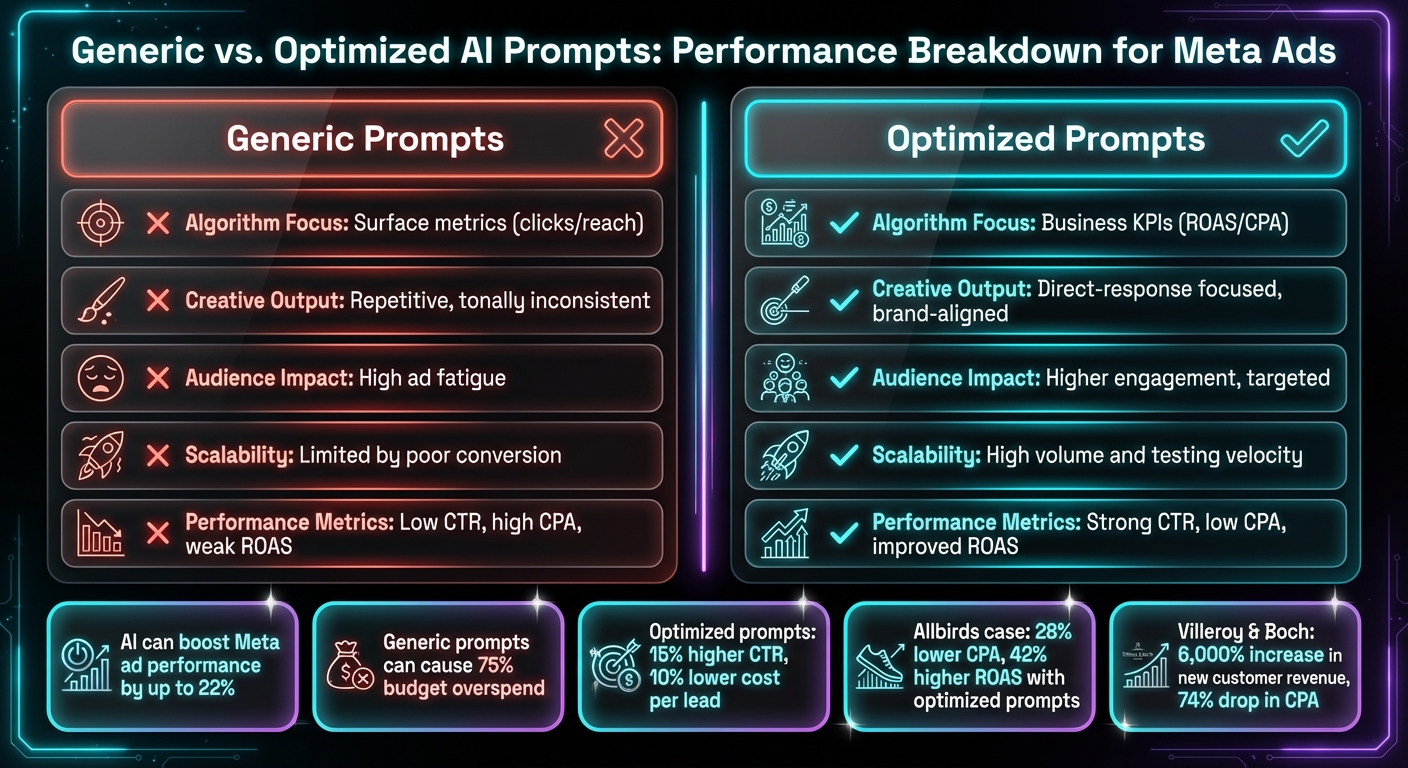
Generic vs Optimized AI Prompts Performance Comparison for Meta Ads
Generic prompts can significantly undermine ad performance on Meta by failing to align with the platform's advanced algorithm. Meta's system processes billions of language translations daily, with over 90% of the content users see being delivered through AI-powered recommendation engines. When prompts lack specificity, you're essentially leaving the algorithm to guess your intent, leading to the safest - and often most generic - results.
Misalignment with Meta's Algorithm and Creative Fatigue
Meta's algorithm thrives on clarity and specificity. The platform has evolved from a social graph (who you follow) to a discovery engine (what you like). This shift means the algorithm prioritizes engaging, targeted content. Generic prompts, however, create broad and uninspired copy that the system quickly identifies as low-engagement material, leading to rapid ad fatigue.
The numbers back this up. While AI can boost Meta ad performance by up to 22%, campaigns using generic prompts often see the opposite - overspending daily budgets by as much as 75% without delivering results. Without clear guidance, the algorithm struggles to optimize, resulting in wasted ad spend and missed opportunities.
"You need to find a way to align your business goals with ad delivery... AI is not smart. You are." - Rémi Kerhoas, Digital Marketing Expert
Take Villeroy & Boch, for example. This luxury home goods brand shifted from generic brand awareness campaigns to conversion-focused strategies tailored to specific customer journey stages. The result? A 6,000% increase in new customer revenue and a 74% drop in cost-per-acquisition. The key was providing the algorithm with precise instructions that aligned with its optimization capabilities, rather than vague goals like "awareness."
Poor ROAS from Weak Copy
Generic prompts often generate bland, forgettable copy that may sound polished but fails to drive action. Without incorporating direct-response frameworks, AI tends to produce brochure-like content that generates traffic but struggles to convert.
This happens because such prompts fail to address the core reasons for hesitation - whether it's price, trust, or switching costs. In B2B scenarios, the impact can be even worse. Simplifying complex messaging might keep the cost-per-acquisition (CPA) manageable, but it often attracts unqualified leads. For instance, rephrasing "Enterprise Resource Planning" as "Better Business Software" might sound clearer but could draw interest from small businesses that can't afford enterprise solutions.
The data is clear: AI-generated headlines outperformed human-written ones in 60% of tests, but only when they followed proven high-converting patterns, such as emphasizing specific discounts over vague hype. Using direct-response frameworks like PAS (Problem-Agitate-Solution) or AIDA (Attention-Interest-Desire-Action) dramatically improved performance. For example, one test using detailed prompts for AI visuals achieved a 15% higher click-through rate (CTR) and a 10% lower cost per lead compared to generic stock imagery.
This lack of strategic focus not only hurts immediate performance but also limits scalability - a critical issue for businesses looking to grow.
Scalability Issues for E-Commerce and Lead Generation
Scaling requires a high volume of creative variations to test and optimize. Generic prompts fall short here, producing repetitive alternatives that quickly lead to ad fatigue and declining performance.
Meta's Advantage+ campaigns, for instance, typically need at least five distinct visual and copy assets to effectively test and identify winning combinations. Additionally, AI-driven creative tools often require a minimum monthly spend of $2,000 to $3,000 per campaign to gather enough conversion data for optimization. Generic prompts simply can't generate the creative diversity or testing velocity needed for high-spend campaigns.
Lovepop, a greeting card company, demonstrated the power of moving beyond generic approaches. By leveraging Meta's Advantage+ tools while maintaining tight human oversight - reducing ad sets from 20 to just 5 - they achieved a 29% increase in ROAS and a 25% reduction in costs within 30 days.
Without clear instructions tied to metrics like CPA, CTR, or ROAS, AI struggles to align with your business goals. The result is advertising that looks polished but performs poorly.
"The bottleneck isn't generation anymore - it's strategic direction and quality control." - Synergist Digital Media
Generic vs. Optimized Prompts: A Performance Breakdown
The difference between generic and optimized prompts is stark when you look at campaign metrics. Here's how they compare:
| Prompt Type | Algorithm Focus | Creative Output | Audience Impact | Scalability | Performance |
|---|---|---|---|---|---|
| Generic | Surface metrics (clicks/reach) | Repetitive, tonally inconsistent | High ad fatigue | Limited by poor conversion | Low CTR, high CPA, weak ROAS |
| Optimized | Business KPIs (ROAS/CPA) | Direct-response focused, brand-aligned | Higher engagement, targeted | High volume and testing velocity | Strong CTR, low CPA, improved ROAS |
Allbirds, the footwear company, provides a great example. By combining Advantage+ broad targeting with human-led strategic oversight - replacing generic prompts with optimized ones - they reduced their cost-per-acquisition by 28% and boosted ROAS by 42%. The algorithm didn’t change; the prompts did.
These findings highlight the importance of crafting AI prompts that directly support your business objectives. Generic prompts not only fail to deliver actionable insights but also make it harder to scale campaigns effectively, leaving you with traffic but no conversions.
What Winning AI Prompts for Meta Ads Include
Generic prompts just don't cut it when you're trying to create Meta ads that deliver results. To stand out, you need detailed, technical instructions that guide AI toward producing measurable outcomes. Precision is the name of the game here.
Specific and Clear Instructions
When working with AI, clarity is everything. Instead of vague requests like "write good ad copy", get specific. For example, ask for "five headlines for a lead generation campaign." This clarity ensures the AI knows exactly what you need.
The RAFT Model - Role, Audience, Format, Task - helps structure your prompts. Here's how it works:
- Role: Assign the AI a specific role, like "direct-response copywriter."
- Audience: Define the target group, such as "women aged 30–45 interested in sustainable fashion."
- Format: Specify the ad format, like "4:5 vertical image with headline overlay."
- Task: Be clear about the deliverable, such as "create three PAS-framework ad variations."
This approach leaves no room for guesswork and keeps results aligned with your brand's needs.
Constraints are equally important. Set clear boundaries to avoid irrelevant or overly generic outputs. For instance, specify word or character limits (e.g., "12 words or fewer" or "under 90 characters") and ban overused terms like "innovative" or "seamless." For visual content, you can even include instructions like "-text, -logo" to ensure clean, focused imagery.
When it comes to static ads, technical details matter. Specify essential parameters like aspect ratios (e.g., 4:5 or 1:1), lighting preferences ("soft natural lighting"), and design elements ("black-on-white subtitles" or "product PNG overlays"). Research shows that 4:5 vertical formats perform up to 15% better in Meta Feeds than the standard 1:1 visuals. Plus, using AI-generated visuals instead of stock images can boost click-through rates by 15% and lower cost per lead by 10%.
Once you've nailed the technical setup, it's time to focus on what really drives engagement: buyer emotions and objections.
Buyer Pain Points and Motivations
To create ads that resonate, address your audience's hesitations head-on. For example, if price, trust, or time-to-value are common concerns, include these objections in your prompt. Then, ask the AI to create headlines that tackle these issues directly.
One effective method is the Angle Matrix, which helps you approach the message from multiple perspectives:
- Pain: Highlight the problem (e.g., "back pain from sitting all day").
- Outcome: Showcase the solution (e.g., "pain-free workdays").
- Identity: Appeal to self-image (e.g., "for remote workers who care about their health").
- Proof: Add credibility (e.g., "clinical study shows 40% pain reduction").
For deeper context, the SPARK Framework can refine your prompts further. This framework focuses on:
- Situation: The context or scenario.
- Persona: The AI's role.
- Audience: The target group.
- Requirements: Specific deliverables.
- Knowledge: Brand-specific guidelines.
For instance, a prompt might read: "Act as a performance copywriter for busy parents who struggle with meal planning. Generate three ads that disqualify non-parents and emphasize time savings over nutrition." This "disqualification" strategy narrows the audience, improving ad relevance and reducing refund rates. A marketer once used the line "Not for experts - built for beginners" to set clear expectations and attract the right customers.
With buyer pain points addressed, the next step is ensuring your copy aligns with your brand's tone and style.
Direct-Response Copy and Brand Style Matching
AI-generated content needs to stay true to your brand's voice. While AI is great for producing content quickly, human oversight is essential to ensure the tone and positioning align with your goals.
To maintain consistency, give the AI clear stylistic guidelines. For example:
- "Conversational but not casual."
- "Focus on value rather than features."
- "Avoid hype or exaggerated claims."
You can also provide examples of high-performing ads or a list of approved words and phrases. If your brand avoids exclamation points or words like "amazing", spell that out in your prompt.
Direct-response frameworks can further refine your ads. For instance, include a "Proof Menu" that outlines different types of evidence:
- Hard proof: Data or statistics.
- Social proof: Reviews or testimonials.
- Process proof: Explanations of how your product works.
In one test, an e-commerce account with a $12,000 monthly budget compared AI-generated ads to human-created ones. The AI ads achieved a 2.8% average click-through rate (CTR) and a cost per conversion of $18.50, outperforming the human ads, which had a 2.3% CTR and $22.30 cost per conversion. Even more impressive, the AI created 50 variations in just 25 minutes - a task that would take a human team four days.
"The AI is only as good as your brief. Turns out that's true for human creatives and robot ones." - Forem
Another effective strategy is "Message Match." Ensure the top three phrases from your ad are repeated on the landing page. This reduces cognitive friction and boosts conversion rates.
Static Ad Format Optimization
Creative quality drives 70–80% of Meta ad performance, making it far more critical than budget or targeting settings. Winning prompts take Meta's specific requirements into account, especially for static ads.
Details like lighting and composition can make all the difference. For example:
- Use "soft natural lighting, no harsh shadows."
- Try a "split-screen format with the product on the left and a benefit callout on the right."
Split-screen formats can improve memory retention by 12%. And for Meta's Advantage+ campaigns, generating multiple creative variations allows for better testing and optimization.
When writing claims, avoid absolute statements to reduce the risk of ad disapproval. Instead of saying "lose weight fast", try "support healthy weight management with a balanced approach."
Meta's platform is evolving into more of a "discovery engine", prioritizing engagement signals over follower counts. This shift means structured, serious tones - like drama-led scripts or interviews - are currently outperforming casual, trend-based storytelling. Adjust your prompts to reflect this trend and stay ahead of the curve.
4 Prompt Frameworks for High-Performing Meta Ads
If you’re looking to improve your Meta ad performance, these four frameworks can help you tackle common AI prompt issues. Each one focuses on a critical aspect of ad success, from audience insights to budget optimization.
Here’s why they matter: companies using structured prompt frameworks see a 340% higher ROI on AI investments compared to those using unstructured methods. And with over 71% of marketers admitting they don’t fully understand AI tools, having a clear game plan makes all the difference.
The Audience Whisperer Framework
This framework is all about understanding your audience on a deeper level. Start by feeding your AI precise customer data - like lifetime value (LTV), purchase frequency, and engagement metrics - to uncover hidden traits of high-value customers.
Then, segment your audience based on demographics, behavior, and psychographics. Build unique value propositions for each group. A sample prompt might look like this:
"Analyze our top 500 customers by LTV and identify three non-obvious characteristics that predict high value. Then create a multi-tiered lookalike strategy segmented by predicted lifetime value."
This method ensures your ads connect with what your audience truly cares about, avoiding the generic messaging that often drags down AI-generated ads. Once you’ve nailed audience insights, it’s time to refine your ad copy.
The Ad Copy Wizard Framework
This framework helps you craft prompts that generate compelling, benefit-driven ad copy. Models like RACE (Role, Action, Context, Expectation) and COSTAR (Context, Objective, Style, Tone, Audience, Response) are particularly useful for structuring prompts that deliver results.
Here’s how RACE works:
- Role: “Act as a senior direct-response copywriter.”
- Action: “Write five ad headlines.”
- Context: “For a B2B SaaS product targeting CFOs concerned about cash flow.”
- Expectation: “Deliver in table format, under 30 characters each, using the Problem-Agitate-Solution structure.”
By sticking to a problem-solution-result formula and respecting Meta’s character limits (125 characters for primary text), you can create headlines that resonate. Include safety guidelines like “Avoid jargon” or “Don’t use hypey phrases like ‘game-changing.’”
This approach works. In tests, AI-generated headlines outperformed human-written ones in 60% of cases based on click-through rates. For one SaaS client, AI-generated headlines boosted CTR by 15% in just one week.
"The difference between mediocre AI output and genuinely useful content? The prompt." - Zach Chmael, Head of Marketing, Averi
Remember, the first AI output is just a starting point. Use follow-up prompts like “Make it more conversational” or “Add specific statistics” to fine-tune results. Now, let’s tackle creative fatigue.
The Creative Variation Framework
Avoiding creative fatigue is crucial, and this framework helps you generate multiple ad variations that test one variable at a time. Focus on changing elements like the hook, benefit, call-to-action, or tone to see what drives performance.
Start with 8–12 distinct creative concepts, such as lifestyle imagery, user-generated content, or before-and-after comparisons. Avoid minor tweaks to the same image. A good prompt might be:
"Generate 10 distinct ad variations testing different hooks while keeping visuals and CTAs consistent."
You can also include creative fatigue detection. For example:
"Compare CTR and conversions over 30 days. Flag any ads with a 15% or greater decline in performance."
This approach works wonders. A Shopify brand boosted its cost-per-acquisition performance from 11% to 47% by switching from 5 similar product images to 15 truly distinct concepts. Another outdoor gear brand saw a 31% improvement when AI suggested unconventional pairings, like a rain tent image with headlines about family adventures.
Across 50 campaigns, this method delivered an average 23% improvement in cost per conversion. With your creative variations in place, it’s time to align your budget with performance.
The Budget Predictor Framework
Scaling ad campaigns efficiently often comes down to smart budget management, and this framework helps you do just that. By analyzing historical campaign data, AI can predict what works and suggest dynamic budget allocations based on seasonality, trends, and real-time performance metrics.
For example, you might prompt:
"Review the last 60 days of campaign data. Identify the top 20% performers by ROAS and analyze the bottom 20% by CPA. Suggest a reallocation plan."
To ensure accuracy, include instructions like “Analyze correlations without inferring causation.” You can also add pacing alerts to monitor daily spend.
This approach saved one supplement e-commerce brand during the holiday season of 2025. After ROAS plummeted from 1.35 to 0.75 while testing six ads simultaneously, they paused all campaigns for 24 hours, launched one clean ad set with 10 proven concepts, and left it untouched for a week. The result? ROAS rebounded to 2.50, and CPA dropped from $87 to $29 within five days.
"AI prompts for media planning work best when they include specific details like target audience, campaign goals, budget constraints, and desired output format." - Catherine Mietek, VP Product Marketing, Pixis
How ADEN's LAB Solves the Prompt Problem for Meta Ads
The frameworks are effective, but crafting and testing detailed prompts can be time-consuming. That’s where ADEN's LAB steps in to simplify ad creation. Instead of spending hours on prompt engineering, you just drop in a product link, and the platform generates hundreds of Meta ads on autopilot in less than 90 seconds.
AI-Powered Static Ad Generation in Under 90 Seconds
ADEN's LAB takes what could be hours of effort and condenses it into moments. By entering your product URL or uploading an image, the AI generates static ads optimized for Facebook and Instagram. This includes tailored visuals, persuasive copy, and platform-specific formatting. For example, inputting a product link can instantly produce a compelling Meta ad designed to drive urgency. If you’re focusing on lead generation, the tool creates ads that address buyer pain points, like “Struggling with [pain point]? Get Free Guide.” The process eliminates the need for manual edits, external designers, or back-and-forth coordination, making it easy to launch ads quickly. This streamlined workflow ensures that the ads are not only ready fast but are also built to resonate with your audience.
Buyer Psychology-Driven Ad Frameworks
ADEN's LAB doesn’t just churn out generic ads - it integrates proven direct-response frameworks into every ad it creates. These include tools like the Audience Whisperer, which pinpoints pain points and motivations; the Ad Copy Wizard, designed to handle objections; and retargeting progressions that move users from reminders to education, social proof, and urgency. The system automatically incorporates emotional storytelling, strong calls-to-action, and buying behavior insights. It even aligns with Meta's Lattice model, tailoring ads in real-time based on factors like location and weather. By embedding these frameworks, ADEN's LAB ensures that every ad is not only polished but also psychologically geared to engage and convert.
Efficient, Scalable Ad Production
ADEN's LAB doesn’t just save time - it slashes costs. Traditional ad production can run anywhere from $500 to $2,000 per creative when working with agencies or designers. With ADEN's LAB, costs drop by over 80%, with plans starting at $59/month for 30 ads. This allows users to create over 100 ad variations per hour, enabling aggressive testing across broad and lookalike audiences. The result? Lower customer acquisition costs through rapid iteration. While specific performance metrics are proprietary, similar AI tools have reported ROAS increases of 15–30%, productivity boosts of 67%, and content creation speeds up to 80% faster. One e-commerce brand even scaled from producing 10 ads per week to 500, cutting CAC by 25% along the way. The platform also integrates seamlessly with Meta's Conversions API, allowing for first-party data tracking and AI-driven scaling that aligns with automation trends. This combination of speed, cost-efficiency, and advanced integration makes ADEN's LAB a game-changer for ad creation.
Conclusion: Improve Your Meta Ad Performance with Better Prompts
Meta ads often fall short when AI-generated prompts lack clarity, fail to align with platform-specific formats, or overlook buyer psychology. This leads to poor engagement and inflated costs. The key to success lies in crafting precise prompts that use direct-response copy and structured frameworks tailored to Meta's standards. By focusing on audience pain points, ad format requirements, and ongoing testing, you can achieve engagement rates 2–3× higher and significantly reduce customer acquisition costs.
The four frameworks - Audience Whisperer, Ad Copy Wizard, Creative Variation, and Budget Predictor - serve as practical templates that turn prompt creation into a systematic process. For instance, using the Audience Whisperer or Ad Copy Wizard frameworks allows you to shift from trial-and-error to data-driven improvements. Testing variations with a small portion of your budget (10–15%) and maintaining a performance-based prompt library help you scale winning creatives while minimizing fatigue. Prompts that are personalized and rooted in buyer psychology consistently lead to better click-through rates and conversions. This structured approach also lays the groundwork for automation, enabling even faster optimization.
While crafting prompts manually can be tedious, tools like ADEN's LAB simplify the process. In under 90 seconds, ADEN's LAB generates static Meta ads from a product link, applying direct-response principles and optimizing for Meta’s formats. This eliminates creative bottlenecks, reduces production costs, and allows for the rapid creation of hundreds of ad variations ready for large-scale testing.
The takeaway? Ditch vague prompts. Rely on structured frameworks and automation to stay ahead of the competition. Whether you’re running campaigns for e-commerce, SaaS, or lead generation, combining optimized prompts with tools like ADEN's LAB ensures you achieve the speed, scale, and performance edge essential for success on Meta in 2026.
FAQs
How can I create more effective AI-generated Meta ads?
To make AI-generated Meta ads work effectively, start with clear and detailed prompts. These should steer the AI toward creating content that's both engaging and relevant to your audience. Focus on showcasing what makes your product stand out, use emotionally impactful language, and include a strong call to action that encourages interaction.
Your prompts should also guide the AI to generate visually appealing elements. Think of catchy headlines, persuasive descriptions, and striking visuals like images or videos that grab attention. Pay attention to how your ads perform and tweak your prompts accordingly. This helps you fine-tune the content to better match what your audience responds to.
By consistently refining your prompts and using data-driven insights, you can boost engagement and see improved results from your ads.
What makes an AI prompt effective for creating Meta ads?
To get the most out of AI for your Meta ad campaigns, your prompts need to be clear, detailed, and aligned with your goals. Start by specifying the task - whether it's creating ad headlines, suggesting visuals, or brainstorming messaging ideas. Be as specific as possible about your product, target audience, and the tone you’re aiming for. This context helps the AI generate content that resonates.
Include key phrases or themes that reflect your brand's voice and campaign objectives. If you have examples or references, share them to guide the AI’s output more effectively. Over time, tweak and refine your prompts based on what works. This iterative process ensures the AI consistently delivers content that drives engagement, reduces customer acquisition costs, and scales your campaigns successfully.
How does ADEN's LAB improve Meta ad creation with AI?
ADEN's LAB takes the guesswork out of crafting Meta ads by offering expertly designed AI prompts that help marketers create ads that perform. These prompts are tailored to generate attention-grabbing visuals, persuasive copy, and scalable ad variations - all in record time. The result? Better engagement, lower customer acquisition costs, and easier scaling.
What sets ADEN's LAB apart is its focus on clear, structured prompts. These prompts guide AI to produce ads that resonate with your audience by addressing their motivations, pain points, and emotional triggers. On top of that, it offers tested frameworks that simplify complex tasks, like:
- Turning a winning ad concept into multiple variations.
- Extracting fresh messaging ideas directly from customer feedback.
With this approach, ADEN's LAB helps advertisers unlock the full potential of AI, delivering measurable improvements to Meta campaigns.
Your next ad batch starts here
Finish with a ready-to-test ad batch
Paste your website to generate static creatives. Drop the link → get ads in about 90 seconds → upload them to Meta → scale.
Free to try No prompt writing