Competitor Ad Breakdown Prompts: Steal the Strategy, Not the Ad
Use the prompts on your real offer
Generate these ad angles for your product
Skip the blank prompt box. Paste your product page and ADEN'S LAB applies the angles to your offer, images, headlines, and copy.
Free to try No prompt writing

Copying competitor ads word-for-word doesn’t work. Here’s why: most ads you see in Meta’s Ad Library are experimental, not proven winners. Mimicking them can lead to wasted budgets, ad fatigue, copyright issues, or even account bans. Instead, focus on reverse-engineering the strategy behind long-running ads (30+ days).
Key takeaways:
- Ad Format: Look for trends like UGC videos or carousels, which dominate successful campaigns.
- Headline & Hook: Study how competitors grab attention and deliver value in the first 80 characters.
- Body Copy: Recognize frameworks like PAS (Problem-Agitation-Solution) and tailor ad copy ideas to your audience.
- Visual & Text Synergy: Ensure visuals and text deliver the same message in under 2 seconds.
- Ad Longevity: Ads running 60–90+ days are likely profitable.
- Placement Fit: Analyze where ads run (e.g., Facebook Feed vs. Instagram Stories) to understand audience targeting.
- Fatigue Resistance: Spot creative variations within successful campaigns to stay fresh.
Bottom line: Borrow the structure and strategy, not the exact content. Tools like Aden’s Lab can help you produce Meta ads on autopilot to quickly test and refine campaigns based on these insights.
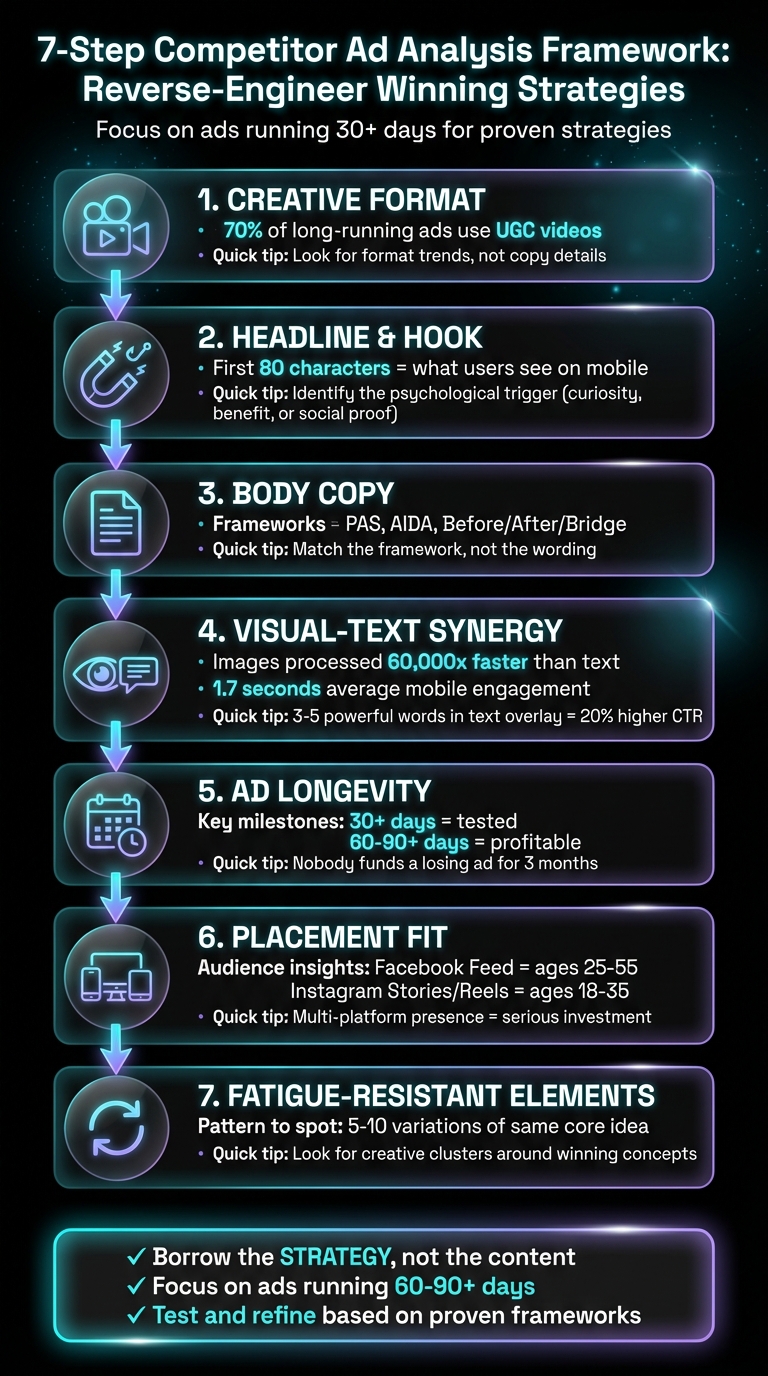
7-Step Framework for Analyzing Competitor Ads Strategy
1. Creative Format
Identify the Format That's Actually Working
When analyzing a competitor's ad, start by focusing on the format, not the finer details of the copy. Is it a UGC (user-generated content) video, a static image with bold text, a carousel, or a transformation visual? Each format delivers its message in a unique way.
Take this for example: roughly 70% of long-running ads in major niches rely on UGC videos. Why? Because these videos often feel more genuine and blend seamlessly into social media feeds. A UGC video can create a sense of authenticity, a carousel can address multiple objections or highlight a range of products, and a static image with bold text is great for grabbing attention and quickly showcasing a key benefit.
"Creative is the #1 performance lever in Meta ads today." – Adligator Team
If you notice an ad format that’s been running for 30, 60, or even 90+ days, it’s likely a winning structure you should A/B test against your current creatives. Instead of duplicating the ad, break it down to understand its core elements - like the hook, price messaging, and how the creative aligns with the landing page. Then, adapt these components to suit your brand. This step lays the groundwork for diving deeper into other ad elements. Understanding these fundamentals is key to optimizing Meta ads for long-term performance.
Put the playbook to work
Apply this playbook to your page
Paste your website and the Lab will turn the strategy you are reading into a ready-to-test ads.
Free to try No prompt writing
2. Headline and Hook
Understand the Strategy, Not Just the Words
When you spot a competitor's ad that's been running for over two weeks, it's clear the headline and hook are doing their job. But here's the thing: copying the exact words won't help unless you understand why the ad works.
A hook isn’t just a catchy phrase - it’s a psychological trigger. Does it spark curiosity, like “I tested 47 creatives... only 3 made money”? Does it highlight a clear benefit, such as “Cut your CPA by 40% in 7 days”? Or maybe it leans on social proof, like “Trusted by 500+ teams”? The key is to figure out the type of hook being used and then rework it in a way that fits your brand’s voice and message.
Pay special attention to the first 80 characters of the text. Why? That’s all users see before the text gets cut off on mobile. Your headline needs to hit hard and fast - there’s no room for ambiguity. If you’re analyzing a competitor’s ad, focus on how they front-load value in their opening lines. Don’t just copy their words; study how they connect the visual, the message, and the promise to their landing page.
One more thing to keep in mind: high engagement doesn’t always mean high conversions. Meta’s algorithm might push ads that get clicks and comments during the learning phase, but that doesn’t mean those ads are profitable. To truly measure a hook’s success, wait until you’ve hit at least 10–15 conversions. The ads that stay live for 60, 90, or even 120 days? Those are the ones worth dissecting and learning from.
Next, we’ll dive into how the body copy builds on this strong foundation.
3. Body Copy
Match the Framework, Not the Wording
When analyzing a competitor's body copy, the goal isn't to replicate their exact words - it's to understand the structure that drives their message. Many successful ads are built on time-tested frameworks like PAS (Problem-Agitation-Solution), AIDA (Attention-Interest-Desire-Action), or Before/After/Bridge. These frameworks aren't just marketing jargon - they're proven strategies designed to guide viewers toward taking action. Recognizing these structures helps you craft your own compelling copy.
Take this example: a competitor's ad might start with, "Tired of wasting $3,000/month on ads that don't convert?" —a hook often paired with high-CTR headlines— - a clear nod to the problem. Then, it stirs urgency with, "Every day you wait, your competitors are stealing your customers." Finally, it offers a solution. The takeaway here isn't to mimic their exact pain points or numbers. Instead, it's about identifying the PAS framework and tailoring it to your audience's specific challenges and goals.
"Copying a competitor's ad gets you their results minus originality. Adapt the structure, not the content." - Adligator Team
The approach also changes depending on the product's price point. For items under $50, concise, benefit-driven copy tends to work best. On the other hand, higher-priced products (over $500) often require longer, narrative-style copy that establishes trust and credibility. Specificity is another critical factor - claims like "reduce your CPA by 34% in 14 days" are far more persuasive than vague statements like "improve your results". Use these structural insights to craft messages that resonate with your audience and reflect your brand's voice.
4. Visual-Text Synergy
The Image Does the Heavy Lifting, Text Seals the Deal
Did you know that humans process images 60,000 times faster than text? This makes the visual element of your ad the first thing people notice - and the most powerful tool for grabbing attention. The text, however, plays a critical supporting role. Modern advertisers often use Meta ads automation to streamline this process. It doesn’t compete with the image; instead, it amplifies the message the visual delivers in that split second.
When analyzing a competitor's ad, pay attention to how the visual and text work together. For example, if the image shows a before-and-after transformation, does the headline emphasize the result? If it’s a product demo, does the overlay text call out the specific benefit being showcased? The best ads seamlessly combine visuals and text to tell a cohesive story, ensuring users don’t have to choose between looking or reading - they get the message instantly from both.
On mobile devices, users spend just 1.7 seconds engaging with a piece of content. That’s why consistency is key. If your visual screams "luxury" but your text suggests "bargain bin", the disconnect will turn users off. Similarly, cluttered visuals paired with overly complex text overlays can confuse and lose the audience. The winning formula? One clear message, delivered twice - once through the image and once through the text.
For text overlays, stick to 3–5 powerful words that highlight the main benefit or call-to-action. Ads featuring concise, compelling value propositions in their text overlays can see up to 20% higher click-through rates. But here’s the catch: the text must enhance the visual, not obstruct it. Use Meta’s safe zone guidelines to ensure critical text stays clear of profile icons and CTA buttons. Nothing derails an ad faster than having key parts of your message cropped out.
Top brands investing $50K to $200K+ monthly in ads aren’t leaving this to chance. They rigorously test combinations of visuals and text to find what resonates. When you spot an ad running for 60+ days, that’s a sign it’s a proven winner. It’s not just luck - it’s a result of data-driven refinement. Use this approach to move beyond imitation. Adapt the framework, align it with your offer, and test until you find your own high-performing combination. Up next, we’ll dive into how ad longevity reinforces these strategies for success.
5. Ad Longevity
The 30-Day Rule: Let Time Highlight the Best
The runtime of an ad is one of the clearest indicators of its success. Ads that last beyond the typical 30-day testing phase (often guided by a pre-launch testing checklist) have likely proven their worth. If an ad continues running for 60, 90, or even 120 days, it’s a strong sign that it’s performing well and generating profits.
"Runtime duration is the strongest free signal. An ad running for 60, 90, or 120+ days is almost certainly profitable. Nobody funds a losing ad for three months." - Vibemyad
But don’t rely solely on runtime as your guide. Look for other indicators of success, like iterating on a core concept (5–10 versions, for example), consistent use of the same creative across platforms like Facebook, Instagram, and Stories, or deployment in multiple countries. These patterns suggest that a brand has found a winning formula and is doubling down to maximize its impact.
Instead of chasing every new ad that pops up, focus on those that have been active for at least 30 days. This approach helps you filter out short-lived experiments and zero in on strategies with proven staying power. And when a long-running ad finally stops, see it as an opportunity to refresh the concept with your own unique spin tailored to your brand.
6. Placement Fit
Where It Runs Tells You Who It's For
The platforms where a competitor places their ads can reveal a lot about their target audience and budget priorities. For instance, ads on Facebook Feed often aim at users aged 25–55, while Instagram Stories and Reels typically cater to a younger crowd, aged 18–35. When you see ads running across Facebook Feed, Instagram Feed, and Stories, it signals a brand's serious investment in reaching multiple demographics.
"An ad running on Facebook Feed, Instagram Feed, and Stories simultaneously represents real investment" - Vibemyad
Placement choices also reflect a brand's strategy. Heavy use of Instagram, with minimal Facebook activity, suggests a focus on visuals and aesthetic appeal. On the flip side, a campaign that sticks exclusively to Facebook often targets older, more methodical buyers and prioritizes conversions. To dig deeper, check the "About This Advertiser" section. A brand running over 200 ads at once is likely scaling across various placements, while a handful of ads (3–5) usually indicates a more focused, evergreen approach.
Beyond ad volume, consistency across platforms is another key indicator. Use the Meta Ad Library to filter by platform, set the start date to over 30 days ago, and observe which ads remain active. Ads that continue running across placements without being pulled are likely delivering strong results. If a competitor is increasing an ad's presence across multiple placements instead of phasing it out, you've likely identified a winning combination of placement and format. The longer an ad stays active in a specific placement, the more profitable it likely is. This profitability often stems from efficient AI-driven budget allocation that prioritizes high-performing assets.
To refine your own placement strategy, focus on scaling efficiently. Tools like Aden's Lab can help by generating dozens of static Meta ads from a single link - no design work required. This allows you to test Facebook Feed, Instagram Feed, and Stories simultaneously and use performance data to identify where your audience engages and converts most effectively. Drop in a link, get tailored ads, and let the results guide your next move.
7. Fatigue-Resistant Elements
Runtime Is the Real Signal
If an ad has been running for 60, 90, or even 120+ days, it’s a strong indicator that the creative is holding up against fatigue. By using the Meta Ad Library filters to spotlight ads active for over 90 days, you can identify these evergreen performers - ads that have moved beyond initial testing and consistently deliver results.
But runtime alone isn’t the whole story. The way brands approach creative variation is just as important. Look for "creative clusters" - groups of 5 to 10 variations built around the same core idea. These variations might tweak the hook, visuals, or copy, showing that the brand has refined a strategy to keep the content fresh. Often, the longest-running version within the cluster serves as the control for ongoing iterations. And when multiple top brands lean into similar formats - like user-generated content demos or problem–solution narratives - it’s a sign that these structures resonate well with audiences.
Pay special attention to the hook in these enduring ads. The first few seconds of a video or the combination of the headline and primary visual often determines whether viewers stick around. For instance, in November 2025, the AI-builder startup Lovable hit $200M in ARR by leveraging YouTube Shorts with an opening hook: "How do we make so much chocolate?" This unexpected question grabbed attention before viewers realized it was an ad, helping the video surpass retention benchmarks and rack up 25M views.
Once you identify these proven patterns, scaling becomes straightforward with tools like Aden's Lab. This platform simplifies the process by generating dozens of static Meta ads from just one URL. It allows you to test different hooks, visuals, and copy angles without the need for traditional design workflows. Simply input your URL, and the platform delivers a batch of ads built on successful frameworks, using runtime data to guide you toward combinations that effectively counter creative fatigue.
How To Analyze Competitor Ads (Best Tools & Methods)
Wrapping It Up
Success in media buying isn’t about luck - it’s about having a structured process to reverse-engineer what works. By analyzing competitor ads effectively, you can uncover repeatable patterns that are backed by real ad spend. For instance, when you notice the same hook, copy style, or visual format in ads that have been running for 60 or even 90+ days, you’re looking at strategies that competitors have fine-tuned and proven profitable over time.
But even the smartest strategies fall flat if you can’t act on them fast enough. A common challenge advertisers face is the inability to quickly turn these insights into ready-to-launch ads. Slow production cycles and high costs often lead to missed opportunities, especially as creative fatigue sets in.
That’s where Aden’s Lab steps in to make a difference. By simply dropping your landing page URL, you can generate dozens of static Meta ads - no need for prompts, briefs, or endless design revisions. It’s fast, efficient, and built to keep you ahead of the game.
FAQs
How can I tell if a competitor's ad is profitable?
Advertisers rarely let unprofitable ads linger. So, when you see ads running for over 60 days or with multiple versions, it's a strong hint they’re performing well. Why? Successful ads are often tested and scaled, while underperforming ones are paused quickly. Although you can’t see exact profit margins, these patterns can point you toward ads that are worth analyzing further.
What’s the fastest way to reverse-engineer an ad without copying it?
To create your own ad by reverse-engineering another without directly copying it, focus on understanding its structure. Look at key elements like the hook, the messaging, and the call-to-action. Analyze what makes the ad effective - whether it’s the emotional appeal, a unique angle, or how it grabs attention - and adapt those strategies to suit your brand and audience.
Tools like the Meta Ads Library can help you study competitors' active ads. Pay close attention to why specific elements work, such as the emotions they evoke or the way they present a solution. Then, use these insights to craft original ads that resonate with your target audience.
How can I create enough new creatives to avoid ad fatigue?
To keep your audience engaged and avoid ad fatigue, it's essential to regularly introduce new creatives. Seeing the same ad over and over can lead to lower engagement and higher costs. The solution? Use tools that allow you to quickly create a variety of ads, making it easier to test different visuals and messaging at scale. For example, dropping your product link into Aden’s Lab can instantly generate high-performing static ads, helping to keep your campaigns fresh and your audience interested.
Your next ad batch starts here
Finish with a ready-to-test ad batch
Paste your website to generate static creatives. Drop the link → get ads in about 90 seconds → upload them to Meta → scale.
Free to try No prompt writing