The Best ChatGPT Prompts to Create Static Ads That Actually Convert
Build the ads while the examples are fresh
Turn your product page into static ad creatives
Paste your product URL and generate scroll-stopping images, headlines, and primary text—ready for your next Meta creative test.
Free to try No prompt writing

Creating static ads that convert is no longer about just clever wording - it's about speed, precision, and scaling effectively. ChatGPT simplifies this process by generating dozens of ad copy variations in minutes, helping marketers craft headlines, primary text, CTAs, and even full ad strategies tailored to specific audiences. Here's what you'll learn:
- Headlines: Use role-specific prompts to create platform-optimized headlines like "Meta Ads automation copywriter" or "Google Ads specialist." Include measurable goals like CTR or ROAS for performance-focused results. Use an ad budget planner to align these goals with your spending.
- Primary Text: Experiment with narrative styles (aspirational, emotional, authority-based) and adjust tone for retargeting campaigns.
- CTAs: Craft concise, audience-specific calls-to-action aligned with user intent and journey stage.
- Ad Variations: Test different angles for various audience segments while isolating one variable at a time.
- Brand Alignment: Ensure ads reflect your brand's unique tone by providing ChatGPT with brand guidelines and examples.
- Creative Scaling: Analyze top-performing ads and generate new variations based on shared themes.
- E-commerce Optimization: Tailor ads to different buyer intents and journey stages with specific prompts.
- Buyer Psychology: Leverage emotional triggers like scarcity, urgency, and loss aversion to drive conversions.
- Landing Page Alignment: Match ad messaging with landing pages to maintain consistency and avoid drop-offs.
- Performance Iteration: Use past performance data to refine and improve campaigns with the "Pause, Scale, Create" framework.
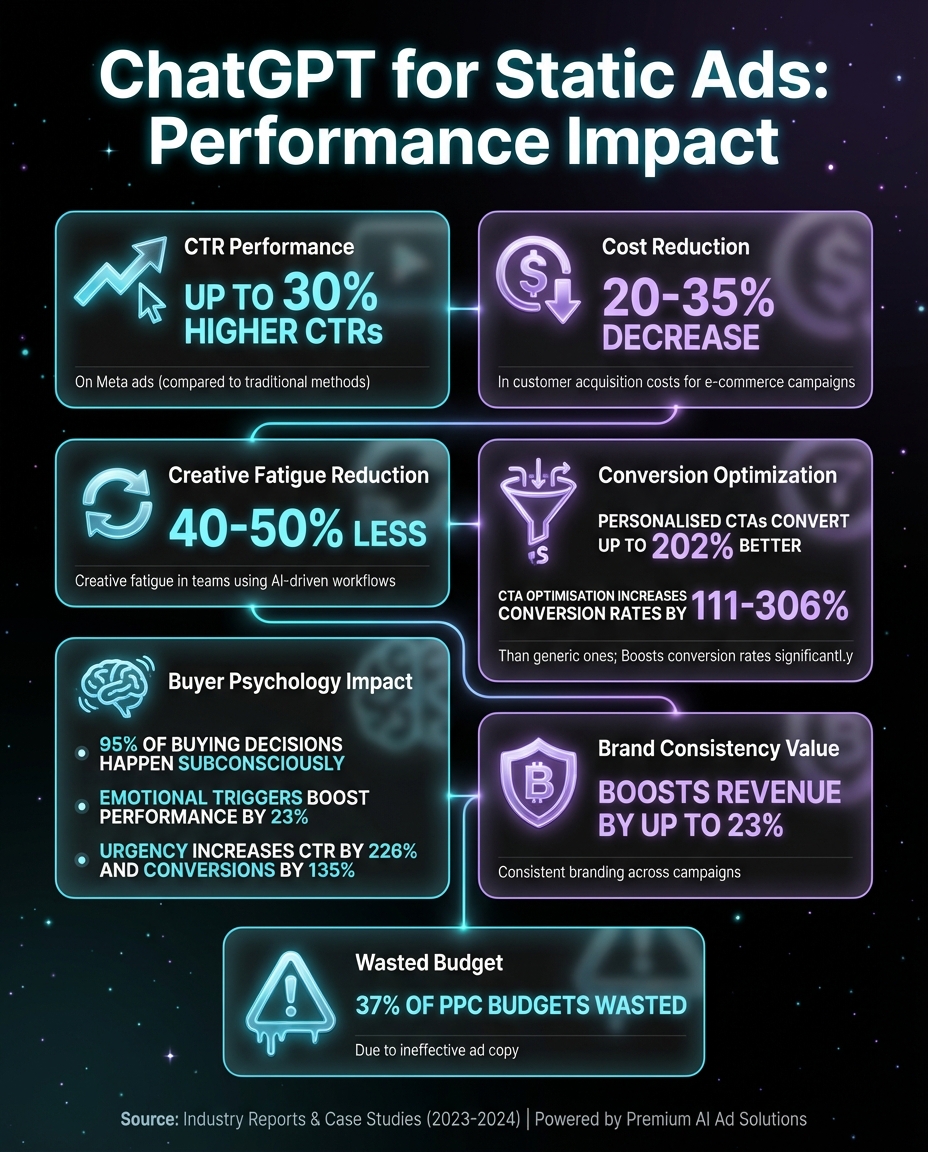
ChatGPT Ad Performance Statistics: CTR Improvements and Cost Reductions
How to Write Great Ad Copy with ChatGPT
Put the playbook to work
Apply this playbook to your page
Paste your website and the Lab will turn the strategy you are reading into a ready-to-test ads.
Free to try No prompt writing
1. Ad Headlines
A strong headline is your first chance to grab attention and drive conversions.
Using Role-Specific Prompts for Better Headlines
To sharpen headline creation, assign ChatGPT a specific professional role. For example, you could ask it to act as a "Meta Ads copywriter" or "Google Ads specialist". This approach helps the AI tailor its suggestions to match platform requirements, audience behavior, and campaign goals.
For Meta ads, you might use a prompt like this:
"Act as a Meta Ads copywriter. Write 5 high-converting headlines for [product], targeting [audience]. Focus on [benefit] and include a call to action. Keep each under 8 words to ensure clarity and impact."
For Google Ads, try:
"Act as a Google Ads specialist. Write 3 RSA headline sets (30 characters each). Use urgency and social proof, but avoid clickbait."
The 30-character limit is essential for Google’s Responsive Search Ads (RSA), ensuring the headlines fit within the platform’s constraints while encouraging immediate action.
Adding Quantitative Anchors and Brand Consistency
To make these outputs more effective, include measurable goals like target CTR, CPA, or ROAS. This ensures the AI generates performance-focused suggestions. Additionally, uploading brand guidelines and Voice-of-Customer (VoC) research keeps the tone consistent with your brand identity.
"Voice-of-customer research is key. It always was, always is, and always will be." – Vesna Mirosavljev, Author, Copyhackers
Once your headlines are optimized, you can move on to refining other ad components, like primary text, to complete your campaigns. If you need more inspiration, you can also use an ad copy idea generator to brainstorm creative variations.
2. Primary Text
The primary text of an ad is where you can truly connect with your audience. It’s not just about delivering information - it’s about sparking emotion, addressing pain points, and building trust. When done right, this text can turn a casual scroller into an engaged customer.
Using Narrative Frames to Experiment with Ad Angles
A smart way to approach ad writing is by testing different storytelling angles and Meta ad copy frameworks. For instance, you can use ChatGPT to create three types of narrative frames: aspirational, emotional, and authority-based. This allows you to experiment with how your audience responds to various styles while keeping the offer consistent. Here’s a sample prompt you can use:
"Act as a performance marketing creative strategist. Write primary text for a Meta ad promoting [product] to [audience]. Generate three versions: aspirational, emotional, and authority-based. Keep each under 125 characters and include a pain-point-driven hook in the first sentence."
This approach can uncover which narrative strikes the strongest chord with your audience, giving you valuable insights for future campaigns.
Shifting the Tone for Retargeting Campaigns
When it comes to retargeting, the tone and focus need to shift. These ads target users who are already somewhat familiar with your product but haven’t converted yet. The goal here is to address their hesitations and provide that final push.
For retargeting text, focus on emotional reassurance and clear, compelling offers. For example:
"Write retargeting ad primary text for retargeting campaigns. Address objections such as [price concern/trust issue], provide reassurance, and include a limited-time offer. Use a conversational, brand-aligned tone."
Making Your Prompts Specific and Impactful
To avoid generic or bland results, include as much context as possible in your prompts. Specify details like:
- The platform (e.g., Meta, Google, TikTok)
- The character limit (e.g., under 125 characters)
- Emotional triggers (e.g., urgency, trust, excitement)
- Audience specifics (e.g., age, pain points, stage of awareness)
For even more tailored results, ask ChatGPT to rate its output on clarity, relevance, and emotional impact using a 1-10 scale. This extra step ensures your text is sharp, engaging, and aligned with your goals.
3. Calls-to-Action
Your call-to-action (CTA) is what turns interest into action. It’s the final step in guiding users toward conversion, and crafting the right CTA can make all the difference.
Crafting CTAs That Match User Intent and Journey Stage
An effective CTA aligns perfectly with where the user is in their journey. For instance, a direct “Buy Now” works well on high-intent pages, while softer options like “Learn More” are better for users still in the discovery phase.
Here’s a powerful stat: personalized CTAs can convert up to 202% better than generic ones. This means tailoring your CTAs to specific audiences - like first-time visitors versus those who abandoned their carts - can dramatically improve results. In fact, optimizing CTA copy and placement has been shown to increase conversion rates by 111% to 306%.
Keep your CTA button text short and clear - ideally 2 to 4 words. Use phrases that highlight urgency or value. For example, instead of the generic “Click Here,” try something more action-oriented like “Get My Free Guide” or “Start Saving Today”.
If you’re brainstorming ideas, here’s a prompt to generate multiple CTA variations for testing:
"Write 10 concise CTAs (2–4 words each) for a campaign promoting [product/offer]. Each should highlight urgency or benefit without being too pushy. Our audience is [brief audience description]."
For cart abandoners, you could refine it further:
"Suggest three CTAs to encourage cart abandoners to complete their purchase by emphasizing [benefit/offer]."
Testing CTA Styles for Maximum Impact
To find the most effective approach, experiment with CTAs that tap into different psychological triggers. For example:
- Problem-led: Focus on solving a pain point.
- Desire-led: Highlight a benefit or aspiration.
- Curiosity-led: Spark intrigue to encourage clicks.
For Meta ads, keep button text under 40 characters and description lines under 30 characters to ensure they look clean and clear on mobile devices. Testing these variations and optimizing Meta ad campaigns can help you discover what resonates most with your audience and drives the best results.
4. Ad Variations
Creating Multiple Versions That Test Different Angles and Audiences
When creating ad variations, the key is to test different messages tailored to specific audience segments. The trick? Change only one variable at a time. This method ensures you can pinpoint exactly what drives performance. It builds on earlier strategies for headlines and primary text by focusing on individual creative elements. You can also leverage AI platforms for ad asset creation to speed up this process.
By isolating one variable - like a psychological hook or target audience - you can generate variations that are both insightful and actionable. For example:
"Act as a performance marketing creative strategist. Generate three ad variations for [product/offer]. Target three segments: analytical buyers (35–50), values-driven millennials, and budget-conscious first-time buyers. Use a problem-led hook for the first, a desire-led hook for the second, and a curiosity-led hook for the third. Keep the CTA consistent across all three. Output in a table with columns for Segment, Headline, and Primary Text."
This type of prompt allows you to test messaging that resonates with distinct groups while maintaining a consistent foundation.
You can also experiment with different psychological approaches for the same audience. For instance, ask ChatGPT to reframe your core message in three ways: one focusing on the problem your product solves, another highlighting the aspirational benefits, and a third showcasing social proof, like testimonials or user statistics. This strategy helps uncover the angle that connects best with your audience.
When A/B testing Meta ads, aim for a 20% relative improvement as your benchmark, particularly for newer or lower-traffic placements. Once you've fine-tuned your ad variations, they can seamlessly align with your brand identity, setting the stage for the next step.
5. Brand Alignment
Making Sure Your Ads Reflect Your Brand, Not a Generic AI
Your ads need to sound like you. They should capture your brand's unique tone, personality, and vocabulary - not some cookie-cutter AI output. Why? Because when your audience sees consistency in how your brand communicates, it builds trust and recognition. In fact, consistent branding across all platforms can boost revenue by up to 23%. So, nailing this consistency is not just a nice-to-have - it’s essential.
To achieve this, crafting the right prompt for ChatGPT is key. The best approach is to assign ChatGPT a role, like "Brand Voice Guardian" or "Brand Editor", and provide it with clear reference materials. These could include your brand guidelines or examples of your top-performing ads. Instead of broadly asking for "on-brand copy", give ChatGPT 3–5 examples of successful ads. Then, instruct it to analyze the specific patterns in those examples - things like sentence structure, emotional tone, and word choice - and apply those insights to new ads.
Here’s a prompt you can use:
"Act as a brand editor. Compare this ad draft against [brand_guide.md]. Flag any misalignments in tone, phrasing, or claims, and output a table with columns: Issue, Excerpt, and Suggested Fix."
This structured process helps ChatGPT review your reference material, compare it to the new ad draft, and suggest only the minimal changes needed to ensure everything aligns.
Another pro tip? Include a "words to avoid" list in your prompt. This ensures ChatGPT steers clear of generic marketing buzzwords that don’t fit your brand’s personality. After all, your brand’s distinct voice is what grabs attention and makes people pause their scrolling - don’t lose that edge. This is especially critical when you scale winning creatives across multiple campaigns.
6. Creative Scaling
Turning Winners Into a Repeatable Creative Engine
Scaling static ads starts with analyzing creative signals that predict winners and expanding their success across different audiences, platforms, and messaging angles. ChatGPT can play a big role here by breaking down your top ads - those with high click-through rates (CTR) or strong return on ad spend (ROAS) - and generating variations that stick to the winning formula while introducing fresh perspectives.
Here’s a prompt structure that can help you get the most out of this process:
"Act as a performance marketing strategist. Analyze this CSV of last month's ad performance. Identify all ads where CTR ≥ 3%. Extract the shared themes from these top performers. Then generate 3 new narrative frames based on these themes: one aspirational, one emotional, and one authority-based. For each frame, write 3 headline variations."
This structured approach ensures the AI works with real data and generates ad variations tailored to specific buyer stages. For instance, you can create educational content for awareness, benefit-driven copy for consideration, and urgency-focused messaging for conversions. The idea is to make your creative efforts deliberate and aligned with proven themes.
Another critical aspect of scaling is adapting successful strategies for different platforms. For example, a headline that works well on Facebook (with a 40-character limit) may need adjustments to fit Google Ads (30-character limit) or LinkedIn (50-character limit). A simple prompt like, "Rewrite this top-performing Facebook headline to fit Google Ads' 30-character limit while keeping the core benefit and emotional hook intact," can help you repurpose winning content across platforms without losing its effectiveness.
Did you know that nearly 37% of PPC budgets go to waste due to ineffective ad copy? Using ChatGPT to refine and scale what’s already working takes the guesswork out of the equation. It transforms creative production into a data-driven process, ensuring your ad strategy builds on success and continues to deliver results over time.
7. E-commerce Optimization
E-commerce optimization focuses on aligning your messaging with specific buyer intents, ensuring that your content resonates with the right audience at the right time.
Product Descriptions That Speak to Specific Shoppers
To succeed in e-commerce, your ads need to go beyond listing features - they should truly connect with your target audience. With tools like ChatGPT, you can create product messaging tailored to different customer segments, whether you're speaking to impulse buyers or those who prefer to research before making a purchase.
Try using a 5-part framework - Role, Audience, Task, Context, Output - to guide AI in crafting conversion-focused messaging. For example, you could enter a prompt like:
"Act as a conversion-focused e-commerce copywriter. Write 5 Instagram ad captions for busy moms during back-to-school season. Highlight time-saving benefits and include a 25% off discount. Keep each caption under 100 characters and include one emoji per caption."
This level of specificity ensures that ChatGPT delivers messaging that speaks directly to your audience and drives action.
Similar to iterating Meta ads at scale, e-commerce optimization thrives on segmentation. For instance, you can ask ChatGPT to create three variations of the same product ad, each tailored to a different stage of the buyer's journey:
- Awareness: Focus on educating potential customers about the product.
- Consideration: Highlight key benefits to encourage further interest.
- Conversion: Use urgency and incentives to drive immediate action.
You can even include design-related details, such as visual cues, to ensure your ad copy aligns with your brand's aesthetic. You can also leverage AI platforms for Meta ads to streamline this creative process.
To refine your approach further, upload performance data in a CSV format. Use this data to identify which narratives resonate most with specific customer segments. Then, expand on those successful themes for new segments by tweaking tone and value propositions. This data-driven strategy replaces guesswork, helping you fine-tune your e-commerce efforts for better results.
8. Buyer Psychology
Emotional Triggers That Drive Conversions
Understanding buyer psychology is a game-changer when it comes to creating ads that truly connect. Research shows that 95% of buying decisions happen subconsciously, driven more by emotions than logic. This means your static ads should aim to tap into those emotional instincts to drive conversions.
The most impactful emotional triggers include scarcity, social proof, authority, reciprocity, urgency, loss aversion, and simplicity. The trick? Focus on one trigger per ad. Trying to cram multiple emotional appeals into a single ad can overwhelm your audience and dilute the message. These emotional triggers work hand-in-hand with earlier strategies for optimizing headlines, primary text, and CTAs.
One of the strongest triggers is loss aversion - the idea that people fear losing something more than they desire to gain something. In fact, the pain of loss is said to be twice as strong as the joy of gain. For example, Amazon leans into scarcity on most of its product pages with phrases like "Only 3 items left!" This creates a sense of urgency and activates the fear of missing out, compelling users to act quickly.
Here’s how you can use loss aversion in your strategy:
- Reframe your messaging to highlight what users stand to lose by not acting. For instance, try prompts like: "Rewrite this headline to emphasize what users risk losing by not acting now."
- Dive into your audience’s mindset with empathy-focused prompts like: "Act as a consumer psychologist. Map out the fears of [Target Audience] regarding [Product]. Which emotional trigger - Scarcity, Social Proof, or Loss Aversion - would address those fears most effectively?"
Why does this matter? Ads that use emotional triggers tend to perform 23% better. Incorporating these triggers can boost conversions by up to 150%, while urgency alone can lead to a 226% increase in click-through rates and a 135% jump in conversions.
Use these psychological principles to fine-tune your creative approach and test them in your next ad campaign.
9. Landing Page Alignment
Message Match: The Bridge Between Click and Conversion
Even the most well-crafted ad can fall flat if the landing page doesn’t deliver on its promises. When the message in your ad doesn’t align with the content on the landing page, you risk wasting ad spend and losing potential conversions. To maintain momentum, your landing page must reflect the same precision and creativity as your ad copy.
ChatGPT can help you achieve this crucial alignment by ensuring the message in your ad is echoed on your landing page. Here’s how you can use it effectively:
Start by feeding ChatGPT your landing page copy with a clear prompt like:
"I am going to provide the copy from my landing page. Please identify the primary headline, the main call-to-action, and the top three benefits mentioned. Do you understand?"
Once the context is set, ask ChatGPT to craft ads that perfectly mirror the landing page messaging. For example:
"Based on the landing page details provided, write 5 static ad headlines and primary text variations that use the same value proposition and terminology to ensure a 1:1 message match."
To ensure consistency, focus on these four key areas: the core promise, visual tone, specific call-to-action, and objection handling. For instance, if your ad promises "Download the Free Guide", the landing page should reflect this exact phrase, rather than offering something vague like "Get Started." You can even use ChatGPT as a quality checker by assigning it a role:
"Act as a Senior Media Buyer. Compare this ad copy to the landing page text and identify any gaps or inconsistencies that could lead to user drop-off. This is a critical step when you scale ad testing to ensure budget efficiency."
Large Language Models are particularly skilled at identifying text mismatches. To maintain a consistent brand voice, you can use a tone alignment prompt such as:
"Analyze the tone of this landing page [Insert Text]. Now, write 3 ad variations that maintain this exact brand voice so the transition from ad to page feels seamless."
This approach eliminates the risk of a friendly, approachable ad leading to a landing page with a formal, corporate tone.
10. Performance Iteration
Building on strategies like creative scaling and aligning landing pages, performance iteration takes things a step further by using real-world data to refine your campaigns.
Turn Data Into Your Next Winning Ad
One of ChatGPT's standout abilities is its knack for turning past performance data into actionable insights. Instead of spending hours manually sifting through metrics, you can use real-time tracking practices to feed ChatGPT your performance data and receive tailored recommendations in return.
Here’s how to get started: Export a 7-day Meta Ads performance report as a CSV file. Be sure to include key columns like creative_id, spend, conversions, CTR, and CPA. From there, use a structured prompt to guide ChatGPT’s analysis. For example:
"Act as a Performance Marketing Analyst. I'm providing a 7-day ad performance export. Top-performing ads = top 10% CTR and ROAS above 3.0. Analyze this data and group ads into three categories - Pause (ROAS below 2.0), Scale (ROAS above 3.5), and Create (generate new hypotheses based on winning themes). Present the results in a table."
This "Pause, Scale, Create" framework simplifies decision-making and eliminates guesswork. By following this system, you can consistently build on what works, ensuring your ads evolve based on proven results. It also helps prioritize your next three test ideas, keeping performance steady and reducing the risk of decline.
Conclusion
ChatGPT prompts are changing the game for ad creation, turning what used to be a slow and costly process into a automated ad production system. By automating tasks like crafting headlines, primary text, calls-to-action, and even tapping into buyer psychology, you can produce dozens of high-performing ad variations in just minutes. Marketers who’ve embraced AI prompts have seen up to 30% higher CTRs on Meta ads compared to traditional methods. On top of that, e-commerce campaigns using AI have achieved a 20–35% decrease in customer acquisition costs. That’s not just quicker - it’s a smarter, more profitable approach.
This isn’t just about saving time. It’s about gaining a competitive edge. With AI, you can test 5–10 times more creatives, tackle creative fatigue before it impacts your results, and refine your ads based on real performance data. Teams using AI-driven workflows report 40–50% less creative fatigue, allowing them to focus on strategic decisions like optimizing landing pages and scaling campaigns. These advantages make AI a key player in outperforming traditional methods, especially when it comes to performance iteration.
Ready to get started? Use these prompts in ChatGPT for your next Meta campaign. Test 5–10 variations, track your CTR and ROAS in Meta Ads Manager, and use the "Pause, Scale, Create" framework from the Performance Iteration section. Your next winning ad could be just one prompt away.
To make this framework work for you, start with the area that needs the most attention. Struggling with headlines? Check out Section 1. Need better CTAs? Head to Section 3. The modular design means you can jump in right away, with minimal risk and plenty of potential for reward.
FAQs
What details should I include in a ChatGPT prompt for better ads?
When creating prompts for ChatGPT to generate ads, it's important to include all the essential details. Here's what you should focus on:
- Product or Service: Clearly explain what you're advertising. Be specific about what makes it stand out.
- Target Audience: Define who you're trying to reach. Are they young professionals, parents, or tech enthusiasts? The more specific, the better.
- Main Benefits or Features: Highlight the key selling points. Is it affordable, eco-friendly, or packed with innovative features?
- Tone or Style: Specify the vibe you're going for - should it be formal, playful, or conversational?
- Call-to-Action (CTA): Include a clear directive, like "Shop now", "Learn more", or "Sign up today."
By providing these details in a clear and concise way, the AI can produce ads that are not only attention-grabbing but also designed to drive conversions effectively.
How do I A/B test ChatGPT ad variations without changing too much?
When running A/B tests on ChatGPT ad variations, focus on making small, incremental changes to elements like headlines, calls-to-action, or visuals. Keep the core message and structure of the ad consistent. Why? Because this strategy allows you to measure the impact of specific adjustments without confusing your audience or straying from the ad's original intent.
By testing minor elements, you can pinpoint what works best while ensuring your campaign remains clear and cohesive.
How can I use ChatGPT to match my ad copy to my landing page?
To ensure your ad copy and landing page work together seamlessly, provide clear details about your landing page when using ChatGPT. This could include the page's content, tone, and key elements.
Here’s how to do it:
- Share the landing page URL or a detailed description of the page.
- Instruct ChatGPT to match the messaging and style of the landing page.
This approach helps create a consistent experience for users, making it easier for them to connect the ad with the landing page. The result? A smoother journey that can lead to better conversions.
Your next ad batch starts here
Finish with a ready-to-test ad batch
Paste your website to generate static creatives. Drop the link → get ads in about 90 seconds → upload them to Meta → scale.
Free to try No prompt writing