Copy-Paste AI Prompts for Creative Volume: How to Scale Output Without Hiring Designers
Use the prompts on your real offer
Generate these ad angles for your product
Skip the blank prompt box. Paste your product page and ADEN'S LAB applies the angles to your offer, images, headlines, and copy.
Free to try No prompt writing

If you're running Meta ads, you’ve likely faced this frustrating challenge: keeping up with the constant demand for new ad variations. Creative fatigue - when ad performance plummets due to overused designs - can double costs and kill results. Traditional solutions like hiring designers or agencies are too slow and expensive to meet the pace Meta's algorithm requires. Even manual AI prompting falls short, as it quickly becomes time-consuming and inconsistent.
The solution? Automation. Systems like Aden's Lab eliminate the need for manual prompts, generating over 100 Meta-ready ads in under 90 seconds. This approach saves time, cuts costs (as low as $0.90 per ad), and delivers results faster. Brands that adopt automated tools can test more variations, find winning ads quicker, and outperform competitors.
Key insights from the article:
- Creative fatigue is inevitable, requiring constant ad updates to maintain performance.
- Manual AI prompts are slow and inconsistent, costing time and money.
- Tools like Aden's Lab automate the process, producing optimized ads in seconds.
- Automated systems save up to 90% on creative costs and significantly boost ROI.
If your ad campaigns are stuck in a cycle of delays and rising costs, automation is the game-changer you need.
How we Automated a Meta Ad Agency with AI
Put the playbook to work
Apply this playbook to your page
Paste your website and the Lab will turn the strategy you are reading into a ready-to-test ads.
Free to try No prompt writing
Why Copy-Paste Prompts Don't Scale for Meta Ads
At first glance, manually crafting prompts for Meta ads seems like a solid strategy. But when you're managing campaigns at scale, the cracks start to show. The issue isn't that prompts don't work; it's that they work inconsistently, and inconsistency can wreck your results - especially when you're spending big on Meta ads. Sure, one prompt might deliver a winning headline, but slight adjustments often lead to bland, off-brand, or ineffective copy. Before you know it, you're sinking more time into tweaking prompts than actually running and testing ads.
Time and Money Lost to Manual Prompting
Relying on copy-paste prompts can quickly turn into a time sink. You generate an ad, realize it's not quite right, tweak the prompt, regenerate, edit, and repeat. What should take minutes can balloon into days of back-and-forth. Meanwhile, your competitors are already testing their next round of creatives.
Here’s the real kicker: delays cost money. I've seen campaigns lose $10,000 a week because outdated ads stayed live too long, simply because new variations weren’t ready. Every extra day spent fiddling with prompts or reviewing outputs eats into your budget, driving up your cost per acquisition. And even the best prompts need constant tweaking to fit different audiences, angles, or messages. This endless cycle drains resources and speeds up creative fatigue.
Creative Fatigue Kills Ad Performance
Meta's algorithm thrives on novelty. Ads that perform well at first often see click-through rates nosedive after just 7–14 days. Costs can double - or worse, triple. If you're running a high-budget campaign, say $50,000 a month, you’ll need to churn out 20 or more fresh ad variations every week just to keep things steady. The bigger the budget, the faster you burn through creatives.
Manual prompting just can’t keep up. You end up recycling the same concepts with minor tweaks, which fails to satisfy Meta's algorithm. Without truly fresh ideas, your ad costs skyrocket while performance drops. The brands that succeed on Meta aren’t necessarily the ones with the best products - they’re the ones with systems in place to automate Meta ad production at lightning speed. Competitors generating hundreds of variations while you're stuck with a handful will always find and scale the winning ads faster.
Why Static Ads Still Win on Meta
When manual methods stall, static ads become the go-to solution. They load faster than carousels or videos, making them perfect for Meta's mobile-first, fast-scrolling audience. Static images grab attention instantly and convert well without the production headaches of video.
They’re also much easier to test at scale. You can launch thousands of static variations quickly, avoiding delays caused by video rendering or file issues. For campaigns delivering millions of impressions daily, static ads consistently perform because they fit seamlessly into Meta's system. There’s no need for motion optimization or sequencing - just simple, fast-loading creatives that stop the scroll and drive clicks.
10 Ready-to-Use Prompts for Meta Ad Headlines and Copy
Struggling with the time-consuming process of crafting ad copy? These 10 ready-to-use prompts can help. Built on proven direct-response frameworks and backed by real-world ad spend data, these prompts are designed to generate high-performing copy quickly. By giving the AI the right context - your product, audience, and the angle you’re testing - you can create ads that resonate with buyer psychology instead of producing generic, ineffective text. These prompts are all about cutting through creative delays that can drain your ad budget.
For headlines, try this:
"Act as a direct-response copywriter with 10+ years running Meta ads. For [product name] targeting [specific audience], generate 10 headlines under 40 characters using the PAS framework - identify the problem ([pain point]), agitate with ([consequence]), and solve with ([key benefit]) - and include urgency with a call-to-action."
This method has been shown to improve click-through rates (CTR) by 47% in real campaigns. Why? Because it mirrors how people scroll: the problem grabs attention, the agitation keeps them engaged, and the solution drives action. It’s a structured, reliable way to eliminate the trial-and-error process of manual prompting.
For primary text, use this approach:
"Draft 5 Meta ad primary texts under 125 characters for [product/service] targeting [audience]. Use AIDA: grab attention with [emotional hook], build interest with [specific benefit], create desire with [social proof or proof point], and end with a call-to-action like 'Shop Now' or 'Claim Offer'."
This framework has been shown to double return on ad spend (ROAS) in tests by delivering the full conversion journey in just a few seconds. It’s a consistent way to produce clear, compelling copy without endless revisions.
For A/B testing variations, try this:
"Create 10 headline variations for [product] on Meta: 3 urgency-focused (e.g., 'Last Chance', 'Ends Tonight'), 3 benefit-driven (e.g., 'Get [result] in [timeframe]'), 3 question-based (e.g., 'Tired of [pain point]?'), and 1 control. Target [audience]."
By testing multiple angles at once, Meta’s algorithm can quickly identify which performs best, reducing wasted ad spend by up to 50% in unoptimized campaigns. This approach saves time and resources while improving campaign performance.
For social proof, use prompts like these:
"Incorporate this testimonial '[actual customer quote]' into 3 Meta ad primary texts for [product] targeting [audience]. Integrate a concise problem-solution narrative and end with a call-to-action."
Or:
"Generate 5 Meta headlines using social proof for [product]: for example, 'Join 10,000+ users who [specific benefit]'."
Customer testimonials can boost conversions by 15–30% on Meta, as they build trust and credibility immediately. These prompts ensure you’re using testimonials effectively, creating ad copy that feels authentic and persuasive.
Prompts for Generating Static Ad Visuals at Scale
When it comes to visuals, the strategy differs significantly from crafting copy. You can't just tell an AI to "make a good ad" and expect a scroll-stopping design. AI-generated visuals often lack personality and can feel generic. The goal isn't just to create attractive images but to develop visuals that stand out in mobile feeds, emphasizing clear marketing messages. This means prioritizing bold layouts, clear visual hierarchy, and designs that grab attention in seconds.
Visual Prompts That Stop the Scroll
Start by focusing on structure rather than style. A clear prompt should define the layout, focal points, and mobile-friendly format. For instance, if you're creating a product-focused ad, your prompt might look like this:
"Design a vertical 1080x1920px static ad for [product name]. Place the product in the top 60% of the frame on a solid [brand color] background. Add bold white text overlay in the bottom third: '[key benefit in 5 words or less]'. Include a small '[discount percentage] OFF' badge in the top-right corner. The design should be clean, high-contrast, and optimized for mobile viewing."
This approach ensures the AI prioritizes a mobile-first design - a critical factor since over 90% of social media users access platforms on mobile devices. A vertical format fills the screen, making text legible and presenting information in a clear, digestible way.
For carousel ads, it's essential to outline each frame individually to avoid repetitive or disjointed sequences. Here's an example:
"Create a 5-frame carousel for [product].
Frame 1: Close-up product shot with a '[pain point question]' overlay.
Frame 2: Lifestyle image showing the product in use.
Frame 3: Customer review quote '[actual testimonial]' on a solid background.
Frame 4: Before/after comparison.
Frame 5: Clear CTA '[Shop Now]' with product price.
Each frame should be 1080x1080px."
Text overlays can be tricky for AI to get right, so be explicit about font size, placement, and contrast. For example:
"Add text overlay '[headline]' in 72pt bold font, positioned in the top 20% of the image with a semi-transparent black background bar for contrast. Ensure the text is legible on mobile screens."
Once you've nailed the layout, the next step is to generate multiple versions that test different creative approaches.
Creating Multiple Variations Without Quality Loss
A common pitfall is making only minor adjustments, like changing background colors or tweaking font sizes. While these changes technically count as variations, they rarely offer the fresh creative concepts platforms like Meta require for effective testing. Instead, focus on creating distinct versions that appeal to different buyer motivations.
For instance, if you're advertising a fitness product, you might create one version highlighting transformation (e.g., a before/after image), another showcasing social proof (like a customer testimonial), and a third addressing objections (e.g., "No gym required"). Each variation should present the product from a unique perspective, tapping into different triggers.
A sample prompt for this could be:
"Generate 3 static ad variations for [product].
Version 1: Highlight the product with '[specific benefit]' as the headline, set against a lifestyle background.
Version 2: Feature a customer testimonial '[quote]' in a clean, text-heavy layout with a small product image in the corner.
Version 3: Display an '[objection-busting statement]' alongside a product comparison or feature callout.
All visuals should be 1080x1080px and adhere to [brand colors and logo placement]."
Using tools with "Brand Kits" can simplify this process. These kits store essential assets like logos, fonts, and color palettes, ensuring every variation stays aligned with your brand identity.
Scaling up these iterations can be challenging, but automation can make it more efficient. By leveraging systems that generate ad variations at scale, you can save time while maintaining quality, allowing you to focus on launching campaigns seamlessly on platforms like Meta.
When Manual Prompts Hit Their Limit
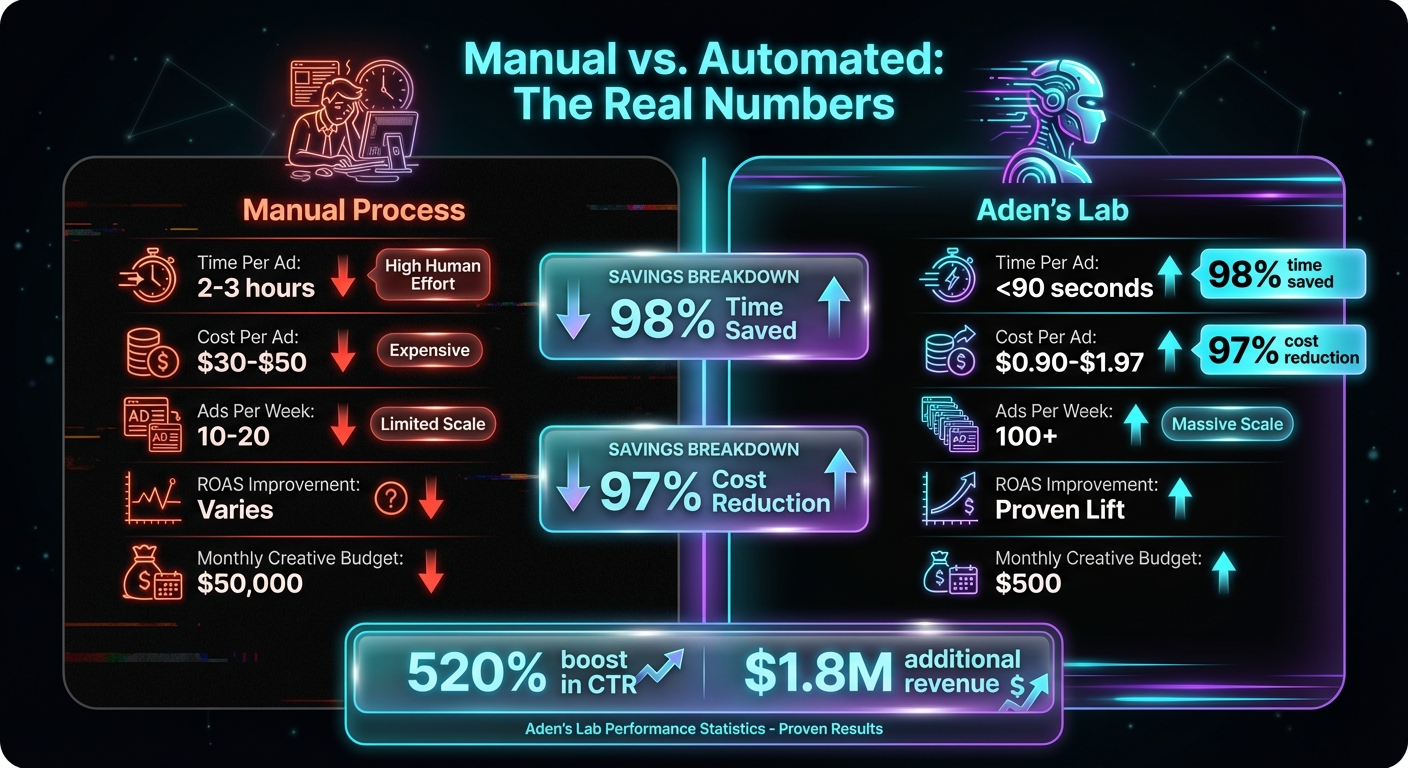
Manual vs Automated Meta Ad Creation: Cost and Time Comparison
Manual prompting might seem manageable at first, but it quickly becomes a bottleneck as demands increase. Even with a well-organized prompt library, creating each ad still requires crafting a tailored prompt, reviewing the output, tweaking it, and exporting the final version. This process takes around 2–3 hours per ad. Now imagine needing over 50 variations every week - those hours pile up fast.
But the real challenge isn’t just the time - it’s the mental toll. By the time you’re churning out your 20th ad for the week, you’re no longer thinking about strategy. Instead, you’re just scrambling to keep up, and that fatigue inevitably affects the quality of your work.
There’s also the issue of inconsistency. Different team members may interpret briefs in their own way, which can lead to mixed messaging in your campaigns. When your ads lack cohesion, Meta’s algorithm struggles to optimize delivery, resulting in weaker performance and a lower return on ad spend (ROAS).
Let’s break it down: managing a $100M annual ad account means producing around 100 new ad variations every month. That’s roughly 250 hours of work - essentially the workload of six full-time employees just to write AI instructions. This isn’t scaling; it’s swapping one roadblock for another. That’s where automation becomes a game-changer.
How Aden's Lab Removes the Creative Bottleneck
Aden's Lab takes the manual work out of the equation entirely. Instead of crafting prompts, you simply paste a product link. The system handles the rest - analyzing your product page, pulling benefits and objections from customer reviews, and generating everything from headlines and body copy to eye-catching visuals tailored for Meta’s feed. The entire process? Under 90 seconds.
By eliminating the human element in this step, Aden’s Lab removes delays and decision fatigue. It doesn’t tire, second-guess, or deviate from a proven framework. Built on patterns derived from billions in Meta ad spend, the system ensures every creative is optimized for conversions. Instead of relying on one person’s instincts, you’re tapping into performance data that’s been tested at scale.
Take Fashion Forward Co. as an example. Their CMO, Sarah Chen, had been working with an agency that needed three weeks to deliver 10 ads. After switching to Aden’s Lab, she produced over 200 variations in a single day. The results? The AI-generated ads outperformed the agency’s by 340%, driving $2.3M in additional revenue and slashing customer acquisition costs by 67%.
"ADEN'S LAB created 200+ ad variations in one day. Our previous agency took 3 weeks for 10 ads. The AI-created ads outperformed our human-created ones by 340%."
– Sarah Chen, CMO, Fashion Forward Co.
This shift is transformative. Instead of spending 80% of your time on production and 20% on strategy, those numbers flip. The question changes from, “What prompt should I write?” to, “Which of these 50 generated ads should I test first?” The real gains happen when you focus on identifying which creative approaches drive ROAS, rather than getting bogged down in creating each variation.
Manual Process vs. Automated: The Real Numbers
The numbers speak for themselves. Here’s a side-by-side comparison of manual workflows versus Aden’s Lab for Meta advertisers:
| Metric | Manual Process | Aden's Lab |
|---|---|---|
| Time Per Ad | 2–3 hours | <90 seconds |
| Cost Per Ad | $30–$50 | $0.90–$1.97 |
| Ads/Week | 10–20 | 100+ |
| ROAS Improvement | Varies | Proven Lift |
TechGadget Pro’s Growth Director, Mike Rodriguez, saw these results firsthand. His team had been spending $50,000 per month on creative agencies. After switching to Aden’s Lab for just $500 per month, they achieved a 520% boost in click-through rates, generated $1.8M in additional revenue, and reduced cost per click by 45%.
"We went from spending $50k/month on creative agencies to $500/month on ADEN'S LAB. The AI understands our tech audience better than any human designer ever could."
– Mike Rodriguez, Growth Director, TechGadget Pro
The savings go beyond dollars. When you can test 100+ variations weekly instead of being limited to a handful, you find winning strategies faster than your competitors. For a $100M ad account with a 3% ROAS, even a small 0.5% improvement translates to an additional $1.5M in revenue. Manual methods simply can’t match the speed and efficiency needed to unlock these gains. Shifting time away from production is essential for scaling Meta campaign performance.
Conclusion
Relying on manual prompting might seem effective at first, but it quickly becomes a time drain as fine-tuning takes precedence over scaling. Copy-paste prompts can provide a temporary lift, but they still require constant adjustments, quality checks, and human intervention.
Creative fatigue is another hurdle - CTR can plummet by over 50% after just a few rotations, necessitating frequent creative refreshes. Meanwhile, competitors using automation are testing upwards of 100 different angles, leaving manual methods struggling to keep up. This is where automation cutting Meta CPA becomes a game-changer.
Automated creative engines tackle these challenges head-on. For instance, Aden's Lab eliminates the need for manual effort entirely. Just drop in a product link, and within 90 seconds, you’ll have over 100 Meta-ready ads. Not only does this free up time for strategic planning, but it also comes at a fraction of the cost - just $0.90 per ad compared to the $50 typically spent on traditional design work.
Why spend hours creating ads manually when you can generate optimized ones in minutes? With one product link, you can produce ready-to-launch ads and shift your energy toward high-level strategy.
FAQs
How many new Meta ad creatives should I add each week?
To keep your campaigns effective and avoid creative fatigue, aim to produce 3-5 new Meta ad creatives each week. This steady flow of fresh content is especially crucial when scaling campaigns, as it helps sustain performance and prevents your audience from losing interest.
Why do my winning ads stop working after 7–14 days?
Ads that perform well initially often start losing their edge after 7–14 days. Why? It usually comes down to audience fatigue, where viewers grow tired of seeing the same ad repeatedly, or offer saturation, where the appeal of your offer diminishes over time. Another common culprit is high frequency - when the same people are exposed to your ad too often, it loses its impact.
Other contributing factors might include seasonal shifts in demand, creative burnout (your ad visuals or message no longer resonate), or overlapping targeting, which limits your ability to reach fresh audiences. Tackling these challenges head-on can help extend the lifespan of your ad's performance.
What do I need to use Aden’s Lab?
All you need is your product link. Just paste it into Aden’s Lab, and in about 90 seconds, it will generate high-converting Meta ads for you - no need for prompts, setup, or even a credit card. The entire process is fully automated, offering an effortless way to boost your creative output.
Your next ad batch starts here
Finish with a ready-to-test ad batch
Paste your website to generate static creatives. Drop the link → get ads in about 90 seconds → upload them to Meta → scale.
Free to try No prompt writing