Best Meta Ad Prompts for SaaS Startups
Use the prompts on your real offer
Generate these ad angles for your product
Skip the blank prompt box. Paste your product page and ADEN'S LAB applies the angles to your offer, images, headlines, and copy.
Free to try No prompt writing

In SaaS advertising, every dollar counts. Meta ads powered by AI-driven prompts can help SaaS startups lower customer acquisition costs (CAC) while driving better conversions. Here's a quick rundown of what works:
- Free Trial Ads: Focus on outcomes, not just features. Use short videos and high-intent targeting for better results.
- Demo Booking Campaigns: Offer personalized demos with clear CTAs like "No Credit Card Required" and leverage Meta's native lead forms.
- Feature Launch Ads: Highlight benefits, not technical details, and test multiple headlines to find what resonates.
- Testimonial Ads: Use detailed customer success stories to build trust and increase engagement.
- Retargeting Abandoned Trials: Address specific user pain points with personalized ads that guide them back to your product.
- Competitor Targeting Ads: Target dissatisfied competitor users by addressing their frustrations and offering clear solutions.
- Pricing Transparency Ads: Be upfront about pricing to build trust and improve click-through rates.
- Lead Generation Ads: Use pre-filled Meta lead forms for higher completion rates and cleaner data.
- Scaling Ad Prompts with AI Tools: Automate ad variations to test and optimize campaigns faster.
For SaaS startups, these tailored prompts are key to crafting high-performing Meta ads that convert without overspending.
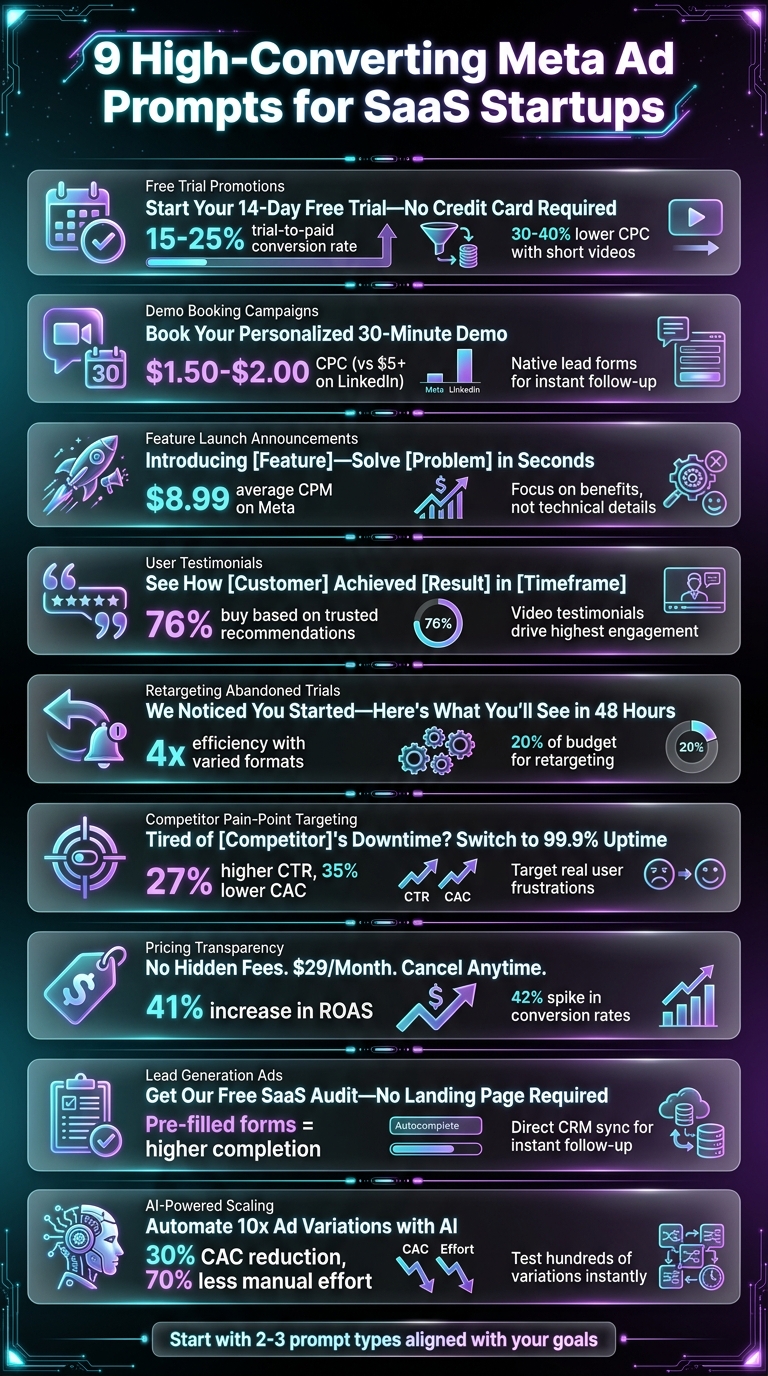
9 High-Converting Meta Ad Prompts for SaaS Startups
1. Free Trial Promotions
"Start Your 14-Day Free Trial - No Credit Card Required"
Want to make your free trial ads more effective? Use AI to craft prompts that not only grab attention but also attract high-quality leads while keeping customer acquisition costs low.
Free trial campaigns tend to have lower cost-per-click (CPC) compared to direct purchase ads. The trick is to focus on what the trial delivers rather than just listing features. For example, instead of saying, "Try our analytics platform", go with something like, "See your data trends in 14 days." This approach ties the trial to a specific, measurable outcome. AI tools for Meta ads can help fine-tune these prompts, ensuring they resonate with your target audience.
Short-form videos (15–30 seconds) showcasing user benefits are a game-changer. They can lower CPCs by 30–40% compared to static images. Keep text overlays minimal - less than 20% - and make sure they blend naturally with newsfeeds. Position text below or around visuals for a seamless look.
When it comes to converting free trial users into paid subscribers, the numbers are promising. On average, 15–25% of users make the transition, with top-performing campaigns hitting 30–40%. To achieve these kinds of results, focus your ads on high-intent audiences - like people who’ve visited your product page or interacted with your content. Targeting these groups helps secure 50+ weekly conversions, which is critical for AI optimization.
For SaaS products with an annual contract value (ACV) of $1,000 or more, free trials perform better than freemium models. Why? They encourage faster product evaluation and deliver immediate value. Your ad copy should highlight this urgency: "Get full access for 14 days - experience the ROI before you commit." This is especially effective for complex products, as the trial deadline motivates users to dive in and see results.
Lastly, don’t forget to segment your campaigns by country to account for CPM differences. For example, in the U.S., CPM averages around $20.48. Also, take advantage of seasonal trends - Q1 typically offers 15% lower CPMs compared to Q4.
Put the playbook to work
Apply this playbook to your page
Paste your website and the Lab will turn the strategy you are reading into a ready-to-test ads.
Free to try No prompt writing
2. Demo Booking Campaigns
"Book Your Personalized 30-Minute Demo - No Credit Card Required"
Demo booking ads work best when they eliminate hurdles and build trust. Instead of a generic "Request a Demo", offer something specific: a 30-minute personalized demo. This sets clear expectations for potential customers. Including "No Credit Card Required" further lowers the barrier, making it easier for users to take action.
To strengthen trust, highlight security certifications like "GDPR & SOC2 Type II" in your ad visuals. These reassure decision-makers about your platform’s security standards. On Meta platforms, the average cost-per-click (CPC) for B2B SaaS ads is around $1.50 to $2.00, which is far more cost-effective compared to LinkedIn, where CPCs often exceed $5.00.
Focus on high-intent audiences - those who have interacted with pricing pages, feature breakdowns, or blog posts. Use the Meta Pixel to track these interactions and target them with direct "Book a Demo" calls-to-action. For optimal results, aim for a minimum of 50 conversions per week. This helps Meta’s algorithm move out of the learning phase and improves ad performance. For more insights, check out these Meta ad optimization answers to common scaling questions.
Meta's native lead forms are a great option for collecting demo requests without redirecting users off the platform. These leads can be synced with CRMs like HubSpot or Marketo for instant follow-up. Additionally, create Lookalike Audiences from your current customer base to reach new prospects who share similar traits. This approach not only streamlines lead generation but also lays the groundwork for ongoing ad improvements by analyzing your CPA.
When designing your ads, keep text overlays minimal - under 20% of the image area. Ads with excessive text are categorized as "Low", "Medium", or "High" text by Meta, which can limit their reach. As Afsheen Ali, Product Marketing Manager at Facebook, explained:
"Our research has shown that people demonstrate a preference for ads with less text".
3. Feature Launch Announcements
"Introducing [Feature Name] - Now You Can [Solve Specific Problem] in Seconds"
When launching a new feature, focus on the benefits rather than diving into technical details. For example, instead of saying, "We added a new API integration", highlight the value it delivers: "Automatically sync your CRM data." This approach directly addresses the challenges your audience faces and shows how your feature solves them.
Pair these benefit-driven messages with engaging visuals to showcase your feature in action. Video ads are particularly effective for demonstrating how your software works, while carousel ads are perfect for multi-component features - each card can spotlight a different aspect of the update.
To fine-tune your messaging, consider using AI tools to generate and test headline variations. Generate 3–5 different headlines for your feature and allocate a small budget of $2–$5 per headline using AI-driven budget allocation. This method helps identify which message resonates best with your audience. For instance, with Meta's average CPM of $8.99, a $20 daily budget can deliver around 2,200 impressions - enough to gauge the effectiveness of your creative approach. Make sure your ad links to a dedicated landing page for the feature to keep the messaging consistent and drive better conversions.
4. User Acquisition via Testimonials
"See How [Customer Name] [Achieved Specific Result] in [Timeframe] - You're Next"
Testimonials work hand-in-hand with AI-driven ad prompts by offering social proof that helps lower customer acquisition costs (CAC). Just as free trial and demo campaigns emphasize clear benefits, testimonials bring credibility by showcasing real-world results to potential customers.
The most impactful testimonials go beyond generic compliments. They tell a transformation story, packed with specific details like "Reduced onboarding time from 2 weeks to 3 days." This kind of concrete example connects customer success directly to your conversion strategy.
Video testimonials are especially effective on platforms like Meta's Reels and Stories. To maximize engagement, structure them using the Hook-Value-CTA formula: start with a compelling customer success story, dive into their experience, and end with a clear call to action, such as "Start your free trial".
When writing ad copy, using the PAS (Problem-Agitate-Solve) framework can be a game-changer. Identify the pain point, emphasize its impact, and then show how your SaaS provides the solution. Research shows that 76% of people make buying decisions based on trusted recommendations, making this approach particularly effective.
Take the example of Adam Robinson, founder of RB2B, who scaled his SaaS to $5 million ARR between March 2024 and April 2025 with just a six-person team. His strategy? Turning free users into brand advocates by collecting over 50 G2 reviews and weaving authentic customer success stories - complete with revenue milestones - into his social proof campaigns. This highlights how genuine testimonials can drive growth.
AI tools can take your testimonial ads to the next level by analyzing customer feedback to identify recurring "quick wins" that resonate. They can also create multiple variations of the same testimonial for different formats - static images, Stories, or Reels - helping you figure out which emotional or practical angle hits the mark. Just remember to keep text overlays minimal; Meta's algorithm tends to limit the reach of ads with too much text.
5. Retargeting Abandoned Trials
"We Noticed You Started - Here's What You'll See in 48 Hours"
When it comes to addressing trial abandonment, precision and personalization are key. Meta's AI, Andromeda, highlights the importance of tailoring creative elements - like visuals, hooks, and language - to match users who are on the verge of converting. To make your retargeting ads effective, focus on understanding why users abandoned the trial in the first place and craft your messaging around that.
Start by analyzing user behavior. Look at the last 14 days of traffic data, focusing on pages visited (pricing, documentation, features) and session depth. This can reveal whether users dropped off due to setup anxiety, confusion over pricing, or not seeing immediate value. To dig deeper, Christopher Good suggests using AI to generate a ranked list of inferred user intent, pinpointing likely pain points and suggesting tailored offers like a diagnostic tool or calculator.
Your ad copy should directly address these pain points. Avoid generic calls-to-action (CTAs) like "Finish your trial." Instead, focus on specific outcomes, such as "See your first automated report in 48 hours" or "We'll migrate your data in one click." These kinds of CTAs reduce setup anxiety by offering guided onboarding and quick wins. Pair these with softer CTAs like "See how it works for your team" instead of pushing hard-to-commit language like "Buy Now."
Meta's GEM framework suggests using a variety of formats - like UGC videos, carousels, and testimonials - rather than minor variations of the same ad. This approach can improve efficiency and reduce your Meta Ads CAC by up to 4x. Allocate about 20% of your ad budget to retargeting efforts, keeping a balanced split with prospecting campaigns.
Lastly, ensure your retargeting ads align with the original offer. For example, if your initial ad promoted "real-time analytics", your retargeting message should continue that theme. This consistency prevents users from feeling like they’re starting over and keeps them moving forward in their decision-making process.
6. Competitor Pain-Point Targeting
"Tired of [Competitor]'s Downtime? Switch to Our 99.9% Uptime SaaS"
Using AI to identify and target competitor weaknesses can dramatically cut customer acquisition costs (CAC) while boosting conversions. Frustration with competing products is a strong hook for Meta ads. Instead of listing your features, focus on real problems users face with competitors - problems that drive them to seek alternatives. This strategy ties directly into existing dissatisfaction, making your ads more relevant to users already considering a switch.
The key? Research actual user complaints. Platforms like G2, Capterra, and Reddit are goldmines for uncovering patterns of frustration - things like slow performance, hidden fees, poor mobile functionality, or clunky interfaces. For example, in Q4 2024, Notion successfully targeted Evernote users who were fed up with sync failures. Their Meta ads, led by Growth Lead Alex Chen, stated: "Evernote syncing failing you? Notion syncs instantly across devices." The campaign reached 500,000 users, achieved a 4.2% click-through rate (CTR) - more than double the 1.8% industry average - and brought in 28,000 sign-ups, generating $1.2 million in annual recurring revenue (ARR).
To replicate this success, use AI to craft precise ad prompts. For example: "Generate a Meta ad for our SaaS tool targeting users of [Competitor X] annoyed by $49/month hidden fees. Highlight our $29/month transparent pricing, seamless mobile experience, and 'Start Free Trial' CTA. Use an urgent tone." This kind of prompt can lead to ads like: "Ditch [Competitor X]'s fee traps - get unlimited projects for $29/month!" These ads speak directly to the frustrations of potential customers.
On the Meta Ads Manager side, leverage interest targeting by focusing on competitor names (e.g., "Salesforce users") and create lookalike audiences based on your current customers. Test various pain points with ad sets running a daily budget of $5–$10. Pain-point ads often deliver a 27% higher CTR and can reduce CAC by up to 35% compared to generic feature-based ads. Just remember to keep your claims accurate - steer clear of direct attacks and instead focus on how your product solves these issues better. This method fits seamlessly into your broader AI-driven ad optimization strategy.
7. Pricing Transparency Prompts
"No Hidden Fees. $29/Month. Cancel Anytime."
Being upfront about your pricing is a game-changer. With so many brands vying for attention daily, showing clear, exact pricing immediately grabs interest. SaaS buyers want to know what they're committing to before they even click.
This clarity doesn’t just build trust - it delivers results. For example, Meta ads with transparent pricing have been shown to increase ROAS by 41% and highlight savings by up to 57%. A great case study is Humac, a Scandinavian Apple retailer. In 2025, they added exact pricing and "buy now, pay later" monthly amounts to their Meta catalog ads. The result? A 42% spike in conversion rates and a 23% increase in click-through rates.
For SaaS startups, ditch the vague messaging and replace it with real, tangible numbers. Use AI to create prompts that emphasize transparency. For instance:
"Write a Meta ad for our project management tool targeting small businesses. Headline: '$29/month - no hidden fees, cancel anytime.' Body: Highlight unlimited projects, 10 team members included, and transparent annual savings of $120. CTA: 'Start Free Trial.' Use a tone that builds trust."
"Pricing is no longer a back-office decision - it drives the entire go-to-market motion".
To maximize results, showcase annual versus monthly savings, use "sales badges" for limited-time discounts (which have been shown to boost ROAS by 48%), or display original versus discounted prices to see a 30% lift in performance. Remember, SMB buyers care most about affordability and simplicity, while enterprise customers focus on security and compliance. Tailor your campaigns to these priorities, and let pricing transparency do the heavy lifting - lowering CAC and driving conversions.
8. Lead Generation with Lead Ads
"Get Our Free SaaS Audit - No Landing Page Required"
Lead ads are a game-changer when it comes to reducing customer acquisition costs. Meta's Instant Forms make it incredibly easy to capture leads without redirecting users to a separate landing page. Instead, prospects can fill out a form directly within Facebook or Instagram. This streamlined process often results in higher completion rates and reduced acquisition costs. The cherry on top? Pre-filled forms pull information like name, email, and phone number straight from a user’s profile. This minimizes the chances of drop-offs and increases form submissions. For SaaS startups, this means more qualified leads at a lower cost.
AI can take these lead ads to the next level by helping you create ads that deliver value right out of the gate. For instance, you could use a prompt like this:
"Write a Meta lead ad for our CRM software targeting sales managers. Headline: 'Free 30-Day Trial - No Credit Card Required.' Body: Highlight automated follow-ups, pipeline tracking, and instant Slack integration. Use Instant Forms with pre-filled fields. Add a custom question: 'How many sales reps are on your team?' CTA: 'Claim Your Trial.' Tone: professional and direct."
To further refine your leads, consider adding custom qualifying questions such as "What's your company size?" or "What's your current software stack?" These questions help filter out low-intent prospects. You can also use SMS verification to weed out bot submissions and ensure cleaner data.
Lastly, syncing your lead ads directly with your CRM - whether it’s HubSpot, Salesforce, or Zoho - allows for immediate follow-up. Timing matters, so schedule your campaigns during peak engagement hours to keep your cost-per-lead as low as possible.
9. Scaling Ad Prompts with ADEN's LAB
"Automate Prompt Scaling with ADEN's LAB for 10x Ad Variations"
Creating ad prompts manually can take forever and seriously limit how many ideas you can test. That’s where ADEN's LAB steps in - it automates the whole process. Just feed in a single base prompt, and the platform generates hundreds of variations optimized for Meta campaigns, specifically designed for SaaS businesses. This automation can cut your CAC by as much as 30% by using AI to provide A/B testing insights and predict ad performance. Let’s break it down with an example.
Imagine you’re promoting a free trial for a project management tool. You might start with a prompt like:
"Scale this Meta ad prompt for a SaaS project management tool free trial: 'Struggling with team chaos? Try [Product] free for 14 days – unlimited tasks, real-time collab. Start now!' Generate 5 variations optimized for US mobile users, focusing on pain points and urgency."
ADEN's LAB would then produce options like:
- "Team tasks overwhelming? [Product] free trial: 14 days unlimited, sync in real-time. Claim yours!"
- "End project disarray – free 14-day [Product] trial with seamless collab. Get started free."
Each variation comes with AI-suggested targeting parameters, such as "tech managers, 25-45", along with engagement and performance predictions.
ADEN's LAB doesn’t just save time - it slashes manual effort by up to 70%. You can quickly generate, test, and implement variations, focusing on those with a predicted CTR above 1.5%, conversion rates over 5%, and relevance scores higher than 8. These top-performing prompts can lower CAC by 25% by improving ad relevance.
Here’s how to start: Use Meta analytics to define your core prompt pillars. For example, you could input: "Generate 20 Meta ad variations for SaaS demo booking, US English, $10-50k revenue startups." The AI will group outputs by format and priority, allowing you to A/B test the top 5-10 options in Meta Ads Manager. From there, refine further by prompting: "Optimize based on 2x CTR variants". This process takes minutes instead of days, all while keeping your creative sharp and your branding consistent. It’s a game-changer for boosting campaign efficiency and cutting CAC, perfectly aligning with SaaS-focused ad goals.
I've analyzed 460 SaaS ad campaigns - here's what works
Conclusion
Running Meta ads for SaaS isn’t just about increasing your ad spend - it’s about creating prompts that directly address your audience’s challenges, aspirations, and decision-making journey. Whether you’re promoting free trials, driving demo bookings, retargeting abandoned trials, or targeting competitor pain points, each type of prompt serves a unique purpose in guiding prospects through your funnel. These tailored approaches not only improve engagement but also help achieve specific business goals. Pairing these strategies with AI-driven tools takes performance to the next level, cutting customer acquisition costs (CAC) and driving higher conversions.
Scaling becomes even simpler with automation platforms like ADEN's LAB. This tool streamlines ad creation, tests multiple variations in minutes, and uses real-time data to determine the best-performing ads. By tapping into AI-optimized campaigns, you can see noticeable improvements in metrics like click-through rates (CTR) and return on ad spend (ROAS), leaving guesswork behind and embracing a data-first strategy.
Start small by choosing 2–3 prompt types, such as free trial promotions or retargeting abandoned trials, that align with your goals. Use ADEN's LAB to test them, track your CTR and CAC weekly, and fine-tune based on the insights you gather. The brands succeeding on Meta aren’t necessarily the ones with the largest budgets - they’re the ones consistently producing fresh, relevant creatives that the algorithm favors.
Now’s the time to use these AI-powered prompts to lower CAC, increase conversions, and stay ahead of the competition. The tools are available, the strategies are proven, and the results are waiting for you.
FAQs
Which Meta ad prompt type should I start with for my SaaS?
The best type of Meta ad prompt to kick things off for your SaaS business is a direct-response prompt. These prompts are designed to drive action, making them a powerful tool for creating ads that grab attention and encourage immediate engagement. For SaaS startups, this approach can be a game-changer, helping you attract users and generate leads efficiently. By starting with direct-response prompts, you can craft ads that connect with your audience and boost conversion rates right out of the gate.
How can I use AI prompts without compromising my brand voice?
To keep your brand voice consistent when using AI, start by designing prompts that match your tone and messaging style. Regularly test and tweak these prompts to ensure they connect with your audience. The key is to create specific and tailored prompts that mirror your brand’s personality and values. Avoid generic phrasing, as it can dilute your identity. By refining this process over time, you’ll ensure that AI-generated ads remain aligned with your brand’s unique voice.
What metrics should I track weekly to know my prompts are working?
Track essential metrics like click-through rates (CTR), conversion rates, cost per acquisition (CPA), and return on ad spend (ROAS) to measure your ad’s performance. Additionally, keep an eye on engagement stats such as likes, shares, and comments, as they provide insight into how well your prompts resonate with the audience. Together, these numbers can highlight what's working and reveal opportunities to fine-tune your approach.
Your next ad batch starts here
Finish with a ready-to-test ad batch
Paste your website to generate static creatives. Drop the link → get ads in about 90 seconds → upload them to Meta → scale.
Free to try No prompt writing