The Best Image Ad Prompts for Meta Ads in 2026
Build the ads while the examples are fresh
Turn your product page into static ad creatives
Paste your product URL and generate scroll-stopping images, headlines, and primary text—ready for your next Meta creative test.
Free to try No prompt writing

Want to create Meta Ads that convert faster in 2026? Here's the key: AI tools like Midjourney v6 and Meta's AI Sandbox make it possible to generate high-quality image ads in hours instead of weeks.
AI-generated content can cut production costs by up to 90% while boosting ad performance by 10–15%. The challenge now is refining AI outputs to create more effective, engaging ads. This guide breaks down the best strategies for crafting ad prompts that focus on product visuals, storytelling, social proof, and engagement-driven design.
Key Takeaways:
- E-commerce Ads: Use detailed prompts for lifelike product visuals (e.g., material textures, lighting) and contextual backgrounds that connect emotionally with your audience.
- SaaS & Service Ads: Leverage abstract visuals and "before-and-after" transformations to highlight outcomes instead of processes.
- Social Proof: Generate clean, realistic scenes with space for overlaying testimonials, ratings, and authority badges.
- Engagement Features: Design images that integrate animated call-to-action stickers and image-to-video transformations for Stories and Reels.
AI tools like Midjourney v6, DALL-E 3, and Meta's Advantage+ Creative Suite make these strategies accessible and efficient. The secret? Combine AI speed with human refinement to stay ahead of the competition. Let’s dive into how to make it work.
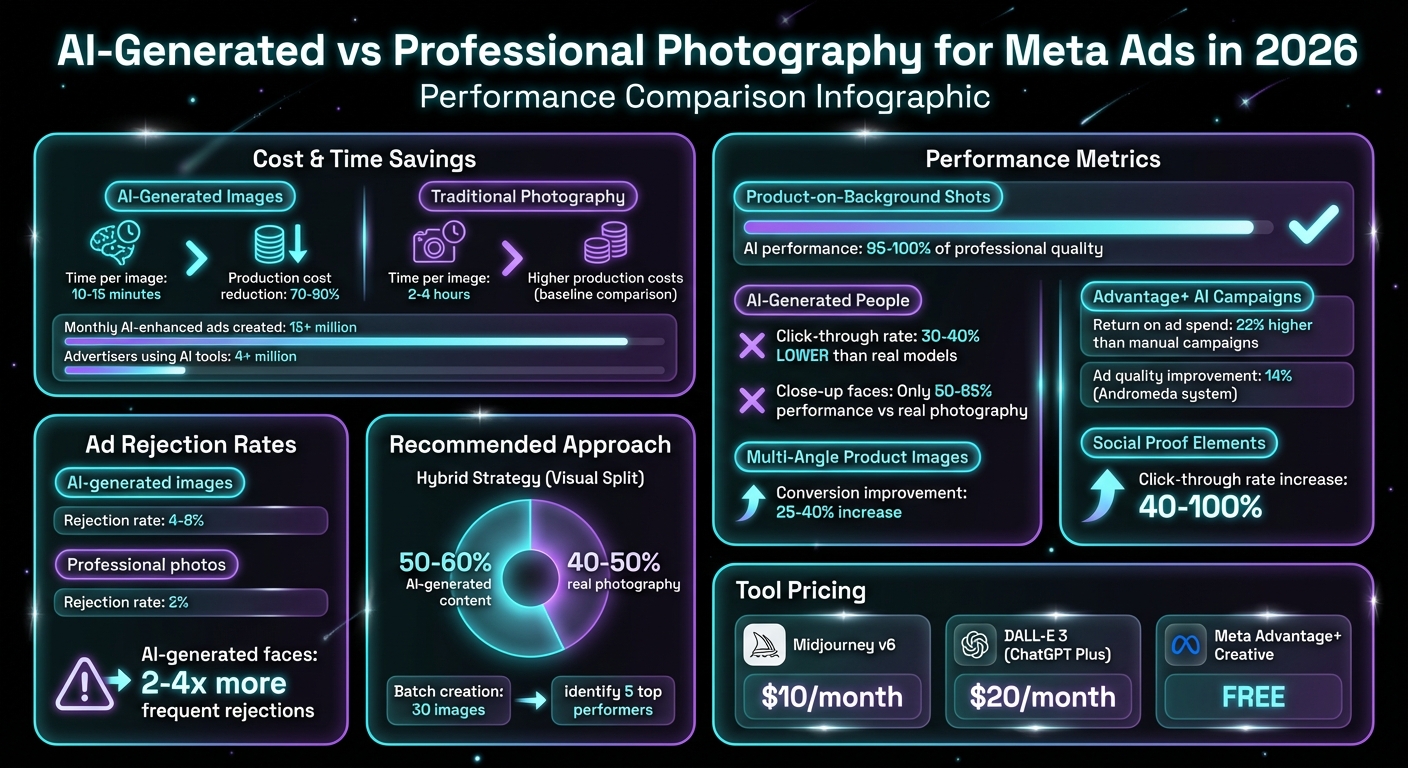
AI-Generated vs Professional Photography Performance for Meta Ads 2026
1. E-commerce Product Focus
Clean Product Showcases with Material-Level Detail
Creating effective e-commerce ads begins with showcasing products clearly and attractively. In 2026, AI prompts should include precise details about materials and textures to generate lifelike visuals that highlight quality. For example, a prompt like "matte black stainless steel watch with embossed logo, macro shot of brushed metal finish, 85mm lens at f/2.8" can produce images that emphasize craftsmanship. This approach allows AI tools to capture details like precision stitching on leather, intricate fabric patterns on clothing, or the exact design of ports on electronics.
Meta's Advantage+ Creative tool now automatically adjusts product images to fit various aspect ratios - such as 1:1 for feeds or 9:16 for Stories and Reels - without awkward cropping. Including material details in prompts and leaving enough negative space around the product for text overlays can enhance both clarity and versatility. Research shows that using multiple angles - such as front, back, side, and close-up detail shots - improves conversions by 25–40% compared to single-image ads.
Contextual Backgrounds That Tell a Story
Once the product details are perfected, adding a compelling background can elevate the ad's appeal. Contextual, AI-generated environments help create an emotional connection and increase engagement. Instead of plain white backdrops, prompts should describe settings that resonate with your audience. For instance, a high-end coffee brand might use "freshly brewed coffee in a ceramic mug on a rustic wooden table bathed in morning sunlight," while tech accessories could be featured in "sleek wireless earbuds on a minimalist desk setup with a softly blurred MacBook in the background and studio lighting from the left."
Meta's AI can even tailor visuals to align with seasonal and regional preferences. As Aaron Edwards from The Charles Group explains, "Meta's AI then determines which messages, formats, and angles are most likely to resonate most with different sets of users". This means that whether your product is shown on a sunny beach or in a cozy winter setting, AI can automatically match the visuals to the audience's preferences, eliminating the need for manual adjustments. This level of automated ad production allows brands to maintain high creative volume without increasing overhead.
Put the playbook to work
Apply this playbook to your page
Paste your website and the Lab will turn the strategy you are reading into a ready-to-test ads.
Free to try No prompt writing
2. Transformational Visuals
Abstract Metaphors for Conceptual Shifts
When promoting SaaS, services, or digital products, abstract visual metaphors often outperform literal screenshots in conveying transformation. Instead of showing software interfaces, consider prompts that contrast chaos with order. For example, "A high-quality 3D render illustrating workflow automation. On the left, a messy, tangled web of glowing red strings. On the right, the strings transition into perfectly straight, organized glowing blue lines entering a sleek glass server. Modern corporate aesthetic". This type of imagery creates an emotional connection and communicates the concept without requiring technical knowledge.
Meta's 2026 algorithm prioritizes authentic visuals over overly polished stock photography. Avoid using AI-generated human images - these tend to underperform, with click-through rates 30–40% lower than professional photos featuring real models. Additionally, they face rejection by Meta's ad review process 2–4 times more frequently. Instead, focus on visuals that highlight environmental or conceptual transformations, emphasizing outcomes rather than the mechanics of the process. This approach encourages user engagement through visual storytelling.
The "Before-and-After" Framework Without People
Building on the idea of abstract metaphors, before-and-after visuals are another powerful way to demonstrate a product's impact. For physical products, creating transformations that resemble user-generated content can be particularly effective. For instance, for the "before" state, you might use a prompt like "iPhone snapshot of a cluttered kitchen countertop with natural lighting." Then, for the "after" state, try "the same kitchen counter, now organized with [your product], warm afternoon sunlight from a window". This natural, unpolished aesthetic aligns with Meta's Andromeda ad retrieval system, which has been shown to improve ad quality by 14%.
To maximize ad functionality, always include "clean negative space for text overlay". Side-by-side "before-and-after" images make an instant impression, while Carousels - where users swipe from "before" to "after" - leverage curiosity to boost engagement. Keep in mind that AI-generated images take significantly less time to create (10–15 minutes per image compared to 2–4 hours for traditional photography), but they come with a higher rejection rate (4–8% versus 2% for professional photos). These strategies align with Meta Ads 2026's focus on precision and engagement, ensuring your visuals resonate with the audience.
Ads and AI: Leveraging AI Creative in 2026
3. Social Proof Elements
Social proof plays a key role in building trust and encouraging engagement, complementing strong product visuals and imagery.
Lifestyle Scenes Designed for Overlaid Testimonials
AI image generators often fall short when it comes to creating realistic human faces and hands. To work around this, focus on generating high-quality product or environmental scenes that leave clean, open spaces for adding testimonial text later. For instance, instead of asking for "happy customers", try prompts like: "A serene, modern living room with soft morning light streaming through sheer curtains, product placed on a minimalist coffee table, right side has clean negative space for ad copy overlay". This method ensures that you can later add testimonials, names, and ratings using tools like Photoshop or Canva while avoiding issues like distorted AI-generated faces that could lead to ad rejections.
Interestingly, AI-generated images of people tend to underperform, with click-through rates 30–40% lower than professional photos featuring real models. Close-up AI-generated faces are even less effective, achieving only 50–65% of the performance of real photography. On the other hand, AI excels at creating product-on-background shots, performing at 95–100% of the level of professional imagery. So, focus your AI prompts on creating the perfect backdrop - whether it’s a cozy kitchen, a sleek workspace, or an inviting outdoor scene. Once the base image is ready, overlay your testimonials and other social proof elements with design software to ensure clarity and compliance.
After setting up testimonial spaces, you can further reinforce trust by incorporating authority badges and milestone markers.
Authority Badges and Milestone Markers in Context
Adding authority badges or milestone markers to your visuals can significantly boost ad performance. Ads that include social proof elements like engagement metrics often see click-through rates increase by 40–100%. When crafting your AI prompts, include compositional details like: "Product centered using rule of thirds and shallow depth-of-field, reserve the upper-right quadrant for a trust badge". This ensures there’s a dedicated area for elements such as "As Seen On" media logos, "10,000+ Happy Customers" counters, or five-star rating icons without overcrowding the image.
It’s worth noting that AI-generated text often appears as gibberish, which can lead to ad rejections. To avoid this, don’t rely on AI to create review copy or milestone numbers. Instead, use the AI to generate the foundational image, then add authority elements - like customer milestones, media endorsements, or rating badges - using professional design tools. This approach not only keeps your visuals compliant with Meta’s policies but also simplifies the creative process while maintaining a polished, professional look.
4. Engagement-Driven Features
Once you've established trust through social proof, the next step is creating visuals that actively encourage user interaction. Building on those trust elements, these engagement-focused features make ads more interactive across Meta's platforms. Thanks to Meta's evolving AI tools, advertisers can now enhance static images with features designed to boost engagement in Stories, Reels, and Feed placements.
Animated CTA Stickers for Stories and Reels
Meta is experimenting with animated AI Sticker Call-to-Action (CTA) formats for Stories and Reels ads. These animated CTAs aim to grab more attention and drive higher engagement compared to static buttons. When designing your image prompts, it's important to leave room for these animated elements. For example, you can specify that the upper-right corner remains uncluttered, allowing Meta's system to overlay the animated sticker without covering important product details.
With over 4 million advertisers using Meta's generative AI tools, more than 15 million AI-enhanced ads are created each month. Animated CTAs are proving to be a smart way to combat creative fatigue and keep ads fresh. Beyond these dynamic CTAs, Meta's tools also bring static visuals to life through advanced video transformations.
Image-to-Video Transformation for Reels
Static images still perform well, but Meta's Advantage+ suite takes things further by converting up to 20 static product photos into seamless, multi-scene video ads. To make the most of this feature, design your base images with a smooth sequence in mind. Use prompts that ensure consistent lighting, angles, and backgrounds across all shots. For instance, you might specify: "Minimalist white studio background with soft diffused lighting from the left, product centered at eye level, captured at a 45° angle."
This consistency helps Meta's AI create polished, engaging Reels content. With video time spent on the platform seeing double-digit growth, this approach taps into a key area of user engagement. Advantage+ campaigns are already delivering an average of 22% higher return on ad spend compared to manually managed campaigns. These tools highlight Meta's focus on using AI to create dynamic, engaging ad experiences, further supporting the strategies outlined in this guide.
Conclusion
In 2026, the most successful Meta advertisers will be those who can churn out 30 creative concepts in an afternoon rather than waiting weeks. This approach allows them to test more variations, pinpoint winning strategies faster, and outpace creative fatigue. Speed and volume are the game-changers.
This efficiency also supports structured, data-driven strategies. The tactics discussed - like product-focused prompts, eye-catching visuals, social proof, and engagement-centric features - work because they’re rooted in performance data. For instance, AI-generated product images with plain backgrounds can achieve 95–100% of the quality of professional photography while slashing production costs and cutting Meta CPA by 70–90%. Specificity matters: prompts that clearly define the subject, context, composition, style, and ad constraints (like leaving space for text overlays) outperform generic ones.
A hybrid approach balances speed and quality. AI can handle rapid ideation and bulk creation, while humans refine the output, ensuring it aligns with brand standards and meets quality benchmarks. A good mix? Around 50–60% AI-generated content paired with 40–50% real photography. This approach mitigates risks like policy rejections and keeps campaigns authentic. Creating batches of 30 images to identify 5 strong performers keeps production both agile and cost-effective.
To make these strategies work for your business, tailor prompts to your goals. E-commerce brands can focus on product displays, SaaS companies might lean on before-and-after imagery, and lead generation campaigns can highlight social proof. With tools like Midjourney v6 (starting at $10/month), DALL-E 3 (included in ChatGPT Plus at $20/month), and Meta’s free Advantage+ Creative tools, the resources are accessible. The key is execution: refine your prompts, test rigorously, and let the data guide your next move.
FAQs
How do I write prompts that keep my product accurate and on-brand?
To ensure your prompts lead to accurate and on-brand product descriptions, focus on being clear and specific. Include details like the product's type, materials, key features, and how it’s used. For instance, instead of a vague description, say something like: "a matte black stainless steel water bottle with a bamboo lid." This level of precision helps the AI create ad creatives that reflect your brand's voice and maintain consistency.
What’s the safest way to use AI images without getting Meta ad rejections?
When creating ads for Meta, selecting AI-generated images requires careful attention to their guidelines to prevent rejections. Steer clear of visuals with close-up faces, excessive text, or overly busy designs, as these might not only breach policies but also result in lower performance. Instead, aim for clean, visually appealing images that resonate with your ad's goals and fit seamlessly with the placement.
How many AI image variations should I test before picking winners?
Testing 3 to 5 AI-generated image variations is a smart way to ensure your Meta Ads campaigns hit the mark. By comparing a handful of options, you can pinpoint the visuals that resonate best with your audience and deliver top performance. This method not only boosts effectiveness but also adds variety to your creative strategy.
Your next ad batch starts here
Finish with a ready-to-test ad batch
Paste your website to generate static creatives. Drop the link → get ads in about 90 seconds → upload them to Meta → scale.
Free to try No prompt writing