The Best Static Ad Prompts for Meta Ads (Copy + Paste Swipe File)
Build the ads while the examples are fresh
Turn your product page into static ad creatives
Paste your product URL and generate scroll-stopping images, headlines, and primary text—ready for your next Meta creative test.
Free to try No prompt writing

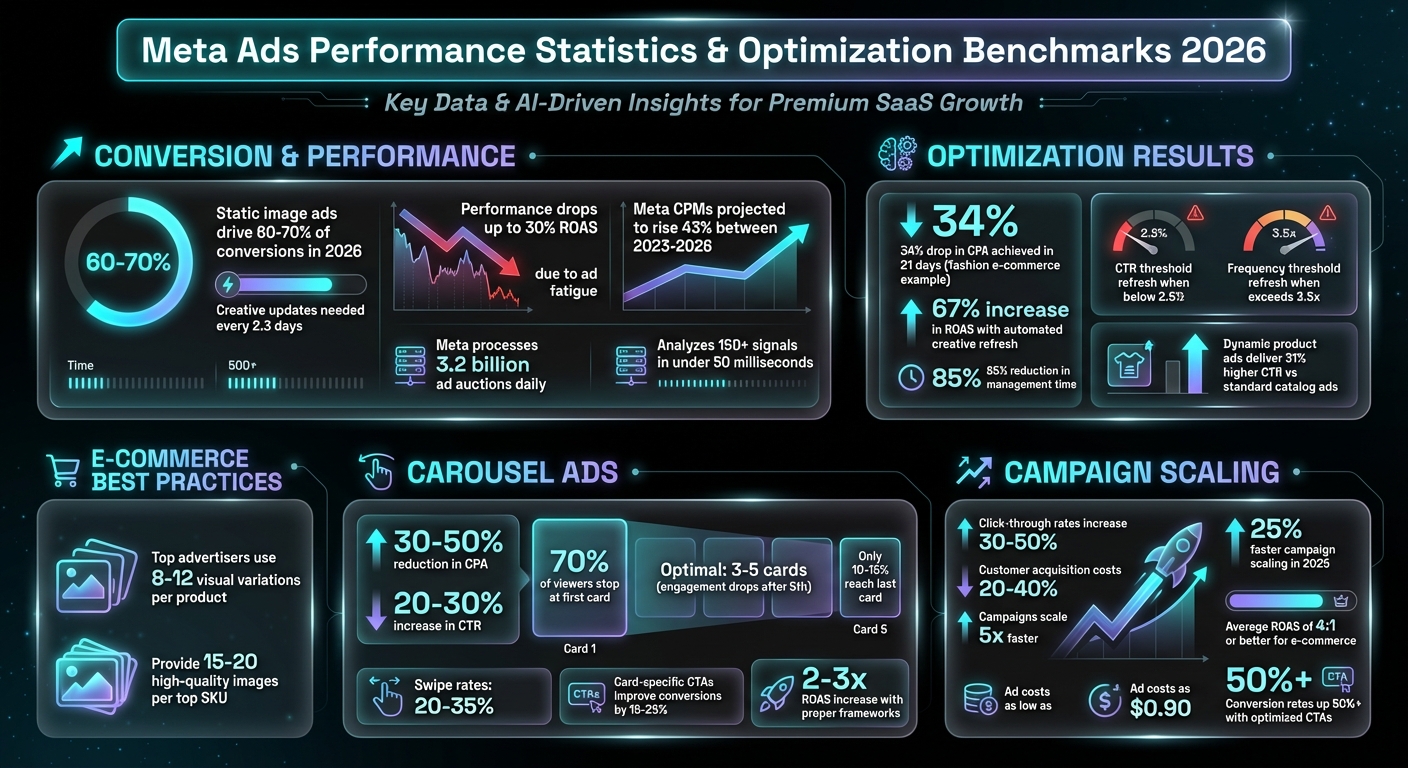
Static image ads remain a dominant force on Meta, driving 60-70% of conversions in 2026. However, frequent creative updates - every 2.3 days - are essential to avoid performance drops of up to 30% ROAS due to ad fatigue. This guide provides ready-to-use ad prompts to simplify the process, boost results, and reduce costs for e-commerce, SaaS, and lead generation campaigns.
Key takeaways:
- Scroll-stopping visuals: Use bold, repetitive text to grab attention.
- Scaling ads: Analyze winning creatives and create variations to maintain performance.
- Customer-focused copy: Address pain points and aspirations directly.
- Competitor differentiation: Highlight your unique strengths using "Us vs. Them" comparisons.
- E-commerce tips: Test diverse visuals (8–12 per product) and automate Meta ad production.
- SaaS strategies: Apply frameworks like Problem-Agitation-Solution for lead generation.
- Carousel ads: Optimize sequences to reduce CPA by 30-50%.
- Headline testing: Compare question-based and benefit-driven headlines.
- CTA optimization: Use personalized, benefit-focused CTAs instead of generic buttons.
Using tools like ADEN'S LAB, you can generate high-performing ads in minutes, helping you scale campaigns faster while reducing CPA and maximizing ROAS. Start implementing these strategies to keep your campaigns effective and relevant.
Meta Ads Performance Statistics and Optimization Benchmarks 2026
How to make Meta Ad Creatives (in 2026)
Put the playbook to work
Apply this playbook to your page
Paste your website and the Lab will turn the strategy you are reading into a ready-to-test ads.
Free to try No prompt writing
1. Scroll-Stopping Concepts
These static ad ideas are crafted to improve Meta Ad performance by using visuals that grab attention instantly.
Bold Repetitive Text to Stand Out
Using bold, contrasting keywords repeatedly can disrupt the usual scrolling pattern and make your ad pop. This approach sets your ad apart from the typical product photos flooding feeds.
For example, Foton® applied this strategy in the crowded scented candle market and stood out. You can do the same by addressing specific concerns in your industry. A Shopify merchant might emphasize "Profit margins?" repeatedly to resonate with their audience, while a SaaS founder could highlight "Churn rate?" to strike a chord with potential users. These targeted messages help draw attention by speaking directly to key pain points.
Take some time to analyze high-performing ads on platforms like Facebook and Instagram. Look for common visual elements that drive engagement and adapt those ideas to fit your brand's style and message.
For a more automated approach, ADEN'S LAB can analyze trends and generate attention-grabbing concepts tailored to your product or service. Once you’ve nailed down these ideas, you can move on to creating scaled variants to maximize your campaign's reach. Before going live, ensure your creative is ready with an e-commerce ad checklist.
2. Scaling Variants
Break Down Your Winning Ads
When you spot an ad that's performing well, take a closer look to figure out why. What about it is clicking with your audience? Is it the visuals, the tone of the copy, or the way the layout grabs attention? Understanding these elements lets you recreate the essence of what works without resorting to carbon copies - which can quickly lead to creative fatigue.
This kind of analysis also helps you refine your brand's voice while trying out different messaging approaches. For instance, you can keep your core message intact but swap out hooks or address different pain points. Instead of "Back pain at 3 PM?" you could try "Sitting 8+ hours daily?" - each appealing to a slightly different audience segment.
Focus on Profits, Not Just Engagement
Scaling Meta ads effectively isn't just about throwing more money at a popular ad. Make sure the numbers work. A high-engagement ad isn't worth scaling if your customer acquisition costs are too high. Keep a close eye on how your ad spend translates into actual revenue, not just likes and clicks. The goal is real growth, not vanity metrics.
Scaling also helps keep your campaigns fresh, ensuring your audience doesn't tune out from seeing the same thing over and over.
"Lila Le... combines hands-on selling experience with marketing expertise to help Shopify merchants scale smarter - through clear positioning, profit-first strategies, and high-converting campaigns." - Lila Le, Marketing Manager at TrueProfit
ADEN'S LAB offers tools to quickly generate multiple ad variations based on your winning frameworks, saving you time and effort while keeping your ads effective.
3. Customer Insights
Connect Directly to Challenges and Aspirations
The best ad prompts are like a mirror, reflecting the customer’s struggles and ambitions. To achieve this, your copy needs to address their specific pain points and goals in a way that feels personal and relatable.
Kick things off with a thought-provoking question that encourages self-reflection. Take TrueProfit’s ad as an example: "Is Your Profit Margin Below Average?". This simple question immediately grabs attention by sparking curiosity and self-comparison. It’s not just a random query - it feels targeted, making the customer wonder about their own situation. That moment of engagement happens before they even click, which is the magic of a well-crafted question.
Another powerful technique is to tackle objections upfront using the "[Benefit] Without [Objection]" formula. For instance, if price is a concern, you could write: "Premium quality without the premium price tag." Or, if complexity is a barrier, try: "Professional results without the learning curve." This approach helps dissolve doubts that might otherwise stop someone from taking action.
To make your prompts even more effective, dive into demographic and psychographic details using AI tools for Meta ads. Don’t just think in broad terms like "homeowners" - narrow it down to something like "homeowners passionate about DIY weekend projects". With this level of specificity, you can create messaging that resonates deeply. For example: "For small business owners who need monthly bookkeeping but hate spreadsheets - here's your solution".
Finally, focus on value-based segmentation by prioritizing your top 20% of customers based on lifetime value. This strategy ensures your ad system learns from high-conversion data, leading to better results and lower acquisition costs. Once you identify these high-performing angles, you can implement a creative scaling system to maintain momentum. Your copy should reflect what matters most to these high-value customers, rather than casting a wide net for anyone who might click.
4. Competitor Differentiation
Stand Out by Highlighting What Sets You Apart
One of the most effective ways to grab attention and convert customers is by using the "Us vs. Them" framework. This approach highlights your advantages while addressing the shortcomings of traditional options. Instead of leaving potential customers to figure out why your product is better, you can generate ad copy ideas that lay it out for them directly. This principle is the backbone of a high-performing static ad strategy.
Take brands like Javy, a coffee company, or Immi, a food brand, as examples. Both have used this strategy successfully in their Meta ads, showcasing their products' strengths against the drawbacks of conventional choices. As copywriter Kushagra Oberoi puts it:
"The classic Us V/s Them is a high-converter always. Contrast the benefits of your product with your competitors' limitations".
The beauty of this strategy is that you don’t need to call out competitors by name. Instead, use general terms like "Traditional Brands" or "The Old Way" to highlight common industry pain points. A simple template like "[Benefit] Without [Objection]" works wonders for emphasizing your unique strengths. For example, "Great Taste Without the Guilt" or "Convenience Without Compromise" makes your message clear and impactful.
To make this approach work, thorough market research is key. A balanced, accurate comparison ensures your claims resonate with your audience and builds trust. By integrating these contrasts into your ads, you not only communicate your value but also keep your campaigns fresh and engaging.
With Meta CPMs projected to rise by 43% between 2023 and 2026, standing out is no longer optional - it’s critical for maintaining profitability. Your static ads need to answer one essential question immediately: "Why should I choose you over the alternatives?"
5. E-commerce Optimization
Fine-tuning visual assets plays a key role in the Meta ad strategy discussed earlier.
Dynamic Product Showcase Strategy
For e-commerce brands, having a mix of visuals is crucial. The top advertisers typically use 8–12 variations per product, combining lifestyle images, studio shots, detailed close-ups, and comparison charts. This variety gives Meta's AI the flexibility to identify the best-performing combinations for different audience groups.
Here's an example: In April 2026, a fashion e-commerce brand with a $45,000 monthly ad budget achieved a 34% drop in CPA in just 21 days. How? By adopting autonomous creative testing and management. This highlights how testing diverse visuals can significantly reduce costs.
When it comes to messaging, test multiple angles at once. For e-commerce, AI-generated copy should emphasize factors like price, quality, convenience, social proof, urgency, and clear benefits. Meta's Advantage+ Shopping 2.0 processes over 3.2 billion ad auctions daily, analyzing more than 150 signals in under 50 milliseconds to deliver highly targeted messages.
To avoid ad fatigue, set automated rules to refresh creatives. For instance, replace ads when the CTR drops below 2.5% or frequency exceeds 3.5x. Without this, ROAS can decline by 20–30% as ads lose their effectiveness. Brands using this approach have seen a 67% increase in ROAS while cutting down management time by 85%. These strategies align with earlier methods for tackling creative fatigue.
As always, variety is key. Aim to provide 15–20 high-quality product images for each top SKU and let AI handle optimization. Dynamic product ads, in particular, deliver a 31% higher CTR compared to standard Meta catalog ads.
6. SaaS Lead Generation
Problem-Agitation-Solution Framework for Maximum Conversions
When it comes to SaaS campaigns, focusing on specific pain points can make all the difference. A great way to do this is by using the Problem-Agitation-Solution (PAS) framework. Here's how it works: start by identifying a common frustration (like the hassle of manual data entry), highlight the negative impact (lost hours and inevitable human errors), and then position your software as the perfect fix.
Another effective approach is the "Job to be Done" (JTBD) framework. Instead of broadly advertising "project management software", zero in on the exact task your audience needs to complete. For instance, you could frame your message around "helping marketing teams avoid missed deadlines caused by scattered communication." This kind of laser-focused messaging helps platforms like Meta find the right audience - those actively searching for a solution to their specific problem.
When designing your static ads, visuals matter. Use clean, high-contrast UI elements to give potential customers a quick glimpse of how your software works. Highlight how your product delivers results in minutes, not days - this sense of immediacy can be a powerful selling point.
7. Brand Consistency
Keep Your Brand Voice Unified with Reusable Prompt Templates
To maintain a consistent brand identity, create reusable prompt templates with placeholders like {{brandname}}, {{differentiators}}, and {{targeting}}. These templates ensure that everyone on your team provides consistent input, laying the foundation for messaging that aligns with your brand's identity.
Be specific when defining your brand voice. Instead of simply saying "casual", clarify it as something like "casual, witty, and playful" or "professional, data-driven, and authoritative." For instance, you could use a prompt such as: "Write 3 ad copy variations that reflect a casual and witty tone, incorporating humor and lighthearted language." This level of detail helps the AI avoid generic responses and ensures your messaging stays true to your brand's personality.
Remember, AI-generated content should be treated as a starting point. As Swipekit points out, "Good copy needs multiple iterations". Even with a well-crafted prompt, the initial output may not fully capture your brand's voice. Refining, testing, and tweaking are essential steps to ensure the final result aligns with your standards.
To reinforce brand consistency, reuse high-performing visual and copy elements in your campaigns. Use your best-performing ads as a "swipe file" to guide future prompts. This strategy allows you to replicate the engagement-driving elements of past successes while maintaining the distinct positioning that sets your brand apart in a competitive market.
8. Carousel Simulations
Prompt AI to Design Multi-Card Sequences That Drive Swipes and Conversions
Carousel ads offer a more interactive alternative to single-image campaigns, delivering results that often outperform their static counterparts. Studies show carousel ads can reduce CPA by 30–50% and increase CTR by 20–30%. However, there’s a catch - nearly 70% of viewers stop at the first card. To tackle this challenge, aim for carousels with 3–5 cards. Engagement tends to drop sharply after the fifth card, and only 10–15% of users make it to the last one. Swipe rates typically hover between 20–35%.
To encourage swipes, consider using numbered sequences like "1/5" or imagery that spans across cards, creating a sense of continuity. For product showcases, lead with your bestsellers in the first two cards, and include pricing on each card. This helps qualify clicks and reduces bounce rates. Adding card-specific calls-to-action that link directly to product pages can improve conversion rates by 15–25%. These tactics work hand-in-hand with earlier ad testing strategies to keep viewers engaged throughout the carousel.
Frameworks such as "Problem-Agitation-Solution" (e.g., Card 1: Problem, Cards 2–3: Agitation, Cards 4–5: Solution) or "Before-During-After" for transformation stories can dramatically increase ROAS, sometimes by 2–3× compared to static ads. Maintaining visual consistency across the cards is key - consistent fonts, color schemes, and a 1:1 aspect ratio (1,080 x 1,080 px) ensure a cohesive look and reduce cognitive friction. These strategies not only enhance engagement but also reinforce brand messaging, making carousel ads a powerful tool for scalable campaigns. If you're stuck on visuals, use an ad creative idea finder to generate fresh concepts for your cards.
9. Headline Testing
Test Question-Based vs. Direct Benefit Headlines to Find Your Audience's Sweet Spot
When it comes to grabbing attention, your headline is everything. It’s the first thing people notice, and it can either pull them in or let them scroll right past your ad. That’s why testing different headline styles is so important.
Question-based headlines, like "Is Your Profit Margin Below Average?", are designed to challenge readers and make them think about their own situation. This style works particularly well for businesses like eCommerce stores or service providers, where performance metrics are a big deal. On the other hand, direct benefit headlines focus on what the reader stands to gain, offering a clear, no-nonsense value proposition. For instance, you could test "Struggling with Low Conversions?" against a more straightforward benefit-driven line to see which one resonates more with your audience.
"Good copy needs to go through multiple iterations, testing, and refinements before it resonates with your audience." - Shash7, Swipekit
But the work doesn’t stop there. Social proof headlines, like "Real customers, real results", can instantly build credibility and trust with your audience. You can also experiment with different brand tones - casual, witty, or playful - and apply the AIDA framework (Attention, Interest, Desire, Action) to guide potential customers from curiosity to conversion.
To streamline the process, start with a swipe file of proven, high-performing headlines. This gives you a solid foundation to build on instead of starting from scratch. Tools like ADEN'S LAB can speed things up by using an ad headline generator to create multiple variations in minutes. This lets you test more ideas faster, helping you zero in on the headlines that truly connect with your audience. By leaning on this data-driven approach, your ad campaigns can stay fresh, engaging, and results-focused.
10. CTA Optimization
Swap Generic Buttons for First-Person, Benefit-Driven CTAs That Mirror Your Audience's Desire
Your call-to-action (CTA) is where your audience decides to act - or not. Phrases like "Sign Up" or "Download" might get the job done, but they often lack the personal touch or urgency needed to truly engage. Instead, use first-person, benefit-focused language that aligns with what your audience wants in that moment.
Take TrueProfit’s approach as an example. For a lead generation campaign aimed at Shopify merchants, they used the CTA “Yes, I want this guide!” to collect names and emails for their Meta Ad Swipe File. In another campaign offering a free financial course for eCommerce brands, the CTA “Subscribe for free access” emphasized both value and ease of entry - providing participants with six impactful financial lessons along the way.
The key is tailoring your CTA to match your audience’s concerns and the value you’re offering. If your target is merchants worried about profit margins, a CTA like “Yes, I want to keep more of my hard-earned profit” directly addresses their pain point. For educational resources, highlighting free access and immediate benefits can be especially effective.
Don’t forget to test standard Meta CTA buttons like “Shop Now,” “Learn More,” or “Join Today.” Each option works differently depending on where your audience is in the funnel. For instance, “Learn More” can spark curiosity at the top of the funnel, while “Shop Now” or “Book a Demo” is better suited for driving quick conversions.
Tools like ADEN'S LAB make testing easier by generating multiple CTA variations in minutes. This allows you to experiment with different tones and phrases, helping you zero in on the CTA that resonates most with your audience - without wasting time on manual rewrites. This efficiency is crucial when scaling Meta Ads with AI budget methods to ensure your top-performing creative variations receive the right investment.
Conclusion
Static ad prompts can significantly improve your Meta Ads campaigns. By leveraging proven frameworks that grab attention in fast-moving feeds, advertisers have seen click-through rates increase by 30-50% and customer acquisition costs drop by 20-40% across various industries like e-commerce, SaaS, and lead generation. This swipe file provides everything you need, from attention-grabbing hooks to fine-tuned CTAs, designed to deliver maximum results.
The key advantage lies in speed and scalability. Instead of spending days crafting custom creatives or scheduling ads based on untested ideas, you can roll out high-performing ads in just minutes. Tools such as ADEN'S LAB simplify this process - copy a prompt, adapt it for U.S. audiences with elements like dollar-based pricing or imperial measurements, and launch. Many users report scaling campaigns 5x faster and achieving ad costs as low as $0.90.
Incorporating customer insights with optimized CTAs, like "Claim Yours Free – Limited Spots", can drive conversion rates up by over 50%. This end-to-end strategy - from initial concept to the final call-to-action - is what separates campaigns that stall from those that scale profitably.
Meta’s algorithm favors fresh and relevant creatives. By using these prompts to produce dozens or even hundreds of ad variations each month, you can combat creative fatigue and maintain strong performance. In fact, businesses using these templates experienced 25% faster campaign scaling in 2025, with e-commerce brands achieving average ROAS of 4:1 or better.
Your next high-performing ad is just a prompt away - start creating today.
FAQs
How do I know when a static ad is fatigued?
When trying to spot static ad fatigue, keep an eye on key performance metrics. Some red flags include a noticeable drop in click-through rate (CTR), rising cost per action (CPA), and increased frequency, meaning your audience is seeing the same ad over and over. Engagement metrics like likes, comments, and shares may also decline.
If your frequency score climbs above 3-4 or you start receiving negative feedback (like users hiding your ad), it’s time to shake things up - either by updating your creatives or tweaking your targeting.
How many image variants should I test per product?
To get the best results from your ads, try testing 3 to 5 different image variations for each product. This approach helps you figure out which visuals connect best with your audience, boosting engagement and performance.
What’s the fastest way to turn a winning ad into new variants?
If you're looking to create new versions of a winning ad without starting from scratch, copy-paste AI prompts are your go-to solution. With ADEN'S LAB, all you need to do is input your existing ad or product link into their system. In just 90 seconds, you'll have multiple fresh ideas or variations ready to go. This approach not only saves time but also helps ensure your ads stay engaging and perform well.
Your next ad batch starts here
Finish with a ready-to-test ad batch
Paste your website to generate static creatives. Drop the link → get ads in about 90 seconds → upload them to Meta → scale.
Free to try No prompt writing