Why High-Spend Advertisers Care Less About Design Than You Think
Turn the strategy into creatives
Create Meta ads for your product
Paste your product page. ADEN'S LAB turns the offer, audience, and positioning into complete ready-to-use Meta static ads.
Free to try No prompt writing

When companies spend $100,000+ a month on Meta ads, you’d expect their ads to be polished and high-budget. But here’s the truth: simple, fast, and low-cost ads often perform better. Why? Because success hinges on speed, volume, and results - not perfect visuals.
Here’s what matters most:
- Creative fatigue: Ads stop working when audiences see them too often. This happens faster with high ad spend.
- Fast production beats perfection: Waiting weeks for polished designs slows testing and drains budgets.
- Engagement drives results: Bold, attention-grabbing hooks and direct messaging outperform flashy, overproduced visuals.
- Volume is key: Testing 50–200+ ad variations monthly increases the chances of finding winners.
High-budget advertisers focus on producing lots of simple, effective ads quickly, rather than obsessing over perfect designs. Tools like ADEN's LAB help by generating Meta-ready ads in 90 seconds, letting advertisers stay ahead of fatigue and competition. If you want better results, prioritize speed and testing over perfection.
How to Test Facebook Ads Creatives at Every Budget (2026)
Put the playbook to work
Apply this playbook to your page
Paste your website and the Lab will turn the strategy you are reading into a ready-to-test ads.
Free to try No prompt writing
The Real Problem: Creative Fatigue and Slow Production
If you're investing heavily in Meta ads, you're likely grappling with two major challenges: ads have a limited shelf life, and most production processes can't churn out fresh ads quickly enough to replace the ones that lose their effectiveness.
What Creative Fatigue Actually Means
Creative fatigue happens when audiences see the same ad too many times, and it stops grabbing their attention. It’s not that the ad wasn’t good - it’s just that users have already made up their minds about it. At this point, they simply scroll past without engaging.
Here’s the kicker: when engagement drops, Meta charges you more to keep showing that ad. Your CPMs (cost per thousand impressions) go up, your CTR (click-through rate) plummets, and suddenly you’re paying significantly more for far worse results. Meta’s algorithm doesn’t care how much effort or money went into creating the ad - it only cares about one thing: engagement.
This problem escalates when you’re spending big. A $10,000/month budget means your ad gets shown to the same audience repeatedly, wearing out its appeal in just a few days instead of weeks. Privacy changes have made this even tougher by shrinking the pool of targetable users, so the same people see your ads again and again. And when purchase intent drops by about 16% after six or more exposures, running stale ads becomes a costly mistake.
Creative fatigue drains your ad performance quickly, but slow production only makes the situation worse.
How Slow Production Drains Your Budget
The second issue is just as frustrating: traditional ad production is painfully slow. Think about it - briefing a designer, waiting for drafts, requesting revisions, securing approvals, and finally launching the ad can take weeks. By the time your new ad is ready, your current one is already fatigued, and your campaign performance is suffering.
Here’s another harsh reality: only 5% of new ads outperform your current best. That means slow production not only wastes time but also burns through your budget as you wait for a winner. Testing new ideas takes too long, and while you’re stuck in limbo, fatigued ads are eating into your returns.
"If you can't test ads quickly and affordably, your campaign's financial performance is likely to suffer from a lot of unproductive spend." - Brian Bowman, Founder & CEO, ConsumerAcquisition
For advertisers spending $100,000 or more per month on Meta, this delay is devastating. Every single day without fresh creatives drives up CPAs and wastes your budget. You’re forced to keep running ads that you know are losing effectiveness because you don’t have replacements ready. The real problem isn’t your targeting or strategy - it’s your inability to produce new ads fast enough to keep up with the pace of fatigue.
Why Perfect Design Hurts Performance
Many advertisers believe that pouring extra effort into design will lead to better results. But here's the truth: chasing visual perfection often prioritizes aesthetics over what truly matters - performance. Ads that look flawless to you may not resonate with real users scrolling through their feeds. For advertisers managing high budgets and battling creative fatigue, the focus should always be on performance, not perfection.
The Hidden Cost of Over-Designed Ads
Obsessing over perfect design doesn’t just waste time - it can drain your budget and stall progress. While you're fine-tuning every detail, your competitors are out there testing and automating Meta ad production, finding what works faster than you can finalize your revisions.
Take SketchDeck's July 2016 experiment, for example. They tested 48 Facebook ads to uncover what drives performance, and the findings were eye-opening. Ads without text overlays performed 6–7% better (lower CPC) than those with text. Small logos outperformed large, prominent ones, reducing CPC by 8%. Even more surprising, visually unique images - like using a picture of the Golden Gate Bridge for a tech company - outperformed brand-relevant visuals by 6%. Why? Because these unexpected images stood out in users’ feeds.
The takeaway? Ads that look too polished often blend in with traditional advertisements, making them easy to ignore. Users reward what grabs their attention, not what looks "perfect."
Beyond aesthetics, this impacts your cost-per-winner (CPW). High production costs paired with a low win rate can make scaling campaigns financially unsustainable.
What Actually Drives Conversions: Psychology and Direct Response
Winning ads don’t just look good - they grab attention in the first three seconds and directly address buyer needs. Meta’s algorithm prioritizes engagement over strict adherence to brand guidelines or visual symmetry. If users scroll past your ad, the algorithm takes note and stops showing it, which drives up your costs.
The hook is everything. Whether it’s a bold claim, a surprising statistic, or a direct callout of a pain point, grabbing attention early is far more effective than a perfectly lit product shot. SketchDeck’s test of 48 ads revealed that "stopping power" - the ability to make someone pause - matters more than brand relevance. In other words, even an "ugly" or off-brand ad can outperform a polished one if it captures attention.
Creative quality plays a massive role in Facebook ad performance - about 56%, to be exact. But "quality" doesn’t mean high production value. It’s about tapping into psychological triggers like urgency, social proof, and clear calls to action. These elements speak to buyer motivations and objections, driving conversions in ways polished visuals alone can’t.
"The image may capture attention – but it's the copy that closes people." - Joanna Wiebe, Editor, Copyhackers
High-budget advertisers understand that testing hooks is more impactful than endlessly tweaking designs. Changing the opening line or reframing the message can reset the algorithm’s engagement metrics faster than minor visual adjustments. They focus on creating modular assets - flexible copy, adaptable aspect ratios, and simple visuals - that Meta’s algorithm can dynamically tailor for individual users.
Ultimately, if your ad doesn’t stop the scroll within three seconds, no amount of perfect design will save it. When performance is driven by psychology and attention-grabbing hooks, polished visuals take a backseat, paving the way for faster and more scalable creative production.
What High-Spend Advertisers Focus On Instead
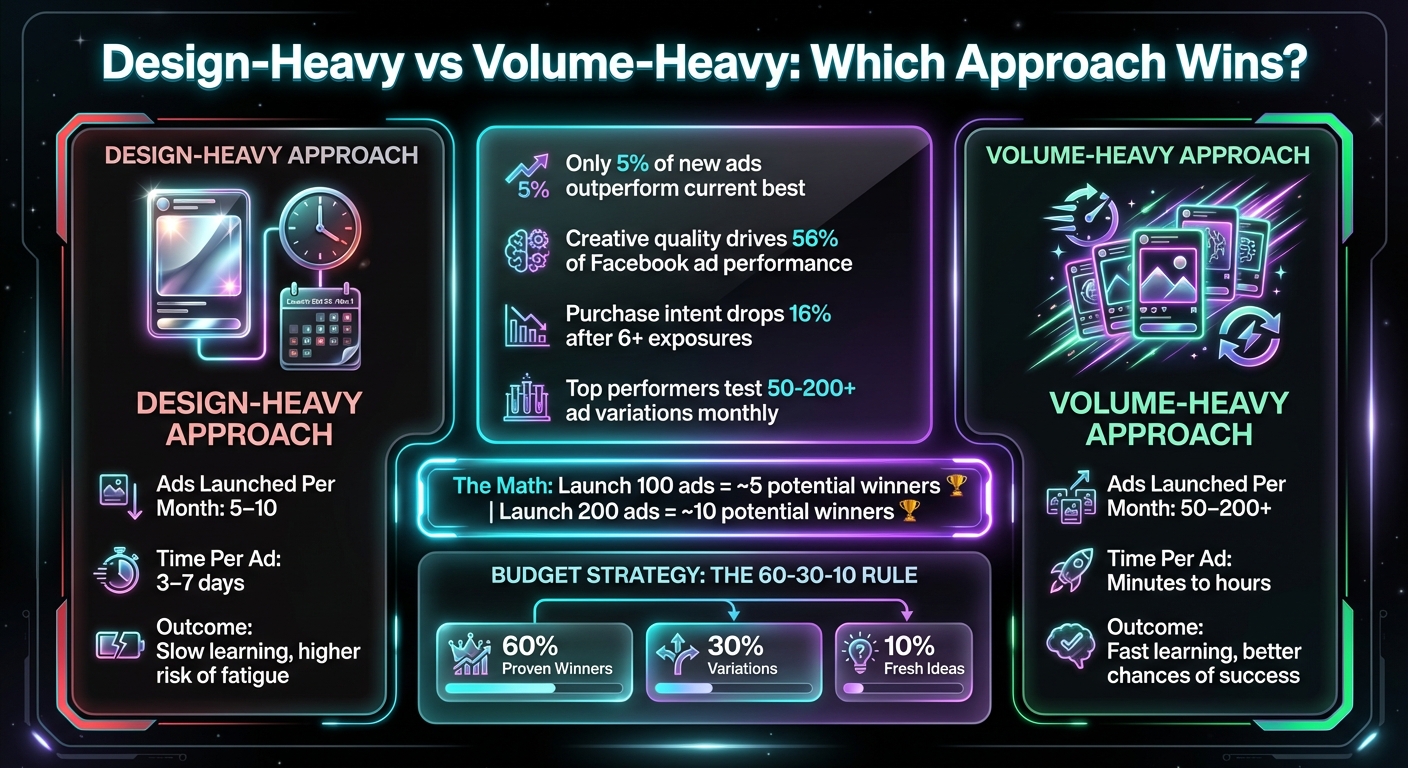
Design-Heavy vs Volume-Heavy Ad Testing: Performance Comparison
When creative fatigue and slow turnaround times threaten performance, top advertisers shift their strategy: they focus on volume. For those spending six figures monthly on Meta ads, the priority isn't a polished, "professional" look - it’s about what actually delivers results. Instead of perfecting one ad, they aim to churn out as many variations as possible, accelerating testing and improving their odds of finding a winning ad. It’s a numbers game: the more you test, the better your chances of success.
Why Launching More Ads Wins
Here’s the reality: only about 5% of ads outperform your current best performer. That means if you launch 20 new ads, you’ll likely find just one that beats the rest. Launch 100 ads? You’ve got five potential winners. Push 200 ads? Now you’re looking at ten chances to find a standout.
This is why advertisers spending $100,000+ per month often test between 50 and 200+ ad variations monthly. For example, in 2025, a growth team tested 70 static ads in just one week, quickly identifying three standout performers to scale. Compare that to a design-heavy approach, where weeks are spent perfecting a handful of ads. It’s clear which strategy allows for faster learning and better results. While creative quality still accounts for around 56% of Facebook ad performance, you can’t optimize what hasn’t been tested.
Testing at scale also feeds Meta’s algorithm with more data - clicks, watch time, scroll behavior - allowing it to stabilize faster. Meta’s learning phase typically requires about 50 optimization events per ad set. A well-planned budget strategy, like the 60-30-10 rule (60% for proven winners, 30% for variations, and 10% for fresh ideas), ensures even a small portion of your spend can fund extensive testing without the high costs of traditional, designer-heavy ads.
| Approach | Ads Launched Per Month | Time Per Ad | Outcome |
|---|---|---|---|
| Design-Heavy | 5–10 | 3–7 days | Slow learning, higher risk of fatigue |
| Volume-Heavy | 50–200+ | Minutes to hours | Fast learning, better chances of success |
By launching more ads, you not only speed up learning but also give Meta’s algorithm the flexibility to optimize performance.
Why Meta-Optimized Formats Outperform Complex Designs
Meta’s algorithm doesn’t reward flashy, overproduced ads - it rewards engagement and conversions. A sleek, Hollywood-style ad might impress your team, but if users scroll past it in seconds, the algorithm stops prioritizing it. This is why simple, even "ugly", ads often outperform.
Take this example: In late 2025, a supplement brand’s ROAS dropped from 1.35 to 0.75 after launching six high-engagement ads at once. One ad achieved a 44% hook rate but came with a 58% higher cost per acquisition than their proven winner. The algorithm favored the engaging ad, even though it was losing money. The brand recovered by pausing further tests and focusing on 10 proven, straightforward concepts, bringing their ROAS back to 2.50 in just five days.
The takeaway? Meta’s system doesn’t care about aesthetics - it cares about performance. Ads built with modular, flexible assets (clean images, multiple headlines, direct copy) allow the algorithm to adapt them across its 26 placements. This adaptability creates thousands of variations tailored to user behavior, device, and placement.
"Your 'ad' is no longer a clearly defined set of components. It's now a collection of assets, or 'ad pieces,' that can be combined to create limitless variations." - Jon Loomer, Meta Ads Expert
On the other hand, complex designs don’t scale well. A video with intricate animations or baked-in text isn’t easily adaptable for Stories, Reels, or feed placements. Meanwhile, a simple static ad with a bold hook and clean product shot works across all formats. High-spend advertisers understand this, which is why they favor Meta-optimized formats - ads designed for the algorithm, not for aesthetics.
There’s also the matter of cost. Spending $2,000 on a single high-end video that flops is a costly mistake. But producing 50 simple static ads for the same budget spreads the risk. Even if most fail, the few winners with a 3× ROAS more than make up for it.
This is where tools like ADEN's LAB come in. With it, you can generate dozens of Meta-optimized static ads in minutes. This AI-driven approach to cutting CPA allows you to scale efficiently without sacrificing performance. No designer bottlenecks, no endless revisions - just rapid production, testing, and the ability to outperform competitors still stuck in feedback loops.
How to Scale Without Design Delays
The biggest challenge in scaling ad campaigns isn’t your budget or targeting - it’s how quickly you can churn out fresh creatives. Waiting 5–7 days for new ads puts you at a disadvantage. While you’re stuck in production limbo, competitors are optimizing their campaigns, driving up costs, and leaving you behind. The faster you can produce ads, the better your chances of beating creative fatigue before it starts eating into your margins.
The fix isn’t hiring more designers or paying extra for rush jobs. Instead, you need a system that delivers Meta-optimized static ads in minutes, not days. This is how top advertisers stay ahead: they ditch the slow, traditional design process in favor of automated tools that crank out dozens - or even hundreds - of ads each month. It’s all about meeting the demand for speed without sacrificing performance.
How ADEN's LAB Eliminates Production Delays
The secret lies in automation. With ADEN's LAB, you can generate Meta-optimized static ads directly from a single product or landing page link. No briefs, no revisions, no waiting. In just 90 seconds, you get ready-to-launch ads that are tailored for Meta’s ad placements.
This isn’t a trade-off between speed and quality. ADEN's LAB focuses on producing conversion-driven creatives at scale. The ads are built using direct-response frameworks that prioritize clear hooks, psychological triggers, and engagement signals - all the elements that boost performance, not just aesthetics.
Here’s the kicker: it costs just $0.90 per ad with the Apex Mode plan. For $179 a month, you can generate over 200 ads. Compare that to traditional designers, who charge $30–$50 per ad, or agencies that bill $500+ for a batch. The savings allow you to test far more variations, increasing your odds of finding a winning ad.
Speed is just as important as cost. If your competitor launches 50 new ads this week while you’re still waiting on revisions, they’re gaining valuable data and optimizing faster. ADEN's LAB eliminates delays entirely, letting you launch new ads daily, test different angles, and refresh your creatives every 7–10 days to avoid fatigue. All of this happens without the hassle of managing back-and-forth revisions.
Replacing Traditional Design Teams for Scale
Traditional design teams excel at creating polished, visually stunning ads - great for brand campaigns but a bottleneck for performance-driven efforts. When scaling, those delays can cost you the edge. Automating ad production with ADEN's LAB removes these roadblocks entirely.
With this system, you don’t need briefs, approvals, or to wait for office hours. Ads are generated on demand, whenever you need them. If your campaign starts to fatigue late on a Friday night, you can whip up fresh variations in minutes and launch them immediately.
This agility keeps you ahead of the game. Meta’s algorithm thrives on fresh engagement signals, and by consistently feeding it new creatives, you can stabilize costs and maintain steady delivery. In performance marketing, success isn’t about how “pretty” your ads are - it’s about how well they grab attention, drive clicks, and convert profitably. ADEN's LAB is built for one purpose: to create ads that perform, not just ads that look good.
Conclusion
When it comes to high-budget advertising, speed and volume often take precedence over perfect design. Why? Because success on Meta depends on iterating Meta ads at scale. If you're spending six or seven figures monthly, waiting a week for a designer to perfect an ad that might fizzle out quickly just isn't feasible. The brands thriving on Meta today are the ones pumping out dozens of fresh creatives every week, experimenting with bold hooks, and feeding the algorithm exactly what it needs to keep costs under control.
Creative fatigue is a real threat, and it can drag down results fast. With creative quality driving about 56% of Facebook ad performance, and purchase intent dropping by roughly 16% after users see the same ad six or more times, the stakes are high. Slow production doesn’t just delay results - it costs money. While you're stuck waiting, competitors are testing faster, finding winning ads, and gaining an edge. That's why top-performing brands refresh their creatives every 10 days, proving that speed matters more than perfection in this fast-paced environment.
This is where automation becomes a game-changer. ADEN's LAB offers a seamless way to generate Meta-optimized static ads in just 90 seconds - no briefs, no revisions, no delays. At $0.90 per ad with the Apex Mode plan, you can produce over 200 ads a month for $179. Compare that to the cost of hiring a designer, and the savings are clear. But it’s not just about saving money - it’s about outpacing your competition by testing more variations, faster.
The goal isn’t to create ads that belong in a design showcase. It’s about producing attention-grabbing, conversion-driving creatives quickly enough to avoid fatigue and stay ahead of the curve. ADEN's LAB delivers exactly that, offering a streamlined solution that keeps you focused on finding winners instead of battling production delays. In a landscape where speed and adaptability define success, this tool gives you the edge you need to maintain performance and outpace the competition.
FAQs
How do I know when an ad is fatigued?
When an ad's performance begins to dip, it’s a clear sign of fatigue. Watch for key indicators such as a rising cost per acquisition, declining engagement rates, or an increasing frequency - this suggests your audience has seen the ad too often and is no longer reacting to it. Monitoring these metrics closely allows you to identify fatigue early and make adjustments before your budget takes a hit.
How often should I refresh creatives at high spend?
For campaigns with significant budgets, it's generally a good idea to update your creatives every 2–4 weeks. This approach helps keep your ads fresh and engaging, reducing the risk of creative fatigue and maintaining strong performance over time.
What should I test first: hook, image, or offer?
Start by focusing on the hook - it’s the cornerstone of capturing attention and boosting engagement. A good hook can make or break your ad's performance and directly affects how effectively your budget is used. Once you’ve nailed the hook, shift your attention to fine-tuning the image and offer to maximize results even further.
Your next ad batch starts here
Finish with a ready-to-test ad batch
Paste your website to generate static creatives. Drop the link → get ads in about 90 seconds → upload them to Meta → scale.
Free to try No prompt writing