Ultimate Guide to Cross-Channel Attribution for Meta Ads
Turn the strategy into creatives
Create Meta ads for your product
Paste your product page. ADEN'S LAB turns the offer, audience, and positioning into complete ready-to-use Meta static ads.
Free to try No prompt writing

Cross-channel attribution helps marketers measure the true impact of their Meta ads alongside other platforms like Google, email, and TikTok. It ensures credit for conversions is distributed across all customer touchpoints - not just the last-clicked ad. This is crucial in 2026, where privacy changes and tracking limitations create significant data gaps.
Key Takeaways:
- Why it matters: Platforms like Meta often overstate conversions by 20–40%, leading to inflated ROI metrics.
- Common issues: Attribution windows differ (e.g., Meta's 7-day click vs. GA4's 30-day click), causing data discrepancies.
- Best practices:
- Use tools like Meta Pixel, Conversions API, and UTM parameters for accurate tracking.
- Adjust Meta's attribution to 7-day click only to reduce inflated view-through conversions.
- Reconcile platform data weekly with backend systems to maintain accuracy.
- Attribution models: Options like last-click, linear, and data-driven models suit different business needs. For instance, data-driven models work best for high-volume campaigns, while time decay models help with short-term promotions.
By implementing proper tracking and choosing the right attribution model, marketers can improve ROI by 42% and make better budget decisions. You can further optimize your workflow by automating Meta ad production to save time and improve performance.
Meta’s New Attribution Update Explained: What Every Advertiser Needs to Know

Put the playbook to work
Apply this playbook to your page
Paste your website and the Lab will turn the strategy you are reading into a ready-to-test ads.
Free to try No prompt writing
What Is Cross-Channel Attribution?
Cross-channel attribution assigns credit for conversions to every touchpoint a customer interacts with during their journey - whether it’s through search, social media, email campaigns, display ads, or organic channels. Instead of focusing solely on the final step before a purchase, it considers the entire path that led to the conversion.
Let’s say a customer first sees your product in a Meta Instagram ad, later searches for it on Google, and finally makes a purchase after receiving a promotional email. Each of these interactions plays a role and is measured. This is critical because 73% of customers engage with multiple touchpoints before making a purchase. Without this broader view, decisions about where to allocate your marketing budget are based on incomplete data.
Why Single-Channel Attribution Falls Short
Relying on single-platform reporting, like Meta’s, can lead to skewed insights. Meta’s reporting system, for example, attributes conversions to its ads within its attribution window, which often inflates the overall results - a phenomenon known as the "sum problem".
"The platforms that sell you ads are the same ones measuring whether those ads work. This fundamental conflict of interest means every ROAS number you see is inflated." - Cresva.ai
Here’s a real-world example: In April 2025, Seer Interactive analyzed $1.05 million in ad spend across six accounts. Meta’s internal reporting claimed an 87% incremental conversion rate, but when compared to GA4’s path-based attribution, the figure dropped to 67%. That’s a 20-percentage-point difference for the same campaigns. Relying solely on Meta’s dashboard could have resulted in overspending on ads based on inflated numbers. To combat this, many advertisers are turning to AI-driven optimization to lower Meta CPA and improve efficiency.
This is why understanding metrics like click-through and view-through attribution is essential for accurate cross-channel analysis.
Key Attribution Metrics for Meta Ads
When it comes to cross-channel attribution, three key metrics are crucial for understanding how Meta ads perform:
| Metric | Definition | What to Watch For |
|---|---|---|
| Click-Through Attribution | Assigns credit when a user clicks an ad and converts within the attribution window | The most reliable metric; a 7-day click window is the industry standard |
| View-Through Attribution | Assigns credit when a user sees an ad but doesn’t click, yet converts within 24 hours | Often overstates conversions that might have occurred organically |
| Conversion Window | The time period after an interaction during which a conversion is recorded | Meta defaults to 7-day click + 1-day view; GA4 uses 30-day click-only |
View-through attribution, in particular, can inflate Meta’s conversion numbers by 1.2x to 1.5x when compared to CRM data, as it often credits conversions that were likely driven by other channels.
To get more accurate cross-channel data, adjust your Meta reporting settings to 7-day click only. This eliminates the inflation caused by view-through attribution, making it easier to align your data with GA4 or your CRM.
These metrics are the foundation of effective attribution modeling. Up next, we’ll dive into how different attribution models can align with specific business objectives.
Attribution Models and How to Use Them
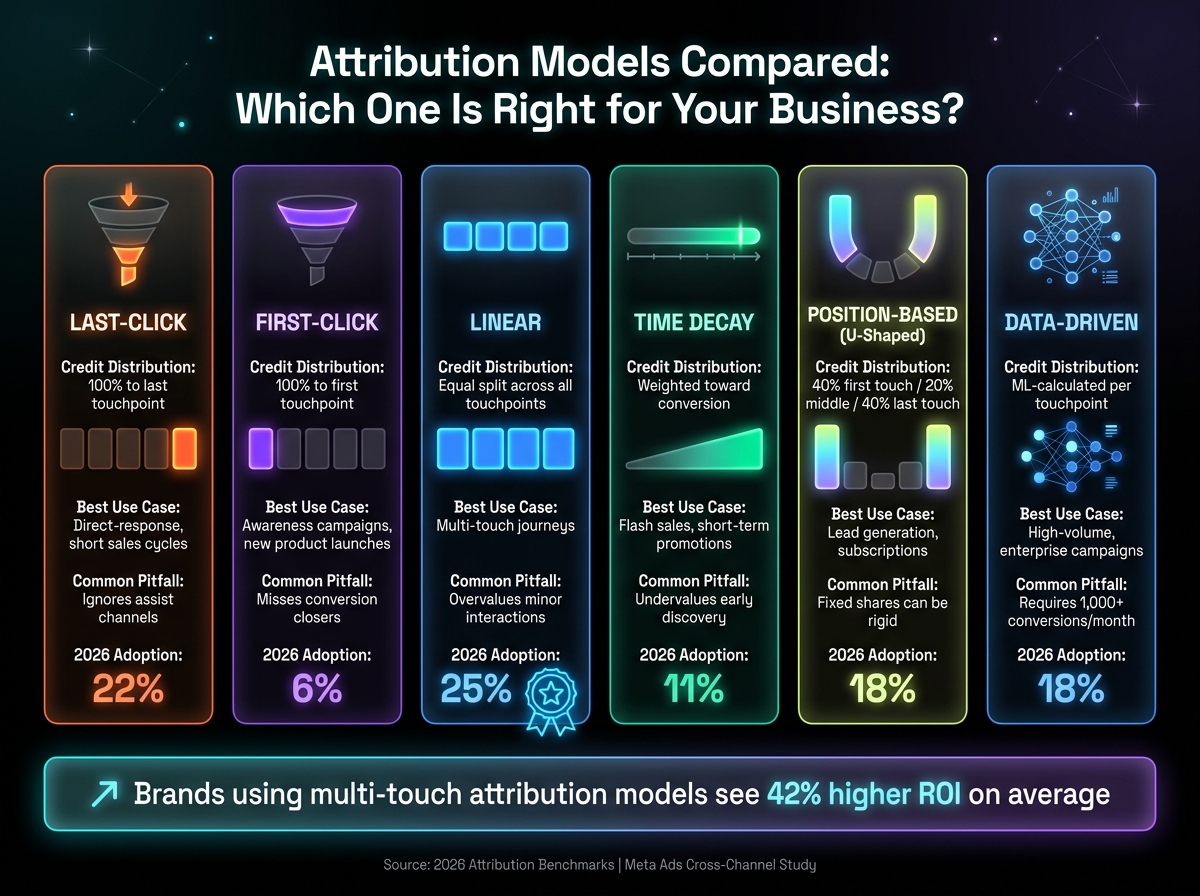
Attribution Models Compared: Which One Is Right for Your Business?
There’s no one-size-fits-all attribution model. Each comes with its own set of assumptions about how credit should be assigned across the customer journey. Picking the wrong one could lead to poor budget decisions. This often results in an inflated customer acquisition cost that drains your margins. Below, we’ll break down how these models work and when they’re most effective.
"Attribution is an opinion, not a fact. Every model makes different assumptions about how credit should be distributed across touchpoints." - AdLibrary
Types of Attribution Models
Last-click attribution is the simplest model to set up. It works best for impulse buys with short sales cycles, but it completely ignores earlier interactions that helped guide the customer toward the purchase. On the flip side, first-click attribution focuses solely on the first interaction, making it useful for spotting which channels drive initial interest. However, it misses the touchpoints that ultimately close the deal. Both models oversimplify the customer journey by reducing it to a single interaction, which doesn’t work well for campaigns spanning multiple channels.
Linear attribution spreads credit equally across every touchpoint, offering a broader view of complex journeys. It’s the most popular multi-touch model in 2026, used by 25% of marketers. While it’s more balanced, it can overemphasize minor interactions, making it harder to pinpoint which steps truly drive results. Time decay attribution adjusts for this by giving more weight to touchpoints closer to the conversion. This approach is ideal for short-term promotions or flash sales but tends to undervalue the touchpoints that introduce your brand to new prospects.
Position-based attribution (U-shaped) splits credit unevenly, giving 40% each to the first and last touchpoints and 20% to everything in between. It’s a good fit for lead generation or subscription businesses where both discovery and closing are key. Data-driven attribution takes things a step further by leveraging machine learning to calculate the actual impact of each touchpoint. While it’s the most precise option, it requires at least 1,000 conversions per month to deliver reliable results, making it better suited for high-volume campaigns.
Brands that use multi-touch attribution models see a 42% higher ROI on average compared to those that don’t. For instance, a direct-to-consumer fitness brand switched from last-click to linear attribution and uncovered that TikTok and Instagram Reels were the first touchpoints in 54% of their purchases. By reallocating budget to these channels, they boosted incremental sales by 27% and lowered their blended CPA by 18% in just 90 days.
Attribution Model Comparison Table
Here’s a quick comparison of the most common attribution models:
| Model | Credit Distribution | Best Use Case | Common Pitfall | 2026 Adoption |
|---|---|---|---|---|
| Last-Click | 100% to last touch | Direct-response, short cycles | Ignores assist channels | 22% |
| First-Click | 100% to first touch | Awareness, new launches | Misses conversion closers | 6% |
| Linear | Equal split across touches | Multi-touch journeys | Overvalues minor interactions | 25% |
| Time Decay | Weighted toward conversion | Flash sales, promos | Undervalues early discovery | 11% |
| Position-Based | 40/20/40 split | Lead gen, subscriptions | Fixed shares can be rigid | 18% |
| Data-Driven | ML-calculated per touchpoint | High-volume, enterprise | Requires 1,000+ conversions/mo | 18% |
The best model for your business depends on your sales cycle. For example, a direct-to-consumer brand with quick purchase decisions will have very different needs compared to a B2B SaaS company with an eight-month sales funnel. Choose a model that aligns with your customer journey to gain more accurate insights. Up next, we’ll dive into how to set up cross-channel tracking to make the most of these attribution models.
How to Set Up Cross-Channel Tracking for Meta Ads
To get accurate attribution from your Meta ads, you need a solid tracking setup. Without it, even the best attribution models won't deliver reliable insights.
Tracking Tools You Need
There are four key tools you’ll need to track and automate Meta ads effectively: the Meta Pixel, Conversions API (CAPI), UTM parameters, and GA4.
The Meta Pixel is your browser-side tracker. It activates when users visit your site or take specific actions. However, with around 75% of iOS users opting out of tracking and ad blockers affecting 40% of users worldwide, Pixel tracking alone isn’t enough. That’s where CAPI comes in. It works server-side, sending conversion data directly to Meta, bypassing browser limitations. Using both Pixel and CAPI together ensures you’re collecting the most accurate data possible.
UTM parameters act as the bridge between Meta and GA4. Without them, traffic from Meta often appears as "direct" or "referral" in your analytics, making attribution nearly impossible. To avoid this, use Meta’s dynamic UTM parameters, such as utm_campaign={{campaign.name}} or utm_content={{ad.name}}, to automate tagging and reduce errors. This step is critical:
"Roughly 70% of attribution projects fail due to UTM drift, not model error. Clean tagging at the source matters more than which model you pick." - LucaG, Co-founder, ShortPen
Finally, enable Automatic Advanced Matching in Meta Events Manager. This feature encrypts customer data like emails and phone numbers before sending it to Meta, increasing match rates from roughly 50% to 70–85%. Higher match rates mean better attribution for your conversions.
Once your tracking tools are in place, the next challenge is ensuring smooth data flow between platforms.
How to Connect Tracking Across Platforms
With the tools set up, it’s time to make sure data moves accurately across all channels. Here’s how to do it:
-
Deduplicate events: When both the Pixel and CAPI track the same action, Meta needs to avoid counting it twice. To do this, attach a unique
event_idto every interaction from both sources. Use the Diagnostics tab in Meta Events Manager to confirm a 0% duplicate rate. If duplicates appear, it’s likely that yourevent_idvalues aren’t syncing properly. - Rank your conversion events: Meta’s Aggregated Event Measurement (AEM) limits tracking for iOS users to your top 8 conversion events per domain. Go into Events Manager and rank these manually, prioritizing key actions like Purchases. If you skip this step, Meta will decide the ranking for you, which might not align with your business goals.
- Sync time zones and reconcile weekly: Make sure your Meta Ads account and GA4 property are set to the same time zone. A mismatch here can cause 10–15% discrepancies in daily reports. Beyond that, check your data weekly by comparing Ads Manager numbers with your backend systems (like Shopify or a CRM). Calculate a gap ratio by dividing Ads Manager conversions by backend conversions. A ratio above 1.4 suggests over-attribution (often due to view-through conversions), while a ratio below 0.7 indicates signal loss. Also, avoid making decisions based on same-day data - Meta’s conversion reporting can take up to 72 hours to fully update due to delays in mobile signals and modeled data.
Common Attribution Mistakes and How to Fix Them
Even the best tracking systems can’t always protect your data from common attribution mistakes. These errors can distort your insights and lead to poor budget decisions.
Attribution Errors That Skew Your Data
One of the most frequent mistakes is adding up conversions across different platform dashboards. If you total conversions reported by Meta, Google, and email separately, the combined number can overshoot your actual sales by as much as 200%. Why? Each platform credits its own touchpoints, creating an inflated view of performance.
Another big issue is mismatched attribution windows. For instance, Meta uses a 7-day click and 1-day view window by default, while GA4 typically relies on a 30-day last-click model. Comparing these is like using two different measurement systems - it doesn’t work without manual adjustments.
Then there’s cross-device behavior, which can cause up to 35% under-attribution for mobile-initiated conversions. Imagine a user sees your Meta ad on their phone but completes the purchase on their desktop. Meta might track the full journey if the user is logged in, but GA4 could see this as two separate users, under-crediting the mobile ad that started it all.
Lastly, relying on same-day data is a common pitfall. Meta’s conversion reporting can take up to 28 days to finalize, and early reports often miss 40–60% of conversions. Making decisions based on incomplete data can lead to misallocated budgets.
Fixing these errors is crucial to ensure your attribution model is as accurate as possible.
How to Reduce Attribution Bias
Once you’ve identified these common errors, it’s time to reduce bias and improve your measurement accuracy.
One major source of bias is over-crediting branded search. Branded paid search often gets credited for over 50% of conversions, but its actual contribution is typically closer to 10–20%.
To tackle this, use incrementality testing. Meta’s Conversion Lift studies, for example, compare results between an exposed group (who see your ads) and a holdout group (who don’t), similar to how you would A/B test Meta ads to isolate variables. These tests reveal the true impact of your campaigns. In Meta’s own findings, campaigns optimized for incremental conversions achieved a 46% boost compared to standard methods. If a channel takes up more than 15% of your budget, it’s worth running these tests.
It’s also important to embrace the uncertainty in data. As AdLibrary puts it:
"The practitioners who win are those who build decision-making processes that are robust to 20–30% data uncertainty, not those who chase a mythical clean dashboard." - AdLibrary
Another effective approach is using a correction factor. Divide Meta-reported conversions by actuals from your CRM or payment processor weekly. A stable ratio of around 1.2:1 is typical. If it starts creeping toward 2.5:1, that’s a red flag for deduplication or modeling issues. This method helps you maintain consistent, data-backed decisions across all channels.
How to Pick the Right Attribution Model for Your Business
Choosing the right attribution model is a critical step after addressing the challenges and solutions in marketing attribution. There’s no universal solution - what works best depends on factors like your monthly conversion volume, sales cycle length, channel mix, and business goals.
Step-by-Step Attribution Selection Framework
Start by evaluating your conversion volume. If you’re generating at least 1,000 conversions per month, data-driven (algorithmic) models and AI tools for Meta ads can deliver reliable insights. For businesses with fewer conversions, rule-based models like position-based or time decay are safer choices, as data-driven models may misinterpret random noise as patterns.
Next, think about your sales cycle. For products with short decision windows, such as impulse buys, a 7-day click model is usually enough. On the other hand, B2B or high-consideration purchases often involve longer journeys - averaging 8.3 touchpoints over 45–90 days. In these cases, use a model that credits both early awareness and final actions.
Your channel mix also plays a role. If you’re running three or more paid channels at once, siloed dashboards can inflate reported conversions by over 200%. To avoid this, cross-channel attribution becomes essential.
Here’s a quick guide to matching business types with effective attribution models:
| Business Type | Recommended Model | Why It Works |
|---|---|---|
| E-commerce (impulse buys) | Last-Click or 7-Day Click | Short decision cycle; final touch is decisive |
| E-commerce (high-value) | Time Decay | Customers research multiple times before buying |
| Lead generation / SaaS | Position-Based (U-shaped) | Credits both first impression and final close |
| B2B / Long sales cycle | Time Decay or Data-Driven | Accounts for long, multi-touchpoint journeys |
| Enterprise (high volume) | Data-Driven | Handles complex customer paths with machine learning |
Before settling on a model, ensure your UTM parameters are standardized. Roughly 70% of attribution projects fail due to inconsistent link tagging, not because of flaws in the model. Stick to lowercase characters, avoid spaces, and use consistent naming conventions across all teams and channels.
"Most teams that struggle with attribution don't have a model problem, they have a data hygiene problem." - LucaG, Co-founder, ShortPen
Once you’ve chosen your model and cleaned up your data, it’s time to act on the insights quickly.
Using ADEN'S LAB to Act on Attribution Data

After selecting an attribution model and gathering accurate data, the next step is to act swiftly. Knowing which ad creative worked - or which one didn’t - is pointless if you can’t adapt quickly enough.
This is where ADEN'S LAB becomes a game-changer. When your data highlights a winning creative angle or flags an underperforming ad, ADEN'S LAB lets you produce high-quality Meta ads in minutes. By simply entering your product or landing page URL, the platform generates eye-catching Facebook and Instagram creatives based on direct-response principles - no designer required.
Conclusion and Key Takeaways
Cross-channel attribution isn’t just a luxury - it’s the difference between making decisions based on solid data or chasing misleading signals. This section covered model selection, tracking essentials, and key lessons about attribution. Now, it’s time to focus on actionable steps to use accurate attribution for scaling Meta ads effectively.
What to Remember About Attribution
Here’s the big takeaway: relying on siloed reporting leads to bad decisions. Why? Because only 14% of conversions in 2026 happen after a single touchpoint. That means last-click models often overfund retargeting campaigns while neglecting the top-of-funnel channels that spark the customer journey in the first place.
Clean data is non-negotiable. Around 70% of attribution projects fail - not because of the wrong model, but due to inconsistent tagging. Treat your attribution data as a directional tool, not an exact count.
"The advertisers who thrive in this environment are those who accept attribution uncertainty as a permanent feature, not a bug to be fixed." - Gaultier D'Acunto, Co-founder, Benly
Next Steps for Scaling Meta Ads with Attribution
To get started, focus on these three crucial steps:
- Standardize your UTM taxonomy: Use consistent naming conventions - lowercase, no spaces, and uniform across all channels.
- Align your Meta attribution window: Match it to your sales cycle. For most e-commerce businesses, a 7-day click window works. For high-consideration purchases, go with 28 days.
- Establish a single source of truth: Whether it’s your CRM or payment processor, reconcile this data with Ads Manager weekly.
Once your attribution data is clean, the next hurdle is creative velocity. Even the best-performing ad angles won’t matter if you can’t launch them quickly. That’s where ADEN'S LAB steps in, helping you turn attribution insights into new Meta ad creatives in minutes. This way, you can test faster, avoid creative fatigue, and double down on the angles that drive real revenue.
FAQs
How do I choose one “source of truth” for conversions?
When it comes to pinpointing a single, reliable “source of truth” for your conversions, your backend data is your best bet. This includes sales records, orders, or CRM data - essentially, the information that’s least affected by tracking issues or attribution inconsistencies.
To ensure accurate tracking, make use of both Meta Pixel and Conversions API with event deduplication. This combination helps bridge gaps in data collection and minimizes errors.
Keep in mind, though, that discrepancies between platforms are normal. It’s common to see differences of 20–40% between various tracking tools. To get a more accurate picture of performance, aim to create a blended view. This approach combines platform data with your backend metrics, giving you a clearer and more balanced understanding of your results.
What’s the fastest way to spot over-attribution in Meta reporting?
The fastest way to spot over-attribution in Meta reporting is to compare the platform's reported conversions with your actual sales data from a CRM or other trusted sources. If you notice large gaps between the two, it could signal over-attribution. It's also worth examining the attribution models Meta uses, such as first-click or last-click, as these can sometimes exaggerate the credit given to specific touchpoints. To get a clearer picture of your campaign's performance, consider pairing Meta's data with independent tracking tools or using multi-touch attribution methods.
Do I need data-driven attribution if I have under 1,000 conversions/month?
If your monthly conversions are below 1,000, using data-driven attribution might not be the best approach. These models usually need more than 10,000 conversions each month to produce reliable results. For smaller campaigns, simpler rule-based models - like time-decay or position-based attribution - make more sense. They offer useful insights without the need for extensive data or complicated analysis, making them ideal for lower conversion volumes.
Your next ad batch starts here
Finish with a ready-to-test ad batch
Paste your website to generate static creatives. Drop the link → get ads in about 90 seconds → upload them to Meta → scale.
Free to try No prompt writing