AI Attribution Models for Meta Ads: What to Know
Turn the strategy into creatives
Create Meta ads for your product
Paste your product page. ADEN'S LAB turns the offer, audience, and positioning into complete ready-to-use Meta static ads.
Free to try No prompt writing

AI attribution models are changing how Meta advertisers track and optimize campaigns. These models use machine learning to analyze customer journeys across devices and platforms, filling gaps left by privacy updates like iOS 14.5. By combining tools like Meta's Conversions API and statistical modeling, advertisers can now track 85–95% of conversions, compared to just 60–70% with pixel-only tracking.
Key Takeaways:
- Incrementality: AI identifies which conversions are directly influenced by ads, avoiding wasted ad spend through smarter budget allocation.
- Performance Gains: Businesses report 15–44% ROI boosts and up to 200% higher ROAS using AI-powered attribution.
- Speed & Accuracy: Real-time data cuts delays from 24 hours to 30 minutes, with forecasting errors reduced to 5–10%.
- Meta Updates: New features like Incremental Attribution and AI-powered targeting (via the Andromeda engine) improve ad relevance and reduce costs.
To succeed, advertisers need to pair Pixel tracking with Conversions API, prioritize event tracking, and focus on producing diverse ad creatives. Using tools to generate ads on autopilot can help maintain this variety efficiently. These updates require a shift in strategy but offer measurable improvements in campaign performance.
Meta Ads Updates Click Through Attribution | EP. 423

Put the playbook to work
Apply this playbook to your page
Paste your website and the Lab will turn the strategy you are reading into a ready-to-test ads.
Free to try No prompt writing
How AI Attribution Differs from Traditional Models
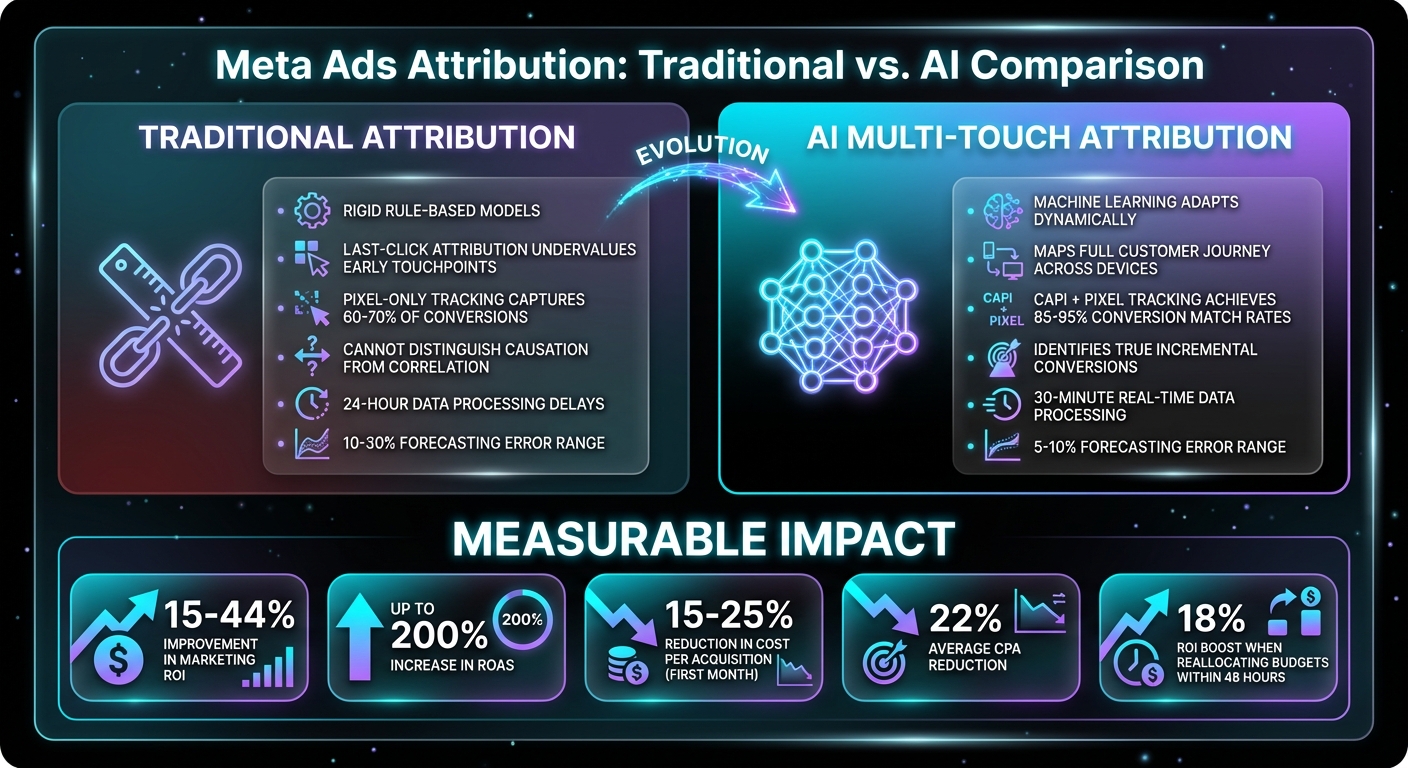
AI Attribution vs Traditional Attribution for Meta Ads: Performance Comparison
Problems with Traditional Attribution
Traditional attribution models often rely on rigid rules, which can overlook the full customer journey. Take last-click attribution, for instance - it gives all the credit to the final interaction before a purchase. This approach undervalues early-stage touchpoints, like awareness campaigns, and skews investment toward bottom-funnel ads. Adding to the challenge, privacy updates have drastically reduced tracking capabilities. Pixel-based tracking now captures only 60–70% of conversions, leaving gaps in the data and making it harder to distinguish between causation and correlation.
These shortcomings highlight why AI's multi-touch approach is a game-changer.
How AI Multi-Touch Attribution Works
AI attribution uses machine learning to map out the customer journey across various devices and touchpoints. Unlike traditional models, it doesn’t stick to preset rules. Instead, it dynamically adapts by analyzing behavioral signals, timing, and context to figure out which interactions genuinely drive conversions.
Here’s an example: Imagine a customer sees an Instagram ad on their phone, later searches for the brand on a laptop, and finally makes a purchase on a tablet. AI connects these touchpoints using deterministic methods, like matching email addresses or phone numbers, and probabilistic techniques to fill in gaps caused by privacy restrictions. Tools like server-side integration through Meta’s Conversions API (CAPI) bypass browser blockers, combining server data with pixel data to achieve match rates of 85–95%. Even when some tracking data is unavailable, machine learning models estimate missing conversions with around 10–15% accuracy.
Meta’s Andromeda AI engine takes this a step further by optimizing ad relevance before the auction even starts. It does this through a process called "retrieval", where it scans creative libraries and engagement data to determine the most effective ads. This process is increasingly streamlined by automating Meta ad production to maintain a fresh library of high-performing assets.
Performance Gains from AI Attribution
The impact of AI attribution is both measurable and impressive. Businesses using AI-powered models report a 15–44% improvement in marketing ROI, with some achieving up to a 200% increase in ROAS. Cost savings are another major benefit. Advertisers who pair AI attribution with CAPI often see a 15–25% drop in cost per acquisition within the first month, with overall reductions averaging 22%.
Additionally, brands that reallocate spending based on real-time AI insights within 48 hours see an 18% boost in ROI.
"In 2026, running Meta Ads without CAPI is like driving with one eye closed - you're missing critical information that affects every optimization decision you make." - Benly Guide
Meta's 2026 Attribution Framework Updates
What Changed in Meta's Attribution System
In 2026, Meta introduced Incremental Attribution, replacing the old rule-based models. By using holdout testing and machine learning, this system identifies conversions that were actually caused by ads, avoiding inaccuracies common with traditional models like 7-day click attribution. Those older models often credited ads for purchases that likely would have happened anyway.
Another big shift came on December 16, 2025, with the launch of AI Conversation Targeting powered by the Andromeda algorithm. Meta now uses signals from interactions with Meta AI - like chatbot conversations, voice commands via Ray-Ban Meta glasses, and image generation requests - as part of its targeting. While these AI-based signals have been shown to improve CPAs, they’re not separately detailed in reporting.
Meta also made the Conversions API (CAPI) nearly mandatory. By combining Pixel data with CAPI, advertisers can achieve match rates of 85–95% for tracking conversions. Additionally, Meta expanded its use of modeled conversions to account for users who’ve opted out of tracking, with performance estimates now within 10–15% of actual values. For iOS users who’ve opted out, Aggregated Event Measurement (AEM) continues to limit tracking to 8 prioritized conversion events per domain.
These updates create new opportunities for advertisers, but they also demand adjustments in how campaigns are measured and optimized. Let’s dive into how these changes are reshaping reporting and strategy.
How These Changes Affect Reporting and Optimization
Meta's new attribution framework is transforming both reporting and optimization, but not without challenges. Reporting transparency has taken a hit. While Meta’s AI automation has improved results - lower CPAs and higher click-through rates - the details behind those improvements are harder to access. The Andromeda algorithm now drives targeting by analyzing creative content, rather than relying on manual audience inputs, but advertisers can’t see exactly how it operates.
"The attribution black box isn't temporary. Winning advertisers will build their own transparency into an increasingly opaque system." - Julia Moreno, Dataslayer.ai
With these changes, creative quality has become a critical factor. Instead of fine-tuning audiences, advertisers now need to focus on producing diverse and compelling creative assets. In late 2025, Meta reported a 14% performance boost on Facebook, thanks to the Andromeda engine’s ability to combine retrieval and ranking models. Feeding the algorithm high-quality signals through CAPI, broad targeting, and varied creatives allows it to dynamically identify high-intent users.
The early results from Incremental Attribution are promising. For example, Laura Geller by AS Beauty ran a Conversion Lift test in 2025 and achieved a 111% lower incremental CPA and 107% higher incremental ROAS compared to their previous campaigns. Similarly, UK wellness brand Purdy & Figg leveraged Meta’s AI-powered targeting in late 2025 to grow revenue by 555% in just 60 days, all while reducing CPA.
To adapt effectively, advertisers need to establish baseline metrics now, as these updates continue to roll out. Use both Pixel and CAPI for redundancy, carefully prioritize your 8 AEM events, and remember that changes to these configurations can take up to 72 hours to reflect. Also, expect discrepancies - differences of 20–40% between Meta Ads Manager and Google Analytics 4 are now standard due to their differing attribution models.
How to Implement AI Attribution for Meta Ads
Steps to Integrate AI Attribution
Using the Conversions API (CAPI) can significantly improve your conversion match rates - jumping from 60–70% (with pixel-only tracking) to an impressive 85–95%. Advertisers who implement CAPI often experience a 15–25% improvement in cost per acquisition within the first month.
Here’s how to get started:
- Verify your domain in Meta Business Manager. This is essential for setting up Aggregated Event Measurement (AEM).
- Prioritize your top 8 conversion events. Align these with your business goals, with "Purchase" often being the highest priority.
- Use unique
event_idandevent_namevalues for each event. This prevents double-counting between Pixel and CAPI, aiming for a deduplication rate of 90% or more. - Track the
fbclid(Facebook Click Identifier) from URLs. Use tools like Google Analytics 4 or Google Tag Manager to connect individual ad clicks to on-site actions and CRM data. - Feed first-party data into Andromeda to refine audience targeting.
- Adopt a blended attribution approach. Combine platform-reported data with backend revenue tracking and incrementality testing to establish a reliable "source of truth".
- Monitor your Event Match Quality (EMQ) score in Events Manager. Strive for a score of 6.0 or higher by sending additional customer parameters like hashed emails, phone numbers, and external IDs.
It’s normal to see a 20–30% discrepancy between Meta Ads Manager and your backend system, but if the gap exceeds 50%, it’s a sign of a tracking issue.
Once you’ve set up attribution, leverage AI-powered creative tools to further enhance your ad performance.
Using AI-Generated Creatives with Attribution Models
With accurate attribution data in place, Meta's Andromeda algorithm assigns "Entity IDs" to ads by analyzing visual patterns using computer vision. For example, if you upload 10 similar ads, they may all share the same Entity ID. If one underperforms, all of them risk being excluded from delivery. The key to avoiding this? Creative diversity.
This is where platforms like ADEN'S LAB come into play. Instead of creating dozens of variations manually, ADEN'S LAB can generate visually distinct static ads for Meta in under 90 seconds. These ads feature different layouts, messaging, and visual styles, ensuring Meta’s algorithm treats them as unique entries in the auction. And with pricing starting at $0.90 per ad for high-volume plans, brands can produce hundreds of creatives each month without bottlenecks [ADEN'S LAB].
AI attribution pinpoints which creative elements drive incremental conversions, feeding that data back into the creative process. This allows you to automatically produce more of what works. Brands using AI for creative and budget optimization report a 22% reduction in cost per acquisition.
"Stop trying to out-target the machine. Start out-creating it." - Logical Position
Instead of testing 10 headlines on a single video, experiment with three distinct creative approaches - like user-generated content (UGC), studio-produced visuals, and text-only ads. This strategy gives Meta’s AI retrieval system more variety to work with. By removing creative production constraints, platforms like ADEN'S LAB make it possible to scale this approach effortlessly.
Performance Benchmarks to Track
Keep an eye on these key metrics to evaluate your performance:
| Metric | Poor | Good | Excellent |
|---|---|---|---|
| Event Match Quality (EMQ) | < 4.0 | 6.0 - 7.9 | 8.0+ |
| CAPI Event Coverage | < 50% | 70 - 85% | 85%+ |
| Platform vs. Backend Gap | > 50% | 20 - 30% | < 20% |
| Deduplication Rate | < 80% | 90 - 95% | 95%+ |
Beyond these technical metrics, focus on Incremental ROAS - the return generated specifically from conversions that wouldn’t have occurred without your ads. For instance, in early 2025, global retailer Pom Pom London tested Meta's Incremental Attribution setting using a Conversion Lift Study. The results? A 57% improvement in ROAS and a 94% increase in incremental ROAS compared to standard campaigns.
AI attribution can also reduce forecasting errors to a 5–10% range, down from the traditional 10–30%. It speeds up data analysis too - cutting processing time from 24 hours to just 30 minutes, enabling near real-time budget adjustments. Brands that reallocate budgets within 48 hours see an 18% boost in ROI.
To measure overall performance, calculate your "Blended ROAS" by dividing total backend revenue by total marketing spend across all channels. Don’t rely solely on Meta’s reporting. Periodic holdout tests with fully isolated groups (no ad exposure) can help confirm the true incremental value of your campaigns.
Conclusion
Main Benefits Summary
AI attribution models are reshaping how advertisers evaluate and improve Meta campaigns. Businesses using these models have reported marketing ROI improvements ranging from 15% to 44%, with some even achieving up to a 200% increase in ROAS. The standout benefit lies in incremental measurement - pinpointing which conversions are directly influenced by your ads versus those that would have occurred regardless.
With faster data processing, advertisers can make near-instant budget adjustments. Brands that reallocate funds within 48 hours have seen an 18% boost in ROI. Tools like ADEN'S LAB, which produces hundreds of distinct static ads monthly at just $0.90 per ad, further enhance this process. By generating diverse creatives, marketers can test and scale campaigns more efficiently, giving Meta's algorithm the variety it thrives on.
These advancements are laying the groundwork for even more precise and actionable insights in the future.
What's Next: AI Attribution and Incrementality
The next phase of Meta advertising is heading toward comprehensive measurement frameworks that combine incremental attribution, Marketing Mix Modeling (MMM), and conversion lift studies. This integrated approach offers a clearer picture of what truly drives revenue across multiple channels, moving beyond platform-reported metrics.
Meta's Andromeda engine is already changing the game by prioritizing signal quality and creative diversity over traditional manual audience targeting.
"True incrementality testing requires a fully isolated holdout group with zero impressions. Without this, results are biased and can't accurately measure incremental impact"
Looking ahead, more brands are likely to embrace regular holdout testing and automated optimization tools. These innovations will allow campaigns to scale or pause based on real-time incremental performance data, ensuring smarter and more effective advertising strategies.
FAQs
Do I still need the Meta Pixel if I use Conversions API (CAPI)?
Yes, combining both tools is the way to go. The Meta Pixel alone tracks around 60-70% of conversions, leaving a gap in your data. When you pair it with the Conversions API (CAPI), you get a much clearer picture of your performance. This combination boosts attribution accuracy and helps you better understand your true Return on Ad Spend (ROAS). It’s a smarter strategy for tracking and optimizing your Meta ads effectively.
How can I tell if Meta’s “modeled conversions” are accurate for my account?
To gauge how accurate Meta's modeled conversions are, start by comparing the reported data against your actual sales or revenue figures. This comparison can highlight any gaps or discrepancies, often caused by tracking limitations introduced by privacy updates. Leveraging Meta’s incremental attribution model or AI-powered tools can offer further clarity on how effective your ads truly are. By cross-referencing modeled conversions with real-world business outcomes, you can confirm their reliability and make sure they align with your overall performance goals.
What’s the simplest way to run a true incrementality (holdout) test on Meta?
To conduct a straightforward incrementality test on Meta, consider using a holdout test. Here's how it works: divide your audience into two groups. One group will see your ads, while the other won't. By comparing the conversion rates between these groups, you can pinpoint the actual impact of your ads, separating it from organic conversions. This approach not only gives you a clear picture of ad-driven results but also ensures compliance with privacy standards while establishing a direct cause-and-effect relationship.
Your next ad batch starts here
Finish with a ready-to-test ad batch
Paste your website to generate static creatives. Drop the link → get ads in about 90 seconds → upload them to Meta → scale.
Free to try No prompt writing